THE SHORT VERSION
What a commercial HVAC replacement includes
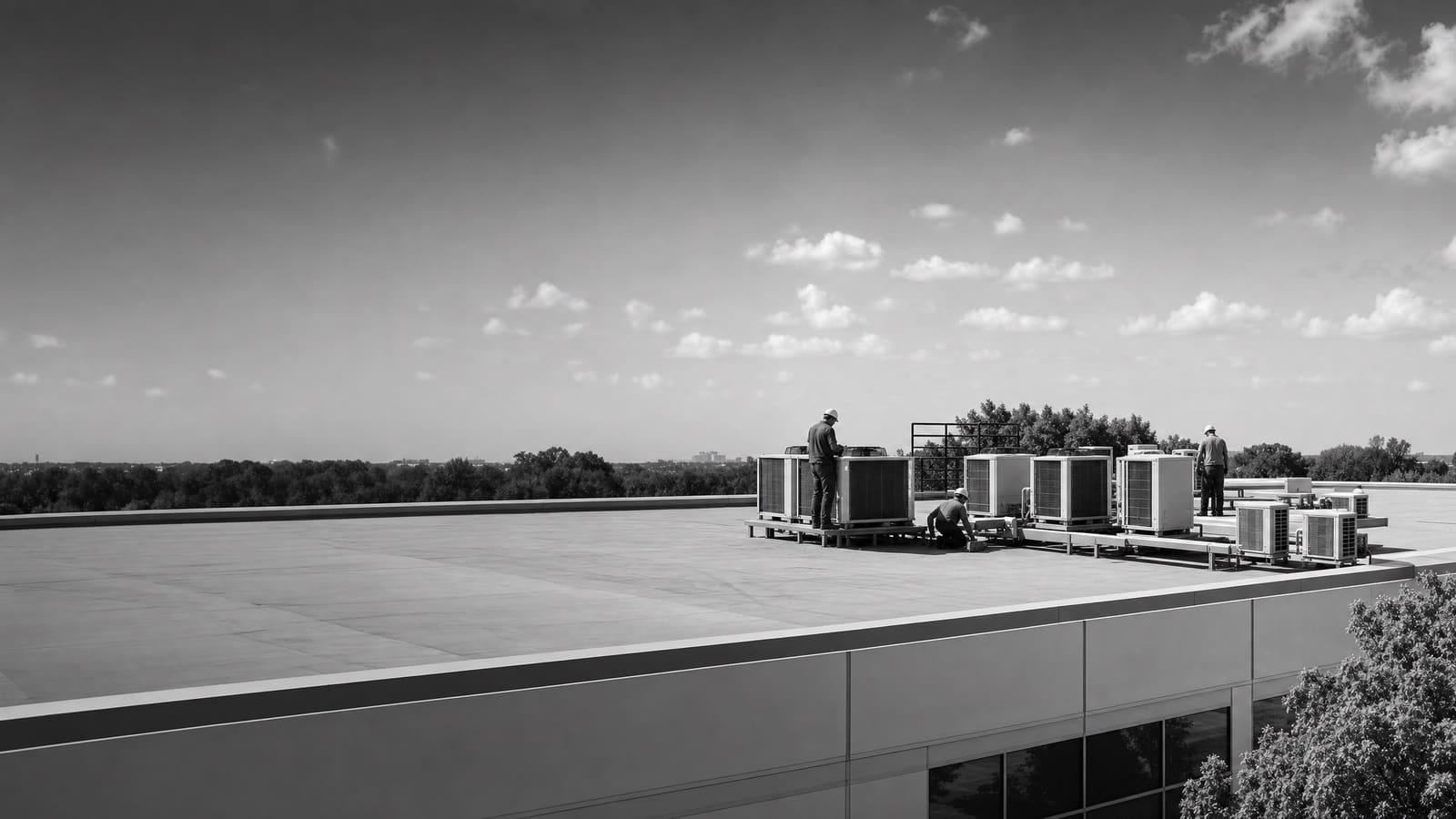
A commercial HVAC replacement covers load confirmation, equipment selection, rigging and set, certified recovery of refrigerant from the old unit, electrical and gas connections, controls, and commissioning. Replacement beats another repair once a rooftop unit is past about fifteen years. Department of Energy guidance puts the waste from old, inefficient commercial rooftop units at roughly $900 to $3,700 per unit every year, which is money a repair does not recover.
A site review still sets the number: roof and curb condition, crane reach and lot access, available electrical capacity, and whether the current load matches how the space is used now.
THREE WAYS TO GO
Three replacement paths worth pricing
Most commercial replacements land on one of three choices, and the right one depends on how many hours the equipment runs and what the building already has on the roof. Rooftop units condition close to half of all commercial floor space in the country, so this same decision repeats across most portfolios.
A like-for-like swap protects the schedule and keeps engineering cost down. A high-efficiency unit costs more up front and earns it back through runtime; the federal high-performance rooftop specification targeted energy use up to half that of the older minimum standard. A heat pump unit adds reverse-cycle heating and takes gas out of that part of the building, but selection depends on available electrical capacity, physical constraints on the roof, and what happens to the existing gas line.
Price at least two of the three. The premium for the better unit should be a number you can weigh against operating hours, not a guess you make from a brochure.
WHAT MOVES THE NUMBER
Where the money actually goes
An installed price is the unit plus everything around it. These are the lines that move most between two quotes on the same building, and the ones worth asking about before you compare totals. A bid that is quiet on three of them is not cheaper, it is less complete.
IN PRACTICE
Buying the replacement, not just the box
The common failure in commercial HVAC buying is waiting. Facility teams hold a rooftop unit until it stops holding the space, needs constant service, or fails outright. Federal guidance is blunt about that habit: units past about fifteen years waste substantial energy and money, and replacing them proactively usually beats replacement on failure — and often beats a like-for-like swap at the end of service life.
The second failure is buying the unit and ignoring the installation. Two quotes carrying the same model number can differ widely because one includes the curb adapter, the structural check, the rigging plan, and commissioning, while the other assumes the roof is ready and the lot is empty. Ask each bidder what happens if the new footprint does not match the old curb, and who absorbs that cost. The answer tells you whether the number is real.
The third is skipping the load. A twenty-year-old nameplate reflects the occupancy, lighting, and plug loads of twenty years ago. Confirm the load against how the space is used today, then decide on purpose whether to match the old tonnage or correct it.
COMPLEXITY
What makes a replacement simple or hard
Two buildings on the same block can price very differently, and the gap is rarely the equipment itself. It is access, capacity, and how much has to change on the way in. Knowing which side of this line your site falls on before bidding keeps both the schedule and the budget honest.
LOWER COMPLEXITY
Straight swap conditions
Same tonnage and footprint, curb in good condition, clear crane reach from the lot, existing electrical and gas adequate, and no controls change. The work is mostly planning and one set day.
HIGHER COMPLEXITY
Scoping-heavy conditions
Tonnage or footprint changes, tight or shared access, a roof needing structural review, a panel with no spare capacity, or a switch from gas heating to electric heating.
BEFORE YOU BID
What a site review has to settle
A useful site review answers a short list of questions, and every one of them changes the price.
Start with the roof. What is the curb size, is an adapter needed, and can the structure carry the new unit? Then access. Where does the crane set up, how many stalls close, and for how long? A lot that is full at ten in the morning changes the set plan and sometimes the day of the week.
Next, capacity. Federal heat pump guidance treats electrical capacity, physical constraints, and existing gas lines as the infrastructure checks that decide whether an electric option is even on the table at a given site. Have the panel and available service confirmed before anyone quotes electric heating.
Then the old refrigerant. Federal Clean Air Act rules govern how refrigerant is recovered and handled when stationary air-conditioning equipment is serviced or removed, so recovery is scheduled work, not an afterthought.
Finally, controls. Decide whether the new unit joins existing building automation or runs standalone. That is far easier to settle before selection than after delivery.
Confirm before the quote, not after
Curb size and structure, crane access and closure time, available electrical capacity, gas line disposition, and controls integration. Five answers turn an estimate into a price you can hold a contractor to.
OWNERSHIP
Two questions owners should settle early
Replacement decisions outlive the person making them. A unit installed this year becomes someone else's maintenance problem for the next decade or two, which makes two questions worth settling before the purchase order goes out. The first is timing: are you replacing on a plan, or waiting for the failure to make the decision for you? The second is standardization: does this site take whatever is available, or does it follow a portfolio standard your service contract already covers?
Neither has a universal right answer. But leaving both open is how a portfolio ends up with four brands, three refrigerants, and no spare parts strategy. Answer them early and bid comparison, service contracts, and parts stocking all get simpler.
TIMING
Planned versus reactive
Waiting for failure means taking whatever is in stock, on whatever schedule exists, during the season you can least afford downtime. A planned replacement keeps the choice yours.
FLEET
One-off versus standard
Matching equipment across sites simplifies training, spare parts, and service contracts. It costs flexibility on any single project, so it pays off across a portfolio more than on one building.
OVER THE LIFE
Phasing, procurement, and what it costs to run
If a building carries several aging units, replacing all of them at once is rarely the best use of capital, and replacing them one failure at a time is rarely the cheapest. The middle path is a ranked plan. Rank by age, service history, and how much runtime each unit carries, then replace the worst one or two per budget cycle. That keeps crane mobilizations efficient and spreads the spend without leaving the whole roof exposed.
Procurement follows the same logic. Equipment availability is a genuine constraint on commercial units, and federal guidance treats it as a decision input rather than a detail to discover later. Ask for lead time next to price on every option, and treat a shorter lead time as part of the value.
Then look past the invoice. A rooftop unit is bought once and paid for every month it runs. The federal upgrade campaign that worked with more than 200 organizations reported over 43,000 rooftop units upgraded, saving those organizations a combined $37 million a year on energy bills. The lesson for one building is smaller in scale but identical in shape: the efficiency tier you pick shows up on every bill for the life of the unit.
THE QUOTE
Five things a comparable quote shows
When two bids are far apart, one of these lines is usually missing from the cheaper one. Ask for all five in writing and the comparison gets simple. Anything a contractor will not put in writing tends to become a change order later.
01
Equipment, tier, and lead time
Model, tonnage, efficiency level, and the real availability date shown next to the price.
02
Curb, adapter, and structural work
Whether the new unit lands on the existing curb, and who pays if it does not.
03
Rigging and site plan
Crane placement, lot closure hours, and who coordinates with tenants and the property manager.
04
Utilities and refrigerant handling
Electrical and gas work, plus certified recovery of refrigerant from the removed unit.
05
Commissioning and closeout
Startup verification, controls settings, warranty registration, and documentation handed over at completion.
Get a defensible number
Price the equipment and the building together.
Send the address, operating target, and target opening date. Flux will identify what must be verified before the project can be priced.
Get a free estimateQuestions
Straight answers.
When does replacement beat another repair?
Once a rooftop unit is past roughly fifteen years, federal guidance treats it as an energy liability, estimating that old, inefficient commercial units waste somewhere between $900 and $3,700 each per year. If that unit is also on frequent service calls or no longer holding the space, another repair buys time rather than value.
Should you match the old tonnage or resize?
Confirm the load either way. If occupancy, lighting, and equipment have not changed, matching is usually right and keeps the installation simple. If the space is used differently now, matching the old nameplate carries a sizing mistake forward for another two decades.
Is a heat pump rooftop unit worth considering?
Federal guidance says today's heat pump rooftop units are an appropriate solution across most of the U.S. South and can cover most or all winter heating demand. The site-level questions are electrical capacity, backup heat for rare hard freezes like the February 2021 Texas event, and whether local energy prices favor the switch.
What has to happen with the old refrigerant?
Federal Clean Air Act rules govern how refrigerant is recovered and handled when stationary air-conditioning equipment is serviced or removed. Certified recovery from the unit coming off the roof is required work and should appear as a line on the quote, not as an assumption.
Who handles the crane, permits, and inspections?
The installing contractor should own the rigging plan, lot coordination, permits, and inspections inside the installed price. Get that in writing before signing. When those items are quietly excluded, the low bid is not actually the low number.
Sources used for this guide
- [1]betterbuildingssolutioncenter.energy.gov — DOE Advanced Rooftop Unit Replacement Guidance
- [2]betterbuildingssolutioncenter.energy.gov — DOE Commercial Heat Pump Rooftop Unit Replacement Guidance
- [3]betterbuildingssolutioncenter.energy.gov — DOE High-Efficiency Commercial Rooftop Unit Toolkit
- [4]energy.gov — DOE Efficient Commercial Rooftop Air Conditioner Program
- [5]epa.gov — EPA Stationary HVAC Refrigerant Management