DIRECT ANSWER
What does commercial HVAC replacement in Dallas actually cover?
A commercial HVAC replacement covers the load review, the new equipment, the curb or connection work it lands on, electrical and gas tie-ins, controls, startup, and the permit and inspection path. Replacement beats another repair once a unit is old enough that failures repeat. Federal guidance notes rooftop units past 15 years waste substantial energy, and old inefficient units can waste $900 to $3,700 each per year.
A site review has to confirm actual cooling and heating load, roof or pad structure, electrical capacity at the panel, gas line size, and whether the existing ductwork and curb still fit the new unit.
THREE PATHS
Repair again, retrofit controls, or replace the unit?
Most Dallas buildings arrive at this decision the same way. A rooftop unit limps through one more August, the service calls stack up, and someone finally asks whether the next repair is money thrown at a machine that is already finished.
Federal guidance is direct about the pattern. Facility teams usually delay a new unit until the old one stops holding space temperature, needs constant service, or fails outright. Replacing an inefficient unit before that point is often the better business move than replacement-on-failure — and often better than a like-for-like swap at the end of service life, because the like-for-like swap locks in yesterday's efficiency for another fifteen years.
There is a middle path too. The federal rooftop campaign tells owners to either replace old units with efficient ones or retrofit them with advanced controls, whichever makes better financial sense for that unit. Which one wins depends on the age of the equipment, the condition of the cabinet and coil, and how much runtime the unit actually sees.
WHAT DRIVES PRICE
Where a Dallas HVAC replacement budget actually moves
No two changeouts price alike, so treat these as the lines that move most between a thin bid and a real one. When two Dallas quotes differ by a wide margin, the gap almost always sits in one of these rows rather than in the equipment itself.
EQUIPMENT CHOICE
Gas heat, dual fuel, or all-electric heat pump
Dallas sits in the part of the country where heat pump rooftop units are an easy technical fit. Federal guidance is explicit: across most of the U.S. South and West, today's heat pump rooftop units are an appropriate solution and are capable of covering most or all of the winter heating demand. Heat pump efficiency drops as outdoor temperature drops and trends toward parity with electric resistance heat, but Dallas winters spend little time down there.
The caution is the tail, not the average. Federal guidance points at the February 2021 Texas freeze as proof that southern climates can still see sharp winter heating demand. That is the case for dual fuel — a heat pump handling the ordinary season with gas heat behind it for the days that break the pattern. All-electric makes sense when the site has panel capacity, when the owner wants gas out of the building, or when the roof has no usable gas run.
Three product families exist: dual fuel, all-electric, and cold-climate heat pump rooftop units. For Dallas, the first two carry the conversation. If you are weighing fuel switching across a portfolio, heat pump conversion is where that scoping starts.
SCOPE COMPLEXITY
What makes a changeout simple or hard
The same nominal tonnage can be a one-day swap or a three-week project. The difference is almost never the unit itself. It is what sits around the unit — the curb, the panel, the roof, and the hours you are allowed to work.
LOWER COMPLEXITY
Straight like-for-like swap
Same fuel, same tonnage, matching curb, adequate panel capacity, clear crane setup, and a building that can lose conditioning on a weekend. The permit path is routine and equipment lead time drives the schedule.
HIGHER COMPLEXITY
Fuel change or capacity change
Switching fuel, resizing capacity, or feeding new electrical load. Expect service or panel work, curb adapters, duct transitions, controls integration, and phased night work if the space cannot go warm during business hours.
SITE REVIEW
What a real Dallas site review has to settle
Before anyone quotes a number, someone has to be on the roof. The federal screening list for rooftop replacement is a good frame: climate, utility bill impact, building type, equipment availability, infrastructure, contractor capability, and incentives. Infrastructure splits into three things that stop projects cold — electrical capacity, physical constraints, and gas lines.
Electrical capacity is the one that surprises owners. A larger or all-electric unit can need more amperage than the existing feeder carries, and that turns a mechanical project into an electrical project with a utility coordination step attached. Physical constraints mean curb dimensions, roof structure, clearances, and whether a crane can even reach the setting point. Gas lines mean whether the existing run is sized for the new burner or is about to be abandoned.
The other half is operational. We need to know which hours the space has to hold temperature, which tenants sit under the affected zones, and where a crane can stage. On a distribution building in southern Dallas County, staging is a different problem than on a downtown office floor. Duct condition belongs in the same walk — a new unit pushing through undersized or leaking ductwork will not deliver what the submittal promised.
Three things that stop a changeout
Electrical capacity, physical constraints, and gas lines are the infrastructure items federal guidance tells owners to check before committing to a rooftop replacement. Any one of them can add scope, cost, and a utility or permit step that was not in the original budget.
DALLAS SPECIFICS
The Dallas code set and permit path
Dallas adopts its construction codes by city code chapter. Chapter 55 is the 2021 International Mechanical Code with Dallas amendments, and that is the one governing the changeout itself. Chapter 59 is the 2021 International Energy Conservation Code with amendments, which matters when equipment efficiency or duct work is in scope. Chapter 60 covers the 2021 International Fuel Gas Code for anything touching the gas side, and Chapter 58 is the 2021 International Existing Building Code, effective June 13, 2022, which comes into play on alteration work inside an occupied building. Commercial mechanical permits and inspections run through the city's building inspection group. Confirm the current amendment set before drawings go out — the amendments, not the base code, are where local requirements live.
Plan around the cooling season
Dallas average highs sit near 94°F in July and August. Equipment lead time plus permit review means a summer failure rarely gets a fast, well-planned replacement. Buildings that scope the changeout in winter get better sequencing and a real crane window.
OWNERSHIP
Two things that outlive the install
The install takes a few days. What you signed up for lasts fifteen years or more. Two considerations decide whether the second half goes well: what the unit costs to run, and whether anyone can service it. The federal rooftop campaign gives a sense of the scale — more than 200 organizations upgraded over 43,000 rooftop units and cut a combined $37 million a year from their energy bills. That is roughly the value of not deferring the decision, spread across a lot of buildings. The service question is quieter but just as real. Equipment availability and contractor familiarity sit on the federal screening list for a reason. A unit nobody in the metro stocks parts for is a unit that sits down in August.
OPERATING COST
Efficiency you actually keep
High-efficiency rooftop units were specified to cut energy use by up to half against the prior standard. That saving only shows up if the unit is sized correctly and the controls are commissioned, not just energized.
SERVICEABILITY
Parts and people
Check that local contractors know the platform and that parts stock exists in the metro. Federal guidance lists equipment availability and contractor knowledge as screening items before a technology decision is made.
PHASING AND PROCUREMENT
Replacing several units without shutting the building
Most Dallas portfolios do not have one bad unit. They have eight units of the same vintage, two of which have already failed. Handling that as eight separate emergencies is the expensive version. Handling it as a phased program is the cheaper one.
The sequence that works: survey every unit, rank by age, runtime, and repair history, then replace in waves tied to the shoulder seasons rather than to whichever unit dies first. Federal guidance frames the choice plainly — proactive replacement usually beats replacement-on-failure, and it also beats the reflexive like-for-like swap, because the failure-driven purchase happens under time pressure with whatever is available that week.
Phasing also lets you use one crane mobilization for several units, negotiate equipment as a package instead of one at a time, and check incentives before the order goes in rather than after. Incentives appear on the federal screening list because availability and terms change; verify what is live at the time you buy, not what was live last year. If the project touches more than equipment — new distribution, structural work, controls across multiple systems — it belongs in a design-build scope where the drawings and the install are held by the same team.
QUOTE CHECKLIST
Five things a comparable quote has to show
Bids that look far apart usually are not pricing the same job. Ask every bidder to break out these five items, then compare. If a number is missing, it is not cheaper — it is arriving later as a change order.
01
Load basis, not old nameplate
The tonnage and heating capacity proposed, with the calculation behind it rather than a copy of the existing unit.
02
Curb, duct, and structural work
Adapters, transitions, and any roof framing shown as their own lines.
03
Electrical and gas scope
Feeder, disconnect, panel, and gas line work, including who coordinates any utility step.
04
Rigging and access plan
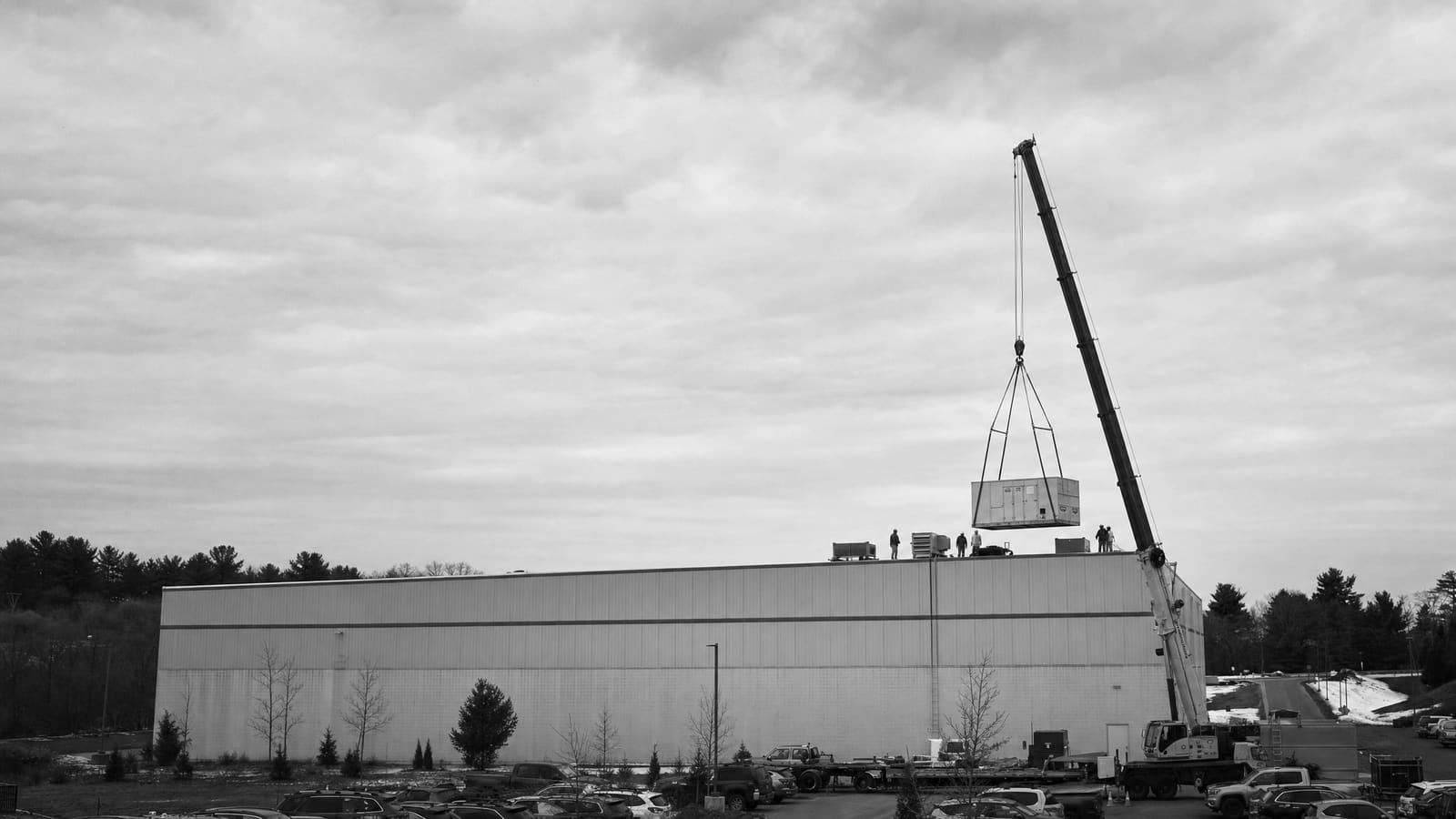
Crane size, staging location, lift date, and permits for any street or lot closure.
05
Permits, startup, and closeout
Dallas mechanical permit, inspections, commissioning, controls setup, warranty terms, and O&M turnover.
Keep planning locally
Related mechanical pages in Dallas
Get a defensible number
Price the equipment and the building together.
Send the address, operating target, and target opening date. Flux will identify what must be verified before the project can be priced.
Get a free estimateQuestions
Straight answers.
When is replacement better than one more repair?
When failures repeat rather than happen once. Federal guidance notes that rooftop units past fifteen years can waste substantial energy and money, and that owners typically wait until the unit stops holding temperature, needs frequent service, or fails outright. Proactive replacement usually beats replacement-on-failure, because a failure in August limits you to whatever equipment can be delivered that week.
Do heat pumps work for Dallas commercial buildings?
Technically, yes. Federal guidance says that across most of the U.S. South and West, current heat pump rooftop units are an appropriate solution and are capable of covering most or all of the winter heating demand. Efficiency drops as it gets colder, so many Dallas owners choose dual fuel — heat pump for the ordinary season, gas heat held in reserve for cold snaps like February 2021.
Which Dallas code applies to a commercial HVAC changeout?
Chapter 55 of the Dallas City Code adopts the 2021 International Mechanical Code with Dallas amendments. Depending on scope, Chapter 59 (2021 International Energy Conservation Code), Chapter 60 (2021 International Fuel Gas Code), and Chapter 58 (2021 International Existing Building Code, effective June 13, 2022) also apply. Commercial permits and inspections run through the city's building inspection group.
Why do two quotes for the same unit differ so much?
Usually because one of them is not pricing the whole job. Curb adapters, duct transitions, electrical feeder work, gas line changes, crane rigging, and permit and inspection time are all real scope that can be quietly left out of a low bid. Ask for each of those as a separate line and the comparison tends to resolve itself.
How much does an old rooftop unit cost to keep running?
Federal reporting puts the waste from old, inefficient commercial rooftop units at roughly $900 to $3,700 per unit each year. High-efficiency units were specified to cut energy use by up to half against the prior standard. That annual waste figure is the number to set next to the replacement cost when you build the case internally.
Can the building stay open during the changeout?
Usually yes, with planning. A like-for-like swap on a single zone can happen overnight or across a weekend. Larger scopes get phased so only one zone is down at a time. Tell us early which hours cannot lose conditioning and where a crane can stage, because those two answers shape the entire schedule.
Sources used for this guide
- [1]betterbuildingssolutioncenter.energy.gov — DOE Advanced Rooftop Unit Replacement Guidance
- [2]betterbuildingssolutioncenter.energy.gov — DOE Commercial Heat Pump Rooftop Unit Replacement Guidance
- [3]betterbuildingssolutioncenter.energy.gov — DOE High-Efficiency Commercial Rooftop Unit Toolkit
- [4]dallascityhall.com — City of Dallas Commercial Mechanical Permits and Inspections
- [5]energy.gov — DOE Efficient Commercial Rooftop Air Conditioner Program