BATTERY ENERGY STORAGE
Battery energy storage systems.
BESS design, installation, interconnection, and service. Cut demand charges, ride through outages, and make solar finally pencil.
Storage that pays for itself.
Commercial batteries earn their keep two ways: shaving the demand peaks that drive your bill, and carrying the building through outages that used to cost you a day. Request pricing on install battery energy storage systems from a single cabinet to containerized BESS on a pad.
The unglamorous parts are where projects die, so price them up front: utility interconnection, permits, NFPA 855 compliance, and commissioning. Pairing with solar or EV charging? One design, one crew, one number.
START HERE
What is a battery energy storage system
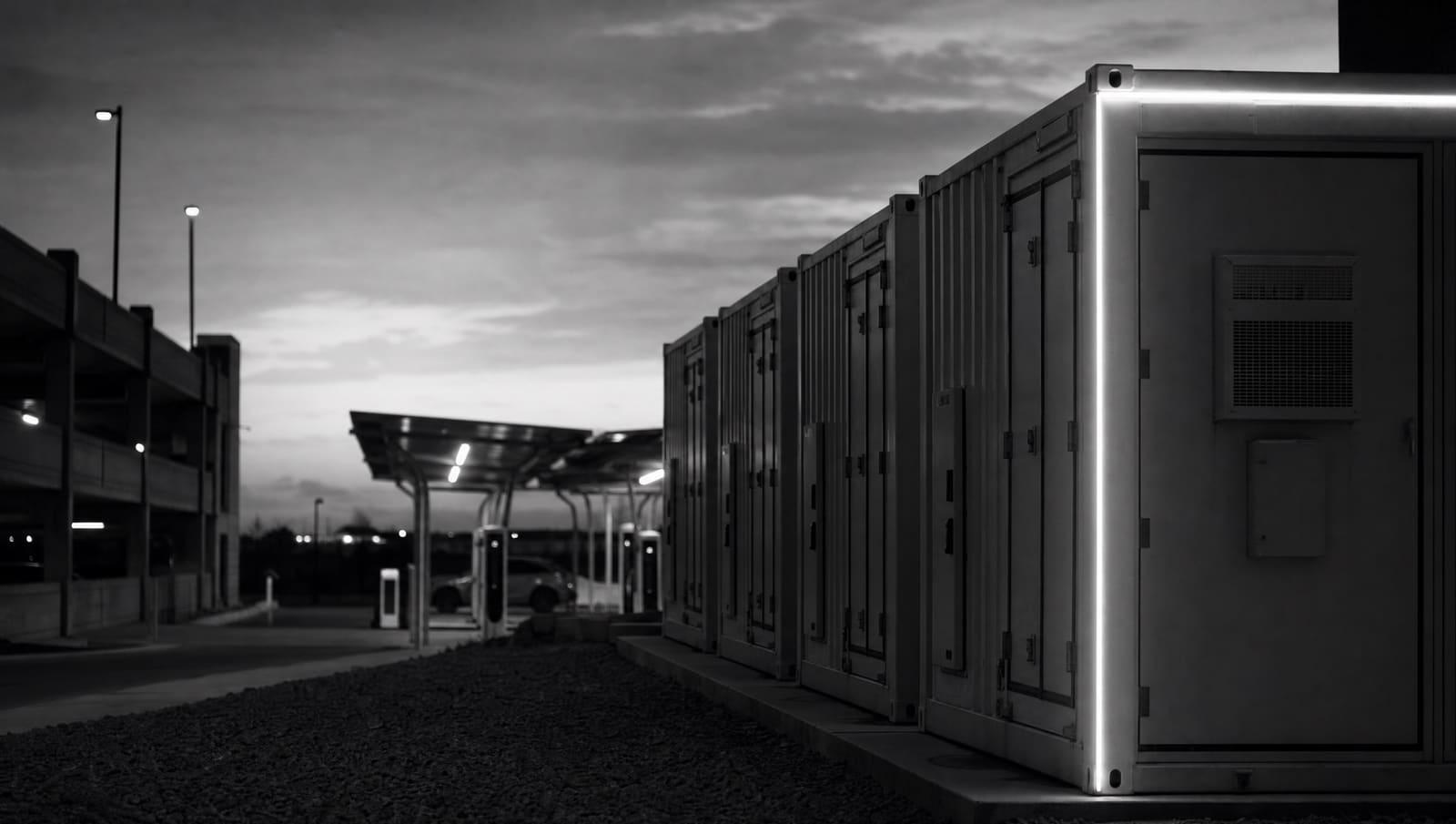
A battery energy storage system, or BESS, is a big rechargeable battery for a building. It sits in cabinets or containers, usually outside on a pad. It charges when power is cheap or when solar is producing. It discharges when power is expensive or when the grid goes down.
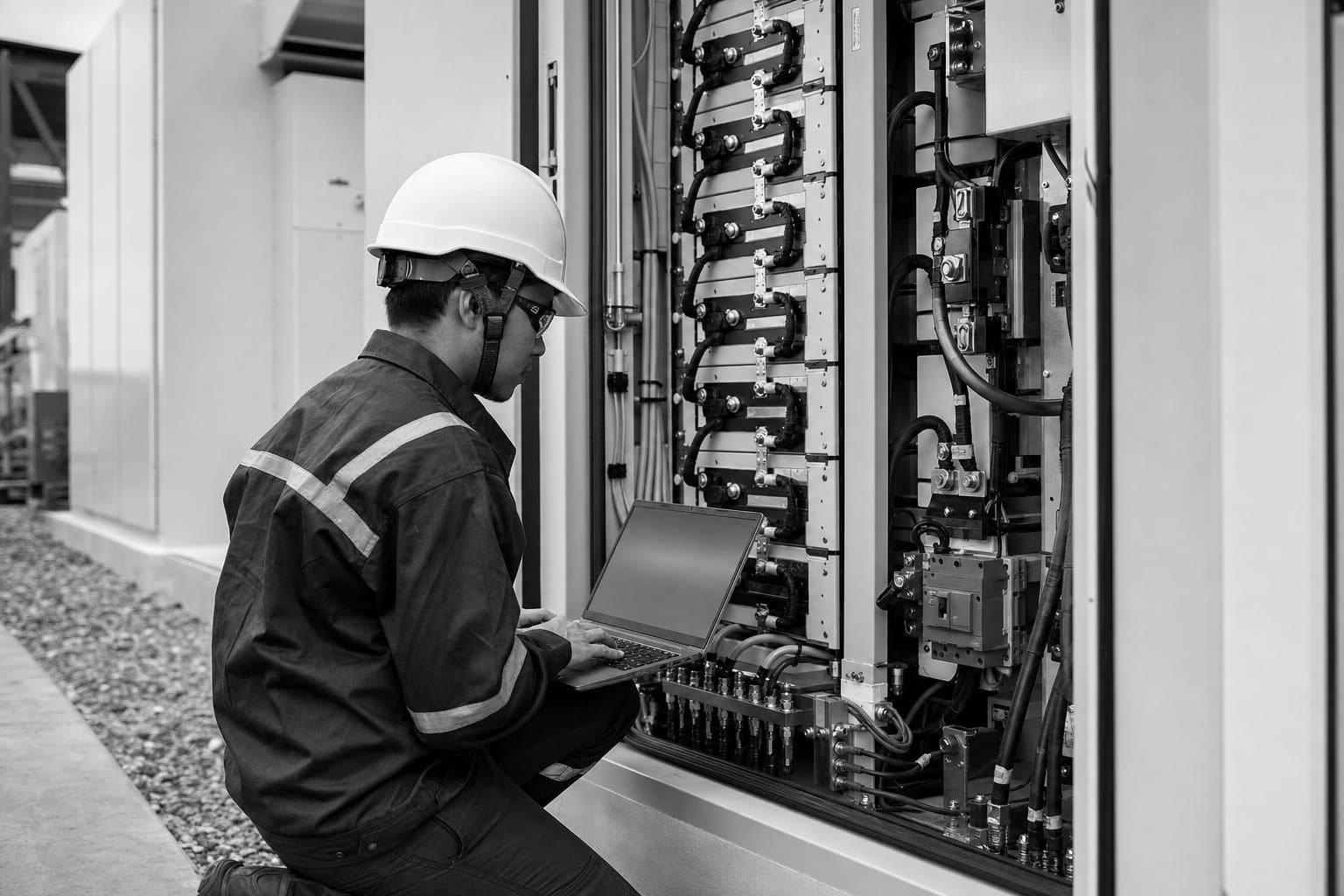
The pieces are simple: battery modules store the energy, inverters convert it, and a controller decides when to charge and discharge. The controller is where the money is made. It watches your building's load and the utility's prices, then moves energy to whichever moment pays most. Every page under this door covers one piece of that decision.
AT A GLANCE
Commercial battery storage by the numbers
$500-1k
PER kWh INSTALLED
Typical installed range for commercial systems in the 50-500 kWh class; large containerized systems fall to $180-$320 per kWh.
UL 9540
THE SAFETY BAR
The ANSI-approved standard for complete storage systems. 9540A is the thermal-runaway test behind it, not a certification itself.
NFPA 855
INSTALL CODE
The installation standard (2026 edition current) that sets spacing, location, and suppression requirements AHJs enforce.
ITC
TAX CREDIT
Storage kept its investment tax credit through the 2025 law changes; credits are transferable, with sourcing rules to satisfy.
THE BILL PROBLEM
How a battery lowers your power bill
Commercial power bills have two parts. One part charges for how much energy you use. The other charges for your biggest spike of use. That spike part is the demand charge, and it can be huge.
A battery fixes the spike. It watches the building's load. When use jumps, the battery discharges and covers the jump itself. The utility never sees the spike, so the demand charge drops. That is peak shaving. Buildings with spiky loads save the most. See the math at demand charge reduction.
THE THREE PAYCHECKS
How commercial battery storage makes money
Batteries earn in three ways, and good projects stack them. First, peak shaving: the battery covers your usage spikes so demand charges drop. This is the workhorse. It works every month, everywhere demand charges exist.
Second, time shifting: charge when power is cheap, discharge when it's expensive. This pays where rates swing during the day, and it makes solar worth more by saving midday power for the evening. Third, backup: when the grid fails, the battery carries the building. Backup alone rarely justifies the cost, but stacked on the first two, it comes almost free.
WORTH KNOWING FIRST
What to know before buying commercial battery storage
01
Demand charges are the business case
Peak shaving discharges the battery during your building's demand spikes, cutting the kW peak the utility bills for. Buildings with spiky loads see the strongest returns.
02
Certification is not optional
AHJs increasingly require UL 9540-listed systems, and NFPA 855 governs where and how they install. An uncertified bargain system can be unpermittable.
03
9540A is a test, not a pass
Vendors waving '9540A certified' are naming a thermal-runaway test method that has no pass or fail. The listing that matters is UL 9540 on the complete system.
04
Scale changes the math
Small commercial installs run $500-$1,000 per kWh installed; containerized systems at campus scale fall toward $180-$320. Sizing decisions swing six figures.
05
The credit still stands
Battery storage kept its investment tax credit through the 2025 legislation, with foreign-sourcing rules attached. Credits are transferable — sellable for cash.
IN PRACTICE
Commercial battery storage applications
The battery watches the building's load and discharges when demand spikes, shaving the peaks that set demand charges. Paired with solar, it stores midday generation for evening use; paired with a generator and switchgear, it anchors a microgrid.
Start with demand charge math, or look at backup power if outages are the driver.
GOOD TO KNOW
Battery energy storage system facts
- UL 9540 references the component standards under it: UL 1973 for the batteries, UL 1741 for inverters, IEEE 1547 for interconnection.
- The 9540A test walks fire behavior up four levels: cell, module, unit, and installation.
- Data-center growth is forecast to raise power demand roughly 160% by 2030, which is tightening capacity and lifting demand charges.
- Peak shaving and demand response stack: the same battery that cuts your peak can earn event payments when the grid calls.
WHAT WE HANDLE
Everything under the battery door.
THE RULES, PLAINLY
UL 9540 and NFPA 855 requirements explained
Two rules matter when you buy storage. UL 9540 is the safety listing for the whole system. Inspectors look for it, and some cities will not approve a system without it. NFPA 855 is the install rulebook. It says where batteries can sit, how far apart, and what fire protection they need.
Why care? Because an uncertified bargain system can be a system you cannot permit. Ask any vendor two things: is the full system UL 9540 listed, and does the layout meet NFPA 855? Good vendors answer fast.
PERMITS AND APPROVALS
Battery storage permits and code requirements
Storage has a real permitting path, and skipping steps kills projects. The fire side runs on NFPA 855: where the system can sit, clearances around it, and what suppression it needs. The equipment side runs on UL 9540: the whole-system safety listing inspectors ask for.
Then comes the utility. A grid-tied battery needs an interconnection agreement, and the interconnection queue can take longer than construction. The clean sequence: pick listed equipment, design to NFPA 855, file interconnection early, then build. Projects that run those in order close. Projects that don't, stall at inspection.

SIZING IT RIGHT
How to size a commercial battery system
Size is two numbers. Power, in kilowatts, is how hard the battery can push at once. Energy, in kilowatt-hours, is how long it can keep pushing. A building with sharp, short spikes needs power. A building trying to ride through long evenings needs energy.
The sizing input is your interval data: the meter readings your utility already records all day. Twelve months of it shows every spike the battery must cover. Systems sized from real interval data fit. Systems sized from a sales target don't. That's why the first question in any serious storage quote is a request for your bills.
WHAT MOVES THE NUMBER
Commercial battery storage cost factors
- System size: bigger installs cost less per kilowatt-hour
- Cabinet vs containerized: containers win at campus scale
- Site work: pad, trenching, and distance to the electrical room
- Interconnection scope and any utility upgrades it triggers
- The tax credit and how much of it your project can claim
- Controls sophistication: smarter dispatch earns more, costs more
THE MONEY SIDE
Battery storage tax credits and incentives
Storage kept its federal investment tax credit through the 2025 law changes, even as wind and solar credits shrank. Two things matter about it. The credit is transferable, meaning a project can sell it for cash instead of waiting on tax bills. And it comes with sourcing rules about where the batteries were made, which vendors now have to answer for.
Stack the credit with state programs and utility incentives where they exist, and the installed cost drops hard. Incentives is its own page because the paperwork order matters: much of the money must be approved before you build, not after.
WHY NOW
Why battery storage demand is growing
The grid is getting crowded. Data centers alone are forecast to push power demand up roughly 160% by 2030, and everything else is electrifying at the same time. Crowded grids mean higher peaks, higher demand charges, and more outages: exactly the three problems a battery answers.
That's also why utilities keep adding programs that pay flexible buildings. A battery makes your building flexible on command. The same system that shaves your peak can sell that flexibility back through demand response and microgrid arrangements. The economics improve as the grid strains, which is not a trend anyone expects to reverse soon.

Pricing a battery project?
Request an estimate and get options sized from your actual interval data, with the credit and incentives netted into the number.
QUESTIONS
Straight answers.
What does commercial battery storage cost?
It ranges widely with size and use case, which is why we start with your utility bills. If demand charges are the target, the bills tell us the system size and the payback before anyone buys hardware.
Do you handle the utility and permits?
Yes. Interconnection applications, permitting, and NFPA 855 fire-code compliance are part of the job, not your homework.
Does it work with our existing solar?
Usually, yes. We evaluate your inverters and interconnection during the site visit and design the storage to match what's already on the roof.
How long does an install take?
Utility approvals set the pace more than construction does. Typical projects run a few months end to end; the on-site work is usually measured in weeks.
GET STARTED
See what storage does to your bill.
Twelve months of bills is all the modeling needs. We'll show the demand-charge math for free, and tell you straight if it doesn't pencil.