THE DIRECT ANSWER
What commercial HVAC replacement and installation covers
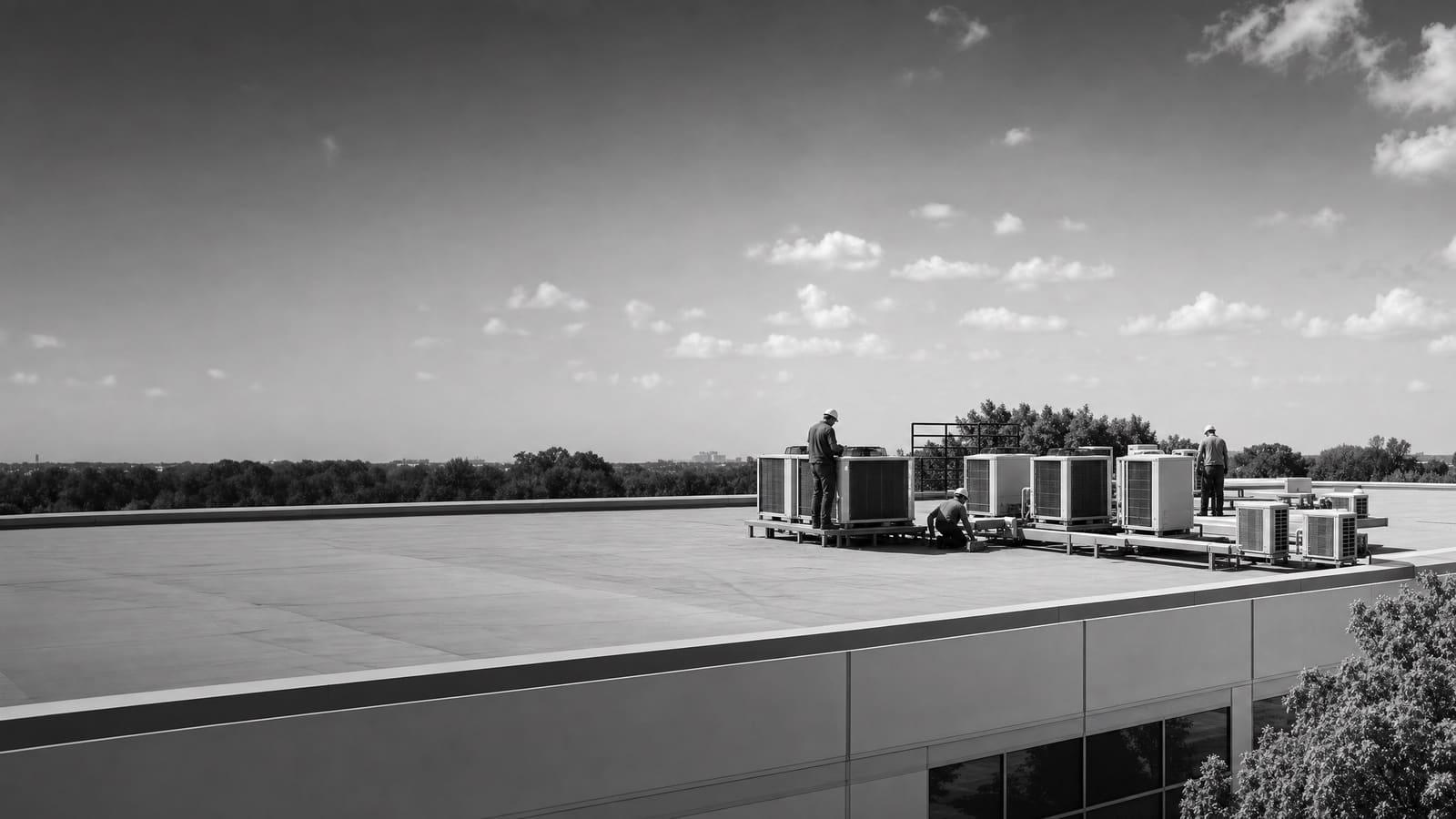
A commercial HVAC replacement confirms the load the building carries today, selects equipment against real availability, sets the unit by crane, ties in power, gas, and controls, then commissions the system to spec. Replacement beats one more repair once a rooftop unit is past fifteen years — units that old waste substantial energy against newer models, and federal work puts the annual waste from an old, inefficient rooftop unit at $900 to $3,700.
A site review has to verify the curb and roof structure, available electrical capacity, gas line status, crane access, and whether today's occupancy still matches the old nameplate tonnage.
THREE OPERATING CHOICES
Repair again, swap like-for-like, or change the equipment
Most buildings arrive at this decision one of three ways: a unit fails in season, a maintenance line item keeps growing, or a lease event forces a plan. The three paths below are not equal in cost or outcome. The right one depends on the age of the equipment and on whether the space is still used the way it was when the unit was specified.
The pattern federal guidance warns about is waiting for total failure. Owners often delay until a unit no longer conditions the space, needs frequent service, or dies outright — and that timing removes every option except whatever is on the truck. Deciding while the old unit still runs gives you competitive bids, a real equipment comparison, and a crane day you schedule instead of one that schedules you.
WHAT MOVES THE NUMBER
Budget lines that change a Yuma installation quote
No two roofs price the same, so treat these as the lines that move your number rather than a national average. Ask each bidder to show them separately. When a line is missing from a quote, it usually reappears as a change order after the crane leaves.
HOW TO BUY IT
Choosing equipment before the unit forces your hand
The most useful decision you can make is to choose equipment while the old unit still runs. Proactively replacing an inefficient rooftop unit is generally a better business move than replacement-on-failure, and often better than a like-for-like swap at end of life, because both of those get decided under pressure with whatever is available. An in-season failure narrows the field to stock, and stock rarely matches the tier you would have picked.
Start with the load, not the nameplate. A unit specified fifteen or twenty years ago was sized for the occupancy, plug load, and envelope of that building at that time. If the space has been re-tenanted, added to, or reconfigured, the old tonnage is a record of a past decision rather than a spec for the new one.
Then decide what the new unit burns. Heat pump rooftop units are technically close to air-conditioning rooftop units but add reverse-cycle heating, and federal guidance places today's models squarely in range for most of the U.S. South and West, where they can cover most or all of the winter heating demand. Whether one fits your building comes down to electrical capacity, gas line status, equipment availability, and what your utility rates actually are.
PROJECT COMPLEXITY
What makes one replacement simple and another complicated
Two buildings on the same block can carry very different installation costs. The difference is rarely the unit itself. It is what the roof, the panel, and the parking lot allow on the day the crane shows up.
LOWER COMPLEXITY
Same size, same footprint
The replacement matches the existing curb and connections, the panel already carries the load, the roof needs no framing, and the crane sets up in a corner of the lot without closing the entrance. Permitting stays mechanical and electrical.
HIGHER COMPLEXITY
New footprint or new fuel
Tonnage or footprint grows, so structural review enters. Going all-electric means confirming panel space and service capacity before ordering. Tight lots, shared access, or a set over occupied tenant space push work into off-hours and add cost.
BEFORE YOU BID IT
What a site review has to settle
A quote is only comparable if every bidder priced the same building. That takes a roof visit, not a phone call. The review should record the existing unit's tonnage, age, and refrigerant, the curb dimensions, the condition of the roof around it, and how the unit is fed with power and gas today.
Infrastructure is where the surprises live. Electrical capacity decides whether an all-electric replacement is a straightforward connection or a service upgrade with a utility timeline attached. Physical constraints — roof structure, access hatches, unit clearances, and how close a crane can park — decide the schedule. Existing gas lines have to be either reused or properly retired.
Refrigerant handling is not optional. Federal rules under Section 608 of the Clean Air Act govern how refrigerant is recovered and managed in stationary air-conditioning equipment, and pulling your old unit falls under them. Documenting that is the installer's job, and it belongs on the quote rather than in a conversation afterward.
Ask for this before you compare bids
A written scope naming the tonnage and efficiency tier, curb adapter approach, electrical and gas work, rigging plan, permit and inspection responsibility, refrigerant recovery, and commissioning. When two quotes differ by thousands, the difference is almost always sitting in one of those lines.
IN YUMA
Plan the inspection, not just the install
Inspection timing is part of the schedule, not an afterthought. Yuma County Development Services publishes its building safety policies online, and those policies include a specific virtual inspection procedure for HVAC replacement, plus a separate one for HVAC duct air leakage testing.
That matters twice on a commercial swap. First, if your building falls under county jurisdiction and the replacement qualifies, a virtual inspection can remove a wait between finishing the tie-in and getting the unit signed off. Second, a published duct air leakage test procedure tells you that duct work touched during a replacement may need to be tested and documented, not simply reconnected.
Confirm which building department has jurisdiction before you assume a submittal path. That answer sets the permit and inspection sequence for the whole job.
One thing to ask your installer
Ask whether your replacement is eligible for the county's virtual inspection procedure, and whether the scope includes a duct air leakage test. Both answers change the closeout timeline, and both should be settled before the crane is booked.
OWNERSHIP CONSIDERATIONS
Two things that outlast the install
The install takes days. The consequences run for the whole service life of the unit, and two of them are far cheaper to decide now than to discover later. Both change how the building gets serviced after the crane is gone, and both belong in the conversation before an order is placed. If you hold more than one building, decide them at the portfolio level rather than one roof at a time — federal heat pump guidance is written for exactly that kind of screening, where some sites in a portfolio are good candidates and others clearly are not.
MIXED FLEETS
Refrigerant and parts planning
New equipment ships on current refrigerants while your older units stay on what they were built with. That split affects technician certification, recovery procedure, and what your service contract needs to stock. Section 608 rules apply to all of them.
CONTRACTOR DEPTH
Who services it in year three
Federal guidance lists contractor availability and knowledge as a real adoption factor, not a footnote. Newer equipment types are only a good decision when someone nearby can commission them correctly and keep them running.
PHASING AND LIFETIME COST
Sequencing a roof that carries several units
If your roof carries several units, replacing them all at once is rarely the best use of capital, and replacing them strictly in failure order is rarely the cheapest either. Rank them by age, service history, and the load each one serves. The oldest unit over a high-occupancy space usually earns the first slot. The newest unit over a storeroom can wait.
The number that makes phasing worth the effort is operating waste. Old, inefficient rooftop units have been measured wasting $900 to $3,700 per unit each year against what efficient equipment would use. Multiply that by the aging units on your roof and by the years you plan to hold the building, and the phasing conversation stops being abstract.
There is precedent at scale. Through the federal Advanced RTU Campaign, more than 200 organizations upgraded over 43,000 rooftop units, and those upgrades were reported to save a combined $37 million a year in energy costs. Owners in that program worked from two options per unit: replace the old equipment outright, or retrofit it with advanced controls, whichever made better financial sense. That is the right framing for your roof — a decision made per unit against a plan, not per emergency.
QUOTE CHECKLIST
Five things a comparable quote should show
Ask every bidder for these five in writing. Quotes that include them can be compared line by line. Quotes that leave them out are estimates wearing a price tag.
01
Equipment, tier, and lead time
Make and model, tonnage, efficiency tier, and an actual availability date the supplier will hold — not a range.
02
Curb, structure, and roof work
Whether the new unit lands on the existing curb, what adapter is needed, and any framing or roof repair included in the price.
03
Electrical, gas, and controls scope
Panel work, disconnects, any service change, gas line reuse or retirement, and how the unit ties into existing building controls.
04
Rigging, access, and schedule
Crane size, staging plan, how many stalls close and for how long, and whether the work happens in hours or after close.
05
Permits, inspection, and commissioning
Who pulls permits, who meets the inspector, refrigerant recovery documentation, and the startup verification you receive at handoff.
Get a defensible number
Price the equipment and the building together.
Send the address, operating target, and target opening date. Flux will identify what must be verified before the project can be priced.
Get a free estimateQuestions
Straight answers.
How do you know when to replace instead of repairing again?
Age plus repeat failures. Rooftop units past fifteen years can waste substantial energy and money compared with newer models, and once service calls come back every season you are already paying for a replacement in pieces. Deciding while the unit still runs is what keeps your equipment options open.
How long does a rooftop replacement take on site?
The set itself is a short, scheduled event once the planning is done. The variable that actually moves your date is equipment lead time, which is why availability belongs on the quote right next to the price.
Does a heat pump rooftop unit make sense in Yuma?
Often, yes. Federal guidance places today's heat pump rooftop units in range for most of the U.S. South and West, where they can cover most or all of the winter heating demand. The deciding factors are electrical capacity, existing gas lines, equipment availability, and your utility rates.
Who handles permits and inspections?
The installing contractor should own permits, inspection coordination, and closeout as part of the installed price. Under Yuma County jurisdiction, ask specifically whether your replacement qualifies for the county's published virtual inspection procedure for HVAC replacement.
What happens to the refrigerant in the old unit?
It has to be recovered and managed under EPA Section 608 rules, which govern refrigerant handling in stationary refrigeration and air-conditioning equipment. Ask for the recovery documentation as part of closeout — it is the installer's responsibility, not yours.
Sources used for this guide
- [1]betterbuildingssolutioncenter.energy.gov — DOE Advanced Rooftop Unit Replacement Guidance
- [2]betterbuildingssolutioncenter.energy.gov — DOE Commercial Heat Pump Rooftop Unit Replacement Guidance
- [3]betterbuildingssolutioncenter.energy.gov — DOE High-Efficiency Commercial Rooftop Unit Toolkit
- [4]energy.gov — DOE Efficient Commercial Rooftop Air Conditioner Program
- [5]epa.gov — EPA Stationary HVAC Refrigerant Management
- [6]yumacountyaz.gov — Building Safety Policies | Yuma County