THE SHORT ANSWER
What a commercial HVAC replacement actually includes
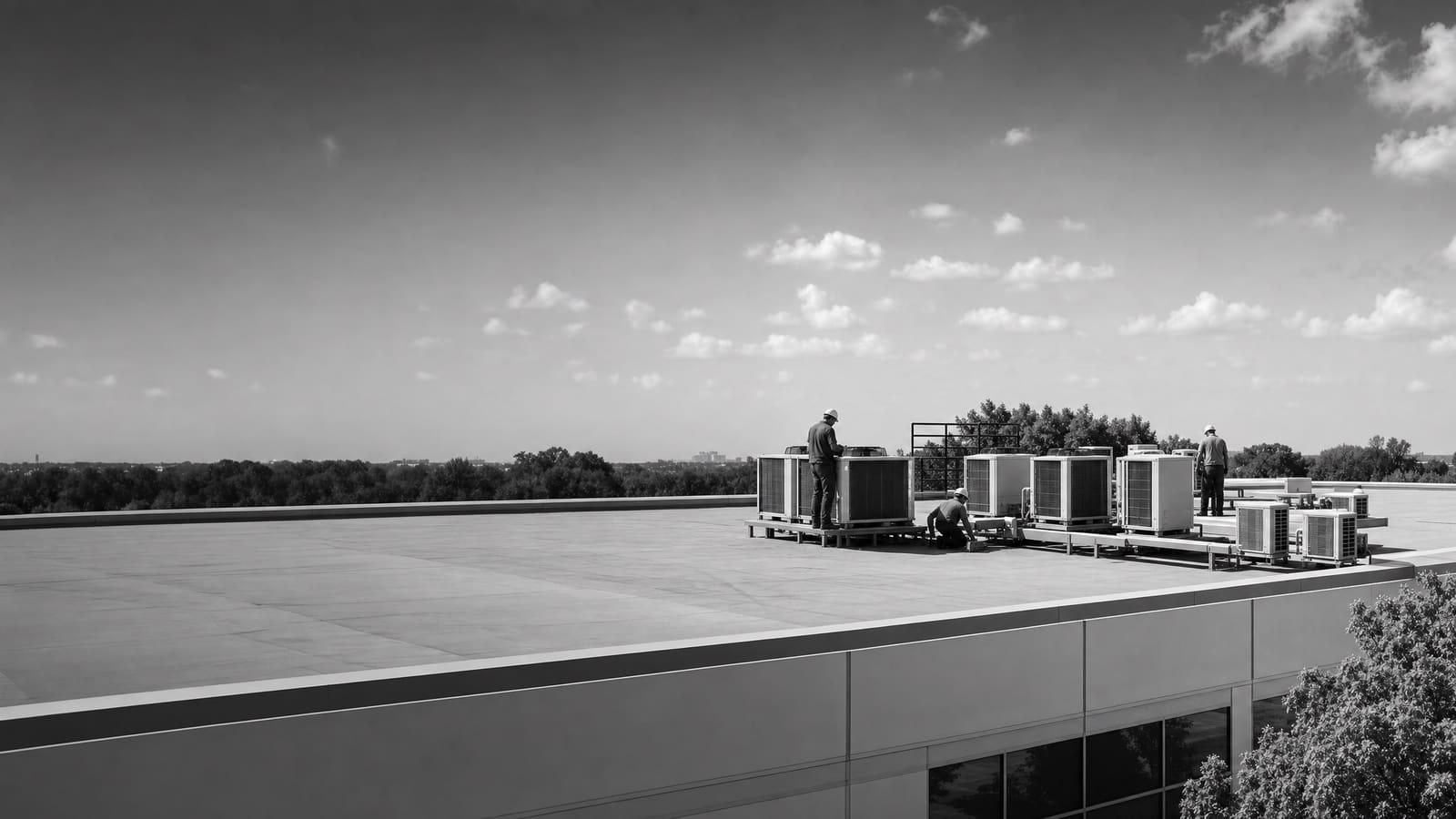
A commercial HVAC replacement covers the load check, equipment selection, the crane set, connections, controls, and commissioning. Replacement beats another repair once a rooftop unit is past about fifteen years, because old and inefficient units have been measured wasting roughly $900 to $3,700 each per year in energy. When failure is likely mid-season, a planned replacement costs less than an emergency one and leaves you a real choice of equipment.
A site review still has to confirm tonnage against how the space is used now, the curb and roof structure, available electrical capacity, gas service, and crane access before any of that becomes a price.
THREE PATHS
The operating choice behind the purchase
Most commercial replacements land on one of three paths, and the right one depends on how the building runs, not on which unit is cheapest to buy. Federal rooftop guidance frames the first fork plainly: replace the old unit with a more efficient one, or retrofit the existing unit with advanced controls, depending on which makes better financial sense. A third path has grown since then. Heat pump rooftop units are built much like a standard air-conditioning unit but add reverse-cycle heating.
Decide this before anyone quotes tonnage. Each path carries a different permit scope, a different electrical scope, and a different lead time. The controls retrofit is the only one that keeps the existing box, so it is fastest and least disruptive, but it does nothing for a unit already near the end of its service life. The heat pump path is the one that most often uncovers work outside the mechanical scope, because the panel, the feeder, and the gas line all get re-examined before the unit is selected.
WHAT MOVES THE NUMBER
The lines that decide your price
No one can price a roof from a phone call, but the cost drivers repeat on almost every job. These are the lines that move a quote the most, and the ones worth pinning down in writing before you set two bids side by side.
BUYING GUIDANCE
How to choose the equipment
Start with the load, not the nameplate. A unit installed twenty years ago was sized for the occupancy, lighting, and plug load of that building at that time. If the tenant changed, if the equipment count went up, or if the envelope was improved, the old tonnage is a guess carried forward. Right-sizing is the cheapest correction available on a replacement, because it costs a calculation rather than a piece of equipment.
Then decide how much efficiency to buy. Rooftop units cool close to half of all commercial floor area in the country, and the older ones are where the waste sits. A federal performance specification pushed manufacturers toward units that cut energy use by up to half against the prior standard, and more than twenty models now exceed it. That premium tier is easiest to justify on a building running long hours with a heavy summer peak. On a lightly occupied building, the payback stretches out.
Last, be honest about timing. Facility managers usually wait until a unit fails, stops holding the space, or needs constant attention. Replacing on failure removes your options. You take whatever is available, at whatever the market is that week, on whatever day a crane can come. Replacing on your own schedule lets you compare equipment, stack the work with other roof projects, and pick a window that does not sit in peak season.
COMPLEXITY CHECK
What makes a replacement simple or hard
Two buildings can buy the same tonnage and get very different quotes. The difference is almost never the unit itself. It is what the roof, the panel, and the parking lot require before that unit can land.
STRAIGHTFORWARD
Same box, same connections
The existing curb fits or takes a standard adapter, tonnage is unchanged, gas and electric are already sized for the load, and a crane can reach the unit from a lot you can close for one morning.
MORE INVOLVED
New footprint or new fuel
Tonnage or weight changes, so the roof gets a structural look. An electric conversion adds panel and feeder work. Tight access means a larger crane, a street closure, or a night set.
BEFORE THE QUOTE
What the site review has to settle
A quote worth comparing comes after someone stands on the roof. The visit is short, but it decides most of the price. The reviewer should confirm the existing tonnage against how the space is actually used, measure the curb, look at the structure and the deck condition around the unit, and photograph the disconnect, the panel, and the gas connection.
Federal heat pump guidance lists the infrastructure questions in a specific order for a reason: electrical capacity, physical constraints, gas lines. Electrical capacity is the one that surprises people. Most all-electric and cold-climate rooftop units carry electric resistance backup heat, and that backup often sizes the circuit rather than the compressor. If the panel cannot carry it, the conversion is a service upgrade wearing a rooftop unit's costume.
The other half of the visit is logistics. Where the crane sets up, how far it has to reach, how many stalls come out of service, and what tenants experience during that window. Those answers belong on the quote, not in a phone call three weeks later.
Ask for these before you sign
Nameplate data on the existing unit, the proposed tonnage with the load basis behind it, efficiency tier and heating type, curb and structural scope, electrical and gas scope, equipment lead time in weeks, and who owns permits, rigging, and inspections.
OWNING THE SYSTEM
Two things that outlast the install
The install is a week. The consequences run for the life of the equipment, and two of them are worth deciding on purpose instead of discovering later.
The first is refrigerant. EPA regulations under Section 608 of the Clean Air Act address how refrigerant is handled, recovered, and recycled in stationary air-conditioning and heat pump equipment. That applies at removal, during service, and at disposal. New equipment ships on newer refrigerants, so a building that replaces units one at a time will run a mixed fleet for years. That is manageable, but only if your service contract and spare-parts plan account for it.
The second is who holds the performance. A unit that is set and started is not the same as a unit that is commissioned. Charge, airflow, economizer operation, and control settings all have to be verified against the specification and written down. Without that record, the first comfort complaint of the summer becomes an argument about whether the equipment or the installation is at fault.
REFRIGERANT
Plan for a mixed fleet
Federal rules cover handling, recovery, and recycling on stationary equipment. Replacing units one at a time means two refrigerants on one roof for a while. Tell your service provider before it matters.
PERFORMANCE
Commission, do not just start up
Ask for a documented startup: measured airflow, verified charge, economizer proven to operate, and controls set to your real schedule. That record is what keeps a warranty conversation short.
PLANNING AHEAD
Phasing, procurement, and lifetime cost
Most commercial roofs carry more than one unit, and they rarely fail on a convenient schedule. Phasing is the tool that keeps a building from lurching between emergencies. Rank the units by age, run hours, and repair history, then replace in that order across two or three budget years. The oldest units are usually the ones bleeding the most, which is why federal guidance frames proactive replacement as the smarter move compared with replacing on failure, or even with a like-for-like swap at the end of service life.
Procurement is where the schedule is really decided. Equipment availability is a stated consideration in that same guidance, and it belongs next to the price on every quote you receive. A unit that is two months out is not the same purchase as one sitting in a regional warehouse, even at an identical number. If the building cannot go without cooling, availability outranks the last few points of efficiency.
Lifetime cost is the final filter. Across the national rooftop campaign, more than 200 organizations upgraded over 43,000 units and cut a combined $37 million a year from their energy bills. That is money released by equipment already installed and already old. The same math applies to a single roof. It is just smaller, and much easier to check.
QUOTE CHECKLIST
Five things a comparable quote shows
Two bids are only comparable when they describe the same scope. If one of these is missing, you are guessing at the difference, and the difference is usually where the money went.
01
Load basis and selected tonnage
The calculation behind the size, not a model number carried over from the old nameplate.
02
Efficiency tier and heating type
Gas heat, electric resistance, dual fuel, or heat pump, with the winter heating assumption stated.
03
Curb, structural, electrical, and gas scope
Everything outside the unit itself, priced, including work the replacement triggers.
04
Equipment lead time in weeks
A real availability date beside the price, and what happens to your schedule if it slips.
05
Rigging, permits, and commissioning
Who pulls permits, who owns the crane day, and what commissioning documentation you get at handoff.
Get a defensible number
Price the equipment and the building together.
Send the address, operating target, and target opening date. Flux will identify what must be verified before the project can be priced.
Get a free estimateQuestions
Straight answers.
When is replacement better than another repair?
Age, repair frequency, and comfort are the three signals. Rooftop units past fifteen years waste substantially more energy than newer models, and old inefficient units have been measured wasting roughly $900 to $3,700 each per year. When repairs start stacking up on a unit that old, the repair is buying time on a losing position.
Should a gas rooftop unit be replaced with a heat pump?
It depends on the site's winter heating load, local electricity and gas prices, and the electrical panel. Heat pump heating efficiency drops as outdoor temperature falls and trends toward parity with electric resistance heat, so the honest answer comes from the building's heating demand and available capacity rather than a preference for one fuel.
How far ahead should a replacement be planned?
Far enough ahead to actually choose the equipment. Waiting for failure hands the decision to whatever happens to be in stock that week. Equipment availability is a standard consideration in federal rooftop guidance, and it should appear on your quote in weeks, right next to the price.
What happens to the refrigerant in the old unit?
It has to be recovered rather than released. EPA regulations under Section 608 of the Clean Air Act address the handling and recycling of refrigerants in stationary refrigeration, air-conditioning, and heat pump equipment, including at removal and disposal. That work belongs in the written scope, not assumed.
Is a controls retrofit a real alternative to replacing the unit?
Sometimes. Building owners are advised to either replace old rooftop units with more efficient ones or retrofit them with advanced controls, depending on which makes better financial sense. A retrofit suits a unit with service life left in it. It will not rescue one that is already failing.
Sources used for this guide
- [1]betterbuildingssolutioncenter.energy.gov — DOE Advanced Rooftop Unit Replacement Guidance
- [2]betterbuildingssolutioncenter.energy.gov — DOE Commercial Heat Pump Rooftop Unit Replacement Guidance
- [3]betterbuildingssolutioncenter.energy.gov — DOE High-Efficiency Commercial Rooftop Unit Toolkit
- [4]energy.gov — DOE Efficient Commercial Rooftop Air Conditioner Program
- [5]epa.gov — EPA Stationary HVAC Refrigerant Management