THE DIRECT ANSWER
What a commercial HVAC replacement actually includes
A commercial HVAC replacement is a load check, an equipment decision, a rigging day, and a commissioning step that proves the system performs to spec. Replacement beats another repair once a unit is past about fifteen years, because older rooftop units waste substantially more energy than current equipment — Department of Energy figures put that waste at roughly $900 to $3,700 per unit each year. Past that point, repair dollars buy time on a machine that already costs too much to run.
A site review still sets the number. Tonnage, curb condition, roof structure, crane access, and available electrical or gas capacity all have to be verified before an installed price means anything.
THREE WAYS TO GO
Three ways to replace a commercial rooftop unit
Most commercial replacements land on packaged rooftop units, and rooftop equipment conditions close to half of all commercial floor space in the country. The real fork is not the brand on the data plate. It is what the new unit burns and how it makes heat.
A gas-heat air conditioning unit is the like-for-like path. A dual-fuel heat pump unit runs the heat pump in mild weather and hands off to gas when it gets cold. An all-electric or cold-climate heat pump unit drops the gas line entirely. The Department of Energy frames that choice around climate, utility rates, building type, equipment availability, and the infrastructure already on your roof: electrical capacity, physical space, and gas service.
The efficiency curve is what decides it. Heat pump heating gets less efficient as outdoor temperature falls, and at the bottom of the range it trends toward the same efficiency as electric resistance heat. That is why the same building can be an easy all-electric candidate in one climate and a dual-fuel candidate in another. Know your winter design temperature before you commit to a fuel.
WHAT MOVES THE NUMBER
What drives commercial HVAC installation cost
No two roofs price the same, so treat these as the lines to interrogate on a quote rather than as a total. The first three usually explain most of the spread between two bids on the same building.
IN PRACTICE
How to buy the replacement, not just the box
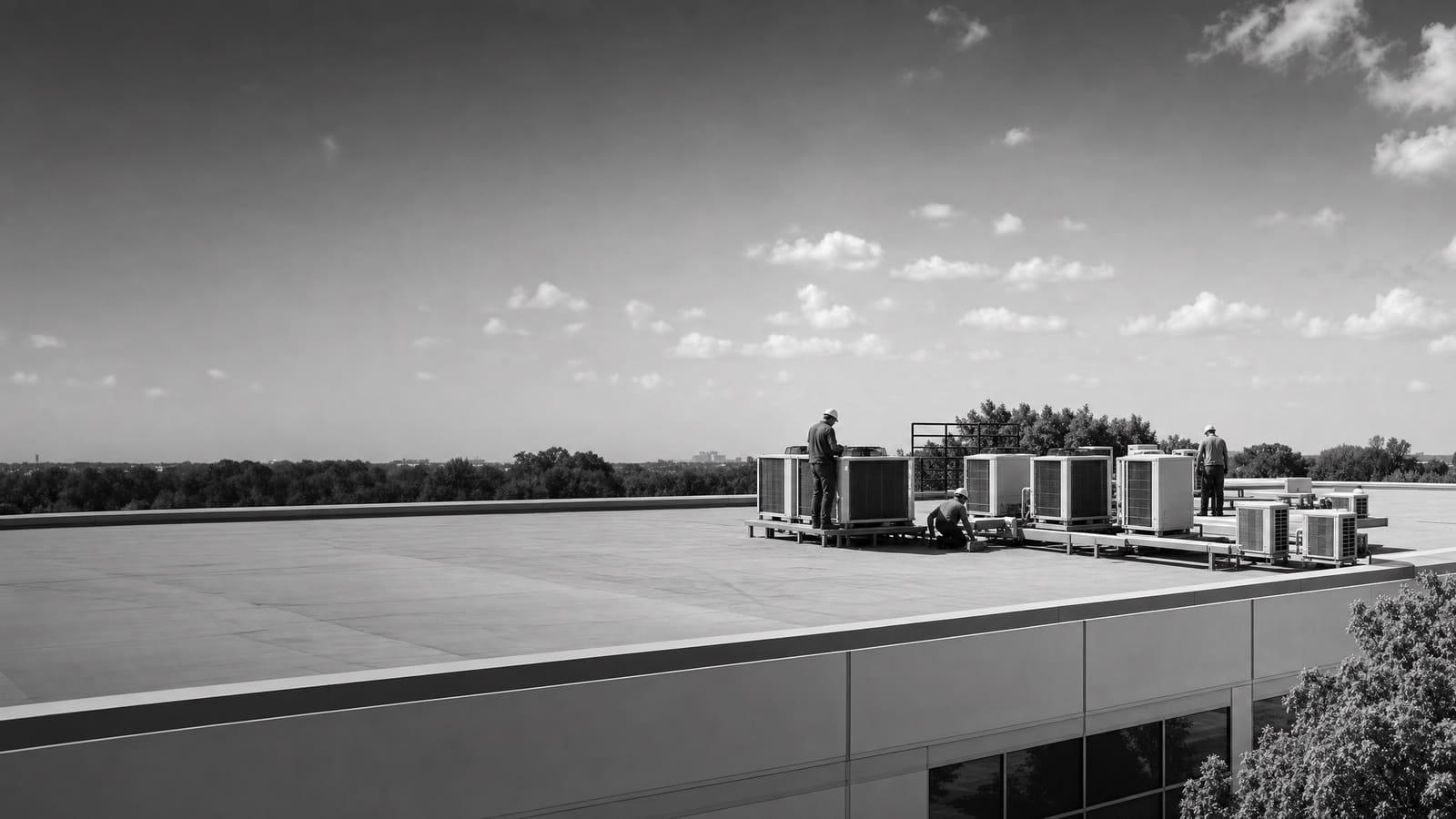
The visible part of a replacement is one morning. The crane sets up, stalls get coned, the old unit comes off, and the new one lands on a curb adapter that was measured weeks earlier. Everything that makes that morning boring happened before it.
The decision that matters most is timing. Facility managers usually wait until a unit stops holding the space, needs constant service, or fails outright, and then buy whatever can ship. A planned replacement lets you compare efficiency tiers, apply for utility incentives that require pre-approval, and pick a shutdown window that does not fall on your busiest week. Replacement on failure removes all three of those options at once.
The second decision is sizing. A twenty-year-old nameplate describes a building that no longer exists — occupancy, plug loads, lighting, and envelope have all moved since. Confirm the load against how the space is used now. Oversized equipment short-cycles, dehumidifies poorly, and costs more to buy. Undersized equipment never catches up on the worst days.
Then ask for the efficiency comparison in operating dollars, not in rating numbers. Today's high-efficiency rooftop equipment was developed against a federal specification targeting up to half the energy use of the older baseline, so the gap between the cheapest compliant unit and a better one can pay for itself well inside a service life. Have the contractor show that math against your actual run hours.
COMPLEXITY CHECK
Straightforward swap or engineered project
Two buildings can order the same tonnage and get very different projects. What separates them is whether the replacement stays inside the existing curb, services, and structure — or steps outside all three.
LOWER COMPLEXITY
Same footprint, same services
Matching or near-matching tonnage, an existing curb that accepts an adapter, adequate panel capacity, and open lot space for the crane. The permit set is usually simple, the set is one morning, and commissioning happens the same week. The old charge still has to be recovered properly.
HIGHER COMPLEXITY
New load, new infrastructure
Growing tonnage, converting to all-electric heat, or adding units where none existed. Expect structural review for the added weight, electrical service or feeder work, possible gas line abandonment, and a longer review path. Phase this kind of project into a shoulder season rather than forcing it in season.
BEFORE YOU PRICE IT
What the site review has to verify
A quote written from a phone call is a guess. The site review is where an installed price becomes real, and it is short — usually an hour on the roof and in the electrical room.
Start with the existing unit: nameplate tonnage, refrigerant type, age, and heat source. Age is the single most useful number, because units past fifteen years are where the energy waste and the service calls concentrate. Then the curb — dimensions, condition, and whether the new footprint needs an adapter. Then the structure under it, since added weight is what quietly turns a swap into an engineered project.
Next, the services. Available panel capacity and feeder size decide whether a heat pump unit is even on the table without an electrical upgrade. Gas line size and routing decide whether dual fuel is simple. Physical constraints — roof clearances, adjacent equipment, screen walls — decide what will actually fit up there.
Last, access. Where the crane sets up, what it has to reach over, which stalls close, and for how long. That answer moves the rigging cost more than most buyers expect, and it is the easiest item to confirm before anyone writes a number.
Bring these four things to the walk
A nameplate photo of every unit in scope, the electrical panel schedule, a roof plan or overhead view of the lot, and your blackout dates. With those in hand, most contractors can price the work without a second trip.
OWNERSHIP MATH
Two things that outlast the install
The install takes a week of your attention. The unit sits on your roof for a decade and a half or more, and two procurement decisions follow it the entire time.
Neither one shows up as a line on the bid. Both show up in the operating budget, in the service contract, and in what the next replacement costs you. Ask about them while you still have leverage — before the purchase order, not after the crane leaves.
SERVICE AND PARTS
Refrigerant and the mixed fleet
New equipment ships on current refrigerants, which will not match what is in your older units. EPA Section 608 rules govern how charges are recovered, recycled, and handled, so your service contractor needs certified technicians and the right recovery equipment for both generations on the roof.
WHO CAN INSTALL IT
Contractor capability
The Department of Energy names contractor availability and knowledge as a real constraint on heat pump rooftop projects, not a footnote. Commissioning a heat pump — charge, defrost behavior, backup heat staging, controls — is different work than starting a gas unit. Ask what the crew has actually installed.
PLANNING AHEAD
Phasing a multi-unit roof
Buildings rarely have one unit, and units rarely fail on a convenient schedule. If you have five rooftop units of similar age, you are not making one decision. You are making a five-year plan, and the cheapest version of that plan gets written before the first failure, not after it.
Rank the fleet by age, service history, and what each unit serves. Anything past fifteen years is a candidate. Anything already on repeat service calls is a priority. Then set the standard: the equipment type, efficiency tier, and controls approach you want the whole roof running when the last unit is replaced. Buying one at a time without that standard leaves you with five platforms and five parts inventories.
Build utility incentives into the plan rather than discovering them afterward. Programs commonly require application before equipment is purchased or installed, and the Department of Energy maintains guidance on how rooftop incentives are structured. Confirm current rules and deadlines with your utility before you order, because program levels change.
Then phase the work into shoulder seasons. Replacing in mild weather buys you a real shutdown window, better contractor availability, and enough time to commission properly instead of chasing comfort complaints in month two.
QUOTE CHECKLIST
Five things a comparable quote shows
If two bids differ by more than a small margin, one of these five is usually missing from the cheaper one. Ask for all five in writing before you compare anything.
01
Equipment, spelled out
Make, model, tonnage, heat source, efficiency tier, and refrigerant — not just "a new rooftop unit."
02
Lead time next to the price
Quoted availability for that exact model, and what happens to the schedule if it slips.
03
Rigging and access plan
Who supplies the crane, which stalls close and for how long, and whether that cost is included or excluded.
04
Everything on the way in
Curb adapter, structural work, electrical or gas changes, controls integration, and old-unit disposal with refrigerant recovery.
05
Commissioning and documentation
Startup, charge, airflow, and control settings verified against spec, documented, and handed over so the warranty holds.
Get a defensible number
Price the equipment and the building together.
Send the address, operating target, and target opening date. Flux will identify what must be verified before the project can be priced.
Get a free estimateQuestions
Straight answers.
When is replacement better than another repair?
Age and repeat service calls are the tell. Rooftop units past fifteen years waste substantially more energy than current equipment, and Department of Energy figures put that waste at roughly $900 to $3,700 per unit each year. Once repair spend is an annual line item, you are paying twice for the same unit.
Should you switch to a heat pump rooftop unit?
It depends on climate, electric and gas rates, and the electrical capacity you already have. Heat pump heating loses efficiency as outdoor temperature drops, so colder design conditions favor dual fuel while milder ones support all-electric. Model the utility bill impact before ordering, not after.
How long does the actual swap take?
For a single packaged unit landing on an existing curb, the on-site set and connection is short — often a single working day. Equipment lead time, not labor, is what usually sets your schedule, so ask for availability alongside the price.
Does new equipment use a different refrigerant?
New commercial units ship on current refrigerants that will not match older equipment on the same roof. It changes nothing about day-one operation, but EPA Section 608 rules govern recovery and handling, so plan service contracts and spare parts around a mixed fleet.
Should you replace like-for-like or resize?
Confirm the load either way. If the space and its use have not changed, like-for-like is often right. If occupancy, plug loads, or the envelope changed, right-sizing fixes comfort problems that the old nameplate would otherwise carry forward for another twenty years.
Sources used for this guide
- [1]betterbuildingssolutioncenter.energy.gov — DOE Advanced Rooftop Unit Replacement Guidance
- [2]betterbuildingssolutioncenter.energy.gov — DOE Commercial Heat Pump Rooftop Unit Replacement Guidance
- [3]betterbuildingssolutioncenter.energy.gov — DOE High-Efficiency Commercial Rooftop Unit Toolkit
- [4]energy.gov — DOE Efficient Commercial Rooftop Air Conditioner Program
- [5]epa.gov — EPA Stationary HVAC Refrigerant Management