THE SHORT ANSWER
What a commercial HVAC replacement actually covers
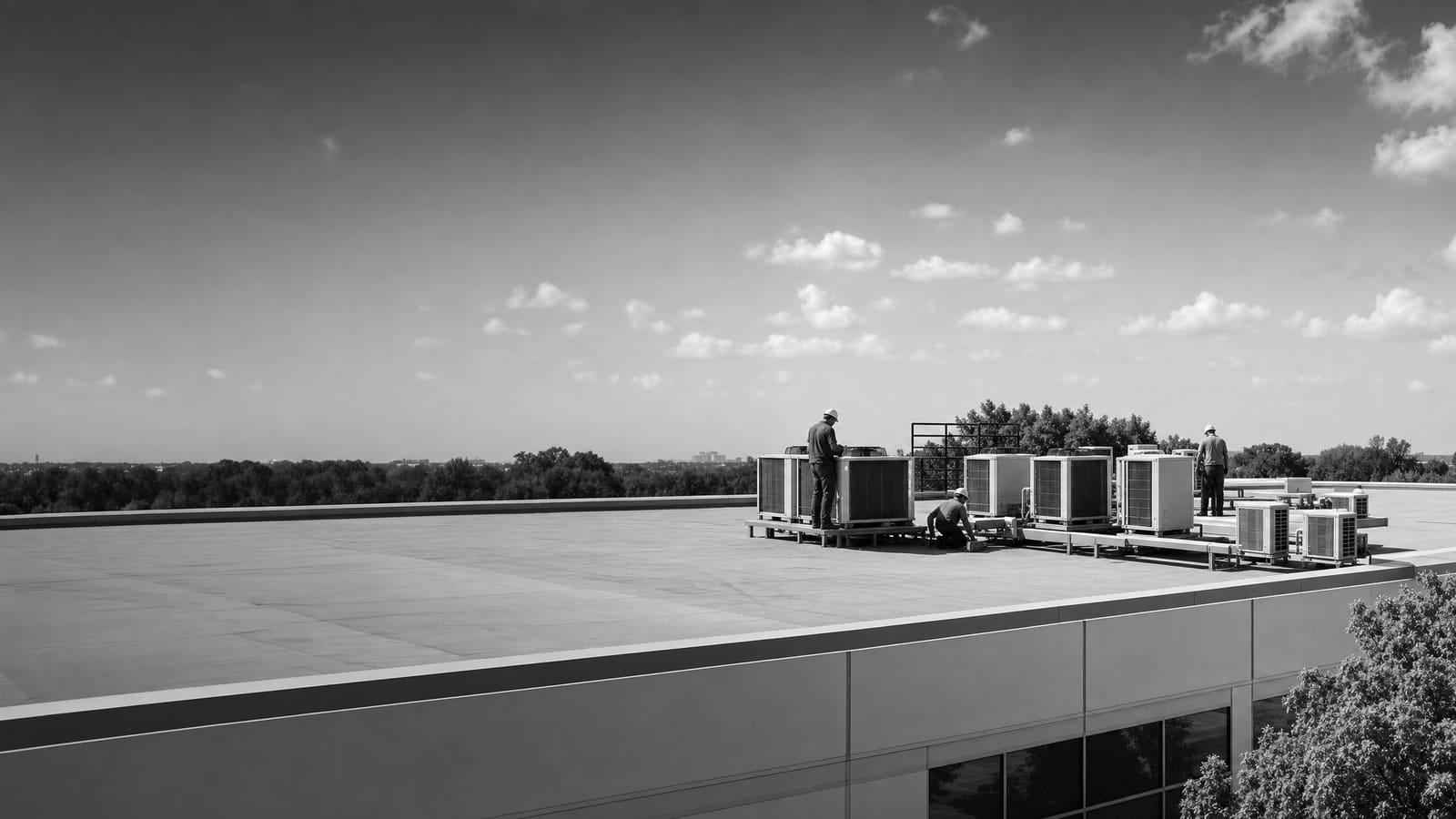
A commercial HVAC replacement confirms the load for how the building is used today, selects equipment against real lead times, handles the roof and rigging work, and commissions the system before handoff. Replacement generally beats another repair once a unit passes about fifteen years, which is where DOE puts the waste: an old, inefficient rooftop unit can burn $900 to $3,700 a year in energy alone. A repair never recovers that.
A site review still has to confirm the real load, the curb and roof condition, crane access, and available electrical capacity before any of that turns into a price for your building.
THE THREE PATHS
Replace like-for-like, convert, or fix the controls
Three paths cover most commercial replacements. The right one depends on what the building is asked to do now, not what it was doing when the old unit landed.
A like-for-like swap is the fastest return to service and the cheapest to engineer, but it carries forward whatever sizing error the old unit had. A heat pump rooftop unit adds reverse-cycle heating on a similar footprint; DOE treats heat pump and air-conditioning rooftop units as technologically similar, so the real decision sits in electrical capacity, gas line status, and how much winter heating the building needs. A controls retrofit is the option owners forget. DOE's rooftop work counts both full replacement and advanced-controls retrofits as legitimate outcomes, and on a unit with real service life left, controls can recover part of the waste without a crane day.
Confirm the load either way. Sizing from today's occupancy, plug loads, and envelope is what separates a replacement that fixes complaints from one that repeats them.
WHAT MOVES THE NUMBER
The lines that decide the price
Commercial HVAC pricing is assembled, not read off a table. These are the lines that move the total, ordered roughly by how far they swing between two buildings that look identical from the street.
HOW TO DECIDE
Price the unit you have, not just the one you want
The buying decision usually starts on the wrong question. Owners ask what a rooftop unit costs, when the number that actually decides the project is what the current unit costs to keep running. DOE puts the annual waste from an old, inefficient rooftop unit somewhere between $900 and $3,700 per unit — before you count emergency service calls, after-hours rates, and the tenant complaints that never make it onto an invoice. On a roof carrying six aging units, that arithmetic changes what a replacement is worth.
Age is the cleanest trigger. Units past fifteen years are where DOE says the waste concentrates, and the common failure in facility planning is waiting for one to quit. Replacement-on-failure removes every option worth having. You take whatever equipment is available, at whatever price, on whatever schedule the crane has open, usually in the middle of the season when the building can least afford the disruption.
The alternative is dull and effective. Survey what is on the roof, record nameplate age and tonnage, and rank the units by remaining life. That list turns a run of emergencies into a replacement schedule you control, and it gives you room to compare equipment on efficiency instead of on who can deliver by Friday.
SIDE BY SIDE
What makes one replacement simple and another slow
Two replacements at the same tonnage can differ by weeks of schedule and a wide margin of price. The difference is almost always what the unit connects to, not the unit itself.
LOWER COMPLEXITY
Same size, same connections
The existing curb fits or takes a standard adapter, tonnage is unchanged, the electrical service has headroom, and the crane can reach from an area you can close for one morning. Review stays in the mechanical and electrical lane.
HIGHER COMPLEXITY
New footprint or new fuel
Tonnage grows, the unit gets heavier, or gas heat becomes electric heat. Now you may add structural review, a panel or service upgrade, and a controls scope, each with its own review time before anyone lifts anything.
BEFORE YOU QUOTE
What a site review has to settle
A useful site review takes about an hour and settles most of what a quote cannot guess. The nameplate comes first: manufacturer, model, tonnage, refrigerant, and year. That one photo tells a contractor what curb they are dealing with and roughly what the replacement options are before anyone climbs.
Next is the roof itself. How the unit sits, whether the curb is original, what condition the surrounding membrane is in, and whether anything structural was documented the last time equipment changed up there. Roof warranty matters here. Cutting into a membrane under an active warranty needs the right contractor, and learning that after the crane is booked is an expensive way to find out.
Then electrical. Panel schedule, available capacity, and what else has been added to the building since the unit went in. DOE's heat pump guidance treats electrical capacity and physical constraints as gating items for conversions, and those two are what most often turn a straightforward swap into a two-phase project.
Last, your own schedule. Operating hours, tenant obligations, and the weeks you genuinely cannot have a crane in the lot.
Four things to have ready
The nameplate photo, a panel schedule, your roof warranty status, and the hours you can close part of the lot. With those four, a contractor can hand you equipment options and a real lead time instead of a placeholder.
OWNERSHIP QUESTIONS
Two things that outlive the install
Most of a replacement decision gets made in the weeks before the crane. Two questions, though, keep mattering long after the unit is running, and both are cheaper to settle now than in year three. One is what the new equipment does to how you service the rest of the roof. The other is who actually captures the savings you are paying for. Neither shows up on a quote, and both change what tier of equipment is worth buying.
SERVICE PLANNING
Refrigerant across a mixed roof
Ask which refrigerant the new unit uses and what that means for your service contract and spare parts on a roof of mixed vintages. Federal rules govern recovery and handling when the old unit comes down, so certified work is not optional.
LEASE STRUCTURE
Who captures the savings
If tenants pay the utility bill, the efficiency gain lands on their side of the ledger while the capital lands on yours. Worth resolving in the lease language before you spec a higher efficiency tier.
PHASING AND PROCUREMENT
Buying efficient equipment on a schedule you control
Efficient equipment stopped being exotic a long time ago. DOE's high-performance rooftop unit challenge asked manufacturers for units that cut energy use up to 50% against the standard of the day, and more than twenty models ended up exceeding that specification. The Advanced RTU Campaign that followed reported over 200 organizations upgrading more than 43,000 units, with combined reported savings of $37 million a year on energy bills. For a single building owner the point is narrower: the efficient tier is a catalog item, not a special order, so ask for it as a priced alternate rather than assuming it is out of reach.
Phasing is where multi-unit owners get the most leverage. Replacing four units across two fiscal years costs more in mobilization than doing them at once, but doing them at once may not fit your schedule or your capital plan. The middle path is to standardize. Pick one platform and one controls approach, then replace on a schedule. Every later unit gets cheaper to specify, service, and stock parts for.
Incentives can improve the math, and they change. If a utility program is part of your payback, confirm it is currently open and ask the program what has to be submitted before equipment is ordered.
THE QUOTE
Five things a comparable quote should show
Two quotes are only comparable when both spell out the same five things. If one is missing any of them, you are comparing a price to a guess.
01
Make, model, tonnage, and efficiency tier
Not "a new rooftop unit." The model number is what makes two numbers comparable.
02
Lead time next to the price
Availability belongs on the quote, along with what happens if the delivery date slips.
03
Roof and curb scope
Curb adapter, structural work, patching, and who carries the roof warranty afterward.
04
Rigging, permits, and inspections
Named as included or excluded. Crane day, lot closure hours, and inspection coordination.
05
Commissioning and documentation
Startup readings, charge, airflow, controls setpoints, and warranty registration handed over.
Get a defensible number
Price the equipment and the building together.
Send the address, operating target, and target opening date. Flux will identify what must be verified before the project can be priced.
Get a free estimateQuestions
Straight answers.
When does replacement beat another repair?
Look at age first. DOE flags rooftop units past about fifteen years as the ones wasting real money, with old inefficient units running $900 to $3,700 a year in avoidable energy cost. Once a unit is in that range and needing repeated attention, another repair buys time without recovering any of that annual waste.
How much does commercial HVAC installation cost in Wilmington?
There is no honest single number, because the price is assembled from tonnage, efficiency tier, curb and structural work, crane access, and any electrical changes. What you can price today is the other side: an old inefficient rooftop unit can waste $900 to $3,700 a year, which is what the replacement is measured against.
Should we switch a gas rooftop unit to a heat pump?
Heat pump rooftop units are technologically similar to air-conditioning units and mount in a similar way, so the decision usually turns on infrastructure rather than the equipment. DOE points at electrical capacity, physical constraints, gas line status, and local heating demand as the gating items. Heat pump efficiency falls as outdoor temperatures drop, so winter design conditions matter.
How long does a replacement take?
The crane portion is short compared with everything around it. Equipment lead time is the real variable, which is why availability belongs on the quote next to the price. Structural review, an electrical upgrade, or a controls scope each add their own review time, so confirm at the site visit whether any of those apply.
Is a controls retrofit a real alternative to replacing the unit?
Sometimes. DOE's rooftop unit work treats replacement and advanced-controls retrofits as two valid outcomes, and owners are told to choose whichever makes better financial sense. On a unit with genuine service life left, controls can recover part of the waste without a crane day. On a failing unit, it is money spent on a box you are about to remove.
Sources used for this guide
- [1]betterbuildingssolutioncenter.energy.gov — DOE Advanced Rooftop Unit Replacement Guidance
- [2]betterbuildingssolutioncenter.energy.gov — DOE Commercial Heat Pump Rooftop Unit Replacement Guidance
- [3]betterbuildingssolutioncenter.energy.gov — DOE High-Efficiency Commercial Rooftop Unit Toolkit
- [4]energy.gov — DOE Efficient Commercial Rooftop Air Conditioner Program
- [5]epa.gov — EPA Stationary HVAC Refrigerant Management