THE DIRECT ANSWER
What a commercial HVAC replacement actually includes
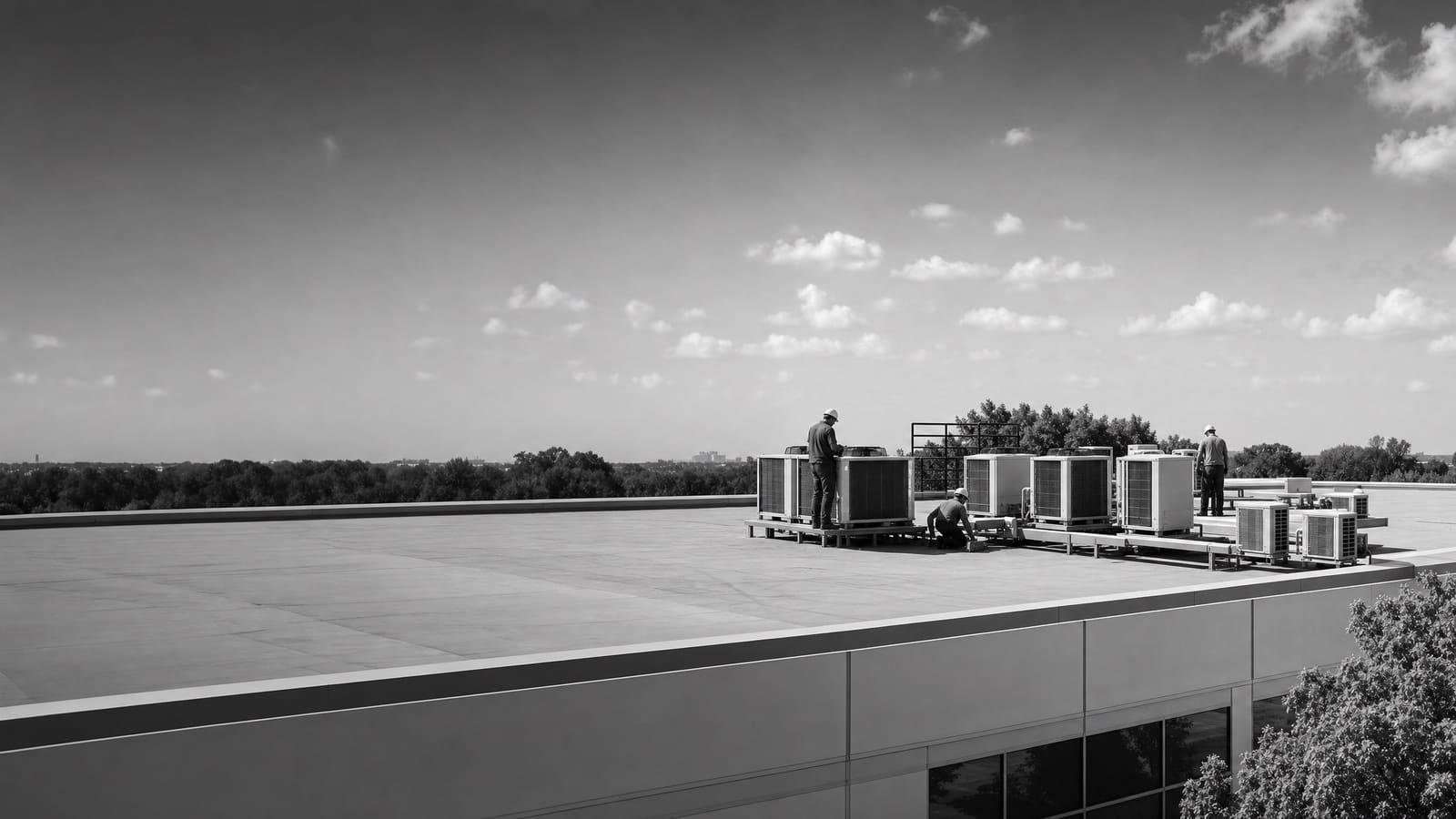
A commercial HVAC replacement covers the load calculation, the equipment order, certified refrigerant recovery and removal of the old unit, curb and structural work, electrical and gas connections, the crane set, and commissioning. Repair stops making sense once a unit is past fifteen years. Old, inefficient rooftop units waste $900 to $3,700 each per year, so a second compressor repair on a tired unit often costs more than it buys.
A site review still has to confirm tonnage against how the space is used today, whether the existing curb fits the new footprint, and whether the electrical service has capacity for the unit you actually want.
THREE WAYS TO PLAY IT
Replace on failure, replace on plan, or retrofit controls
Most buildings default to replace-on-failure: run the unit until it stops, then buy whatever is available that week. It is the most expensive version of the same purchase, because you lose the ability to shop efficiency tiers, negotiate lead times, or schedule the crane around your tenants.
The alternative is not always a new unit. On a unit that still has usable life and a sound cabinet, retrofitting advanced controls can capture real savings for a fraction of a replacement. The right answer is whichever makes better financial sense for that specific unit, and that is a per-unit question, not a per-building one.
Proactive replacement with a high-efficiency unit is the third path. High-efficiency rooftop specifications were built to cut energy use by up to half against the older baseline, and that gap is what makes a planned swap pay back rather than just restore cooling.
WHAT MOVES THE NUMBER
The lines that decide your installed price
No two rooftop replacements price the same, and the unit itself is rarely the line that surprises anyone. These are the items that move an installed number the most, roughly ordered by how much they tend to vary between one building and the next.
IN PRACTICE
Choosing between gas heat, dual fuel, and all-electric
The bigger fork in a replacement today is not the brand on the cabinet. It is whether the new unit heats with gas, with a heat pump, or with both.
Heat pump rooftop units are close cousins of the air-conditioning units already on most commercial roofs, with the added ability to run the cycle backward for heat. Their heating efficiency falls as the outdoor temperature drops, and in a hard cold snap it trends toward the same efficiency as electric resistance. That makes them best suited to mild-to-moderate winter heating. Across most of the South and West, current heat pump rooftop units can cover most or all of the winter heating demand a commercial building sees. The February 2021 Texas freeze is the counterexample worth keeping in mind: southern climates can still produce short stretches of sharp heating demand.
That is why dual fuel exists. A dual fuel unit runs the heat pump through the mild hours and hands off to gas when the heat pump stops being efficient. If the building has gas service and cannot tolerate a cold morning, dual fuel is usually the lower-risk answer. If the gas line is already a liability or the building is targeting all-electric, the all-electric unit is on the table — provided the electrical service can carry it.
SCOPE CHECK
What makes a swap simple, and what makes it a project
Two replacements on the same street can be a one-morning job and a six-week project. The difference is almost never the tonnage. It is how much the new unit asks the building to change.
LOWER COMPLEXITY
Same size, same fuel, same curb
The replacement matches tonnage and fuel, the existing curb takes an adapter, and the electrical service is untouched. The lot has clear crane reach and the controls carry over. The visible work is one morning, and tenants notice the cones more than the outage.
HIGHER COMPLEXITY
New footprint, new fuel, tight access
Tonnage or footprint grows, the curb needs structural review, or the unit switches to all-electric and the panel has to be verified. Add a tight lot, an occupied building, or a phased multi-unit rollout, and the schedule rather than the equipment becomes the hard part.
BEFORE THE QUOTE
What a real site review has to settle
A quote written from a nameplate photo is a placeholder. It is useful when a unit is down in season and you need options today. It is not a number to sign a capital project against.
The site review exists to answer the questions that actually price the job. Start with load: sizing should come from how the space is used now, not from what the last contractor installed twenty years ago. Occupancy, plug loads, lighting, and envelope all changed in that time, and carrying a bad size forward guarantees the same comfort complaints on new equipment.
Then the infrastructure. Electrical capacity is the most common surprise on an all-electric conversion, so the panel, the feeder, and the available service get checked before the equipment is specified. Physical constraints come next: curb dimensions, roof structure, clearances, and whether a crane can actually reach the spot. Gas lines get a decision — kept, capped, or removed.
Finally, the old unit. Refrigerant does not simply get hauled away. Federal rules govern how it is recovered and handled when equipment is serviced or taken out of service, and that recovery belongs in the installer's scope.
Ask for the review before the price
A walk that does not include the electrical panel, the curb dimensions, and the crane path has not priced your job — it has priced an average building. Any one of those three can move the number more than the unit itself does.
OWNERSHIP AND OPERATIONS
Two things that outlive the install
The install takes a week of your attention. The decisions inside it set your operating cost and your service exposure for as long as the unit runs, so the parts that never show up on the invoice are worth a little time.
Two of them matter more than the rest. The first is who actually pays — the split between owner and tenant on capital equipment is a lease question, and it changes which efficiency tier is worth buying. The second is who can service what you bought. Contractor availability and familiarity with the technology is a standard part of this decision for a reason: a unit nobody in your rotation has commissioned before is a slower repair every time it faults.
LEASE STRUCTURE
Who pays capital, who pays power
If the tenant pays the utility bill and you buy the equipment, the efficiency upgrade spends your money and saves theirs. Many commercial leases allow some recovery. Settle that before you pick the tier, not after the unit is on the roof.
SERVICEABILITY
Who can work on it at six in the morning
Familiarity with the equipment is a real selection criterion. A heat pump or dual fuel unit your service rotation has never commissioned turns every fault into a learning call. Check that coverage exists before you standardize a whole fleet on it.
THE LONG VIEW
Phasing a fleet and counting the whole cost
If you own several rooftop units, they will not fail politely one at a time. Buildings that have run the same equipment since the same build-out tend to reach end of life together, which is how a facility ends up replacing four units in one bad summer at emergency pricing.
The way out is a per-unit condition list and a phased order. Rank the units by age, fault history, and what each one costs to run, then replace the worst one or two per budget cycle, ahead of the season rather than inside it. Old, inefficient units waste $900 to $3,700 each per year, so the unit at the top of that list is already paying for part of its own replacement.
Procurement deserves the same attention. Incentives are a standard part of this math — utility and program incentives for high-efficiency rooftop equipment exist in many markets, and they change. Confirm what is actually open and funded before you build one into a budget, because a program that paid out last year may be closed or fully subscribed this year. Get the equipment quote and the incentive status at the same time, and order early enough that lead time stays a planning number instead of an emergency.
APPLES TO APPLES
Five things a comparable quote has to show
Two quotes for the same roof can differ by a wide margin and both be honest, because they scoped different work. These five lines make quotes comparable. When one is missing, it is usually the one that comes back later as a change order.
01
Tonnage, fuel type, and efficiency tier
The exact model and rating, not just a size. The tier is what separates a cheap quote from a cheap operating cost.
02
Equipment availability and lead time
A delivery window in writing, next to the price. Availability is a term of the deal, not a footnote.
03
Curb, structural, and rigging scope
Who supplies the adapter, who verifies the roof, and who pays for the crane and the lot closure.
04
Electrical, gas, and controls work
Every connection change named, including panel work and building automation integration.
05
Commissioning and old-unit disposal
Verified startup with documented charge and airflow, plus certified refrigerant recovery and removal.
Get a defensible number
Price the equipment and the building together.
Send the address, operating target, and target opening date. Flux will identify what must be verified before the project can be priced.
Get a free estimateQuestions
Straight answers.
When is replacing a rooftop unit better than repairing it again?
Once a unit is past fifteen years, energy waste usually outruns repair value. Old, inefficient rooftop units cost $900 to $3,700 each per year in wasted energy alone. Two more repairs on a unit that old often cost more than the head start a new one buys.
Should a Wichita Falls building choose a heat pump or stay with gas?
Heat pump rooftop units suit mild-to-moderate winter heating, and across most of the South and West today's units can cover most or all of a commercial building's winter demand. Their efficiency falls in a hard freeze, which is why dual fuel is the common middle path when the building already has gas service.
What usually blows up the budget on an all-electric conversion?
Electrical capacity. All-electric and heat pump units can ask for more service than the existing panel and feeder provide, and a service upgrade is effectively a second project. It gets checked during the site review, before the equipment is specified.
Do I have to replace every rooftop unit, or can I upgrade what I have?
It is a per-unit call. When the cabinet and coil are still sound, retrofitting advanced controls captures part of the savings for a fraction of the capital. The right choice is whichever makes better financial sense for that specific unit.
What happens to the refrigerant in the old unit?
It is recovered, not vented. Federal rules govern how refrigerant is handled when equipment is serviced or taken out of service, and that recovery is part of the installer's scope. Confirm it appears on the quote rather than assuming it.
Sources used for this guide
- [1]betterbuildingssolutioncenter.energy.gov — DOE Advanced Rooftop Unit Replacement Guidance
- [2]betterbuildingssolutioncenter.energy.gov — DOE Commercial Heat Pump Rooftop Unit Replacement Guidance
- [3]betterbuildingssolutioncenter.energy.gov — DOE High-Efficiency Commercial Rooftop Unit Toolkit
- [4]energy.gov — DOE Efficient Commercial Rooftop Air Conditioner Program
- [5]epa.gov — EPA Stationary HVAC Refrigerant Management