THE SHORT ANSWER
What a commercial HVAC replacement actually covers
A commercial replacement covers the load calculation, equipment selected against real lead times, the curb and roof work the new unit needs, the crane set, and commissioning that proves the system performs to spec. Replacement usually beats another repair once a rooftop unit passes fifteen years, because old, inefficient units waste roughly $900 to $3,700 each in energy every year. That money leaves whether or not the compressor holds.
A site review has to confirm roof structure, curb footprint, available electrical capacity, and existing gas service before any price holds. Those four answers decide whether the swap is simple or engineered.
THREE PATHS
The replacement decision, narrowed to three options
Most commercial replacements come down to three paths, and the right one is usually decided by what changed in the building since the last unit went up.
If nothing changed — same tenant, same hours, same layout — a like-for-like swap is honest and fast. If occupancy, plug load, or lighting changed, the old nameplate is the wrong starting point, and a recalculated load fixes comfort complaints no service visit ever solved.
The third path is the one quotes keep raising now. Heat pump rooftop units are built like conventional rooftop air conditioners but add reverse-cycle heating, and they come in dual-fuel, all-electric, and cold-climate versions. Heat pump heating efficiency falls as outdoor temperature drops, so the fit depends on your winter design temperature, your electric and gas rates, and whether the roof has the electrical capacity for the change. Ask for a conventional and a heat pump option priced side by side, then let the numbers decide instead of the category.
WHAT MOVES THE NUMBER
The lines that decide your installed price
There is no single installed price for a commercial rooftop replacement, because the equipment is only part of the number. These are the lines that move it, roughly in the order they move it. Ask every bidder to show each one separately so the comparison is real.
IN PRACTICE
Choosing the equipment before the crane is booked
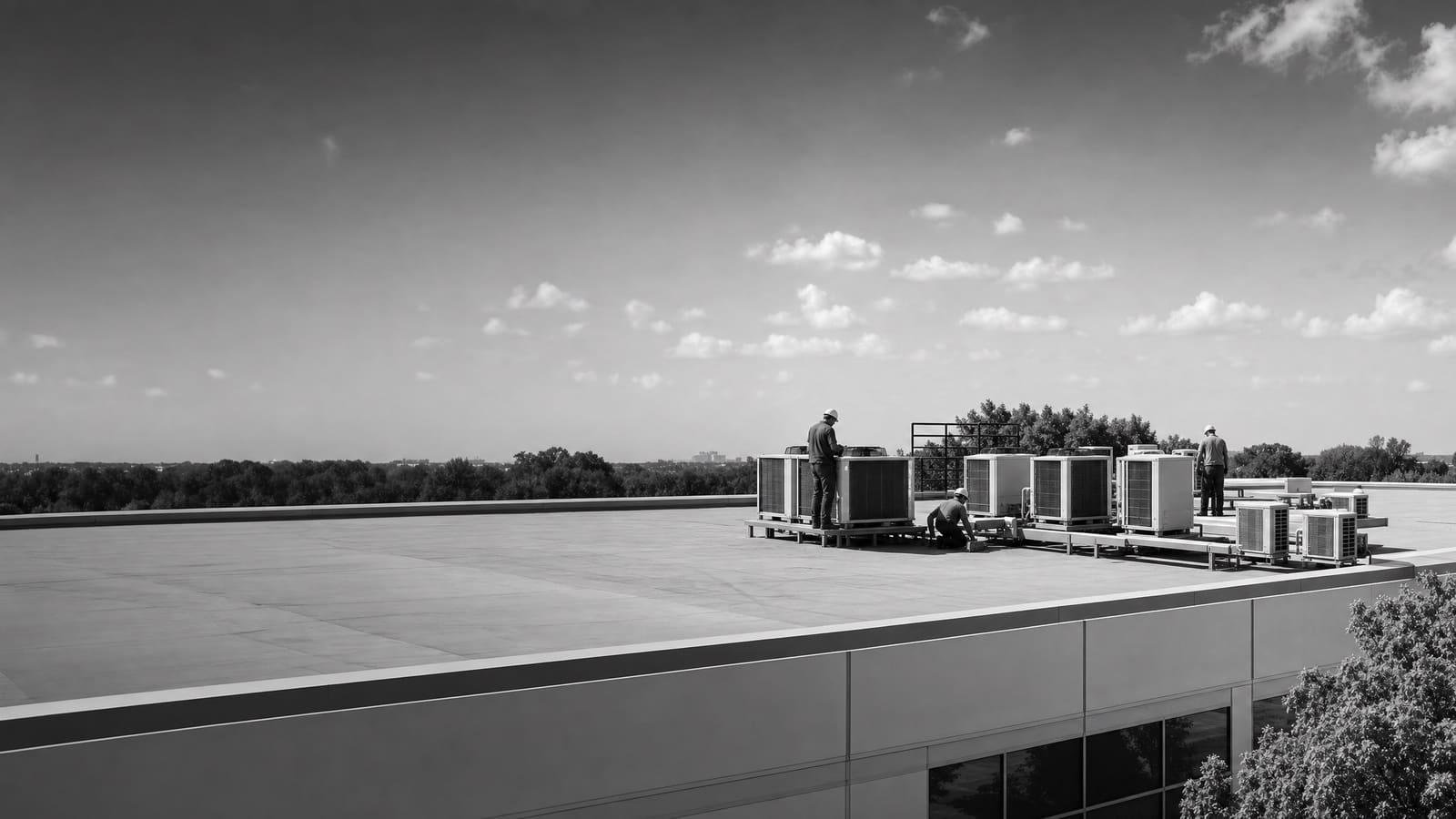
Rooftop units cool close to half of all commercial floor space in the country, so most replacement decisions are rooftop decisions. That is good news, because rooftop replacement is one of the better-understood projects in a building. The trap is treating it as a purchase instead of a design step.
The most common mistake is ordering off the old nameplate. Twenty years of tenant changes, lighting retrofits, and new plug load can move the real requirement a full tonnage step in either direction. Oversizing shows up as short cycling, weak dehumidification, and comfort complaints no service call ever fixes. Undersizing shows up on the hottest afternoon of the year, once, in front of everyone.
The second mistake is waiting for failure. Facility managers often delay until a unit no longer conditions the space, needs constant service, or quits entirely. Replacing on failure removes every option that saves money: you take whatever is in stock, at whatever price, on whatever schedule a crane company can offer. A planned replacement lets you compare efficiency tiers, weigh a heat pump against a conventional unit, and set the lift for a Saturday instead of a Tuesday at noon.
SIDE BY SIDE
Why the same tonnage prices differently
The same size unit can be a one-morning job on one roof and a three-week project on another. What separates them is rarely the equipment itself.
LOWER COMPLEXITY
Straight swap, same footprint
Same fuel and tonnage, the existing curb reused with an adapter, clear crane reach from the lot, and no change to the electrical service. Permitting stays mechanical and electrical, and the building notices one closed row of parking.
HIGHER COMPLEXITY
New footprint or new fuel
Larger tonnage, added weight, a move from gas heat to all-electric, or a roof a crane cannot reach cleanly. Structural review, service upgrades, and phased night work all enter, and the longest of them sets the schedule.
BEFORE YOU PRICE IT
What a real site review has to confirm
A quote written from a photo is a placeholder. A quote you can sign comes after someone stands on the roof.
The review should confirm the load first — occupancy, operating hours, plug load, and envelope as they are today, not as the original design assumed. Then the physical constraints: curb size and condition, roof structure under the new weight, service clearance around the unit, and whether a crane can actually reach the position from somewhere a truck can legally park.
Infrastructure comes next, and it is where projects change shape. Available electrical capacity decides whether an all-electric or dual-fuel option is even on the table. Existing gas service decides the same question from the other side. Duct routing, curb offsets, and adjacent equipment often rule out a model that looked perfect on the datasheet.
Last is the part buyers forget to ask about: who on the crew has installed the equipment being proposed. Heat pump rooftop units in particular reward crews that have commissioned them before, because startup, defrost behavior, and controls setup do not match a conventional unit.
Four answers before the order goes in
Confirmed load, curb and structural fit, available electrical capacity, and a quoted lead time for the exact model. If a bidder cannot give you all four, what you are holding is an estimate, not a quote.
AFTER THE LIFT
Two things that follow the unit for years
Two items follow a new unit for the rest of its life, and both are easier to settle before the crane shows up than after.
The first is refrigerant. Federal rules govern how refrigerant is handled and recycled in stationary air conditioning and heat pump equipment, which makes recovery during removal regulated work rather than a courtesy. The second is what happens to your service program once the roof carries two generations of equipment. Neither one changes day-one comfort. Both change your maintenance contract, your parts stock, and what a technician needs on the truck when a call comes in.
COMPLIANCE
Refrigerant is regulated work
EPA rules under the Clean Air Act cover the handling and recycling of refrigerant in stationary cooling and heat pump equipment. Ask who performs recovery on the old unit and how it appears in your closeout package.
OPERATIONS
Plan for a mixed fleet
Confirm which refrigerant the new unit uses and whether your service contract and spare parts strategy already cover it. A roof running two refrigerants is manageable, but only when the plan is written down.
OVER THE LIFE
Phasing a roof full of aging units
Few buildings have one unit. Most have a row installed the same year, which means they age out the same year too. The real choice is whether to replace them one emergency at a time or on a schedule you control.
Phasing works because it turns a capital event into a plan. Group the units by age and condition, replace the worst performers first, and standardize on one or two models so parts, controls, and crew familiarity carry across the whole roof. One crane mobilization covering two or three units usually costs less per unit than three separate ones.
The arithmetic favors moving early more often than owners expect. Old, inefficient rooftop units waste somewhere between $900 and $3,700 apiece every year, and a unit past fifteen years is usually somewhere in that band. Multiply that by the number of tired units on your roof, then by the years you plan to hold the building. The cost of waiting becomes visible in a hurry, and that number belongs next to the installed price in every replacement decision, because it is the price of doing nothing.
COMPARE THE BIDS
Five things a comparable quote should show
Two quotes are only comparable when both show the same five things. If one bidder shows them and another does not, you are not looking at a price difference. You are looking at a scope difference.
01
The unit, specifically
Tonnage, efficiency tier, fuel type, and model number, so two bids line up item for item.
02
Lead time in writing
Quoted availability for that exact model, plus what happens to your schedule and price if it slips.
03
Curb and structural scope
Adapter or new curb, roof patching, and any structural work the change in footprint or weight triggers.
04
Rigging and site plan
Crane size, lot closure hours, and who coordinates tenants, parking, and building access on the day.
05
Commissioning and closeout
Startup readings, airflow and charge verification, controls setup, permits, inspections, and warranty registration.
Get a defensible number
Price the equipment and the building together.
Send the address, operating target, and target opening date. Flux will identify what must be verified before the project can be priced.
Get a free estimateQuestions
Straight answers.
When does replacement beat one more repair?
Once a rooftop unit passes about fifteen years, repairs usually buy time rather than performance. Old, inefficient units waste roughly $900 to $3,700 each per year in energy, and that loss continues between service calls. If the unit already struggles to hold the space or needs frequent attention, the repair is the more expensive option.
Should we replace like-for-like or recalculate the load?
Confirm the load either way. If the tenant, hours, and layout are unchanged, like-for-like is often the right call and the fastest path back to service. If occupancy, plug load, or lighting changed since the original install, the old nameplate carries forward a sizing mistake you will live with for another twenty years.
Is a heat pump rooftop unit worth considering?
It is worth pricing. Heat pump rooftop units are built much like conventional rooftop air conditioners but add reverse-cycle heating, in dual-fuel, all-electric, and cold-climate versions. Heating efficiency drops as outdoor temperature falls, so the answer depends on your winter design temperature, your electric and gas rates, and available electrical capacity.
What most often surprises a replacement budget?
Electrical capacity and curb work. An all-electric option can outgrow the existing panel or feeder, and a different footprint brings an adapter, roof patching, and sometimes a structural review. Both are knowable during the site review, which is why a price written from a nameplate photo should be treated as a starting point.
How do we avoid replacing on failure?
Group the units on your roof by age and condition, then plan replacements a year or two ahead of expected end of life. Planning preserves your options: efficiency tier, heat pump versus conventional, a scheduled lift, and a combined crane mobilization across several units instead of three separate emergency calls.
Sources used for this guide
- [1]betterbuildingssolutioncenter.energy.gov — DOE Advanced Rooftop Unit Replacement Guidance
- [2]betterbuildingssolutioncenter.energy.gov — DOE Commercial Heat Pump Rooftop Unit Replacement Guidance
- [3]betterbuildingssolutioncenter.energy.gov — DOE High-Efficiency Commercial Rooftop Unit Toolkit
- [4]energy.gov — DOE Efficient Commercial Rooftop Air Conditioner Program
- [5]epa.gov — EPA Stationary HVAC Refrigerant Management