THE SHORT VERSION
What a commercial HVAC replacement includes
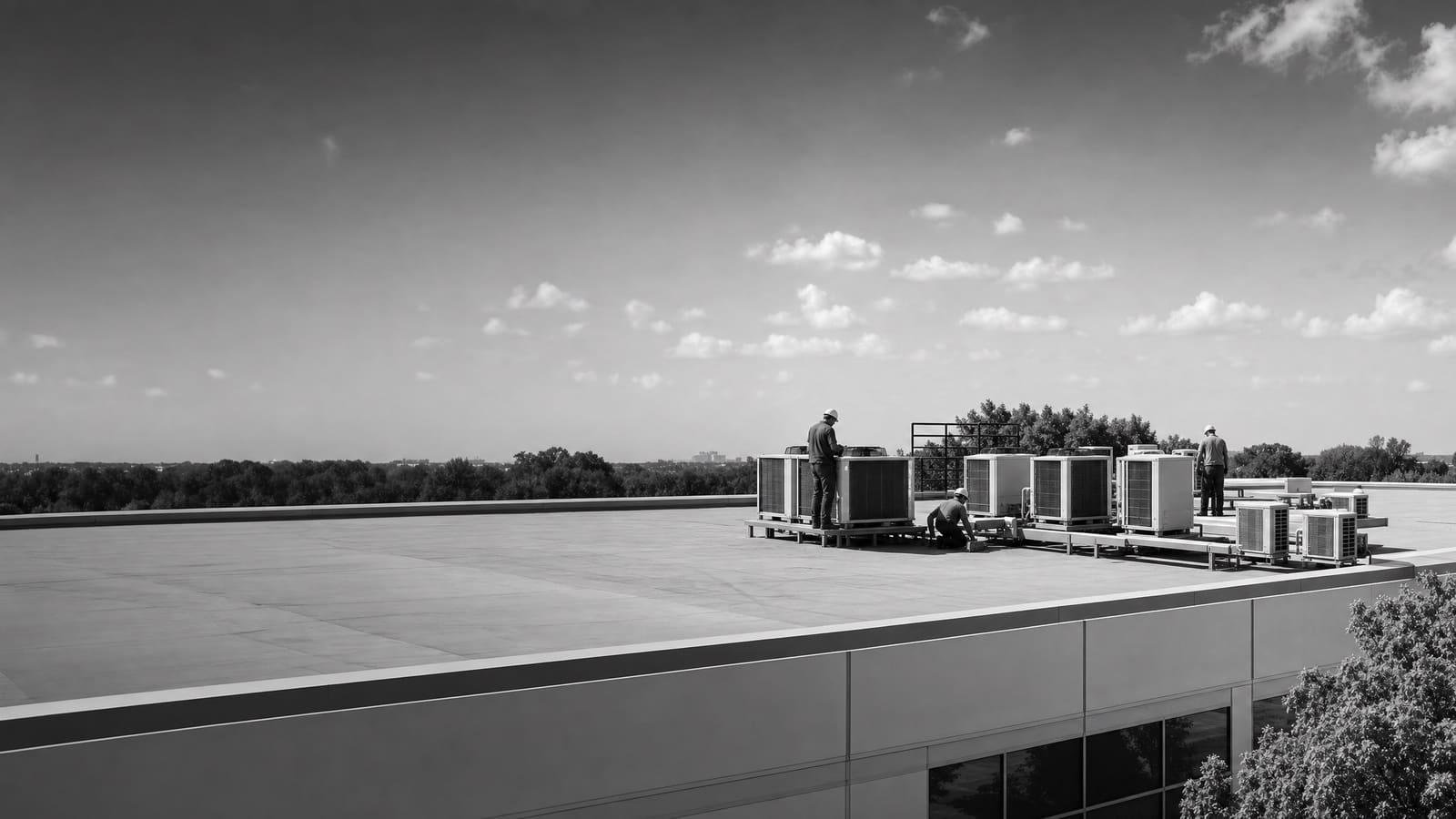
A commercial HVAC replacement covers load confirmation, equipment selection, rigging and the crane set, curb or curb adapter work, gas, electrical and refrigerant connections, controls, permits, and commissioning. Replacement usually beats another repair once a rooftop unit passes 15 years. DOE puts the waste from old, inefficient rooftop units at roughly $900 to $3,700 per unit each year, and a second compressor on a twenty-year-old cabinet rarely earns that back.
A site review still has to confirm the real load against today's occupancy, the curb and roof structure, available electrical capacity, and crane reach before any number is worth holding someone to.
THREE PATHS
The three replacements most buildings choose between
Most Westminster replacements land on one of three paths. The old cabinet decides less than people expect. What usually decides is your fuel, your electrical room, and how long you plan to hold the building.
Rooftop units condition close to half of all U.S. commercial floor area, so this is a well-mapped decision. DOE frames it as a short set of questions: does the site have the electrical capacity, does the climate support heat pump heating, and does the schedule allow anything other than a same-curb swap. For the West, DOE finds today's heat pump rooftop units capable of covering most or all of the winter heating demand, which puts the all-electric option genuinely on the table here rather than as a stretch.
None of the three is the wrong answer. The wrong move is picking one before someone has opened the electrical panel and measured the curb.
WHAT MOVES THE NUMBER
The lines a replacement price is built from
Nobody can quote a commercial rooftop replacement from a phone call, because the number is assembled from these lines rather than pulled from a table. Ask which of them your building actually triggers before you compare two bids.
BUYING IT WELL
How to buy the replacement instead of just approving it
The most useful thing a buyer can do is decide on purpose whether this is a planned replacement or a replacement on failure. DOE is blunt about the difference. Waiting until a unit no longer conditions the space, needs constant service, or dies outright is the expensive path, and it usually forces a like-for-like swap because there is no time left for anything else. Planning the change while the old unit still runs is what buys you the option to right-size or switch fuel.
The second thing is to size against the building you have now. A twenty-year-old nameplate describes a building with different occupancy, different plug load, and often a different envelope. Carrying that number forward carries the original sizing mistake forward with it.
The third is to treat availability as part of the price. Equipment tier, refrigerant, and configuration all move lead time, and a unit that lands six weeks late costs more than the line item you saved choosing it. Ask for the delivery date in writing, next to the number.
COMPLEXITY CHECK
What makes this simple, and what does not
Two buildings can need the same tonnage and still be very different projects. Complexity comes from access, infrastructure, and how much has to change at once, not from the size of the unit.
LOWER COMPLEXITY
Same fuel, same curb, open lot
The new unit fits the existing curb, gas and electrical stay as they are, and a crane can set up in the parking lot. The permit path is straightforward and the work on the roof is short.
HIGHER COMPLEXITY
Fuel switch, tight site, occupied building
Going all-electric adds an electrical capacity question. A tight lot, a shared drive, or a taller neighboring building adds crane engineering. An occupied tenant space adds night or weekend hours and a phasing plan.
BEFORE THE QUOTE
What a site review has to settle
A quote is only comparable if the person writing it has been on your roof. DOE's adoption checklist for rooftop replacement asks a short set of questions, and they map almost exactly onto what a good walk should produce.
Electrical capacity comes first, because it can rule out an option outright. If the panel has no headroom, an all-electric unit turns into a service upgrade project and the whole comparison changes. Physical constraints come next: curb dimensions, roof structure, clearance around the unit, and whether a crane can reach from anywhere it can legally sit. Gas is third, meaning whether the line stays, gets capped, or has to move.
Then the softer ones. Equipment availability sets your schedule. Contractor familiarity with the specific technology matters more on heat pump equipment than on a straight cabinet swap. And incentives, where they apply, generally have to be confirmed and often pre-approved before equipment is ordered, not after it lands on the roof.
A walk that answers those questions produces a number you can hold someone to.
The one question that changes everything
Does the building have the electrical capacity for an all-electric unit? Answer that before comparing bids. It decides whether you are looking at three real options or one, and it is the cheapest question to answer early.
IN WESTMINSTER
Permits, roof sequencing, and mild winters
California building departments issue a dedicated HVAC permit, and the same application scope commonly covers mechanical, electrical, and plumbing upgrades or repairs alongside re-roofing. That grouping is the practical detail worth planning around.
If your roof is within a few years of replacement, sequence it with the unit. Setting a new rooftop unit on a membrane you intend to tear off means paying for the same crane day, the same curb detail, and the same tenant disruption twice. Doing both under one plan is almost always cheaper than doing them in whatever order an equipment failure dictates.
On the equipment side, Westminster sits in the region DOE describes as well suited to heat pump rooftop units, where mild winters let them cover most or all of the heating demand.
Pull the permit before the crane is booked
Mechanical replacement is permitted work, and on a fast job inspection timing drives the schedule more than the equipment does. Confirm the permit path and any electrical permit at the same time, not after the unit ships.
OWNERSHIP AND OPERATIONS
Who holds the asset changes the answer
Two buildings can need the same unit and still deserve different equipment. What separates them is usually the lease and the fleet.
A five-year hold and a twenty-year hold justify different efficiency tiers, because the payback window is not the same. A single-unit building and a twelve-unit portfolio behave differently too. Across a portfolio, standardizing on one platform makes parts, controls, and service contracts simpler, and it lets you stage replacements across budget years instead of absorbing them all at once. DOE writes its rooftop guidance for portfolio owners for exactly this reason: the decision is rarely about one roof.
LEASE STRUCTURE
Who pays the energy bill
If tenants pay utilities and you buy the equipment, the efficiency upgrade saves someone else money. That is not a reason to skip it, but it should shape which tier you approve and how the lease treats the improvement.
FLEET STRATEGY
One roof or twelve
Mixed fleets get expensive to service, especially as refrigerants change across model years. Standardizing the next few replacements on one platform lowers long-run cost more than any single unit's efficiency rating will.
OVER THE LIFE OF THE ASSET
Phasing, procurement, and what the unit costs after year one
The purchase price is the part everyone negotiates and the smallest part of what the unit costs you. DOE puts the waste from a single old, inefficient rooftop unit somewhere between $900 and $3,700 a year. Multiply that across a fleet and the annual bleed is often larger than the replacement budget you have been deferring.
DOE's Advanced RTU Campaign is the clearest evidence this pencils out at scale. More than 200 organizations upgraded over 43,000 rooftop units and cut a combined $37 million a year from their energy bills. Those were largely planned replacements, not emergencies.
Procurement follows from that. Federal minimum efficiency standards for commercial rooftop units were finalized in 2015, so anything you buy today already clears a floor a twenty-year-old unit never met. The real question is how far above that floor to go. And phasing beats crisis: pick the two or three worst units, replace them on your schedule in a shoulder season, and let the program run across budget years instead of running you.
COMPARING BIDS
Five things a comparable quote shows
When two quotes differ by a lot, one of these five is usually missing from the cheaper one. Ask for all five in writing before you compare anything.
01
Tonnage, efficiency tier, and model number
Not just "replace RTU-3." The specific unit, so two bids can actually be set side by side.
02
Equipment lead time and delivery date
A written date, not "in stock." Availability is part of the price on every job.
03
Curb, structural, and rigging scope
Curb adapter, any roof work, crane size, and lot closure time, priced as line items.
04
Utility connections and permits
Gas, electrical, refrigerant lines, and who pulls the permits and meets the inspector.
05
Startup and commissioning documentation
Charge, airflow, and control settings verified against spec and handed to you in writing.
Get a defensible number
Price the equipment and the building together.
Send the address, operating target, and target opening date. Flux will identify what must be verified before the project can be priced.
Get a free estimateQuestions
Straight answers.
When does replacement beat one more repair?
Past about 15 years, the math usually turns. DOE reports that old, inefficient rooftop units waste roughly $900 to $3,700 per unit each year, and a major component repair on a unit that old buys time rather than performance. If the unit is also struggling to hold the space, that is the signal to plan a replacement instead of funding another season.
Should you keep gas heat or go all-electric?
Electrical capacity decides it more often than preference does. If the panel has headroom, a heat pump rooftop unit is a real option here, since DOE finds today's units capable of covering most or all of the winter heating demand across the West. If capacity is tight, a dual-fuel unit or a high-efficiency gas-heat unit keeps the project from turning into a service upgrade.
Do you need a permit to replace a rooftop unit?
Yes. California building departments issue an HVAC permit covering mechanical work, and the same scope typically includes electrical and plumbing upgrades or repairs. Confirm the permit path and inspection timing early, because on a fast replacement that schedule matters more than the equipment date.
How much does commercial HVAC installation cost?
There is no honest universal number, because the price is assembled from tonnage and efficiency tier, curb and structural work, crane access and lot closure, utility connections, and permits. What can be said before a walk is which of those lines your building triggers. Ask any bidder to price them separately so two quotes can actually be compared.
What happens to the refrigerant in the old unit?
EPA regulations under Section 608 of the Clean Air Act govern how refrigerant is handled and recovered from stationary air conditioning and heat pump equipment. It is recovered by a certified technician, not vented. Treat it as a fixed, predictable line on the quote rather than a variable.
Sources used for this guide
- [1]betterbuildingssolutioncenter.energy.gov — DOE Advanced Rooftop Unit Replacement Guidance
- [2]betterbuildingssolutioncenter.energy.gov — DOE Commercial Heat Pump Rooftop Unit Replacement Guidance
- [3]betterbuildingssolutioncenter.energy.gov — DOE High-Efficiency Commercial Rooftop Unit Toolkit
- [4]energy.gov — DOE Efficient Commercial Rooftop Air Conditioner Program
- [5]epa.gov — EPA Stationary HVAC Refrigerant Management
- [6]californiacity-ca.gov — HVAC Permits