THE SHORT VERSION
What a commercial HVAC replacement actually covers
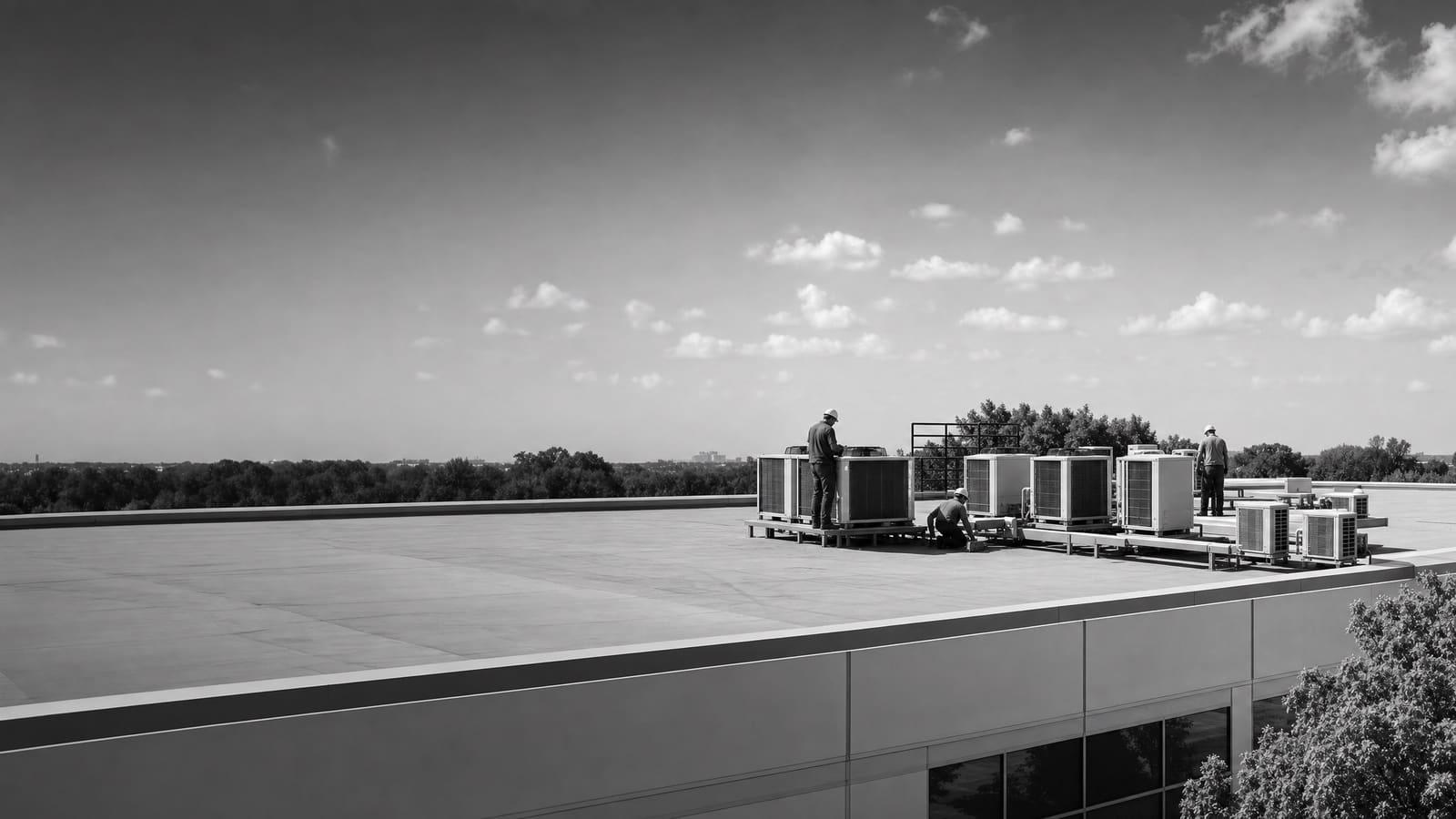
A commercial HVAC replacement covers the load check, equipment selection against real lead times, refrigerant recovery from the old unit, the crane set and curb adapter, gas and electrical connections, controls, and commissioning. Replacement beats another repair once a rooftop unit is past about fifteen years, needs repeat in-season service, or can no longer hold the space. Old, inefficient rooftop units can waste roughly $900 to $3,700 per unit each year — money a planned swap stops spending.
A site review has to confirm the real load, the existing curb and roof structure, panel capacity, gas service, and crane access before any of that turns into a price.
THE REAL CHOICE
Three equipment paths for the same roof
Most commercial replacements now come down to three equipment paths, and the right one depends on the building, not on fashion. Rooftop units cool close to half of all commercial floor area in the country, so this is the decision most facility owners are actually making. Heat pump rooftop units are built much like the air-conditioning units they replace, but they add reverse-cycle heating. What separates them in practice is winter heating demand, the price of electricity against gas at your meter, and whether the building's electrical service can carry more load. Heat pump efficiency drops as outdoor temperatures fall, moving toward the same performance as electric resistance heat on the coldest days, so cold-weather sites lean on dual fuel or on cold-climate equipment rather than a standard heat pump. Compare all three on installed scope, not on sticker price alone.
WHAT MOVES THE NUMBER
The lines that decide your installed price
There is no honest per-ton price that covers every building, because the equipment is only part of the invoice. These are the lines that move a commercial HVAC installation number the most, ranked roughly by how much they vary from one roof to the next.
BUYING GUIDANCE
Replace on your schedule, not the equipment's
Waiting for a rooftop unit to quit is the most expensive way to buy one. When a unit fails in season, the schedule picks the equipment: whatever is available regionally goes on the roof, efficiency tier and all. Replacing an inefficient or underperforming unit before it dies is usually the better business move, and it often beats a like-for-like swap at the end of service life too.
The second decision is sizing. A twenty-year-old nameplate describes a building that no longer exists. Occupancy patterns, plug loads, lighting, and envelope work all change the load, and carrying the old tonnage forward carries the old comfort complaints forward with it. Confirm the load against how the space is used today, then decide whether like-for-like or a resize is the right answer.
The third is efficiency tier. A federal performance push produced rooftop units designed to cut energy use by up to half against the standard in force at the time, and more than twenty models now exceed that specification. In one national upgrade campaign, participating organizations replaced or retrofitted more than 43,000 units and saved a combined $37 million a year on energy. Your building will not see campaign-scale numbers, but the mechanism is the same: the tier you pick shows up on every bill for the rest of the unit's service life.
SCOPE CHECK
What makes one replacement simple and another complicated
Two buildings can run the same tonnage and land in very different price ranges. The difference is almost never the box. It is what the box needs from the roof, the panel, and the fuel service in order to work where it is going.
LOWER COMPLEXITY
Same footprint, same fuel
The replacement matches the existing curb or takes a standard adapter, the roof structure carries it, gas and electrical service are already sized, and the crane has clear reach from the lot. Permits stay mechanical and electrical, and the set happens in a morning.
HIGHER COMPLEXITY
New footprint or new fuel path
The unit is larger or heavier, the curb needs framing, or the switch to all-electric heating needs panel and feeder capacity the building does not have yet. Add limited crane access or a multi-unit roof and it becomes a phased job with structural review.
SITE REVIEW
What the walkthrough has to confirm before a number means anything
A quote that arrives before anyone climbs the ladder is a guess with a number attached. The review starts at the nameplate: model, tonnage, refrigerant type, heating source, and year of manufacture. That last one drives the conversation, because a unit past fifteen years is usually spending more on energy every month than the owner realizes.
From there the reviewer works outward. Curb dimensions and roof deck condition decide whether an adapter works or framing is needed. The electrical panel decides whether an all-electric unit is even on the table — spare breaker space, feeder size, and service capacity are the three things that quietly kill heat pump plans after the equipment is ordered. The gas line decides whether you are capping, keeping, or relocating. Existing controls decide how the new unit talks to the rest of the building.
Then the logistics: crane reach from the lot, which stalls close and for how long, roof access, and the tenant hours the work has to stay out of. None of that is exotic. It is just the difference between an installed price and a starting price.
Have this ready before the walkthrough
A photo of the unit nameplate, the last two years of service invoices, a roof plan or aerial view of the lot, and your electrical panel schedule will get you a far tighter number than a phone description ever will.
OWNERSHIP
Two things that outlast the install
The install is a week of your attention. What follows is years of service contracts, refrigerant obligations, and program paperwork you either handled up front or did not. Two items deserve a decision before the purchase order goes out, because both are much harder to fix afterward. The first is which refrigerant you are taking on and how it fits the rest of your fleet. The second is who is actually qualified to install and service the equipment you are choosing, and whether any incentive you are counting on has to be approved before the work starts.
REFRIGERANT
The fleet has to stay serviceable
Federal rules govern how refrigerant is recovered, how leaks are handled, and who is certified to work on stationary cooling equipment. New units ship on newer refrigerants, so a mixed roof means mixed parts, tools, and certifications for years.
PROGRAMS AND PEOPLE
Confirm capability and incentives early
Contractor familiarity with heat pump rooftop units varies, and so does equipment availability. Incentive programs carry their own rules and timing, so check what applies and what it requires before ordering, not after the unit lands.
PLANNING AHEAD
Phasing, procurement, and what the unit costs over its life
If you own more than one unit, stop treating replacement as an emergency line item and start treating it as a schedule. Walk the roof once, record the age and condition of every unit, and sort them into cohorts: replace now, replace next budget year, watch. That single exercise turns unpredictable failures into a plan you can actually fund.
Procurement follows the same logic. Equipment lead times are real, and the worst time to discover them is the first hot week of the season. Ordering ahead of a cohort's need date gets you the tier you chose rather than the tier that happened to be sitting in a regional warehouse. Standardizing on one or two models across a portfolio pays off later too, in shared spare parts and technicians who already know the equipment.
Finally, judge the decision on lifetime cost rather than the invoice. An aging, inefficient unit is already draining money every year on energy before you count what you spend keeping it running. Set the installed price against that annual drain, against the service history you are ending, and against any incentive you qualify for, and the comparison usually stops being close.
QUOTE CHECK
Five things a comparable quote has to show
Two quotes for the same roof are only comparable if both spell out the same scope. If any of these five are missing, you are comparing a complete price against a partial one, and the difference will find you during the install.
01
Equipment identified, not implied
Manufacturer, model number, tonnage, efficiency tier, heating type, and refrigerant. A tonnage figure on its own is not a specification.
02
The load basis
Whether the sizing came from a current load calculation or from the old nameplate, and which one the quote is priced against.
03
Roof and curb scope
Curb adapter or new curb, any framing or structural work, and roof patching where the old unit sat.
04
Rigging, permits, and access
Who supplies the crane, who closes the lot, who pulls the mechanical and electrical permits, and who meets the inspector.
05
Startup and closeout
Refrigerant recovery from the old unit, charge and airflow verification, controls setup, and documentation that keeps the warranty intact.
Get a defensible number
Price the equipment and the building together.
Send the address, operating target, and target opening date. Flux will identify what must be verified before the project can be priced.
Get a free estimateQuestions
Straight answers.
When is replacing a commercial rooftop unit better than repairing it again?
Once a unit is past about fifteen years, needs repeated in-season service, or can no longer hold the space, replacement is usually the better business decision. Old, inefficient units can waste roughly $900 to $3,700 per unit a year on energy alone, and that number does not improve with one more repair.
Should we replace like-for-like or resize the unit?
Confirm the load either way. If the space and its use have not changed, like-for-like is often correct and keeps the project simple. If occupancy, equipment, or the envelope changed, carrying the old tonnage forward carries the old comfort complaints forward with it.
Is a heat pump rooftop unit a realistic replacement for a gas unit?
Often yes. Heat pump rooftop units are technically similar to the air-conditioning units they replace and add reverse-cycle heating. The deciding factors are winter heating demand, electricity prices against gas at your site, and electrical capacity. Where winters run cold, dual-fuel or cold-climate equipment usually makes more sense than a standard heat pump, because heat pump efficiency falls as outdoor temperatures drop.
What usually surprises owners on the final invoice?
Electrical capacity and curb work. The unit price is the predictable part. Panel or service upgrades for an all-electric unit, structural framing when the footprint grows, and limited crane access are the three items that separate a quote from a final number, which is exactly why they belong in the written scope up front.
Who handles refrigerant from the old unit?
The installing contractor. Federal Clean Air Act rules govern how refrigerant is recovered and handled in stationary air-conditioning equipment, and that recovery belongs inside the installed price. Ask for it in writing, along with the startup and commissioning documentation at closeout.
Sources used for this guide
- [1]betterbuildingssolutioncenter.energy.gov — DOE Advanced Rooftop Unit Replacement Guidance
- [2]betterbuildingssolutioncenter.energy.gov — DOE Commercial Heat Pump Rooftop Unit Replacement Guidance
- [3]betterbuildingssolutioncenter.energy.gov — DOE High-Efficiency Commercial Rooftop Unit Toolkit
- [4]energy.gov — DOE Efficient Commercial Rooftop Air Conditioner Program
- [5]epa.gov — EPA Stationary HVAC Refrigerant Management