THE DIRECT ANSWER
What a commercial HVAC replacement actually includes
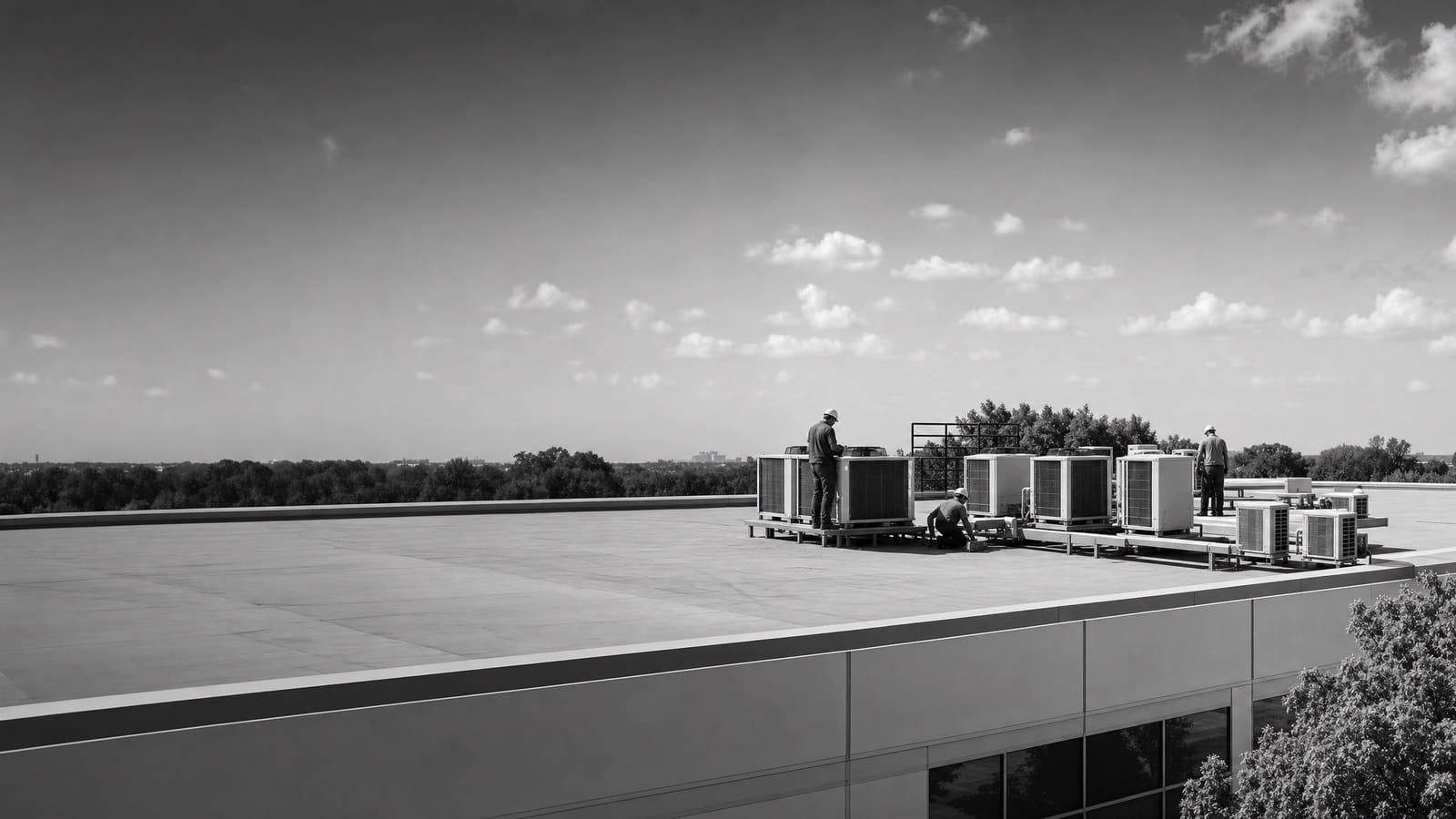
A commercial HVAC replacement covers a load check against how the building is used now, equipment selection against real availability, permit drawings, refrigerant recovery from the old unit, rigging and set, and commissioning before handoff. Replacement beats another repair once a unit is past about 15 years, since older rooftop units can waste roughly $900 to $3,700 each per year and a repair stops buying much life.
A site review still sets the number. Curb size, roof structure, electrical capacity, crane access, and the controls you already run decide how much work sits behind the unit price.
THREE WAYS TO GO
Three operating choices before you buy
Most buildings are choosing between three paths, and the right one depends on what the building does now rather than what it did when the old unit landed.
The first choice is timing. Replacement on failure is the most common way to buy and the most expensive. You take whatever is available, on someone else's schedule. Planned replacement lets you compare efficiency tiers, controls, and lead times while the old unit still runs.
The second is efficiency tier. DOE's high-performance rooftop specification targeted units that cut energy use by up to half against the old standard, so the tier you pick shows up on every utility bill for as long as the unit stays on the roof.
The third is fuel. A heat pump rooftop unit is a close cousin of a standard air-conditioning unit, with reverse-cycle heating added. In southern climates, today's heat pump units can cover most or all of the winter heating demand, which makes the electric option realistic here rather than theoretical.
WHAT MOVES THE NUMBER
Budget lines that decide your installed price
Nobody can quote a rooftop replacement from a tonnage alone, and the unit itself is often the smaller half of the number. These lines are where two bids on the same building end up thousands apart. Make sure each one is priced rather than assumed.
IN PRACTICE
How to choose equipment without guessing
Start with the load, not the nameplate. A unit that went up twenty years ago was sized for the occupancy, lighting, and plug load of that era. Offices got emptier and denser at the same time. Kitchens changed their line. If nobody recalculates, you buy the old mistake again with a new warranty on it.
Then decide how long you plan to hold the building. Rooftop units condition close to half of all commercial floor space in the country, and they are the piece most likely to be bought in a panic. If you expect to own the roof for another decade, the efficiency tier and the controls matter more than the delivery date. If the building is on the market next year, a clean like-for-like swap with a documented commissioning report is the honest play.
Last, take the fuel question on purpose. DOE's guidance for heat pump rooftop units puts climate, electrical capacity, physical constraints, gas lines, equipment availability, contractor familiarity, and incentives on a single checklist. That list is the real decision. A heat pump that pencils out on paper still needs the panel space to land.
COMPLEXITY CHECK
Simple swap or engineered project
Two replacements at the same tonnage can be very different jobs. The gap is rarely the equipment. It is what the roof, the panel, and the drawings demand once the scope opens up. Sort your project into one of these before you set a budget or a date.
LOWER COMPLEXITY
Same footprint, same fuel
The new unit matches the old curb and connections. Use has not changed, the electrical service is untouched, and the crane has a clear lane. The permit package stays mechanical and electrical.
HIGHER COMPLEXITY
New footprint or new fuel
Tonnage grows, the curb changes, or you move off gas. Now you may add structural review, panel or feeder work, and framing details to the drawings. Plan in weeks, not days, before the crane.
THE SITE REVIEW
What a real site review has to verify
A quote written from a photo of the nameplate is a guess with a number attached. It is useful for triage when a unit is down in August. It is not a scope.
The site review should confirm the curb dimensions and the condition of the roof under it, the structural path for the new weight, the electrical service and the panel capacity actually available, the status of any gas line you are keeping or dropping, and the refrigerant in the existing unit so recovery is planned instead of improvised. It should also confirm the crane's reach and staging, because that is what decides how many parking stalls close and for how long.
The controls question gets skipped most often. If the building runs a building automation system, someone has to own the point mapping and the sequences on the new unit. Left off the quote, it surfaces in month two as comfort complaints nobody can trace.
Ask for the commissioning plan in writing. Charge, airflow, economizer operation, and control setpoints verified against the submittal is what separates a unit that runs from a unit that performs.
Bring these to the walk
Nameplate photos of every unit, the roof plan, the last two years of service history, your utility bills, and the hours the building has to stay open. Those five items turn a rough estimate into a scope you can compare bid to bid.
WEST PALM BEACH SPECIFICS
In Florida, the permit drawings carry a seal
Florida commercial alteration permitting treats an HVAC change as a drawing exercise, not a form. Florida permit guides for commercial alterations are direct about it: mechanical plans are required whenever the scope includes installing or relocating equipment such as HVAC, those mechanical plans must be signed and sealed by a Florida licensed architect or engineer, and energy calculations are required whenever the scope touches heating, ventilation, or air conditioning. Equipment location has to be shown on the plans. If the work disturbs roof framing, framing plans with sections and details come with it.
That affects your schedule more than your price. Sealed drawings and energy calculations are a design step with their own lead time, and they only run in parallel with equipment lead time if you start them early.
Start the drawings before you pick a date
Get the engineer engaged the same week you request equipment pricing, and confirm the current submittal checklist with the West Palm Beach building department. Otherwise the permit, not the unit, becomes the long pole on your project.
OWNERSHIP QUESTIONS
Two things to settle before you sign
A rooftop replacement is a capital decision that lands on an operating budget. Two questions decide how it should be structured, and both are easier to answer before a crane is scheduled.
The first is who carries the risk between the purchase order and the startup report. The second is what happens to the rest of the roof. Most buildings do not have one rooftop unit. They have four to twelve, bought at different times, and the one that failed is usually the oldest of a matched set. Replacing them one panic at a time is how a portfolio ends up with several refrigerants, a few control platforms, and no spare parts strategy.
SINGLE POINT OF RESPONSIBILITY
One party owns the outcome
Equipment, rigging, permit, inspections, and commissioning should sit on one installed price. Split them across parties and the gaps show up as change orders on the day the crane is already on site.
FLEET PLANNING
Sequence the rest of the roof
Once one unit is replaced, rank the others by age, service history, and annual energy waste. A two or three year sequence buys better pricing and keeps the fleet on fewer platforms.
OVER THE LIFE
Phasing, procurement, and what the unit really costs
The purchase price is the part you negotiate once. The energy bill is the part you pay every month for as long as the unit sits on the roof. DOE's work on aging rooftop units put the annual waste of an inefficient one at roughly $900 to $3,700 per unit, and the high-performance specification that came out of that program targeted units cutting energy use by as much as half against the prior standard. Run those figures against your own bill before you decide the cheapest bid is the cheapest project.
Phasing is where most owners leave money on the table. If you already know three units are past fifteen years, price them as one program instead of three emergencies. One mobilization, one set of drawings, one crane day if the roof allows, and one control platform across the group.
On procurement, put availability next to price on every line. A unit three weeks out and a unit fourteen weeks out are not competing offers. Ask about incentives in the same breath, since DOE's own guidance lists them as a decision input, but verify what is actually open right now before you count the money. These programs open and close.
APPLES TO APPLES
Five things a comparable quote shows
If two bids do not show these five, you are not comparing bids. You are comparing formatting. Ask every bidder to break the quote out this way, so the difference between them is a real scope difference instead of a hidden one.
01
Unit, tier, and tonnage
Model number, efficiency tier, and the load calculation it was selected against.
02
Availability in writing
A quoted lead time for that exact model, dated, not a general range.
03
Roof and curb scope
Curb adapter, framing, and any structural review, priced rather than listed as excluded.
04
Permit package and who seals it
Mechanical drawings, energy calculations, the sealing engineer, and every inspection included.
05
Startup and commissioning report
Charge, airflow, economizer, and controls verified against the submittal and documented at handoff.
Get a defensible number
Price the equipment and the building together.
Send the address, operating target, and target opening date. Flux will identify what must be verified before the project can be priced.
Get a free estimateQuestions
Straight answers.
How do I know it is time to replace instead of repairing one more time?
Age plus repair pattern. DOE flags rooftop units over 15 years old as the ones wasting real money, and an inefficient unit can burn roughly $900 to $3,700 a year on its own. Once a repair no longer buys meaningful life, you are renting time at full price.
Does a heat pump rooftop unit make sense in West Palm Beach?
It is a real option here. DOE notes that across most of the U.S. South, today's heat pump rooftop units are capable of covering most or all of the winter heating demand. The deciding factor is usually infrastructure: electrical capacity, physical constraints on the roof, and what happens to the existing gas line.
What do the permit drawings have to include?
Plan on mechanical drawings signed and sealed by a Florida licensed architect or engineer whenever HVAC equipment is installed or relocated, energy calculations for the HVAC scope, and equipment location shown on the plans. Confirm the current checklist with the West Palm Beach building department before you commit to a schedule.
What happens to the refrigerant in the old unit?
It gets recovered, not vented. EPA rules under Section 608 of the Clean Air Act govern how refrigerant in stationary air conditioning and heat pump equipment is handled and recycled. Recovery by certified technicians, with documentation, belongs on the quote.
How long is the building without cooling?
When the curb matches and the crane has a clear lane, the set itself is usually one planned day. The schedule risk sits upstream: sealed drawings, permit review, and equipment lead time. Those are the weeks. The crane is the morning.
Can I replace one unit now and the rest later?
Yes, and it is usually smarter if the roof carries several units. Rank them by age, service history, and energy waste, then set a two or three year sequence. You get better pricing and you keep the fleet on fewer refrigerants and one control platform.
Sources used for this guide
- [1]betterbuildingssolutioncenter.energy.gov — DOE Advanced Rooftop Unit Replacement Guidance
- [2]betterbuildingssolutioncenter.energy.gov — DOE Commercial Heat Pump Rooftop Unit Replacement Guidance
- [3]betterbuildingssolutioncenter.energy.gov — DOE High-Efficiency Commercial Rooftop Unit Toolkit
- [4]energy.gov — DOE Efficient Commercial Rooftop Air Conditioner Program
- [5]epa.gov — EPA Stationary HVAC Refrigerant Management
- [6]tampa.gov — Permit Application Guide Commercial Alteration