THE DIRECT ANSWER
What a commercial HVAC replacement actually includes
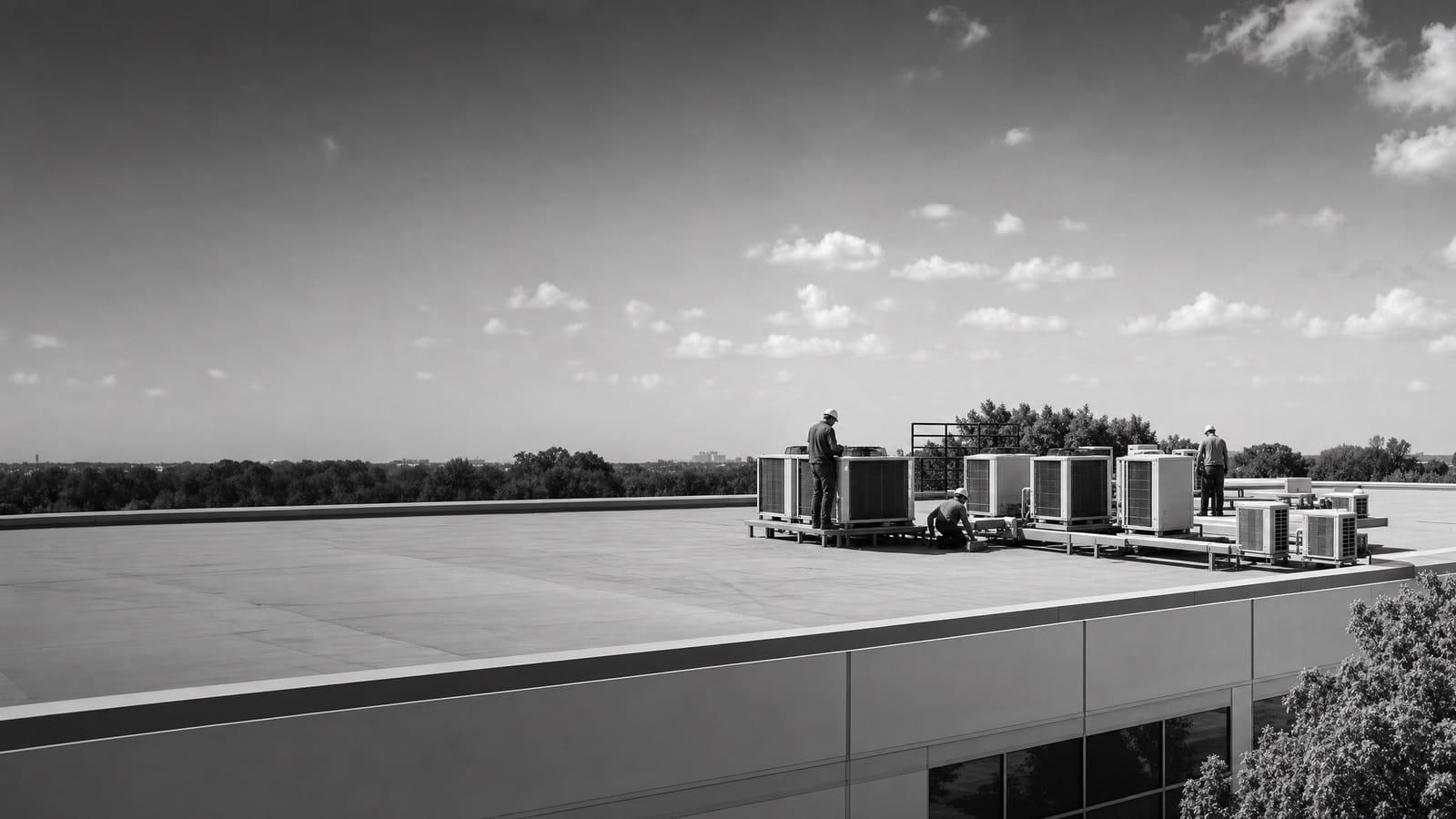
A commercial replacement covers the load calculation, the unit itself, curb and structural work, the crane lift, the gas, electrical and refrigerant connections, controls, the permit, and commissioning. Replacement starts beating another repair once a rooftop unit is past fifteen years old. An old, inefficient unit wastes roughly $900 to $3,700 a year in energy — often more than the repairs you keep authorizing on it.
A site review still has to confirm roof structure, curb dimensions, available electrical capacity, and crane access before any of that becomes a real price. Those four decide whether the job is a morning or a project.
THE EQUIPMENT DECISION
Three ways to heat and cool the same square footage
Waterbury winters are cold enough that this is the decision that matters most. Heat pump rooftop units are most efficient in mild-to-moderate winter heating, and as outdoor temperatures fall their heating efficiency drops toward that of electric resistance heat. That does not rule a heat pump out here. It rules out choosing one without checking how the building heats through a real January, what backup heat the unit carries, and whether the electrical service can feed that backup. Federal guidance frames the choice as three products rather than two, and local electricity and gas prices decide which one lowers your bill. Run that comparison on your rates and your run hours before the order goes in, not after.
WHAT MOVES THE NUMBER
The lines that decide your installed price
Tonnage sets the equipment price. Site conditions usually decide whether the job is a single morning or a multi-day project, and that is where quotes diverge.
BUYING GUIDANCE
Sizing, efficiency tier, and the availability nobody asks about
Start with the load, not the nameplate. A unit installed twenty years ago was sized for that building's occupancy, lighting, and equipment at that time. Lighting got more efficient, plug loads went up, and the way the space is used probably changed at least once. Carrying the old tonnage forward carries the old sizing mistake with it, and an oversized unit cycles too often, handles humidity poorly, and wears out sooner.
Then pick the efficiency tier honestly. A federal rooftop unit challenge pushed manufacturers to build units cutting energy use by up to half compared with the standard equipment of the time, and more than twenty models have exceeded that specification. The premium tier pays back fastest in buildings that run long hours. A warehouse conditioning space forty hours a week has a longer payback than a clinic running fourteen-hour days.
Availability is the third input, and it is the one buyers forget. Equipment lead time belongs on the quote right next to the price. A unit that is perfect on paper and months out is not the right unit for a building that is down in August. Ask for the in-stock alternative and its efficiency tier before you approve anything.
SIDE BY SIDE
What separates a simple swap from a project
Two replacements at the same tonnage can be very different jobs. What separates them is rarely the unit itself.
STRAIGHTFORWARD
Same footprint, open access
Same tonnage, same fuel, existing curb takes a standard adapter, and the roof structure already carries the weight. The lot has room for the crane behind the building. Permit is a mechanical and electrical filing, and the unit is set and connected in a morning.
MORE INVOLVED
New footprint or new fuel
Upsized tonnage, a heavier unit, or a switch to all-electric heat. Now you may have structural review, a service or feeder upgrade, a street-side lift, and controls integration. Occupied tenants push the work to nights or weekends, which lengthens both schedule and price.
SCOPING
What a real site review covers
A real scope starts on the roof, not on the phone. The visit should measure the existing curb against the replacement's footprint, look at the structure underneath it, and note whether the unit's weight is changing. It should check the electrical service and available breaker space, confirm where the gas line lands and what it delivers, and photograph the nameplate so model, tonnage, and refrigerant are on record.
Then it moves to the ground. Where does the crane set up, what does it reach over, how many stalls close, and for how long? A lift that needs a lane of the street is a different conversation than one staged in a back lot. If tenants operate through the day, the lift date and the outage window get agreed before anything is ordered.
The last piece is the building's schedule. A unit serving a space that runs long hours justifies a higher efficiency tier and a tighter commissioning scope than one serving storage. Whoever writes the quote should be able to explain the choice they made and why, in a sentence you can repeat to your ownership group.
Six answers before a price is real
Curb and footprint, roof structure, electrical capacity, gas supply, crane access, and the outage window. If a number arrived without someone answering those six, you have an estimate, not a price.
WATERBURY SPECIFICS
The permit is not optional, even on a like-for-like swap
Connecticut works from a statewide building code that the local building official administers town by town. A permit is required to install, alter, replace, or remove a mechanical system. The exemptions written into the code are for genuinely minor work — replacing a small part that does not change the equipment's approval, or a self-contained refrigeration system holding ten pounds or less of refrigerant or driven by motors of one horsepower or less. A commercial rooftop unit clears both of those thresholds several times over. Plan on a permit for every replacement, including a straight swap onto the existing curb.
Code editions get updated over time, so the contractor should confirm the edition in force with Waterbury's building official during scoping, not after the unit is ordered.
Ask this before the crane is booked
Who pulls the permit, what day it gets filed, and which inspections have to pass before the unit can run. On an in-season replacement, a permit filed the same week as the lift is what pushes the lift.
AFTER THE CRANE LEAVES
Two things that follow you for years
The install is a morning. Ownership is the next fifteen years, and two items in particular keep showing up on facility budgets long after the invoice clears.
REFRIGERANT
Your fleet becomes a mixed fleet
New equipment ships on current refrigerants while your older units keep running what they were built with. Federal rules govern how that charge is handled and recovered on both. Plan spare parts and service coverage for a mixed fleet rather than a uniform one.
OPERATING COST
Bills move with rates, not brochures
Whether a heat pump lowers your bill depends on local electricity and gas prices and on how many hours the building actually runs. Ask for that comparison on your rates, and get any incentive confirmed in writing before it is counted in a payback.
PHASING AND LIFETIME COST
Replace on your schedule or on the equipment's
The expensive version of this project is the one that picks you. Facility teams usually wait until a unit stops holding the space, needs constant service, or fails outright, and then the choice narrows to whatever is available that week. Replacing ahead of failure, on your own schedule, is usually the better business decision than replacing on failure or defaulting to a like-for-like swap at end of life.
If you own more than one building, phase it. Rank units by age, service history, and the hours they run, then take the worst ones first. Federal guidance for portfolio owners walks the same order: climate, utility rates, building type, electrical capacity, physical constraints, gas lines, and whether contractors in your area know the equipment you are considering. That last item is not small. Unfamiliar equipment installed unfamiliarly performs like cheap equipment.
Run the number over the unit's life, not the quarter. A rooftop unit set this fall will likely still be running fifteen years from now. The sizing, the efficiency tier, and the quality of the commissioning are decisions you make once and pay for every month afterward.
COMPARING QUOTES
Five things a comparable quote shows
Two quotes are only comparable when both show the same items. Ask for these five in writing, then compare line to line instead of bottom line to bottom line.
01
The exact model, tonnage, and heat type
Not a tonnage range. The specific unit, its heating method, and its efficiency tier, so you know what you are being priced on.
02
Lead time and the in-stock alternative
Availability next to price, plus what could ship sooner and what that substitution costs you in efficiency.
03
Curb, structural, and roofing scope
Adapter or new curb, any structural review, and who patches and flashes the roof around the opening.
04
Crane, rigging, and lot coordination
Lift plan, stalls closed, hours, and who notifies tenants. It should be in the installed price, not a change order.
05
Permit, refrigerant recovery, and commissioning
Filing and inspections, recovery of the old charge, then documented startup with airflow, charge, and control settings verified.
Get a defensible number
Price the equipment and the building together.
Send the address, operating target, and target opening date. Flux will identify what must be verified before the project can be priced.
Get a free estimateQuestions
Straight answers.
When does replacement beat one more repair?
Past fifteen years is the practical line. Older rooftop units waste substantial energy compared with current equipment, roughly $900 to $3,700 per unit each year for an old, inefficient one. When that waste plus the repair spend approaches the value of a new unit's remaining life, you are paying for a replacement without getting one.
Does a heat pump rooftop unit make sense in a Waterbury winter?
It can, but not automatically. Heat pump heating efficiency drops as outdoor temperatures fall, trending toward electric resistance performance in deep cold. That is why dual-fuel and cold-climate versions exist. Compare them on your electricity and gas rates and your run hours before choosing, and confirm the electrical service can carry the backup heat.
Do I need a permit for a straight like-for-like swap?
Yes. Connecticut's building code requires a permit to install, replace, or alter a mechanical system, and the exemptions cover only minor work such as small self-contained refrigeration systems. A commercial rooftop replacement is well past that. The installing contractor should file it and carry the inspections in the price.
What does a commercial HVAC installation cost?
There is no honest universal number, because tonnage is only one input. Curb and structural work, electrical capacity, crane access, and controls integration routinely move the total more than the unit does. Get the price after someone has measured the curb and looked at the lot, not before.
What happens to the refrigerant in the old unit?
It gets recovered and handled under federal Clean Air Act rules that govern refrigerant in stationary air-conditioning and heat pump equipment. It is not vented. Ask that recovery appear as a line on the quote, and keep the documentation with your equipment records.
How long is the building without cooling?
The visible outage is usually the crane day itself, provided the curb adapter, connections, and permit were handled in advance. The real schedule variable is equipment lead time, which is why availability belongs on the quote beside the price.
Sources used for this guide
- [1]betterbuildingssolutioncenter.energy.gov — DOE Advanced Rooftop Unit Replacement Guidance
- [2]betterbuildingssolutioncenter.energy.gov — DOE Commercial Heat Pump Rooftop Unit Replacement Guidance
- [3]betterbuildingssolutioncenter.energy.gov — DOE High-Efficiency Commercial Rooftop Unit Toolkit
- [4]energy.gov — DOE Efficient Commercial Rooftop Air Conditioner Program
- [5]epa.gov — EPA Stationary HVAC Refrigerant Management
- [6]cga.ct.gov — Building Permit Requirements for Devices Installed in a Home