THE DIRECT ANSWER
What a commercial HVAC replacement includes, and when it beats one more repair
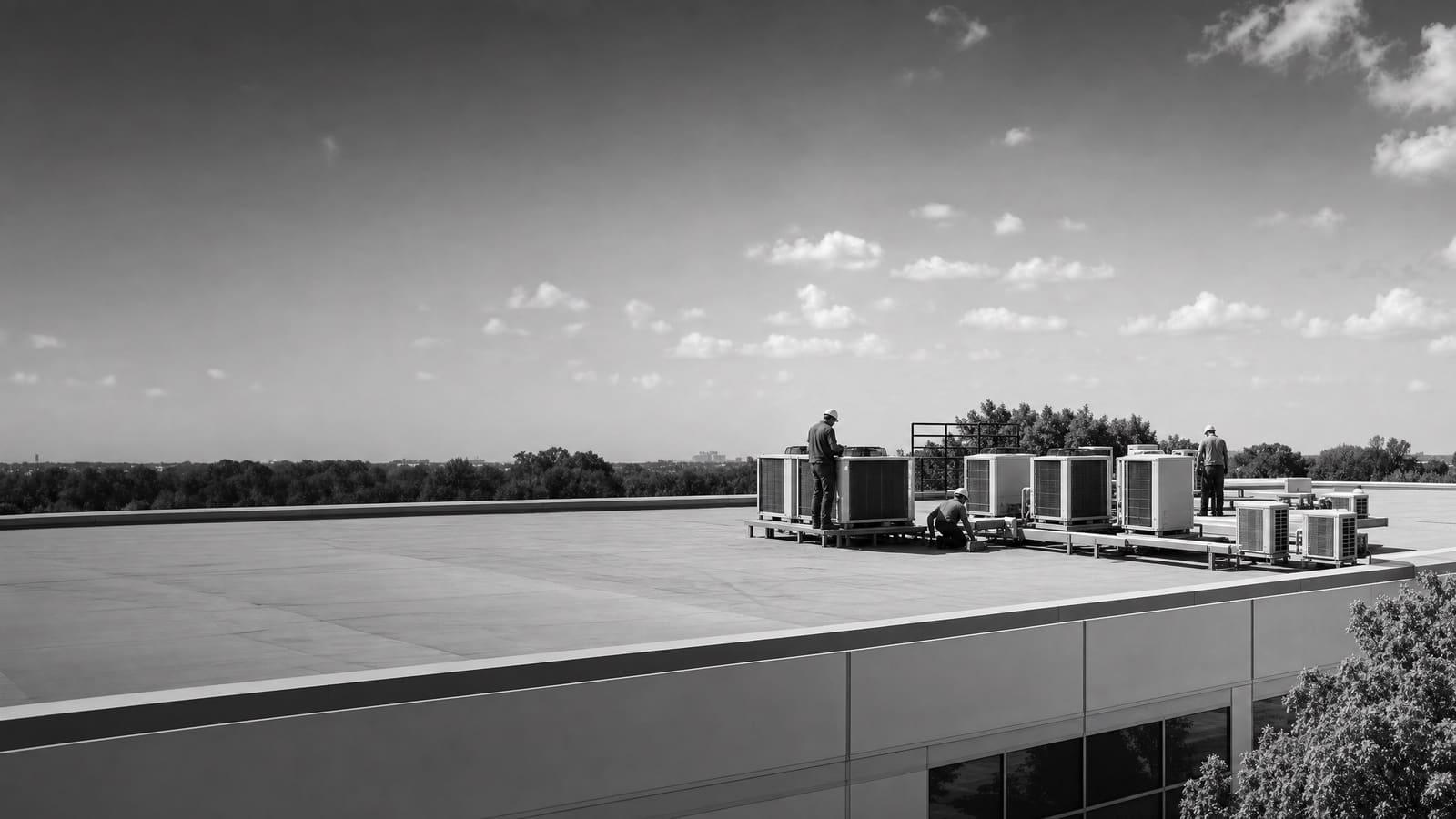
A commercial HVAC replacement means confirming the load the building carries today, selecting equipment that fits the roof and the electrical service, recovering refrigerant and removing the old unit under federal handling rules, setting and connecting the new one, and commissioning it before handoff. Replacement usually beats another repair once a unit passes about fifteen years, because aging rooftop units waste an estimated $900 to $3,700 each per year. That gap repeats every season the old unit stays up there.
A site review still has to verify curb dimensions, structural capacity, crane access, and available electrical service before any of that becomes a real price for your building.
THREE WAYS TO PLAY IT
Three ways owners handle an aging rooftop unit
The equipment decision is usually made for you by whichever of three paths you are already on. Waiting for failure is the default and the most expensive one. DOE's rooftop guidance notes that facility managers often delay replacement until a unit no longer conditions the space, needs constant service, or quits entirely — and by then the choice is whatever is available this week.
Planned like-for-like replacement is the middle path. The unit is sized the way the old one was, it lands on the same curb, and the connections already exist. It is fast, and it is the right call when the space is used the same way it was when the original unit went in.
The third path is a proactive upgrade to a high-efficiency unit or a heat pump rooftop unit. Federal guidance is direct here: replacing inefficient, underperforming units ahead of failure is often the smarter business move than either replacement-on-failure or a like-for-like swap at end of life. Retrofitting advanced controls onto a unit that still has service life left is a fourth option worth pricing before you commit.
WHAT MOVES THE NUMBER
Where a replacement budget actually moves
Two things dominate a commercial HVAC budget: which equipment tier you buy, and what the building has to change to accept it. Everything else is either predictable or discovered during the site review. The tags below describe how much each line can move between a first estimate and the final invoice.
CHOOSING EQUIPMENT
Gas heat or heat pump, baseline or high-efficiency
Rooftop packaged units condition close to half of all commercial floor area in the country, so for most Waco buildings this is a rooftop decision before it is anything else. The first fork is fuel. A gas-heat air conditioning unit and a heat pump rooftop unit are close cousins mechanically, but the heat pump adds reverse-cycle heating and removes the combustion side entirely.
Federal heat pump guidance is clear about where that swap works. Heat pumps are best suited to mild-to-moderate winter heating, and across most of the South and West today's units can carry most or all of the winter heating demand. As outdoor temperatures drop, heat pump heating efficiency trends toward parity with electric resistance. That is why backup heat is a design question and not a footnote — the same guidance points to Texas cold snaps as the reason a southern building still needs a heating plan that holds on the worst days. Dual-fuel and cold-climate variants exist for exactly that gap.
The second fork is efficiency tier. Federal minimum efficiency for commercial rooftop units was raised by a DOE standard issued in 2015, but a minimum is a floor, not a target. High-performance models built to beat that floor were the whole point of the challenge that produced them, and more than twenty models now exceed the specification. Comparing a baseline unit against a high-efficiency unit is a real comparison. Comparing two bids that never name their tier is not.
COMPLEXITY CHECK
What makes one replacement simple and another one hard
Same building, same tonnage, wildly different projects. The difference is rarely the equipment itself — it is what the building has to change to accept it, and how easily the unit can get to the roof.
LOWER COMPLEXITY
A straight swap on a ready roof
Same tonnage and same fuel type, an existing curb the adapter fits cleanly, clear crane reach from the lot, and electrical capacity already proven. Permitting is routine and the building is conditioned again the day the unit lands.
HIGHER COMPLEXITY
Fuel switch, upsize, or tight access
Going all-electric, adding tonnage, or landing a unit where the crane barely reaches. Each one adds engineering, possible electrical service work, structural review, and a longer window between signing and running.
SCOPING IT RIGHT
What a site review has to confirm before a quote is real
A price written from a phone call is a guess. The site review turns that guess into a number, and the items it confirms are the same ones that wreck budgets when nobody checks them.
Start with the roof. The curb under the old unit gets measured and inspected, because the adapter that bridges an old curb to a new unit is fabricated to those dimensions. Structural capacity matters whenever the replacement is heavier or larger. Then look at how equipment actually arrives: crane reach, lot layout, which stalls close and for how long, and whether the lift happens outside operating hours.
Infrastructure is where fuel-switch projects get decided. The federal checklist for heat pump rooftop units puts electrical capacity, physical constraints, and gas lines at the center of the question, because an all-electric unit can need service the building was never built to supply. If the panel cannot carry it, that work belongs in this budget, not in a change order later.
Finally, confirm who does the work. Contractor availability and familiarity with the equipment is a listed adoption factor for a reason, and it is fair to ask about directly. A crew that has commissioned the exact model you are buying finds problems on startup day. A crew learning the unit finds them in month two.
Get these four in writing
Before signing, confirm curb dimensions and structural capacity, crane access and the closure window, available electrical service for the exact unit quoted, and how the gas line is handled. Anything left unverified here is a change order waiting to happen.
OWNERSHIP MATH
Two things owners weigh past the install
The install price is the part everyone compares. The operating cost is the part that decides whether the purchase was smart.
An aging rooftop unit wastes an estimated $900 to $3,700 a year against a current model. That gap runs every month, on every unit, and it appears on no quote you will receive. When the national campaign behind these upgrades tallied more than 43,000 replaced and retrofitted units across more than 200 organizations, the combined result was about $37 million in annual energy savings. Another way to read that: the per-unit gap is real and it repeats.
The second question is whether this is one roof or the beginning of a program. Owners with several units get real value from standardizing on one efficiency tier, one control platform, and one spare-parts strategy, then replacing on equipment age instead of on failure dates.
OPERATING COST
The bill after the crane leaves
Efficiency tier sets the utility bill for the entire service life of the unit. A baseline unit that saves money on install day can spend that savings back within a few seasons, depending on runtime and rates.
PORTFOLIO STRATEGY
One roof or the start of a program
Across multiple buildings, the guidance is to evaluate site by site rather than mandate one answer everywhere. Climate, building type, electrical capacity, and gas service differ enough that some sites are ready for a heat pump and others are not.
PHASING AND PROCUREMENT
Planning replacements instead of reacting to them
Nobody schedules a mid-summer failure, but almost everyone schedules the replacement that follows one. The way out is to move the decision earlier, while there is still time to compare equipment instead of accepting whatever can be delivered.
Start with age. Units past fifteen years are the ones flagged as wasting real money, so that is a reasonable point to begin planning rather than a point to panic. Pull nameplate data on every unit you own, sort by age and service history, and you have a replacement order driven by condition rather than by whichever compressor fails first.
Then handle procurement. Equipment availability is a genuine constraint on commercial projects, and the models worth wanting are not always the models sitting in a regional warehouse. A unit selected in spring with a firm delivery date is a different purchase from the same unit selected in midsummer with the building already too warm to occupy. Ask for availability in writing, next to the price.
Incentives belong in the same conversation. They are one of the listed factors in deciding whether an upgrade pencils, and programs change — so confirm what applies to the specific equipment before the order goes in, not after. Last, compare lifetime cost honestly: installed price, expected annual energy difference, and service burden across the units you are actually choosing between. That comparison usually makes the decision obvious.
QUOTE CHECKLIST
Five things a comparable quote should show
Two quotes for the same roof can differ sharply and both be honest, because they are quoting different equipment and different scope. These five items make bids actually comparable. If one is missing, ask for it before you compare price.
01
Make, model, tonnage, and efficiency tier
Not just "new rooftop unit." Two bids on different efficiency tiers are two different purchases.
02
How the size was determined
Whether tonnage came from a current load calculation or was copied off the old nameplate.
03
Itemized infrastructure scope
Curb adapter, structural work, electrical service, gas line disposition, and refrigerant recovery, each listed separately.
04
Equipment availability and schedule
Real lead time for the unit quoted, the crane day, lot closure, and expected downtime.
05
Commissioning and closeout
Startup, airflow, charge, and controls verified and documented, with warranty registration included in the price.
Get a defensible number
Price the equipment and the building together.
Send the address, operating target, and target opening date. Flux will identify what must be verified before the project can be priced.
Get a free estimateQuestions
Straight answers.
When does replacement beat one more repair?
Age and repair frequency answer this faster than anything else. Rooftop units past about fifteen years waste an estimated $900 to $3,700 apiece each year against current equipment, and that loss continues regardless of what you spend on the next service call. When a unit needs frequent attention or no longer holds the space, planned replacement is usually the cheaper decision.
Is a heat pump rooftop unit a good fit for a commercial building here?
Often, yes. Federal guidance finds that across most of the South and West, current heat pump rooftop units can handle most or all of the winter heating demand. The catch is cold snaps: heat pump heating efficiency drops as outdoor temperatures fall, so backup heat matters. Dual-fuel and cold-climate versions exist specifically for that. Electrical capacity has to be verified first.
What happens to the refrigerant in the old unit?
It is recovered, not vented. Federal Clean Air Act rules govern the handling and recycling of refrigerants in stationary air conditioning and heat pump equipment, and that applies when a commercial unit is taken out of service. Recovery and proper disposal should be a named line in the quote, not an assumption.
Why do two quotes for the same roof differ so much?
Usually because they are not quoting the same thing. One may be a baseline federal-minimum unit and the other a high-efficiency model. One may include the curb adapter, electrical work, and commissioning while the other leaves them for a change order. Ask both bidders for the same five line items and the gap usually explains itself.
How much does commercial HVAC installation cost in Waco?
There is no universal installed price, and any number given before someone looks at the roof is a guess. Cost is driven by equipment tier, tonnage, curb and structural work, crane access, and whether electrical service has to change. What is known is the cost of waiting: an aging unit runs an estimated $900 to $3,700 a year in avoidable energy waste.
Sources used for this guide
- [1]betterbuildingssolutioncenter.energy.gov — DOE Advanced Rooftop Unit Replacement Guidance
- [2]betterbuildingssolutioncenter.energy.gov — DOE Commercial Heat Pump Rooftop Unit Replacement Guidance
- [3]betterbuildingssolutioncenter.energy.gov — DOE High-Efficiency Commercial Rooftop Unit Toolkit
- [4]energy.gov — DOE Efficient Commercial Rooftop Air Conditioner Program
- [5]epa.gov — EPA Stationary HVAC Refrigerant Management