THE DIRECT ANSWER
What a commercial HVAC replacement actually includes
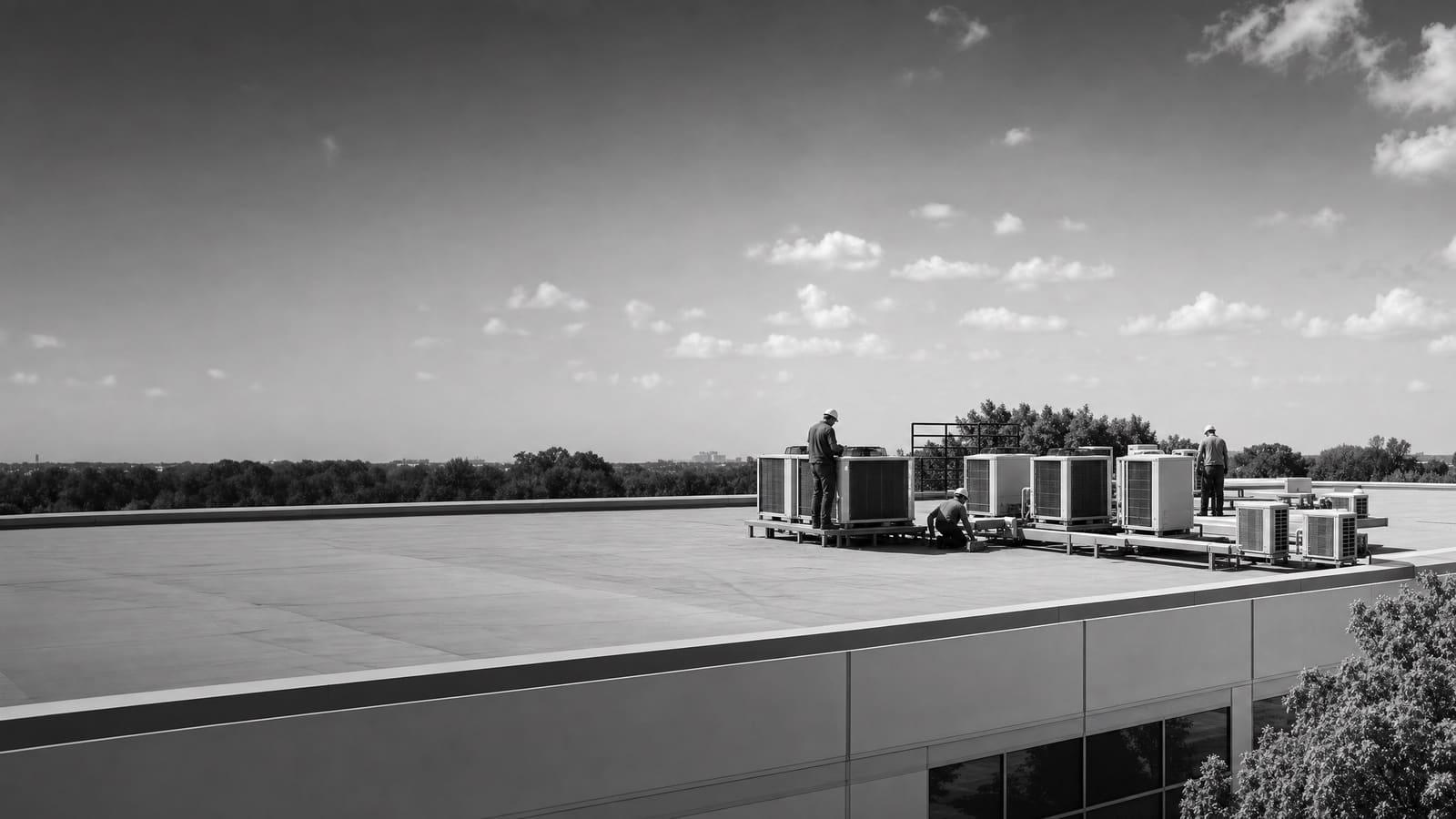
A commercial HVAC replacement covers load confirmation, equipment selection against real lead times, the crane set, curb and connection work, permits and inspection, and commissioning that proves the unit performs to spec. Replacement beats one more repair once a rooftop unit is past about fifteen years and the failures are stacking. An old, inefficient unit wastes roughly $900 to $3,700 in energy every year it stays on the roof.
A site review has to verify the real load for how the space is used now, the curb and roof structure, available electrical capacity and gas service, and whether a crane can reach the unit from your lot.
THREE WAYS FORWARD
Three replacement paths, and when each one is right
Once a unit is at end of life you have three real paths, and the cheapest one on paper is not automatically the right one. Federal rooftop unit guidance frames the first fork plainly: replace with a more efficient unit, or retrofit the existing one with advanced controls, whichever makes better financial sense for that building. A controls-only retrofit is worth pricing while the cabinet and compressor still have life left. Once the unit is actually failing, the question narrows to what goes on the curb — same fuel, better efficiency, or a different fuel entirely. Vista's mild winters matter to that last choice, because in western climates like this one a heat pump rooftop unit is capable of covering most or all of the winter heating demand rather than leaning on electric resistance backup.
WHAT MOVES THE NUMBER
Where a commercial HVAC quote actually moves
There is no honest universal installed price for a commercial rooftop replacement, because these six lines move the total more than the equipment tag does. Ask for each one to appear separately on the quote so you can compare two bids that look identical on the cover page.
BUYING GUIDANCE
Buy the unit you will still like in year ten
The unit you set today is the unit you operate for the next fifteen to twenty-five years, so buy for the second half of that run and not just for startup day.
Start with the load. Sizing from the old nameplate carries forward every mistake the last install made, and twenty years of changed occupancy, lighting, plug load, and envelope work rarely leaves the number where it was. A confirmed load either validates the like-for-like swap or tells you the building has been paying for the wrong tonnage all along.
Then look at efficiency honestly. Rooftop units condition close to half of all commercial floor area in the country, and the ones past fifteen years old are why energy spend drifts up without anyone noticing. The high-efficiency specification the Department of Energy pushed manufacturers toward was built to cut rooftop energy use by up to half against the old standard, and more than twenty models now exceed it. That is a menu, not one premium option.
The last question is fuel. If the old unit burned gas, price a heat pump rooftop unit side by side. Vista's winters are mild, which is exactly the condition where a heat pump carries the heating load efficiently. Compare installed cost plus the utility bill, run against your actual rates.
COMPLEXITY CHECK
What makes this job simple, and what makes it hard
Two rooftop replacements at the same tonnage can be completely different projects. Before you compare prices, figure out which side of this line your building sits on.
LOWER COMPLEXITY
Straight swap conditions
Same fuel, same tonnage, and an existing curb that fits or takes a standard adapter. Open lot with clear crane reach. Space use has not changed since the last install, electrical service is unchanged, and the unit already has an economizer. These jobs are set and connected in a morning.
HIGHER COMPLEXITY
Conditions that stretch the schedule
A fuel switch, larger tonnage, or a footprint the old curb cannot carry. Tight or shared parking that limits crane setup. Electrical capacity that needs upgrading, structural review on the roof, code items the old unit was grandfathered past, and controls that have to talk to an existing automation system.
SCOPING THE WORK
What a real site review has to answer
A quote written from a phone photo of the nameplate is a placeholder. The one you sign should come from someone who stood on the roof.
The site review has to confirm the curb: dimensions, condition, and whether the new unit's footprint needs an adapter or structural work. It has to confirm infrastructure, which is where electrification projects get expensive — available electrical capacity at the panel, the run from the panel to the roof, existing gas service, and physical constraints like clearance, screen walls, and adjacent equipment. And it has to confirm access: where the crane sets up, what it can reach, which stalls close, and for how long.
Then it has to confirm the code items the replacement triggers. Economizer requirements, ventilation rates, and controls provisions attach to the new unit, not the old one, and finding them at inspection is the expensive way to learn about them.
Finally, ask what happens at startup. Commissioning is where refrigerant charge, airflow, and control settings get verified against spec and documented. Skipping it is how a new unit becomes a comfort complaint in month two.
Get the scope in writing
Before the quote is final, confirm who pulls the permit, who owns the rigging plan, what the crane closure looks like on your lot, what commissioning documents you receive at handoff, and what the equipment lead time is on the day you sign.
IN VISTA
Permits belong on the schedule, not after the crane leaves
California building departments treat mechanical work as permitted work. HVAC upgrades and repairs, along with the electrical and plumbing changes that come with them, are pulled as permits and closed out with inspection. A rooftop replacement usually means a mechanical permit plus electrical, and structural review enters the picture when tonnage or footprint grows past what the existing curb and roof were built for.
The decision that follows is scheduling. The permit is not paperwork you catch up on afterward. Confirm permit scope and the inspection window with the City of Vista building division before the crane date is locked, because a unit that lands without an approved permit sits uninspected while your building is already running on it.
Settle one more thing in writing: whether the installing contractor pulls the permit and meets the inspector, or whether that lands on you. On a fast in-season replacement, that single line decides whether the job closes cleanly.
Book the permit before the crane
Ask your contractor to confirm mechanical and electrical permit scope with the City of Vista before equipment is ordered, and to state in writing who pulls the permit and who meets the inspector at closeout.
OWNERSHIP MATH
Two decisions that outlast the install
Two things follow this unit for its whole service life, and both are cheaper to settle before the order is placed than after the crane leaves. The first is refrigerant, which is federally regulated and shapes how the unit is serviced, not just how it is installed. The second is whether you are solving one failure or setting a standard for the entire roof. Neither question moves the day-one price much. Both change what the next ten years of service calls cost, what your technician can carry on the truck, and how fast an in-season failure turns back into a working building.
REFRIGERANT
Handling is federally regulated
EPA rules under the Clean Air Act govern how refrigerant is handled and recycled in stationary air conditioning and heat pump equipment. Recovery when the old unit comes off is a compliance step, not an option. New equipment also ships on newer refrigerants, which is worth planning into service contracts on a mixed roof.
FLEET STRATEGY
One failure or one standard
If the roof holds several units of similar age, decide now whether you are matching the existing platform or starting a new one. Standardizing tonnage, controls, and manufacturer across a site simplifies parts, service knowledge, and every replacement that follows this one.
PHASING AND PROCUREMENT
Replacing one unit versus planning the roof
If you own more than one unit, the roof is the project, not the box that failed. Ask the installer to walk every unit up there and record age, tonnage, refrigerant, and condition while the mobilization is already being paid for. That list is what turns the next three years from emergencies into a schedule.
Phasing has real leverage. Replacing two units on the same crane day costs less than two separate mobilizations, and standardizing on one platform across a site keeps filters, belts, boards, and service knowledge consistent. Equipment availability belongs in the plan too — lead time, more than price, usually decides whether a replacement happens on your calendar or in the middle of your busiest month.
Lifetime cost is the honest comparison. The cheapest quote wins on day one and loses over fifteen years if the unit is undersized, oversized, or a tier below what the building should have. An old, inefficient rooftop unit can burn $900 to $3,700 a year in wasted energy, which means the gap between a base unit and a better one often closes on its own. Run that against your utility rates and operating hours, and check which utility and federal incentive programs are actually open before you sign, since those change from year to year.
COMPARING QUOTES
Five lines every comparable quote should show
Two bids can carry the same total and describe completely different projects. These five lines make them comparable, and any one of them missing is a question to ask before you sign.
01
Equipment, spelled out
Manufacturer, model, tonnage, efficiency tier, refrigerant, and heating type — not just "new rooftop unit."
02
Lead time as of signing
The real availability date for the unit quoted, and what happens to your schedule if it slips.
03
Curb, structure, and connections
Adapter or new curb, any roof work, and every gas, electrical, and control connection included in the price.
04
Crane day and site plan
Rigging plan, setup location, stalls closed, hours on site, and who notifies tenants.
05
Permits, inspection, and commissioning
Who pulls permits, who meets the inspector, and what startup documentation you receive at handoff.
Get a defensible number
Price the equipment and the building together.
Send the address, operating target, and target opening date. Flux will identify what must be verified before the project can be priced.
Get a free estimateQuestions
Straight answers.
When is replacement better than one more repair?
Once a rooftop unit is past about fifteen years, repairs stop being the cheap option. Old, inefficient units waste roughly $900 to $3,700 a year in energy on their own, and that cost repeats whether or not the compressor fails again. If a unit at that age needs a major component, price the replacement before you approve the repair.
How much does commercial HVAC installation cost in Vista?
There is no honest universal price, because tonnage, efficiency tier, curb work, electrical capacity, and crane access move the total more than the equipment tag does. Ask for those lines separately so two bids compare. The number worth holding against any quote is what the old unit costs to run: up to $3,700 a year in wasted energy for an inefficient rooftop unit.
Does a heat pump rooftop unit make sense in Vista?
Often, yes. Heat pumps are most efficient in mild-to-moderate winter heating, and in western climates like this one today's heat pump rooftop units are capable of covering most or all of the winter heating demand. The deciding factors are electrical capacity at the building, your utility rates, and equipment availability — not whether the technology can handle the weather here.
Do I need a permit to replace a rooftop unit?
Plan on it. California building departments treat mechanical upgrades and repairs as permitted work, and a replacement typically means a mechanical permit plus electrical, with structural review when tonnage or footprint grows. Confirm scope with the City of Vista building division before the crane date, and put in writing who pulls the permit.
What happens to the refrigerant in the old unit?
It has to be recovered. EPA rules under the Clean Air Act govern refrigerant handling and recycling in stationary air conditioning and heat pump equipment, so recovery when the old unit comes off is part of the job. New units ship on newer refrigerants, which matters for service planning if your roof will run a mixed fleet for a while.
Sources used for this guide
- [1]betterbuildingssolutioncenter.energy.gov — DOE Advanced Rooftop Unit Replacement Guidance
- [2]betterbuildingssolutioncenter.energy.gov — DOE Commercial Heat Pump Rooftop Unit Replacement Guidance
- [3]betterbuildingssolutioncenter.energy.gov — DOE High-Efficiency Commercial Rooftop Unit Toolkit
- [4]energy.gov — DOE Efficient Commercial Rooftop Air Conditioner Program
- [5]epa.gov — EPA Stationary HVAC Refrigerant Management
- [6]californiacity-ca.gov — HVAC Permits