THE DIRECT ANSWER
What a commercial HVAC replacement actually includes
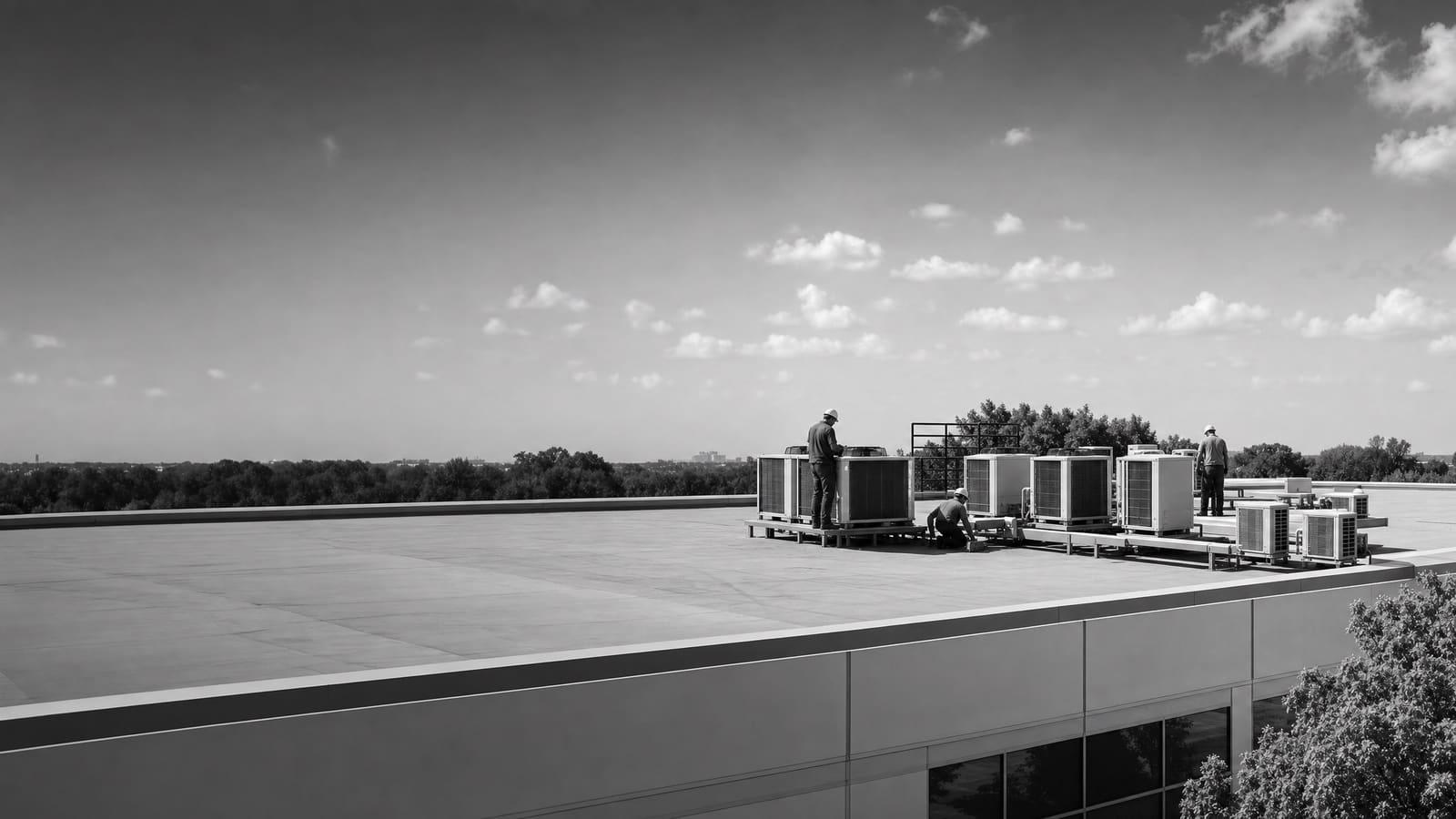
A commercial HVAC replacement covers the load calculation, equipment selection, rigging and set, gas or electrical connections, controls, permits, and commissioning. Replacement beats another repair once a unit is past about fifteen years, because federal research puts the energy waste of an aging rooftop unit at roughly $900 to $3,700 per unit each year. Waiting for outright failure also removes your choices — you take whatever unit is available that week, at whatever price it carries.
A site review still has to confirm tonnage against current occupancy, curb and structural condition, available electrical capacity, and crane access before any number on a quote is real.
THREE WAYS TO GO
Three replacement paths, and who each one fits
Most buildings pick from three paths, and the right one depends on how the space is used now and what the building can actually feed. DOE frames the same decision as a short checklist: climate, utility bill impact, building type, equipment availability, electrical capacity, physical constraints, gas lines, contractor experience, and incentives. Work through that list before the order is placed, not after the crane is booked. The cheapest option on paper is rarely the cheapest to run, and the most efficient option is not always the one your electrical service can carry today. Ask every bidder to say plainly which path they quoted and why they chose it. When two numbers land far apart, the gap is usually a different path, not a different margin.
WHAT MOVES THE NUMBER
Where the money actually goes
Equipment is only part of the number. These lines are where two quotes on the same building drift apart, so ask each bidder to price them separately instead of burying them in one lump sum.
IN PRACTICE
Choose the equipment before you chase a price
Start with the load, not the nameplate. An aging unit was sized for a building that may not exist anymore — different occupancy, different plug loads, different envelope. Carrying the old tonnage forward carries the old mistake forward with it, and an oversized unit short-cycles its way through comfort complaints and early failures.
Then decide the fuel path. Rooftop units cool close to half of all commercial floor space in the country, and the current generation is far more efficient than what sits on most roofs; DOE's high-performance specification targeted units that used up to half the energy of the standard equipment available at the time. A heat pump rooftop unit adds reverse-cycle heating and drops the gas connection, and DOE's guidance treats the West as well matched to that technology, because winters here are mild enough for the heat pump to carry most or all of the heating demand.
The catch is infrastructure. An all-electric unit needs electrical capacity the building may not have, and learning that after the order is placed is expensive. Confirm panel space, service size, and physical clearances first. If the answer is no, a dual-fuel unit keeps gas heat as the backup and still buys you the efficient cooling.
COMPLEXITY CHECK
What makes this project simple or hard
Two replacements on the same street can run very differently. Before you promise anyone a schedule, work out which side of this line your building sits on.
LOWER COMPLEXITY
Straight swap on a sound curb
Same fuel and tonnage, existing curb in good condition, open lot for the crane, no controls integration, and no change to the electrical service. Permitting is routine and the set is a single planned interruption rather than a project.
HIGHER COMPLEXITY
Fuel switch or a bigger unit
Going all-electric, growing tonnage, or landing a new footprint on an old curb. Expect an electrical capacity review, possible structural work, a longer permit path, and a rigging plan built around occupied hours.
BEFORE YOU BUY
The site review that makes a quote real
A price written from a phone call is a guess. The walk that makes it real is short, and it answers a specific list of questions.
On the roof: the nameplate, the curb condition and dimensions, the age of the membrane, and whether the structure carries the weight of the unit being proposed. In the electrical room: available panel space, service size, and how much headroom is left if the new unit is electric. On the ground: where the crane sets up, how far it has to reach, how many stalls close, and who needs notice.
Inside the building: how the space is used today, where the complaints come from, whether the controls get reused or replaced, and what happens to the old refrigerant. That last item is not optional. EPA rules under Section 608 govern how refrigerant is handled and recovered from stationary air conditioning and heat pump equipment, so recovery is part of the job, performed by certified technicians and documented.
Anything a bidder cannot answer after that walk is a change order waiting to happen.
Ask for the walk before the number
If a bidder prices your roof without seeing the curb, the electrical room, and the crane path, the number is a placeholder. Get the site review first, then compare quotes that were built from the same facts.
IN VISALIA
Permits, roof work, and the order you do them in
California building departments treat mechanical work the way they treat electrical and plumbing work: an upgrade or a repair needs a permit before it happens. Re-roofing is permitted separately, whether it is an overlay or a tear-off. That pairing matters on a rooftop replacement. If the membrane is near the end of its life, doing the roof after the new unit lands means paying twice for access and cutting around equipment that was just set.
Confirm the current permit scope and inspection sequence with the building department in Visalia before the crane is scheduled, and have your contractor carry the permit inside the installed price. A straight replacement usually pulls mechanical and electrical permits. A larger unit or a new footprint can add structural review, and that review is what moves a schedule.
Sequence the roof before the unit
If the membrane is within a few years of replacement, schedule the re-roof first or inside the same window. Both are permitted scopes, and combining them saves a second round of crane access, roof penetrations, and inspections.
OWNERSHIP
Two decisions that outlast the install
The install is a week. The choices made during it stay on the roof for the rest of the equipment's service life. Two are worth extra attention because they are cheap to get right now and expensive to fix later: how the unit is verified before handoff, and how the building's units age as a group. Owners who replace only on failure end up with a roof full of mismatched vintages, mismatched controls, and no leverage on price or timing. Owners who plan ahead choose the equipment, the shutdown window, and the budget year.
COMMISSIONING
Verify before you sign off
Charge, airflow, economizer operation, and control setpoints checked against the design and documented. Most month-two comfort complaints trace back to a startup nobody verified.
FLEET PLANNING
Replace on a plan, not on a failure
DOE is blunt about this: replacing inefficient units proactively usually beats replacement on failure, and often beats a like-for-like swap at the end of service life. Sequence the roof across budget years.
OVER TIME
Phasing, incentives, and what the unit costs to run
If your roof carries several units, replace them in a planned sequence instead of one emergency at a time. Group them by age and condition, put the worst performers first, and hold the rest on a maintenance plan until their turn comes. That gives you one rigging mobilization covering multiple units, consistent controls across the fleet, and a budget line you can defend a year ahead.
Incentives belong in the plan, but verify them yourself before you count on the money. Utility and program offers for high-efficiency and heat pump rooftop units change, expire, and get replaced; DOE lists incentives as one factor in the decision, not a guarantee. Confirm what is actually open in your utility territory at the time you buy, and confirm whether the program requires pre-approval before equipment is ordered. A rebate you apply for after installation is often a rebate you do not receive.
Then look at the running cost. The efficiency gap between a fifteen-year-old unit and a current one shows up every month on the bill, which is why the federal estimate of annual waste per aging unit belongs in the comparison right next to the installed price.
WHAT TO REQUIRE
Five things every quote should show
Bids that look different usually are different. Require these five lines on every quote so you can compare them side by side instead of guessing what someone left out.
01
Tonnage, model, and efficiency tier
The specific unit quoted, plus the load calculation it was sized from.
02
Equipment lead time
A real availability date printed next to the price, not a promise to check later.
03
Curb, structural, and roof scope
Curb adapter, any structural work, and who repairs the roof around the new unit.
04
Crane, access, and closure window
Rigging plan, staging area, stalls closed, and the hours the work happens.
05
Permits, commissioning, and refrigerant recovery
Who pulls permits, what startup verification gets documented, and how the old refrigerant is recovered.
Get a defensible number
Price the equipment and the building together.
Send the address, operating target, and target opening date. Flux will identify what must be verified before the project can be priced.
Get a free estimateQuestions
Straight answers.
When does replacement beat another repair?
Age and repair frequency usually settle it. Rooftop units past about fifteen years waste substantial energy compared with current equipment, and federal estimates put that waste at roughly $900 to $3,700 per unit each year. Once a unit needs regular attention to hold temperature, the repair money is buying time on equipment that is already costing you every month.
Should we go with a heat pump rooftop unit or stay on gas?
DOE's guidance treats most of the West as well suited to heat pump rooftop units, because winters are mild enough for reverse-cycle heating to carry most or all of the demand. The deciding factor is usually infrastructure. Check electrical capacity and panel space first. If the service cannot support an all-electric unit, a dual-fuel unit keeps gas heat as backup.
What does a commercial HVAC installation cost in Visalia?
There is no honest universal price, because tonnage, curb condition, crane access, electrical work, and code-triggered items move the number more than the box does. Ask for those lines priced separately rather than as one lump sum. That is the only way to tell whether a lower bid is genuinely cheaper or simply missing scope.
What sets the schedule?
Rarely the install itself. The calendar is driven by equipment availability, permit review, and crane scheduling. DOE lists equipment availability as a core planning factor for exactly this reason. Ask for a lead time in writing beside the price, and start the permit conversation with the building department before the order goes in.
What happens to the refrigerant in the old unit?
It has to be recovered, not vented. EPA rules under Section 608 of the Clean Air Act govern how refrigerant is handled and recycled in stationary air conditioning and heat pump equipment. Recovery is performed by certified technicians and should appear as a documented line on the quote, not an assumption.
Sources used for this guide
- [1]betterbuildingssolutioncenter.energy.gov — DOE Advanced Rooftop Unit Replacement Guidance
- [2]betterbuildingssolutioncenter.energy.gov — DOE Commercial Heat Pump Rooftop Unit Replacement Guidance
- [3]betterbuildingssolutioncenter.energy.gov — DOE High-Efficiency Commercial Rooftop Unit Toolkit
- [4]energy.gov — DOE Efficient Commercial Rooftop Air Conditioner Program
- [5]epa.gov — EPA Stationary HVAC Refrigerant Management
- [6]californiacity-ca.gov — HVAC Permits