THE DIRECT ANSWER
What a commercial replacement actually includes
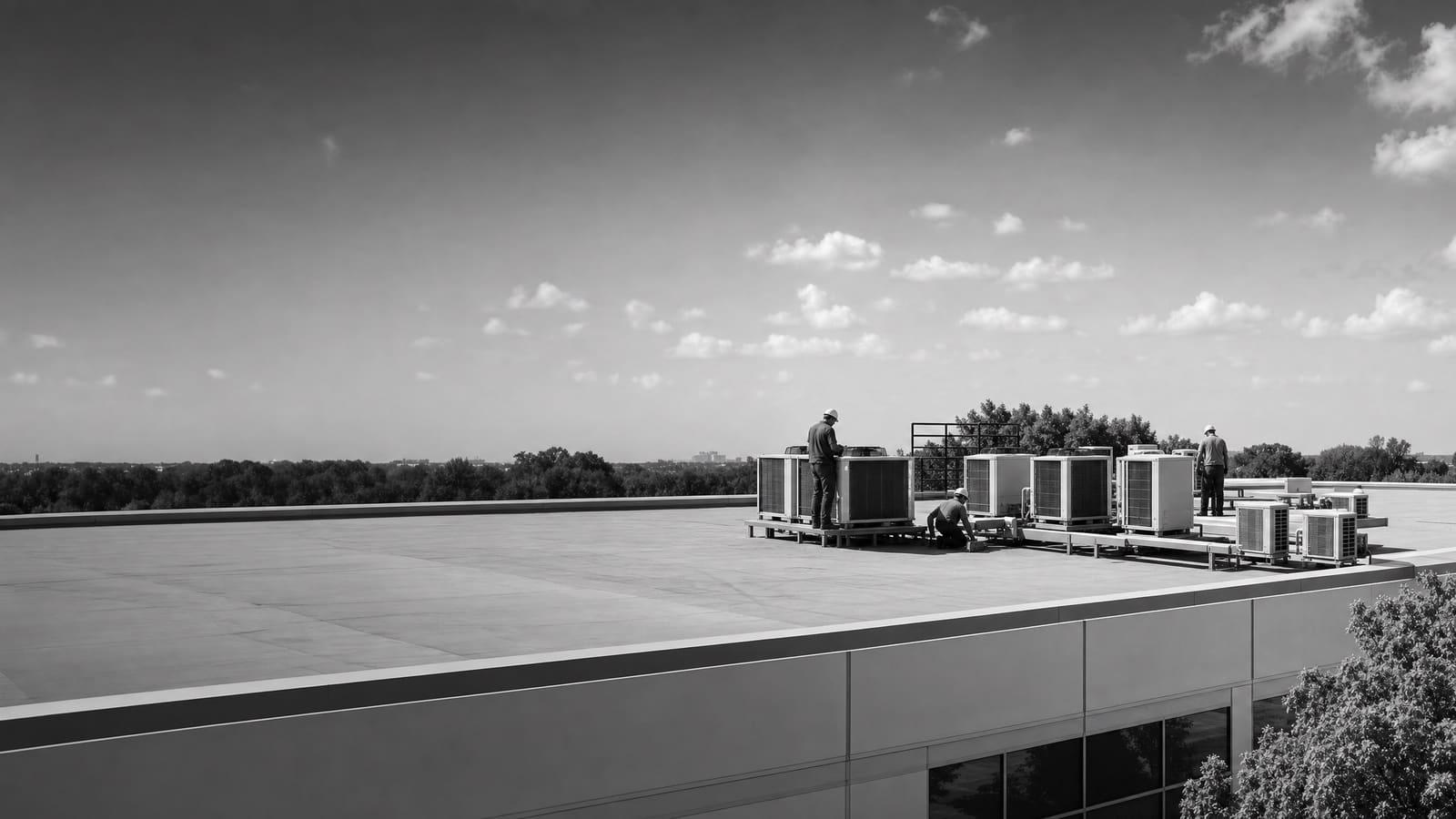
A commercial HVAC replacement covers the load check, equipment selection, permits, rigging, the connections on the roof, and commissioning before handoff. Replacement beats one more repair once a unit is past about fifteen years and needs frequent service, because a unit that old wastes energy every hour it runs. The Department of Energy puts that waste at $900 to $3,700 per unit each year for old, inefficient rooftop equipment.
A site review still has to confirm the real load, the curb and roof structure, panel capacity, gas line status, and crane access before any number on a quote means much.
THREE PATHS
Three ways owners handle an aging rooftop unit
Federal guidance frames rooftop replacement as three separate decisions, and most buildings drift into the worst one by default. Facility managers commonly wait until the unit no longer holds the space, needs constant service, or quits outright. At that point the choice is gone. You take whatever unit is available, at whatever price, on whatever schedule the supplier and the crane allow. Replacing proactively is usually the better business move, both against replacement-on-failure and against a straight like-for-like swap at the end of the unit's useful life. That is not a sales line. It comes out of a national program in which more than 200 organizations upgraded over 43,000 rooftop units and reported a combined $37 million in annual energy savings. The question worth answering early is which of the three you are actually choosing, because it changes your capital year and not just this month's repair invoice.
WHAT MOVES THE NUMBER
Where the money actually goes
There is no universal installed price for a commercial unit, because these six lines swing far more than the equipment sticker does. When you compare bids, compare them line by line here rather than at the bottom.
EQUIPMENT CHOICE
Gas heat or a heat pump on the new unit
Most replacements now come down to one question: does the new unit heat with gas, or with a heat pump? Rooftop heat pumps are mechanically close to standard air-conditioning rooftop units. They cool the same way, then run the cycle in reverse for heat, which takes the gas burner out of the picture.
Federal guidance is direct about geography. Across most of the U.S. South and West, today's heat pump rooftop units are an appropriate solution and are capable of handling most or all of a commercial building's winter heating demand. Heating efficiency does fall as outdoor temperatures drop, and it trends toward parity with electric resistance heat in a real cold snap. That is exactly why dual-fuel units exist: heat pump first, gas backup when the morning is cold enough to need it.
The deciding factors are specific to your Victorville building. What you pay for electricity against what you pay for gas. Whether the electrical service has room for the added load. Whether the roof and curb can carry the unit you want. None of those get answered from the parking lot, and all of them should be answered before equipment is ordered.
COMPLEXITY
What makes this a simple job or a hard one
Not every rooftop replacement carries the same risk. The difference shows up before anything is ordered, in how closely the new unit matches what the building already has.
LOWER COMPLEXITY
Same load, same fuel, same curb
Space use hasn't changed, the replacement matches the old unit's tonnage and heating type, the curb adapts cleanly, and the panel already carries the load. The permit path is short and the crane day is brief.
HIGHER COMPLEXITY
New load, new fuel, new footprint
Occupancy or plug load changed, tonnage grows, the unit is heavier or wider, or the project goes all-electric. Now you may be looking at structural review, a panel upgrade, gas line removal, and controls work.
SCOPING THE JOB
What a site review has to settle
A quote written from a nameplate photo is a starting number, not a price. The site review is where it becomes real, and there is a short list of things it has to settle.
Electrical capacity comes first on any project that adds load. The panel either has room for the new unit or the project includes a service upgrade, and you want to learn that before the order, not during the install. Physical constraints come next: curb dimensions, roof structure, crane reach, and where the truck can set up without closing the wrong half of the lot. Gas lines matter in both directions, whether you are keeping the burner or capping and removing the line.
Equipment availability belongs on the same list, because the unit you specify and the unit that can ship on your date are not always the same unit. So does the contractor's familiarity with the equipment class, which matters more on heat pump work than on a like-for-like swap. Incentive programs open, close, and run out of funding, so confirm any rebate is active in 2026 before you count it against the budget.
The five answers you need before ordering
Panel capacity, curb and roof structure, crane access, gas line disposition, and a confirmed lead time. A quote that doesn't name all five isn't comparable to one that does.
LOCAL PRACTICE
Permits are part of the schedule, not a formality
California building departments publish HVAC permit applications whose scope covers any mechanical upgrade or repair, not just new equipment on new construction. Those same permit lists treat electrical work, plumbing work, and re-roofing as their own triggers.
That shapes two decisions in Victorville. First, even a straight like-for-like swap needs a pulled permit and a passed inspection, so the contractor's installed price should include both and say so in writing. Second, if the roof section under the unit is near the end of its life, doing the roof work on the same mobilization is cheaper than two crane days, but it is two approvals rather than one. Confirm current scope and fees with the City of Victorville building division before the equipment order goes in, because inspection availability, not the crane, often sets the real date.
Ask before the order, not after
Get the permit types, who pulls them, and who schedules inspection named on the quote. If a bid is cheaper because permitting is left to you, it isn't cheaper.
OWNERSHIP
Who pays, and how many roofs you own
Two facts about your situation shape this project more than the equipment does: who carries the capital cost, and how many units you are responsible for. Both are worth settling before you compare bids, because together they decide whether you are buying the cheapest unit that works or the unit you want to standardize on for the next two decades. Owners who sort this out first tend to get bids that are actually comparable.
LEASED SPACE
The capital and operating split
In a leased building the landlord usually buys the unit while the tenant pays to run it. That split is why inefficient equipment keeps getting installed. If your lease allows sharing the cost of an efficiency upgrade, raise it before the spec is locked.
MULTIPLE SITES
One roof or a portfolio
If you hold several buildings, the first replacement quietly sets the standard for the rest: refrigerant, controls platform, service parts. Choosing site by site on price alone leaves you with a fleet no single service contract covers cleanly.
OVER THE LIFE OF THE UNIT
Phasing, procurement, and what it costs to run
Lifetime cost is where this decision is usually won or lost. An old, inefficient rooftop unit wastes $900 to $3,700 a year, so a roof carrying several aging units is bleeding real money before anything breaks. Federal minimum efficiency for commercial rooftop units was raised by a standard finalized in December 2015, which means anything installed today already beats a twenty-year-old unit by a wide margin. The high-performance specification DOE developed with manufacturers went further, targeting units that cut energy use by up to half against the prior standard, and more than twenty models now exceed it. The question is how far past minimum you go.
On procurement, put the efficiency tier, the heating type, and the ship date in writing, and agree in advance what happens to the price if the date slips. On a portfolio, phase worst-first rather than by building, so the units doing the most damage go first.
One more planning item: refrigerant. EPA rules under Section 608 govern how refrigerant is handled and recycled in stationary equipment, and older units may hold an ozone-depleting refrigerant. Recovery from the old unit is a regulated step with a certified technician, not a line to negotiate away.
COMPARING BIDS
Five things a comparable quote shows
Two quotes are only comparable when both answer the same questions. If one leaves an item off, it isn't cheaper. It's less finished, and the difference shows up as a change order.
01
The equipment, spelled out
Make, model, tonnage, efficiency tier, and heating type. Not "or equivalent unit."
02
Lead time with a date
When the unit ships, and what happens to the price and the schedule if that date moves.
03
Permits and inspections
Which permits get pulled, by whom, and that inspection sign-off is inside the installed price.
04
Rigging and site work
Crane, curb adapter, any structural work, lot closure hours, and disposal of the old unit.
05
Startup and commissioning
Charge, airflow, and control settings verified against spec, documented, and handed over with the warranty.
Get a defensible number
Price the equipment and the building together.
Send the address, operating target, and target opening date. Flux will identify what must be verified before the project can be priced.
Get a free estimateQuestions
Straight answers.
When does replacement beat one more repair?
Once a unit is past about fifteen years and needs frequent service, the repair is only buying time on equipment that wastes $900 to $3,700 a year while it runs. Waiting for total failure also removes your leverage over timing, equipment choice, and lead time.
Should a Victorville building go with a heat pump or keep gas heat?
Federal guidance says heat pump rooftop units are an appropriate solution across most of the West and can cover most or all of a commercial building's winter heating. Efficiency drops in a cold snap, so dual-fuel is the middle path. Local electricity and gas prices and panel capacity decide it.
Do you need a permit to replace a rooftop unit?
Plan on it. California HVAC permit scopes cover mechanical upgrades and repairs, not just new construction, and electrical work is typically its own trigger. Confirm the specific requirements with the City of Victorville building division, and make sure the permit and inspection sit inside the contractor's price.
How much does commercial HVAC installation cost in Victorville?
There is no honest universal number, because tonnage and efficiency tier, curb and structural work, crane access, and electrical capacity move the total more than the equipment sticker does. What you can compare is the operating side: an old unit wastes $900 to $3,700 a year against a new one.
What happens to the refrigerant in the old unit?
It gets recovered under EPA Section 608 rules, which govern the handling and recycling of refrigerant in stationary air-conditioning and heat pump equipment. Older units may hold an ozone-depleting refrigerant, so recovery is a certified, documented step and belongs on the quote rather than in the fine print.
Sources used for this guide
- [1]betterbuildingssolutioncenter.energy.gov — DOE Advanced Rooftop Unit Replacement Guidance
- [2]betterbuildingssolutioncenter.energy.gov — DOE Commercial Heat Pump Rooftop Unit Replacement Guidance
- [3]betterbuildingssolutioncenter.energy.gov — DOE High-Efficiency Commercial Rooftop Unit Toolkit
- [4]energy.gov — DOE Efficient Commercial Rooftop Air Conditioner Program
- [5]epa.gov — EPA Stationary HVAC Refrigerant Management
- [6]californiacity-ca.gov — HVAC Permits