THE DIRECT ANSWER
What a commercial HVAC replacement actually includes
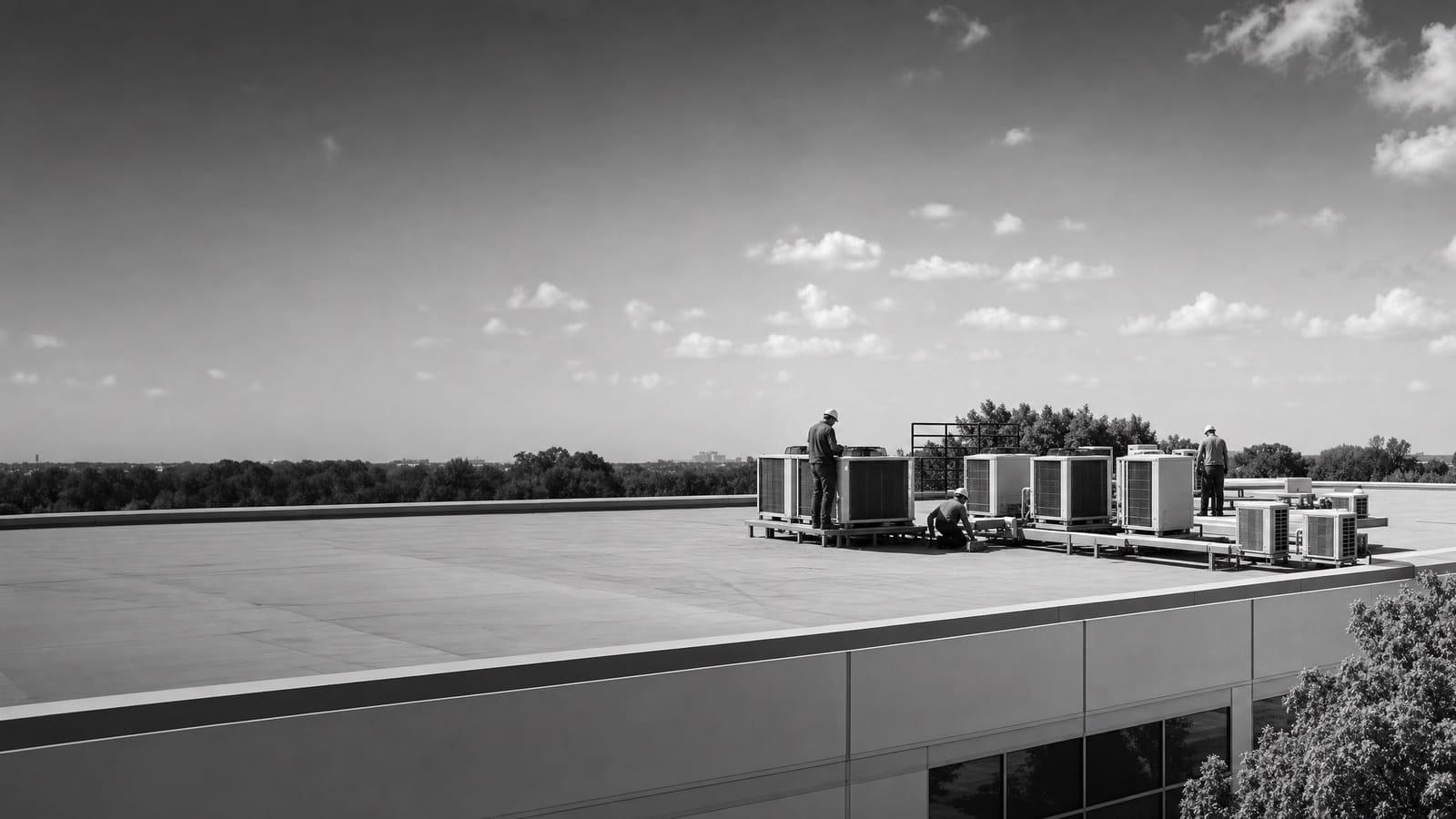
A commercial replacement covers the load calculation, the equipment order, the crane set, the curb and connection work, the permit, and commissioning. Replacing beats repairing again once a unit is past roughly fifteen years and failures start stacking up. DOE puts the annual energy waste of an old, inefficient rooftop unit at $900 to $3,700 per unit, so a second major repair on a tired machine often just buys another expensive year.
A site review still has to confirm tonnage against how the space is used today, the curb and roof structure, available electrical capacity, and crane reach from your lot.
THREE PATHS
The choice is not just which unit
Most Vallejo replacements come down to three paths, and the right one depends on what the building does after the crane leaves. A like-for-like swap gets the space conditioned fastest and keeps engineering and permit work simple. A high-efficiency or heat pump unit costs more on day one and pays back through the meter; DOE built its high-performance rooftop specification around units that cut energy use by up to half compared with the older standard. A controls retrofit is the third path, and DOE treats it as a real alternative for owners whose units still have service life left.
Vallejo sits in the West, and DOE describes today's heat pump rooftop units as fully capable of handling most or all winter heating demand across most of the U.S. South and West. That makes the electric option a live question here rather than a stretch.
WHERE THE MONEY SITS
The lines that move between two bids
Nobody can give you an honest installed price for your roof without seeing it. What they can do is show you where the money sits, so you can tell a thin quote from a complete one. These are the lines that move most between two bids on the same building.
BUYING GUIDANCE
How to avoid buying the same unit twice
The most expensive rooftop replacement is the one you buy twice. That usually happens one of two ways. The new unit gets sized off the old nameplate instead of how the building is used now, or the decision waits until the unit dies in August and every choice gets made under pressure.
Sizing first. A unit that went in twenty years ago was sized for that building's occupancy, lighting, and equipment at that time. Offices thinned out, LED lighting cut heat load, a tenant added a server closet, someone re-roofed and tightened the envelope. Carrying the old tonnage forward locks in the comfort complaints you already have, and an oversized unit short-cycles its way to a shorter life.
Timing second. DOE is direct about this: owners commonly delay replacement until a unit can no longer condition the space, needs constant service, or fails outright, and proactively replacing an inefficient unit is often the smarter business move than replacement-on-failure or even a like-for-like swap at end of life. Old, inefficient units waste $900 to $3,700 each per year while you decide. A unit past fifteen that has already taken one major repair is telling you where it is headed. Buy the planned project and you get equipment choice, a scheduled crane, and a price that was not set by an emergency.
SIDE BY SIDE
What makes one job simple and another complicated
Two buildings on the same street can get very different numbers for the same tonnage. The difference is almost never the equipment. It is what the roof, the panel, and the parking lot allow.
LOWER COMPLEXITY
Same size, same fuel, open lot
Matching tonnage on the existing curb, gas and electric already sized for it, and enough room to set the crane. Permit scope stays straightforward and the outage is a morning.
HIGHER COMPLEXITY
New footprint, new fuel, tight access
Larger or heavier equipment brings roof structure into the conversation. Going all-electric raises electrical capacity. A tight site can mean a bigger crane, a lane closure, or an after-hours set.
BEFORE THE BID
What a real site review checks
A quote written from a phone call is a guess with a number on it. Before anyone commits to a price, someone should be on your roof with the nameplate, a tape, and a look at your electrical room.
DOE's own checklist for commercial rooftop decisions covers the same ground: climate and heating load, the utility bill and emissions impact of the fuel choice, building type and how the space is used, whether the equipment is actually available, and infrastructure, meaning electrical capacity, physical constraints on the roof, and existing gas lines. Contractor availability and knowledge for the technology you pick is on that list too, which matters more than it sounds if you would be the first heat pump rooftop unit that crew has set.
Then add the site items no national guide can know. Curb dimensions and condition, roof age, how the crane reaches the setting point, which stalls close and for how long, whether tenants need notice, and how the unit ties into whatever controls the building already runs. Every one of those either confirms the number or changes it. Finding out after the deposit is the expensive version.
Settle this before the deposit
Ask whether the price includes permits, inspections, rigging, the curb adapter, refrigerant recovery, and commissioning, or whether those arrive later as change orders. A complete quote says so in writing.
VALLEJO SPECIFICS
Permits, roofs, and the order you do things in
California building departments treat a rooftop change-out as permit work. Mechanical, electrical, and plumbing upgrades or repairs all require a permit, and so does re-roofing, both overlay and tear-off. That second item is the one owners miss, and it changes the order of operations.
If your roof membrane is within a few years of replacement, doing the roof after the new unit lands means paying twice for access and cutting around equipment that just went in. Doing both together means one crane mobilization, one round of curb work, and one permit and inspection schedule.
So before you book anything, ask two questions: how old is the roof under that unit, and what does the city need on the application for this exact scope. Confirm that with the Vallejo permit desk rather than assuming the last job's list still applies.
Call the permit desk before the crane is booked
Confirm which permits your scope triggers and how inspections get scheduled. A crane day is booked weeks out. An inspection that lands after the set is a nuisance, but a permit that is not open on the morning of the lift stops the job.
OWNERSHIP
Two things that outlive the install
The install is a morning. What you own afterward is a machine with a refrigerant, a service history, and a place in whatever else sits on that roof. Rooftop units condition close to half of all commercial floor space in the country, which makes this the most common equipment decision a facility owner makes, and the one most often made twice because the first one was made in a hurry.
Two decisions during the buy shape the fifteen years after it. Both cost nothing to settle at quote time and get expensive to fix later.
REFRIGERANT
Your roof is about to be mixed
Federal rules under the Clean Air Act govern how refrigerant is handled, recovered, and recycled in stationary equipment. New units ship on newer refrigerants, so a roof with four units can end up carrying two service standards. Tell your service contractor before it becomes a surprise.
PORTFOLIO
Decide per site, not per policy
DOE is explicit that some buildings in a portfolio suit heat pump rooftop units better than others. If you hold more than one Vallejo property, run the same checklist at each and let the electrical room and the heating load answer, instead of setting one rule for all of them.
OVER THE LIFE
Phasing a roof full of units
If you have one unit, this is a project. If you have six, it is a program, and the sequencing is worth more than any single line on any single quote.
Start by ranking, not replacing. Age, repair history, and how critical the space underneath is will usually sort a roof into three groups: replace now, replace on a planned date, and leave alone with a controls upgrade. That ranking survives a budget cycle. A panic replacement does not.
Then buy on lead time. Equipment availability is a real constraint, and DOE lists it among the core considerations for rooftop decisions alongside electrical capacity and contractor knowledge. A unit you can get in March is worth more than a slightly better unit you cannot get until August. Order early for everything on the planned list and you convert an emergency into a scheduled Tuesday.
Finally, count the whole life. The purchase price is the visible number. The invisible one is the $900 to $3,700 a year an old, inefficient unit hands back to the utility, plus the service calls that come with a machine past fifteen. Efficiency tiers that look expensive on a bid sheet read differently spread across the years that unit stays on the roof, and if you are replacing several, you make that call every time.
THE CHECKLIST
Five things a comparable quote has to show
Two bids are only comparable when they cover the same scope. Ask every bidder to break out these five in writing before you compare totals.
01
Equipment, tonnage, and efficiency tier
The exact model, its capacity, its efficiency rating, and the load calculation that chose it, not the old nameplate.
02
Lead time, stated as a commitment
The availability window for that model, and what happens to the schedule and the price if it slips.
03
Curb, structure, and roof work
Whether a curb adapter is included, and what happens if the roof or structure needs work once the old unit comes off.
04
Permits, inspections, and rigging
Who pulls the permits, who books and pays for the crane, and who meets the inspector.
05
Commissioning and documentation
Startup, charge, airflow, and control settings verified against spec and handed to you in writing so the warranty holds.
Get a defensible number
Price the equipment and the building together.
Send the address, operating target, and target opening date. Flux will identify what must be verified before the project can be priced.
Get a free estimateQuestions
Straight answers.
When is replacing better than repairing again?
Once a unit is past roughly fifteen years, needs frequent service, or can no longer hold the space, repair money starts renting time instead of buying it. DOE puts the annual energy waste of an old, inefficient rooftop unit at $900 to $3,700, and calls proactive replacement the smarter business move compared with waiting for failure.
Should the new unit be a heat pump?
It is a real option here. DOE describes today's heat pump rooftop units as capable of handling most or all winter heating demand across most of the U.S. West. The answer turns on your electrical capacity, your gas and electric rates, and whether a dual-fuel unit fits the building better than an all-electric one.
How long is the building without cooling?
The set itself is usually a morning to a day for a single packaged unit. The variable is equipment availability, which is why lead time belongs on the quote right next to the price rather than in a phone call after you sign.
Do I need a permit to replace a rooftop unit in Vallejo?
Plan on it. California building departments require permits for mechanical, electrical, and plumbing upgrades or repairs, and re-roofing pulls its own permit. Confirm the exact scope with the Vallejo permit desk before the crane day is booked, since the permit has to be open on the morning of the lift.
What does a new unit change about service?
New equipment ships on newer refrigerants, so a roof with several units can end up carrying two service standards at once. Federal rules govern how refrigerant is handled, recovered, and recycled, so bring your service contractor into the conversation before the swap, not after.
Sources used for this guide
- [1]betterbuildingssolutioncenter.energy.gov — DOE Advanced Rooftop Unit Replacement Guidance
- [2]betterbuildingssolutioncenter.energy.gov — DOE Commercial Heat Pump Rooftop Unit Replacement Guidance
- [3]betterbuildingssolutioncenter.energy.gov — DOE High-Efficiency Commercial Rooftop Unit Toolkit
- [4]energy.gov — DOE Efficient Commercial Rooftop Air Conditioner Program
- [5]epa.gov — EPA Stationary HVAC Refrigerant Management
- [6]californiacity-ca.gov — HVAC Permits