THE SHORT ANSWER
What a commercial HVAC replacement includes
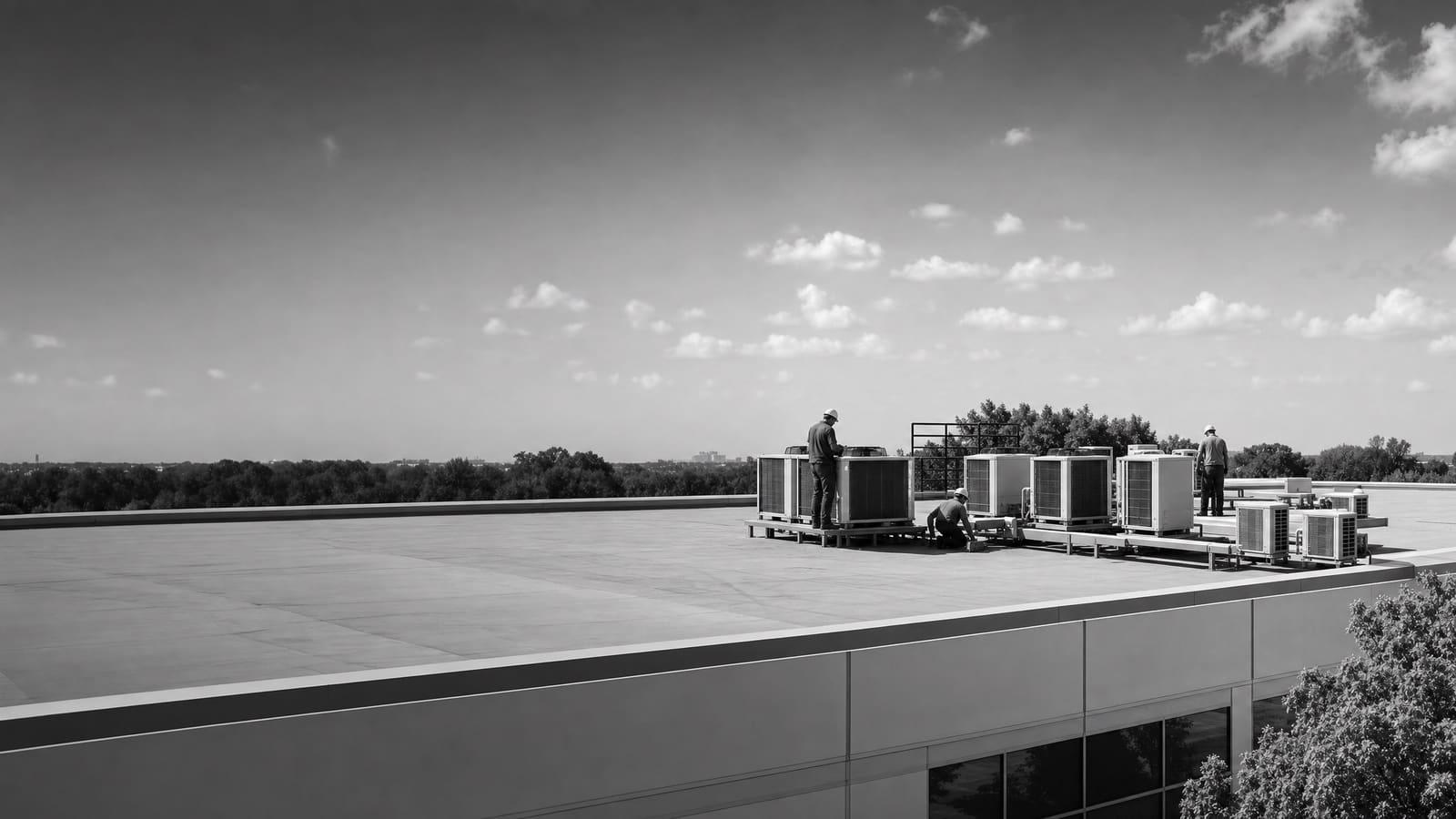
A commercial HVAC replacement covers the load check, equipment selection, removal with certified refrigerant recovery, the curb adapter and any roof work, rigging and the crane set, gas and power connections, controls, permits, and commissioning. Replacement wins over another repair once the unit is past fifteen years and the repairs are stacking: old, inefficient rooftop units waste $900 to $3,700 each per year in energy alone.
A site review still has to confirm tonnage against how the space is used now, curb and structural fit, crane reach from the lot, and whether the electrical service supports the unit you want.
THE DECISION
Three ways to replace a rooftop unit
Most commercial replacements come down to three paths, and the difference shows up in operating cost rather than on crane day. A like-for-like unit is the fastest route back to conditioned space and the cheapest to engineer. A high-efficiency unit uses the same curb and the same connections, but equipment built to the high-performance rooftop specification cuts energy use by up to half against the old minimum standard, which is where the payback lives. A heat pump rooftop unit is built much like a standard air-conditioning unit with reverse-cycle heating added, and comes as dual fuel, all-electric, or cold climate. Across most of the West, current heat pump units can carry most or all of the winter heating load. The gating questions are electrical capacity, existing gas lines, physical space on the roof, model availability, and what your rates and incentives do to the math.
WHAT MOVES THE NUMBER
The lines that decide the price
Ask for these as separate lines instead of one lump sum. This is where quotes drift apart, and where a low bid usually turns out to have left something for later.
IN PRACTICE
Choose the equipment before the crane is booked
The most expensive version of this project is the one you don't choose. Waiting until a unit fails means taking whatever equipment is available, at whatever price, in the week you have the least leverage. Replacing on a plan compares well against both replacement-on-failure and a like-for-like swap at end of service life, because you still get to pick the efficiency tier and the timing.
Start with the load, not the nameplate. A unit installed twenty years ago was sized for a floor plan, an occupancy, and a lighting load that probably don't exist anymore. Confirming the load either justifies the same tonnage or catches the oversizing that has been short-cycling and generating comfort complaints for years.
Then check availability early. Equipment lead time, not labor, usually sets the schedule, and a specific model with a real delivery date is worth more than a lower number attached to a generic standard unit. If a heat pump unit is in play, add one more question: has the contractor installed and commissioned them before? Contractor familiarity is a documented gating factor on these projects, and it shows up in the startup, the controls setup, and the first winter.
SCOPE CHECK
What makes this simple, and what makes it hard
Two identical-looking rooftop units can price very differently. The gap is almost always in what has to change around the unit, not in the unit itself.
LOWER COMPLEXITY
Same curb, same fuel
The replacement matches the old footprint and connections, the roof structure is sound, the lot gives the crane its reach, and the space is used the way it always was. Permits are straightforward and the visible disruption is short.
HIGHER COMPLEXITY
New footprint or a fuel change
Tonnage or footprint grows, a curb adapter or structural review is needed, gas has to be capped or rerouted, or an all-electric unit outruns the panel. Tight access, a live tenant, or an aging roof each add another trade.
BEFORE THE QUOTE
What a site review has to settle
A number produced from a photo of the nameplate is a placeholder. Turning it into a price you can hold someone to takes a roof visit and a short list of confirmations.
Sizing comes first: how the space is used today, what the occupancy and equipment loads actually are, and whether the old tonnage still fits. Then the physical constraints — curb dimensions, roof structure under the new weight, clearances, and whether the unit you want fits where the old one sat. Infrastructure is next. Electrical capacity is the item that most often changes the plan on an all-electric conversion, and existing gas lines decide whether a dual-fuel unit is the simpler path. Access is last: where the crane sets up, how far it has to reach, how many stalls close, and for how long.
Every one of those answers belongs in the proposal as a line. When a bid comes in materially lower than the others, it is usually missing one of them, and the missing item reappears as a change order once the old unit is already on the ground.
Get it on the proposal
Ask for the load basis, the curb and structural scope, the electrical and gas scope, and the access plan as four separate lines. Four questions up front are cheaper than one change order on crane day.
VACAVILLE SPECIFICS
Confirm the permit path before booking the crane
California building departments treat mechanical work as permit work, and the published trigger lists are broad — any mechanical, electrical, or plumbing upgrade or repair, plus re-roofing, whether overlay or tear-off. Two things follow for a rooftop replacement here. First, don't assume a like-for-like swap is exempt. Confirm the application, the scope, and the inspection sequence with the city's building division before a crane date is locked, because inspection timing is what usually slips. Second, if the roof under the unit is near the end of its life, the re-roof is its own permitted job. Sequencing both together means one round of crane staging instead of two.
One trip, not two
If the membrane is within a few years of replacement, price the re-roof and the unit as one sequence. Crane staging, lot closures, and tenant notices are the expensive part to repeat, and both jobs are permitted work either way.
AFTER STARTUP
Two things that outlast the install
The install ends on a Tuesday. The consequences run for the service life of the equipment. Two of them are worth settling in the contract rather than discovering later: what the handoff paperwork actually contains, and how refrigerant is handled coming out of the old unit and going forward in the new one. Neither adds much when it is in the original scope. Both are awkward and expensive to fix after the crane leaves. They also decide how year three goes, when a warranty claim or a service call arrives and someone has to prove what was installed and how it was set up.
PAPERWORK
Commissioning and warranty records
Startup readings, refrigerant charge, airflow, and control settings should be documented and handed over, with the warranty registered in your name. Manufacturer coverage often depends on proof of correct startup, and that proof is hard to reconstruct a year later.
REFRIGERANT
Recovery and handling are regulated
Federal rules govern the handling and recycling of refrigerant in stationary air-conditioning and heat pump equipment. The old charge has to be recovered by certified technicians rather than vented, and the same rules follow the new unit through its service life.
PLANNING AHEAD
When the roof has more than one aging unit
If four units are all pushing twenty years, replacing each one the week it dies is the most expensive schedule available and the least predictable. Rank them instead, by age, repair history, and which spaces generate the complaints. Rooftop units past fifteen years waste substantial energy compared with current models, and an old, inefficient unit runs $900 to $3,700 a year in wasted energy by itself. Multiply that across the roof and the case for pulling replacement forward usually makes itself.
Standardizing helps more than most owners expect. One manufacturer and one control platform across the roof makes the second and third replacements faster to quote, simplifies the service contract, and keeps a single parts shelf instead of four.
Finally, look at the whole cost rather than the invoice. The purchase price is a single decision; the energy bill is that same decision repeated every month for the life of the unit. Incentives are one of the standard considerations on any heat pump conversion, so confirm what your utility offers and what it requires before equipment is ordered. After the fact is usually too late.
THE QUOTE
Five things a comparable quote shows
Two bids are only comparable when both show the same five things. If one is missing an item, ask for it before you compare totals. That gap is usually where the price difference is hiding.
01
The load basis
Tonnage justified by current occupancy and use, with the old nameplate treated as reference only.
02
Model, efficiency tier, and delivery date
A named model with its rated efficiency and a real availability date, not a generic standard unit.
03
Curb, structural, and roof scope
Adapter or new curb, any framing work, and who patches and seals the roof around it.
04
Rigging and access plan
Crane size, staging area, stalls closed, and the hours the lot is affected.
05
Startup and closeout
Charge, airflow, and controls verified in writing, permits closed, warranty registered.
Get a defensible number
Price the equipment and the building together.
Send the address, operating target, and target opening date. Flux will identify what must be verified before the project can be priced.
Get a free estimateQuestions
Straight answers.
When does replacement beat another repair?
When repairs start stacking on a unit past fifteen years. Older rooftop units waste substantial energy against current models, and an old, inefficient one commonly wastes $900 to $3,700 a year on its own. At that point a second or third major repair is money spent keeping a losing unit alive.
Is a heat pump rooftop unit worth considering here?
It is usually worth pricing. Heat pump rooftop units are built much like standard air-conditioning units with reverse-cycle heating added, and across most of the West they can carry most or all of the winter heating load. The deciding factors are electrical capacity at the panel, your gas and electric rates, and available incentives.
What actually drives the installed price?
Tonnage and efficiency tier, curb and structural work, crane access and closure time, electrical or gas changes, and controls. There is no honest universal installed price for a commercial unit. Ask for those items as separate lines and the difference between bids becomes obvious.
Does a like-for-like swap still need a permit?
Assume yes and confirm. California permit guidance lists mechanical upgrades and repairs as permit work, so check the scope and inspection sequence with Vacaville's building division before a crane date is locked in.
What happens to the refrigerant in the old unit?
It has to be recovered by certified technicians under the federal rules covering stationary air-conditioning and heat pump equipment, never vented. Recovery and disposal should appear on the quote rather than turning up later as an extra.
How long does the project take?
The set itself is short. Equipment availability, permit review, and inspection timing set the real calendar, which is why a named model with a firm delivery date belongs on the quote right next to the price.
Sources used for this guide
- [1]betterbuildingssolutioncenter.energy.gov — DOE Advanced Rooftop Unit Replacement Guidance
- [2]betterbuildingssolutioncenter.energy.gov — DOE Commercial Heat Pump Rooftop Unit Replacement Guidance
- [3]betterbuildingssolutioncenter.energy.gov — DOE High-Efficiency Commercial Rooftop Unit Toolkit
- [4]energy.gov — DOE Efficient Commercial Rooftop Air Conditioner Program
- [5]epa.gov — EPA Stationary HVAC Refrigerant Management
- [6]californiacity-ca.gov — HVAC Permits