THE DIRECT ANSWER
Commercial HVAC replacement and installation in Upland.
A commercial HVAC replacement includes load review, equipment selection, permitting, removal, rigging, connections, controls, startup, testing, and handoff. Replacement becomes more useful than another repair when an older unit needs frequent service, cannot hold comfort, wastes energy, or risks failing during critical operating hours.
A site review should verify the present load, roof and curb condition, electrical capacity, gas service, controls, crane access, ventilation needs, and equipment availability.
FIRST DECISION
Choose the project path before choosing a model
The old unit nameplate is a starting point, not a complete design. A direct replacement can work when the space, occupancy, hours, and internal heat loads remain stable. A right-sized replacement is more useful when the building use has changed or the old system never kept every area comfortable.
A heat pump rooftop unit adds another choice. It can provide cooling and reverse-cycle heating in one package. DOE guidance says heat pump rooftop units can suit mild-to-moderate winter conditions, but the decision still depends on electricity and gas costs, electrical capacity, physical constraints, and the building load.
Ask for more than one workable path when the site allows it. Each option should state capacity, heating type, efficiency, electrical requirements, availability, control features, and included work.
BUDGET CONTROL
What moves the installed price
No supplied source supports one universal installed price. A useful budget separates the equipment from the site work and clearly identifies allowances.
EQUIPMENT CHOICES
Compare complete operating systems, not labels
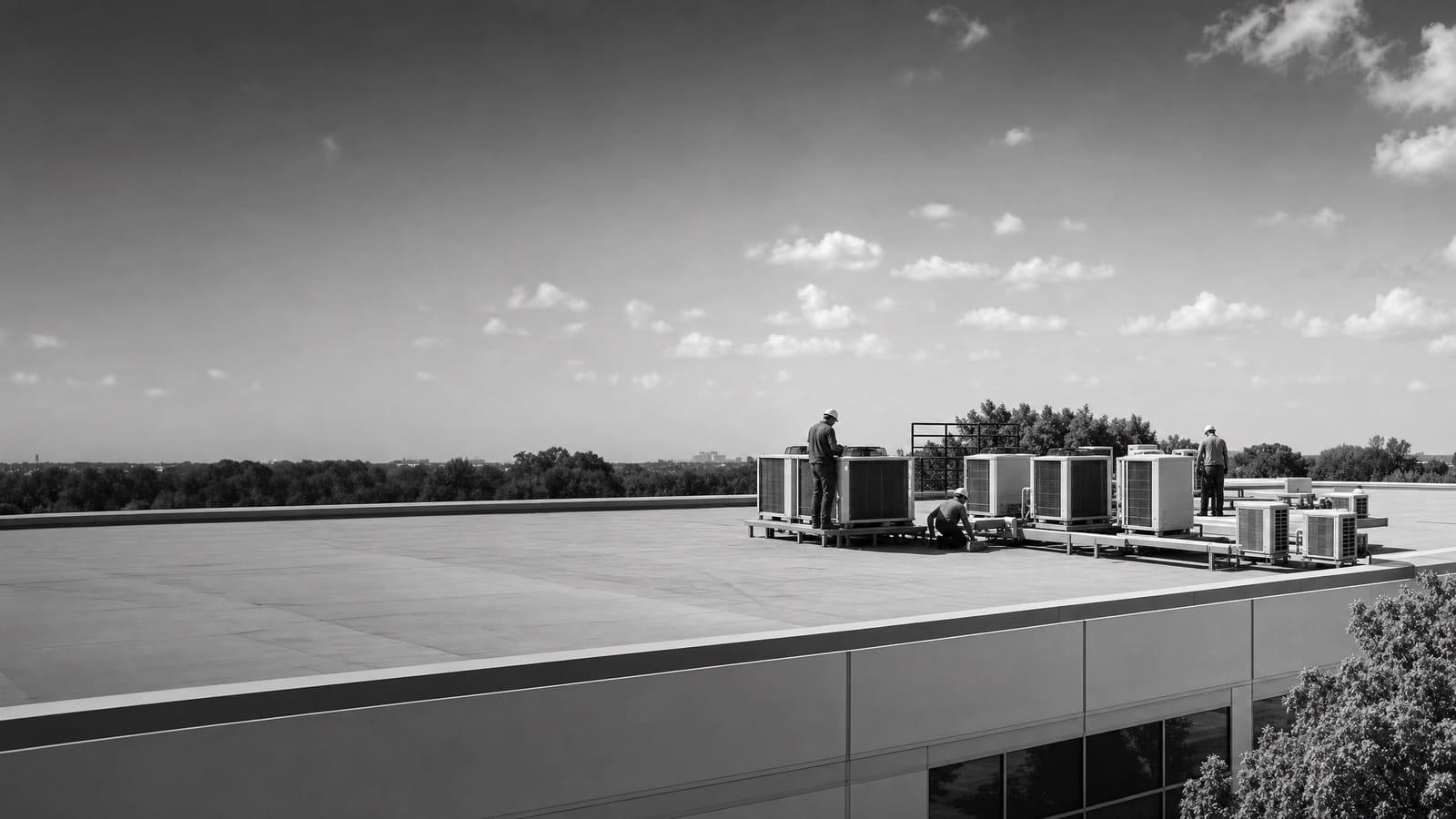
A packaged rooftop unit places cooling, fans, controls, and usually heating in one roof-mounted cabinet. It is common in commercial buildings and can simplify replacement when the existing curb, ducts, utilities, and roof can support the new unit. The quote should still identify every required adapter and connection.
A conventional rooftop air conditioner may pair mechanical cooling with gas heat or another heating source. A heat pump rooftop unit provides reverse-cycle heating as well as cooling. DOE guidance recommends reviewing climate, utility costs, emissions goals, building type, equipment supply, electrical capacity, physical limits, gas lines, and contractor capability before converting. All-electric equipment may require more electrical capacity. A dual-fuel design can preserve another heating source while using the heat pump under selected conditions.
Efficiency matters, but it is not the only operating issue. Fan control, economizer operation, ventilation, staging, sensors, and scheduling can change how the unit performs in daily use. Compare expected operation at the building's real occupancy and hours. Do not accept a higher-efficiency label as a substitute for load review, control sequences, or commissioning.
PROJECT COMPLEXITY
A simple swap can become a building project
The lowest-complexity replacement reuses suitable infrastructure. Complexity rises when capacity, fuel, footprint, weight, ventilation, or control strategy changes.
LOWER COMPLEXITY
Compatible replacement
The new unit fits the verified load, curb, ducts, utilities, structure, and controls. Access is clear, and work can occur within a planned shutdown.
HIGHER COMPLEXITY
System change
The project changes capacity, heating type, electrical demand, roof support, ductwork, ventilation, automation, or the number of occupied areas affected.
SITE REVIEW
Measure what the new unit must actually serve
Start inside the building. Record the areas served by each unit, operating hours, occupancy, major plug loads, ventilation demands, comfort complaints, and any planned tenant or process changes. A unit that was correct for an earlier use may be wrong for the space today.
Then inspect the equipment path. Document the existing model, capacity, heating type, voltage, controls, curb dimensions, duct openings, drain routing, gas connection, disconnect, and service clearances. Check roof access and the condition around the curb. The team also needs a safe crane location, a lifting path, and a plan for protecting people, vehicles, roofing, and ongoing operations.
Finally, decide what must remain live during the work. One failed unit may affect only one zone, while a shutdown involving controls or electrical distribution can affect several systems. Define temporary cooling or heating only when the operating risk justifies it. Put shutdown limits and restoration responsibilities into the written scope.
Bring useful records
Provide nameplate photos, service history, utility data, control drawings, roof information, lease restrictions, comfort complaints, and any planned changes to occupancy or equipment.
OWNERSHIP VIEW
Balance urgent uptime with long-term operation
A failed unit creates pressure to restore service, but urgency should not erase the basic checks. Confirm compatibility, availability, included work, startup requirements, and warranty conditions before approving a rushed replacement.
For planned work, compare more than purchase price. Consider expected maintenance, controls, heating energy, electrical demand, refrigerant service, parts support, and the cost of future downtime. DOE notes that rooftop units more than 15 years old can waste substantial energy compared with newer equipment, and proactive replacement can be more useful than waiting for failure. Age alone is not the decision; condition, performance, repair frequency, and operating risk complete the picture.
ACTIVE FAILURE
Protect operations
Confirm the fastest compatible option, define temporary measures if needed, and keep safety, permitting, startup, and documentation in scope.
PLANNED REPLACEMENT
Use the planning window
Review loads, compare heating choices, coordinate roof work, group similar units, and schedule disruption around the facility.
PROJECT DELIVERY
Plan the work from order to handoff
Procurement begins only after the selected unit and field scope agree. The contractor should confirm the model, options, voltage, capacity, curb interface, connection locations, controls, and delivery conditions before release. Substitutions need the same review. A unit with similar nominal capacity may have different dimensions, weight, electrical needs, airflow, or control requirements.
Before installation, complete permits, equipment staging, roof protection, lifting plans, access control, shutdown notices, and coordination with occupants. Prepare curb adapters, structural work, wiring, piping, drains, and control components when practical. A detailed pre-installation plan keeps the crane event from becoming the start of field design.
After setting the unit, installation is not complete when it turns on. Startup should verify airflow, fan operation, heating and cooling stages, sensors, safety devices, ventilation, drainage, refrigerant condition, and the intended control sequence. Record results, correct deficiencies, label the equipment, and deliver manuals, warranty information, final settings, and maintenance needs. EPA refrigerant rules also govern handling and recycling during stationary HVAC service and replacement, so refrigerant recovery and disposition should be assigned to qualified personnel.
QUOTE CHECK
Five things every comparable quote should show
Use the same scope checklist for every bidder. A lower total is not comparable when equipment, field work, controls, or closeout tasks are missing.
01
Exact equipment
List manufacturer, model, capacity, heating type, efficiency, voltage, options, warranty, and stated availability.
02
Complete field scope
Define removal, recovery, curb work, roofing, rigging, ducts, drains, gas, electrical, controls, and disposal.
03
Assumptions and exclusions
Identify allowances, concealed conditions, structural review, utility work, after-hours labor, and excluded repairs.
04
Schedule and disruption
Show ordering, delivery, shutdown, crane work, inspections, restoration, and responsibilities for occupied areas.
05
Startup and closeout
Require commissioning results, control verification, training, manuals, warranty documents, permits, and final approvals.
Get a defensible number
Price the equipment and the building together.
Send the address, operating target, and target opening date. Flux will identify what must be verified before the project can be priced.
Get a free estimateQuestions
Straight answers.
When should a commercial rooftop unit be replaced instead of repaired?
Replacement deserves a full comparison when the unit needs frequent repairs, cannot maintain comfort, has major component failures, uses too much energy, or creates unacceptable downtime risk. DOE guidance notes that units more than 15 years old can waste substantial energy compared with newer models. Still, age is not a stand-alone rule. Review condition, repair history, parts availability, performance, operating importance, and the cost of keeping the existing system dependable.
Should the new commercial HVAC unit match the old capacity?
Not automatically. Confirm how the space is used today, including occupancy, hours, equipment loads, ventilation, zoning, and building changes. A compatible replacement can be sensible when those conditions remain stable. If the old unit short-cycled, ran constantly, failed to control comfort, or served a space that changed use, a fresh load review can prevent the same problem from being built into the new system.
Is a commercial heat pump rooftop unit a good replacement choice?
It can be. DOE guidance says heat pump rooftop units are appropriate for many mild-to-moderate winter applications, including much of the West. The site decision should compare heating loads, electricity and gas costs, electrical capacity, physical constraints, equipment availability, emissions goals, and control needs. Ask for all-electric, dual-fuel, and conventional options only when each is technically workable for the building.
What should happen before a rooftop HVAC unit is ordered?
Verify the load, service area, curb dimensions, duct openings, roof condition, structural needs, voltage, electrical capacity, gas service, drainage, controls, ventilation, access, and lifting conditions. Confirm the exact model and factory options against those findings. The project team should also settle permit responsibilities, shutdown limits, equipment availability, substitution rules, and the required startup records before releasing the order.
How can an owner compare commercial HVAC installation quotes?
Give each bidder the same requested scope and compare line by line. Check the exact unit, factory options, warranty, curb work, roof work, crane, electrical, gas, controls, ventilation, permits, disposal, startup, testing, training, and closeout documents. Review exclusions and allowances closely. A quote that omits field work may look cheaper while leaving the owner responsible for essential parts of the installation.
Does commercial HVAC replacement require refrigerant planning?
Yes. The proposal should identify the new equipment and its refrigerant, state how refrigerant from the removed unit will be recovered, and explain any service implications for the facility. EPA rules address refrigerant handling and recycling in stationary air-conditioning and heat pump equipment. For sites with several generations of equipment, keep an accurate asset list so technicians arrive with suitable tools, parts, and service information.
What does commissioning add after installation?
Commissioning verifies that the installed system operates as intended, not merely that it starts. Checks should cover airflow, cooling and heating stages, fan operation, ventilation, sensors, safeties, drains, controls, schedules, alarms, and communication with building automation where applicable. The owner should receive recorded results, corrected settings, equipment labels, manuals, warranty documents, and clear maintenance requirements.
Sources used for this guide
- [1]betterbuildingssolutioncenter.energy.gov — DOE Advanced Rooftop Unit Replacement Guidance
- [2]betterbuildingssolutioncenter.energy.gov — DOE Commercial Heat Pump Rooftop Unit Replacement Guidance
- [3]betterbuildingssolutioncenter.energy.gov — DOE High-Efficiency Commercial Rooftop Unit Toolkit
- [4]energy.gov — DOE Efficient Commercial Rooftop Air Conditioner Program
- [5]epa.gov — EPA Stationary HVAC Refrigerant Management
- [6]californiacity-ca.gov — HVAC Permits