THE DIRECT ANSWER
What a commercial HVAC replacement actually includes
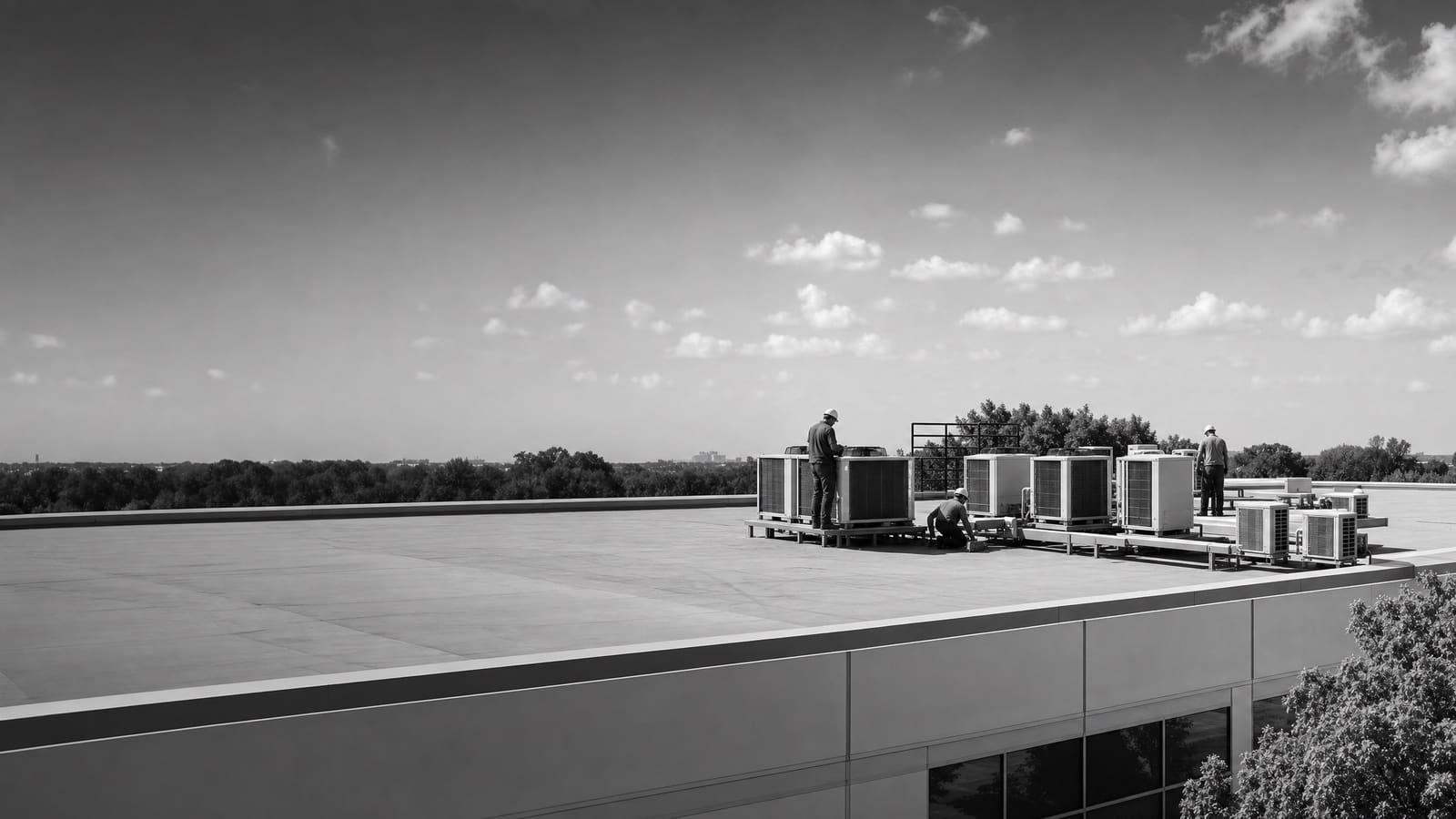
A commercial HVAC replacement covers the load check, equipment selection, rigging and set, the electrical, gas, and refrigerant connections, and commissioning before handoff. Replacement beats another repair once the unit itself has become the recurring problem. DOE puts the annual waste from an old, inefficient rooftop unit at $900 to $3,700 per unit, and units past fifteen years are where that waste concentrates.
A site review still has to confirm the actual load, the curb and the structure under it, electrical capacity at the panel, gas line status, and crane access before any number is real.
THREE WAYS THIS GOES
Replace on failure, swap, or upgrade
Most rooftop units get replaced the day they quit. DOE's guidance is blunt about the cost of that habit: facility managers often wait until a unit no longer conditions the space, needs frequent maintenance, or fails completely, and replacing proactively is usually the better business move than replacement-on-failure, or even than a like-for-like swap at the end of a unit's service life.
So the real choice is about timing and ambition. You can wait, you can plan a straight swap, or you can plan an upgrade. DOE's Advanced RTU Campaign adds a fourth option worth knowing about: owners can either replace old units with more efficient ones or retrofit the existing unit with advanced controls, depending on which makes better financial sense. All of these are easier decisions to make in February than in the middle of a July outage with tenants calling.
WHAT MOVES THE NUMBER
The lines that decide your installed price
Nobody can price a commercial replacement from a photo of the roof. These are the lines that actually move the installed number, roughly in the order they surprise people.
CHOOSING THE EQUIPMENT
Size it for today, then decide what it burns
Two questions decide the equipment, and they are worth answering in that order. First, what load does the space actually have today? The old nameplate is a starting point, not an answer, because occupancy, plug loads, and the envelope all drift over fifteen years or more. Sizing the new unit from the failed one carries forward whatever the failed one got wrong, and that mistake then lives on your utility bill for another equipment lifetime.
Second, does this unit need to burn gas? Heat pump rooftop units are technologically similar to standard air-conditioning units — same general footprint, same curb work, same crane day — but they add reverse-cycle heating. DOE says that for most of the U.S. South and West, today's heat pump rooftop units are an appropriate solution and fully capable of addressing most or all of the winter heating demand. The caveat is fair to name: DOE points to the February 2021 Texas freeze as evidence that southern climates can still see periods of sharp winter heating demand, which is exactly why dual-fuel and backup-heat configurations exist.
Efficiency tier is the third question, and it is simpler than it sounds. Units built to DOE's high-performance specification were designed to cut energy use by as much as 50 percent against the old standard, and manufacturers have since offered more than twenty models that exceed that spec.
SIDE BY SIDE
When it is one morning, and when it is not
The same tonnage can be a one-morning job on one roof and a multi-week project on another. What separates them is almost never the unit itself.
LOWER COMPLEXITY
Straight swap conditions
Same tonnage on an existing curb, an open lot with clean crane reach, adequate panel capacity, and heating fuel unchanged. The load calculation confirms what is already up there. Engineering and review stay light.
HIGHER COMPLEXITY
Where the scope expands
Tonnage changes, the roof needs structural work, the crane has no clean shot, or the unit goes all-electric and the panel will not carry it. DOE flags electrical capacity, physical constraints, and existing gas lines as the three infrastructure items that decide which side you land on.
BEFORE YOU SIGN
What a site review has to settle
A quote written from a nameplate photo is a guess wearing a number. The visit that makes it real is short, but it has a fixed list.
Start on the roof. Confirm the tonnage and the fuel the unit uses now, check the curb dimensions and the structure under them, and look at how the unit has actually been loaded. A space that has run too warm for three summers may be telling you the sizing was wrong long before the compressor quit.
Then follow the infrastructure. DOE's heat pump guidance names three items that decide whether an electric option is even on the table: electrical capacity at the panel, physical constraints at the unit, and the gas lines already run to it. Those get verified on site, not assumed from a drawing.
Finish in the parking lot. Crane reach, staging space, and how many stalls close for how long are scheduling questions, and scheduling is where commercial projects actually go wrong. A tenant will forgive a warm morning. They will not forgive losing the lot on a Saturday with no notice.
The one thing to insist on
Ask for the load basis, not just the tonnage. If a proposal names a size without showing how that size was reached, you are buying the last contractor's assumption a second time.
OWNERSHIP
Two decisions that outlive the install
The install is a week. Two of the decisions inside it run for the life of the unit and show up on your operating budget long after the crane leaves. One is refrigerant. EPA regulations under Section 608 of the Clean Air Act govern how refrigerant is handled and recycled in stationary refrigeration, air-conditioning, and heat pump equipment, which means the old charge is recovered on removal rather than released. New equipment also arrives on newer refrigerants, so a building with units of different ages ends up carrying two service standards for a while. The other decision is who can work on it. DOE lists contractor availability and knowledge as a genuine consideration when adopting heat pump rooftop units, right alongside equipment availability itself.
REFRIGERANT
Plan for a mixed fleet
Recovery on removal is a compliance step with a cost and a paper trail. Going forward, older and newer units on the same roof mean different parts, different training, and a service contract that should say so in writing.
SERVICE
Who maintains it matters
Ask who services the equipment after the warranty period, and whether they have worked on the configuration you are buying. DOE treats contractor knowledge as a gating factor for heat pump units, not a footnote.
THE LONGER VIEW
Phasing, procurement, and cost after year one
If you own more than one unit, replacement is a schedule rather than an event. Rooftop systems cool close to half of all commercial floor area in the country, so most buildings carry several units at different ages, and handling them one emergency at a time is the most expensive version of the plan.
The cheaper version is to rank them. Age first, since DOE's guidance points to units past fifteen years as the ones wasting the most, then run hours, then which failures would actually close the space. Replace the top of that list on your calendar, at a negotiated price, with equipment you chose — instead of equipment that happened to be on a truck the week yours died.
Lifetime cost is where the argument gets easy to make internally. An old, inefficient rooftop unit wastes somewhere between $900 and $3,700 a year on its own. Across DOE's Advanced RTU Campaign, more than 200 organizations upgraded over 43,000 units and cut a combined $37 million a year from their energy bills. That is the figure to set next to the quote: not the price alone, but the price against what the old unit is quietly costing you every year it stays.
THE QUOTE CHECKLIST
Five things a comparable quote shows
Two quotes are only comparable when they show the same things. If one of these is missing, you are holding a price next to a guess.
01
Load basis
The calculation behind the tonnage, not just the tonnage.
02
Equipment and efficiency tier
Make, model, capacity, heating type, and efficiency rating in writing.
03
Availability and schedule
Real lead time for that specific unit, the crane date, and how long the lot is affected.
04
Everything on the way in
Curb adapter, structural work, electrical, gas, refrigerant lines, and controls integration.
05
Commissioning and closeout
Startup verification, permits and inspections, refrigerant recovery records, and warranty terms.
Get a defensible number
Price the equipment and the building together.
Send the address, operating target, and target opening date. Flux will identify what must be verified before the project can be priced.
Get a free estimateQuestions
Straight answers.
When does replacement beat another repair?
When the unit itself has become the recurring problem. DOE's guidance describes the usual trigger points plainly: the unit no longer conditions the space adequately, needs frequent maintenance, or fails completely. Units past fifteen years are where energy waste concentrates, which is why proactive replacement often beats waiting for the failure to pick the date for you.
Is a heat pump rooftop unit a real option for a commercial building here?
Often, yes. Heat pump rooftop units are technologically similar to standard air-conditioning units and add reverse-cycle heating, and DOE says today's models are an appropriate solution for most of the U.S. South and West. The gating items are electrical capacity at the panel, physical constraints at the unit, and the gas lines already run to it.
How much does a commercial HVAC installation cost?
There is no honest universal price. Tonnage, curb and structural work, crane access, and electrical scope move it too far for a single number to mean anything. What is measurable is the other side of the ledger: an old, inefficient rooftop unit wastes $900 to $3,700 per year on its own, before you price the replacement.
Do we have to replace, or can we upgrade what is already there?
DOE's Advanced RTU Campaign treats both as legitimate. Owners can replace old units with more efficient ones, or retrofit an existing unit with advanced controls, depending on which makes better financial sense. Controls are worth pricing when the unit still has useful service life left in it.
What happens to the refrigerant in the old unit?
It gets recovered rather than released. EPA regulations under Section 608 of the Clean Air Act govern how refrigerant is handled and recycled in stationary refrigeration, air-conditioning, and heat pump equipment. Recovery and its documentation should show up in your closeout package, not as something you have to ask for later.
Sources used for this guide
- [1]betterbuildingssolutioncenter.energy.gov — DOE Advanced Rooftop Unit Replacement Guidance
- [2]betterbuildingssolutioncenter.energy.gov — DOE Commercial Heat Pump Rooftop Unit Replacement Guidance
- [3]betterbuildingssolutioncenter.energy.gov — DOE High-Efficiency Commercial Rooftop Unit Toolkit
- [4]energy.gov — DOE Efficient Commercial Rooftop Air Conditioner Program
- [5]epa.gov — EPA Stationary HVAC Refrigerant Management