THE SHORT ANSWER
What a commercial HVAC replacement actually includes
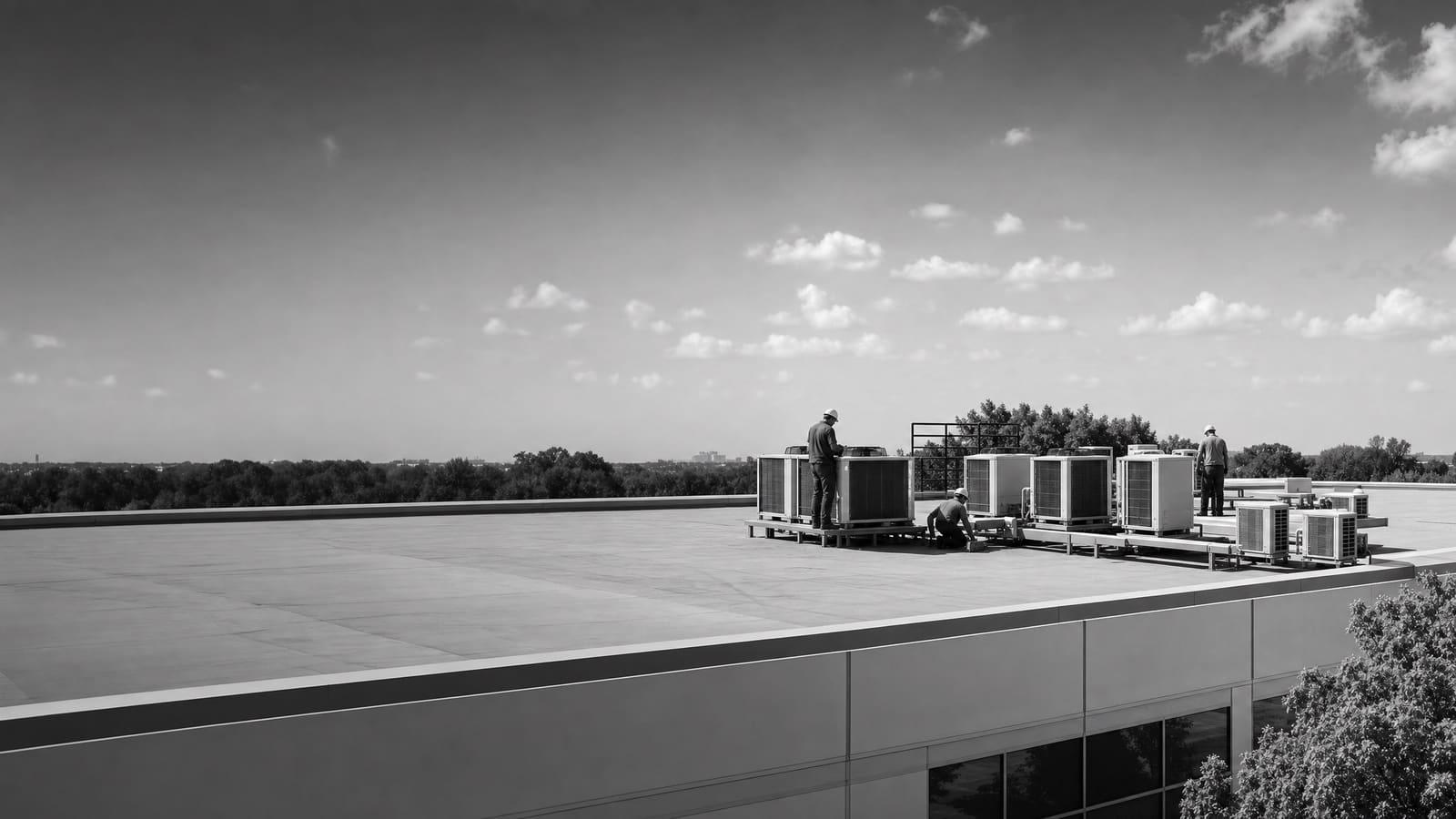
A commercial HVAC replacement confirms the load for how the building is used today, selects equipment against real lead times, handles removal and set, reconnects power, gas, and controls, and commissions the system to spec. Another repair stops making sense once the unit is old enough to waste money every month it runs. The Department of Energy estimates an old, inefficient rooftop unit wastes $900 to $3,700 in energy every year.
A site review still has to verify curb size and condition, roof structure, available electrical capacity, gas service, and crane access before any of that becomes a firm installed price.
THREE PATHS
Replace on failure, replace on plan, or retrofit controls
Most buyers land in one of three places. The default is waiting until the unit quits, which is the most expensive way to buy equipment, because you pay in-season pricing for whatever is available instead of what fits. The second is planned replacement, where an aging unit gets swapped on your schedule with an efficiency tier chosen on purpose. The Department of Energy has pushed that path hard: its Advanced RTU Campaign helped more than 200 organizations upgrade over 43,000 rooftop units, cutting a combined $37 million a year in energy spend.
The third path is a controls retrofit. If the cabinet, coil, and compressor are sound but the unit runs on old single-stage controls, advanced controls can capture savings without a crane day. DOE frames this as a straight financial comparison rather than a rule — replace the unit or retrofit it, whichever pencils out for that building.
WHAT MOVES THE NUMBER
The lines that decide your installed price
No two roofs price the same, and the spread comes from a short list. Ask every bidder to show these separately, so you are comparing proposals line by line instead of comparing two lump sums.
CHOOSING EQUIPMENT
Gas heat, high-efficiency AC, or a heat pump rooftop unit
The biggest fork in a replacement today is whether the new unit heats with gas or with a reverse-cycle heat pump. Heat pump rooftop units are mechanically close cousins of standard AC rooftop units, so the equipment itself is not exotic. What changes is the infrastructure behind it and how the building heats in a cold snap.
DOE guidance walks the same checklist a good contractor should: electrical capacity at the panel, physical space on the curb, whether gas service stays or goes, local electricity and gas prices, and whether qualified installers are available for that equipment. Heat pump rooftop units are most efficient with mild-to-moderate winter heating, and today's units can cover most or all winter demand in warmer regions. Even so, southern buildings do see sharp cold snaps, which is why dual-fuel and cold-climate versions exist.
If the electrical service has no headroom, a dual-fuel unit keeps gas heat as backup and avoids a service upgrade. If the panel has room and the organization has emissions goals, all-electric is the cleaner long-term answer. If neither applies, a high-efficiency unit on the same fuel is still a real upgrade — DOE's performance challenge produced units cutting energy use by up to half against the older standard, and more than 20 models now exceed that specification.
COMPLEXITY CHECK
What makes this simple and what makes it hard
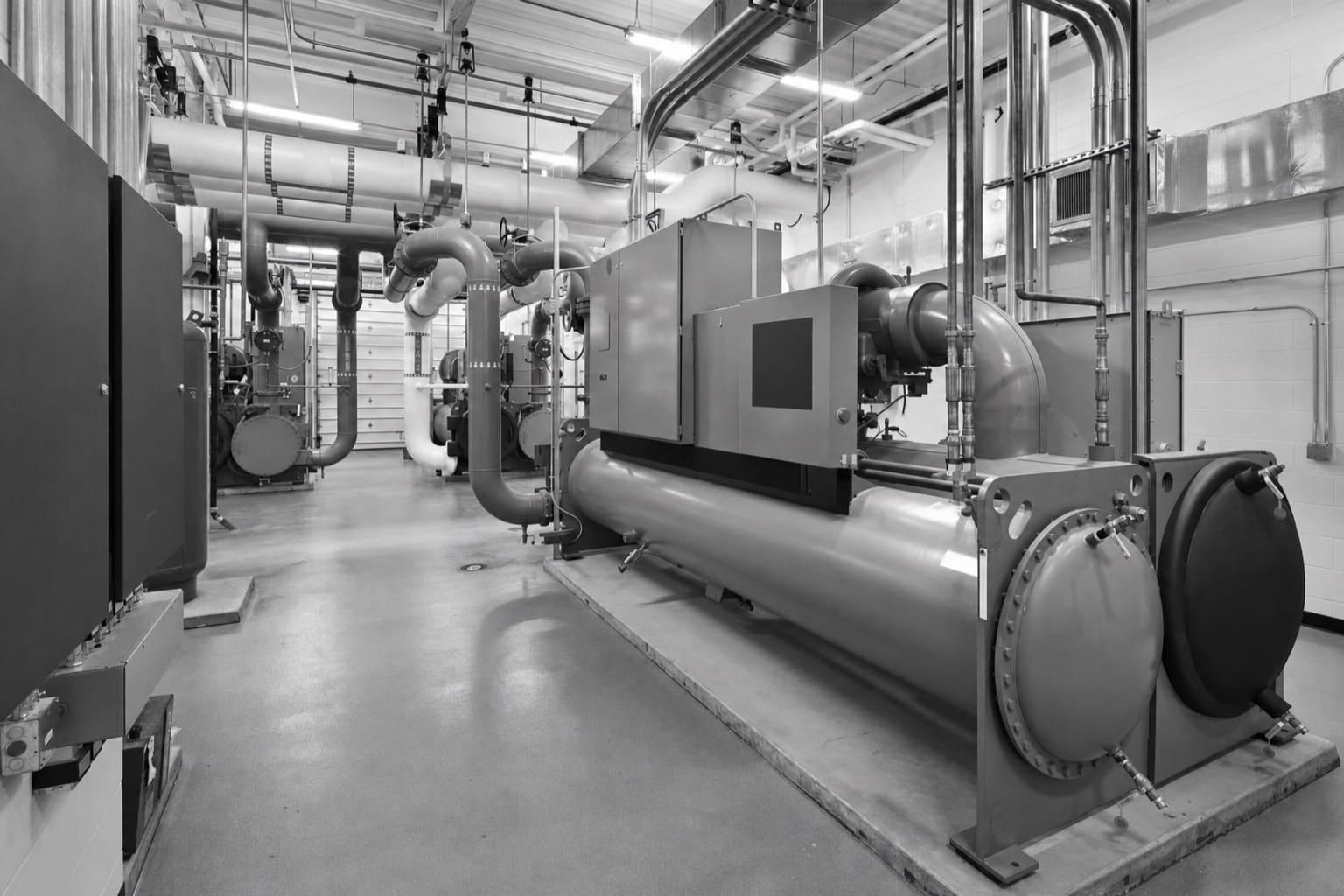
Two buildings with the same tonnage can be a week apart on schedule and far apart on price. The difference is almost never the equipment. It is what the new unit has to connect to, and how hard it is to get up there.
LOWER COMPLEXITY
Same fuel, same curb, open lot
The building's use has not changed, the replacement lands on the existing curb with an adapter, electrical and gas connections stay as they are, and the crane has clear reach from a lot you can close for a morning. This is a one-visit project.
HIGHER COMPLEXITY
Fuel switch, tight roof, live tenants
Going all-electric with no panel headroom, a cabinet larger than the old curb, a roof the crane can only reach from a street lane, or a space that cannot lose conditioning during business hours. Each of those adds engineering, permits, or phasing.
BEFORE YOU BID
What a real site review has to confirm
A quote written from a nameplate photo is a starting number, not a price. It is genuinely useful for triage when a unit is down and you need options today, but it assumes everything above the ceiling is normal. A site review is what turns it into something you can sign.
The review should confirm four things. First, the load — years of tenant changes, added equipment, and envelope work usually mean the old nameplate is not the right target. Second, the physical fit: curb dimensions, roof structure, and whether the new cabinet clears adjacent units and screen walls. Third, the services: available electrical capacity, the gas line's fate, and where condensate and controls wiring run. Fourth, the access plan — crane position, reach, and how long a lot or lane has to close.
That last one is where schedules quietly break. A roof that needs a larger crane, a street closure, or a night lift is a different project than one served from your own parking lot, and it should be priced that way from the start.
Ask for the load basis, not the nameplate
If a bidder sizes the new unit from what is sitting on the roof today, ask what the space actually needs now. Carrying an old sizing mistake into new equipment locks in the same comfort complaints for the next fifteen years.
OWNERSHIP
Two things that outlive the install
The install takes a week of your attention. The consequences run for the life of the equipment, and two of them deserve a decision now rather than a discovery later.
Refrigerant is the first. New commercial equipment ships on newer low-GWP refrigerants, and EPA rules under Section 608 govern how refrigerant is handled, recovered, and recycled whenever equipment is serviced or removed — including the old unit coming off your roof. That is the installing contractor's obligation, and it belongs in the written scope.
The second is the rest of your roof. If you have four units of similar age, the one that failed is a preview. How you sequence the other three decides whether you buy on plan or on emergency for the next several years.
REFRIGERANT
Mixed fleets need a service plan
Once one unit runs a newer low-GWP refrigerant and three run the old one, your service contract and spare-parts strategy cover two systems. It changes nothing day to day, but it should be a deliberate choice instead of a surprise at the next repair.
FLEET SEQUENCING
One failure predicts the next
Units bought together tend to fail together. Pricing the remaining units while the crane plan and engineering are already scoped costs far less than repeating the whole exercise next season under pressure.
PHASING AND LIFETIME COST
Buying on plan instead of on failure
The strongest argument for replacing before failure is not comfort. It is that an aging unit is charging you rent. The Department of Energy's framing is that rooftop units past fifteen years can waste substantial energy compared with current models, and that replacing proactively often beats waiting for failure — and can even beat a like-for-like swap at the natural end of service life.
That math is what makes phasing work. If you have several units of similar vintage, replace the worst performer first, verify the result on your own utility bills, then use that number to justify the next one. You get evidence from your own building instead of a projection, and you spread capital across budget years without ever being forced into an emergency purchase.
Incentives are worth checking before you commit, not after. Utility and program incentives for high-efficiency and heat pump rooftop units exist in many service territories, and they change on their own schedule, so confirm what is currently available for your address and equipment class while the specification is still open. Once the order is placed, the specification is locked, and so is your eligibility.
QUOTE CHECKLIST
Five things a comparable quote shows
Two bids are only comparable if they show the same things. Ask every bidder to break out these five, and the cheaper number usually explains itself.
01
Equipment, spelled out
Make, model, tonnage, efficiency tier, heating type, and refrigerant — not just "new rooftop unit."
02
Load basis
Whether the size came from a load calculation or was copied off the old nameplate.
03
Rigging and access
Crane size, staging location, closure duration, and who pays for any lot or street permit.
04
Infrastructure scope
Curb adapter, roof patching, electrical work, gas line changes, and controls integration.
05
Startup and documentation
Commissioning, charge and airflow verification, warranty registration, and the closeout package.
Get a defensible number
Price the equipment and the building together.
Send the address, operating target, and target opening date. Flux will identify what must be verified before the project can be priced.
Get a free estimateQuestions
Straight answers.
When is replacing better than one more repair?
When the unit costs you money every month it runs. The Department of Energy estimates an old, inefficient rooftop unit wastes $900 to $3,700 a year in energy, and units past fifteen years fall into that group. If the repair in front of you is a compressor or a coil on a unit that age, replacement usually wins on math alone.
Should the new unit be a heat pump?
It depends on your panel, your gas service, and your rates. Heat pump rooftop units are mechanically similar to standard AC units and can handle most or all winter demand in warmer regions, but they need electrical capacity. If the service has no headroom, a dual-fuel unit keeps gas heat as backup and avoids a service upgrade.
Can we keep the existing curb?
Often yes, with an adapter, as long as the new cabinet's footprint and weight work with the existing structure. It is one of the biggest differences between a quick swap and a longer project, so it should be confirmed on the roof before the price is treated as final.
Is a controls retrofit a real alternative?
Yes, when the mechanical parts are sound. DOE guidance treats replacing the unit and retrofitting advanced controls as two valid options, chosen on whichever makes better financial sense for that building. On a unit with a healthy compressor and coil, controls can capture savings without a crane day.
Who handles the old refrigerant?
The installing contractor. EPA Section 608 rules govern how refrigerant is handled, recovered, and recycled when equipment is serviced or removed, and recovery from the unit coming off your roof is part of that obligation. It belongs in the written scope, not in an assumption.
How do we compare two very different bids?
Line by line, not by total. Make both show equipment model and efficiency tier, the basis for the size, rigging and access, infrastructure work like electrical and curb adapters, and commissioning. Most large gaps between bids trace back to one of those being missing rather than to a better price.
Sources used for this guide
- [1]betterbuildingssolutioncenter.energy.gov — DOE Advanced Rooftop Unit Replacement Guidance
- [2]betterbuildingssolutioncenter.energy.gov — DOE Commercial Heat Pump Rooftop Unit Replacement Guidance
- [3]betterbuildingssolutioncenter.energy.gov — DOE High-Efficiency Commercial Rooftop Unit Toolkit
- [4]energy.gov — DOE Efficient Commercial Rooftop Air Conditioner Program
- [5]epa.gov — EPA Stationary HVAC Refrigerant Management