THE SHORT ANSWER
What a commercial HVAC replacement includes
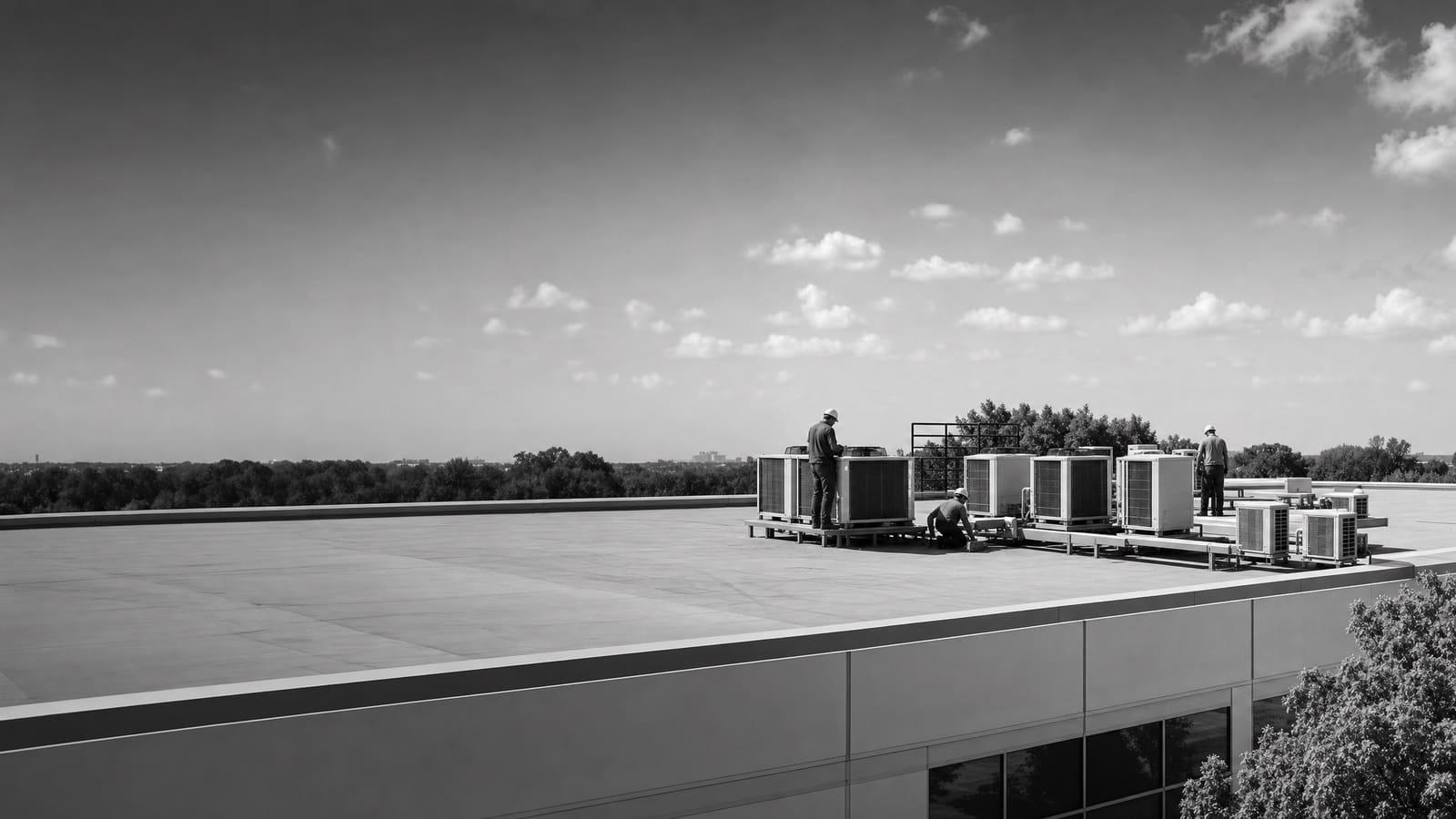
A commercial HVAC replacement covers load verification, equipment selection, rigging and set, mechanical and electrical connections, controls, and commissioning. Replacement beats another repair once a unit is past 15 years old and needs frequent service, no longer holds the space, or has already failed. Waiting for failure hands you emergency pricing and whatever unit happens to be available, instead of the one you actually wanted.
A site review has to confirm the curb and roof structure, available electrical capacity, gas service, physical clearances, and how the space is used now. Those findings decide which equipment can land.
THE EQUIPMENT DECISION
Three ways to replace a rooftop unit
Rooftop units condition close to half of all commercial floor area in the country, so most replacement decisions come down to what kind of rooftop unit goes back on the curb. A like-for-like air-conditioning unit is the simplest path. A heat pump rooftop unit is the same basic machine with reverse-cycle heating added, and it comes in dual-fuel, all-electric, and cold-climate versions.
The deciding factors are heating load, local electricity and gas prices, and what the building can feed. Heat pump heating efficiency falls as outdoor temperatures drop and trends toward electric resistance heating in deep cold, which is why colder winters point toward dual-fuel or cold-climate models rather than a straight all-electric swap. Contractor familiarity belongs in the decision too. Equipment nobody nearby services well becomes a long-term operating problem, not just a purchase.
WHAT MOVES THE NUMBER
Where commercial HVAC installation cost comes from
No two roofs price the same, so read a quote as a stack of line items rather than one number. These are the lines that move most between a simple swap and a complicated one.
IN PRACTICE
Deciding between another repair and replacement
The honest test is not whether the unit can be fixed. It is what the unit costs you while it keeps running. Old, inefficient rooftop units waste somewhere between $900 and $3,700 per unit each year, and that number never appears on a repair invoice. It shows up quietly on the utility bill and in service hours nobody tracks.
Units past 15 years old are the usual candidates. Once one needs frequent service, cannot hold the space, or has already failed, planned replacement almost always beats another round of parts. The federal high-performance specification asked manufacturers for units that cut energy use by up to half against the older standard, and more than 20 models now exceed it, so the efficient option is a catalog choice rather than a special order.
Scale makes the case clearer. Across one national campaign, more than 200 organizations upgraded over 43,000 rooftop units and cut a combined $37 million a year from their energy bills.
SCOPE CHECK
Simple swap or complicated project
Two replacements can carry the same tonnage and price very differently. What separates them is usually infrastructure, not equipment. Here is what pushes a job into each category.
LOWER COMPLEXITY
Same fuel, same footprint
The new unit matches the old one's connections, the curb takes an adapter, electrical capacity is already there, and the roof has clear crane access. The scope stays mechanical and the schedule holds.
HIGHER COMPLEXITY
New fuel path or a bigger load
Moving to all-electric heating, growing tonnage, or finding a deck that needs repair adds electrical work, structural checks, and coordination. Tight access or occupied hours push the crane day into nights or weekends.
THE SITE REVIEW
What a walk of your roof should settle
Every credible quote starts on the roof, not in a catalog. The reviewer should confirm what the old unit actually serves, how the space is used today, and whether the real load still matches the nameplate. Years of tenant changes, added equipment, and envelope work usually mean the original sizing is no longer the right answer.
Then infrastructure. Electrical capacity is the item that most often changes a project's shape, because all-electric equipment can ask for more than the panel has. Gas lines get traced and their future decided. Physical constraints get measured: curb dimensions, clearances around the unit, service access, and whether the crane can reach the position without closing more of the lot than your tenants can absorb.
Equipment availability belongs in the same conversation. A unit that fits the building on paper is only useful if it can be delivered inside your window, so options should arrive with lead times attached rather than as one recommendation you cannot schedule.
Ask for this before you compare prices
A dated site report listing the confirmed load basis, the electrical capacity available, the gas decision, curb and access notes, and the specific model numbers quoted. Two prices are only comparable when both were built from the same findings.
AFTER THE INSTALL
Two things ownership changes
The install ends; the operating decisions do not. A new rooftop unit changes your service plan, your spare-parts strategy, and your refrigerant obligations. That matters most in buildings with several units, where the fleet stays mixed for years while older equipment ages out.
Federal rules under Section 608 of the Clean Air Act govern how refrigerant is handled, recycled, and recovered in stationary refrigeration, air-conditioning, and heat pump equipment. Meeting them is the contractor's job, but they shape what you should expect from a service agreement and how you plan coverage across equipment of different ages.
REFRIGERANT
Service planning for a mixed fleet
Section 608 covers handling, recycling, and recovery in stationary cooling and heat pump equipment. Confirm your service contractor is certified and that recovery is documented on every unit removed from the roof.
TIMING
Planned beats replacement on failure
Facility managers often wait until a unit stops conditioning the space, needs constant service, or dies outright. Choosing the replacement year yourself protects pricing, equipment choice, and the schedule your tenants live with.
PLANNING AHEAD
Phasing replacements and reading lifetime cost
If you own more than one unit, the smartest version of this project is a schedule rather than an event. Rank units by age, service history, and how many comfort complaints they generate, then replace in that order across budget years. That turns an unpredictable capital risk into a line you can plan around, and it keeps you from bidding an emergency in July.
Procurement follows the same logic. Standardizing on a small number of models simplifies training, spares, and controls integration, and it makes the second and third replacements faster to scope than the first. Incentives are one of the standard considerations in a high-efficiency or heat pump replacement, so confirm what applies before the order goes in rather than after.
Lifetime cost should decide it. Purchase price is one year. Energy use, service hours, and downtime are every year after. A unit that costs more up front and meaningfully cuts energy use pays that back over a service life measured in more than a decade, whether or not anybody is tracking it.
COMPARING QUOTES
Five things a comparable quote shows
Bids that differ by a wide margin are usually pricing different scopes, not the same job at different rates. Make every quote show these five items and most of the gaps explain themselves.
01
The load basis
How tonnage was determined: current use and measurements, not just the old nameplate.
02
Model number and efficiency tier
The exact unit quoted, its heating type, and the efficiency level it meets.
03
Lead time
A realistic delivery window for that model, written next to the price.
04
Infrastructure scope
Curb adapter, roof work, electrical, gas, and who owns each item.
05
Rigging, permits, and commissioning
Crane day, lot coordination, permit filing, startup verification, and the documents handed over.
Get a defensible number
Price the equipment and the building together.
Send the address, operating target, and target opening date. Flux will identify what must be verified before the project can be priced.
Get a free estimateQuestions
Straight answers.
When does replacement beat another repair?
Once a unit is past 15 years old and needs frequent service, cannot hold the space, or has already failed, another repair usually buys time at a bad price. Old, inefficient rooftop units waste roughly $900 to $3,700 per unit a year on their own.
Should you switch to a heat pump rooftop unit?
It depends on heating load, electricity and gas prices, and available electrical capacity. Heat pump efficiency drops as outdoor temperatures fall, so colder winters usually point toward a dual-fuel or cold-climate model rather than a straight all-electric replacement.
What should a site review confirm before quoting?
The real load basis for today's use, available electrical capacity, what happens to the gas line, curb dimensions and clearances, crane access and lot impact, and the availability of the specific equipment being proposed.
How much does commercial HVAC installation cost?
There is no single installed price, because equipment tier, curb and roof work, electrical capacity, gas changes, crane access, and controls all move independently. Ask for those as separate lines so two quotes can be compared honestly.
What happens to the refrigerant in the old unit?
EPA rules under Section 608 of the Clean Air Act govern how refrigerant is handled, recycled, and recovered in stationary air-conditioning and heat pump equipment. Your contractor should be certified and should document recovery on every unit removed.
Sources used for this guide
- [1]betterbuildingssolutioncenter.energy.gov — DOE Advanced Rooftop Unit Replacement Guidance
- [2]betterbuildingssolutioncenter.energy.gov — DOE Commercial Heat Pump Rooftop Unit Replacement Guidance
- [3]betterbuildingssolutioncenter.energy.gov — DOE High-Efficiency Commercial Rooftop Unit Toolkit
- [4]energy.gov — DOE Efficient Commercial Rooftop Air Conditioner Program
- [5]epa.gov — EPA Stationary HVAC Refrigerant Management