THE DIRECT ANSWER
What a commercial HVAC replacement actually includes
A commercial HVAC replacement covers load verification, equipment selection, refrigerant recovery from the old unit, rigging and set, gas and electrical connections, controls integration, and commissioning. Replacement usually beats another repair once a unit is past 15 years and the service calls are stacking up. An old, inefficient rooftop unit wastes $900 to $3,700 a year in energy alone, and that gap often decides the question before the next compressor failure does.
A site review has to confirm curb size and roof structure, available electrical capacity at the panel, crane reach across the lot, and whether the current tonnage still matches how the space is used.
THREE WAYS TO GO
Three replacement paths, and when each one is right
Most commercial buildings in Tracy run packaged rooftop units. Nearly half of all commercial floor space in the country is cooled that way, which makes this decision more repeatable than it looks. The real fork is what the next unit should be, not whether the old one is finished.
Three paths cover almost every roof. A like-for-like swap puts the same kind of unit back on the same curb. A high-efficiency replacement steps up the equipment tier while keeping the fuel. A heat pump rooftop unit moves heating to electricity, either fully or as a dual-fuel unit that keeps a gas section for the coldest mornings.
The choice is driven by three things: how long you plan to hold the building, what your electric and gas rates look like against each other, and whether the panel has capacity for a larger electrical load. Answer those before you compare prices, because they change which prices are even comparable.
WHAT MOVES THE NUMBER
Where the budget actually moves
Two quotes for the same rooftop can differ by a wide margin without either one being wrong. The difference is almost always in the items below, not in the unit itself. Ask each bidder to price them line by line so you can see exactly where they disagree.
IN PRACTICE
Buying the unit is the easy part
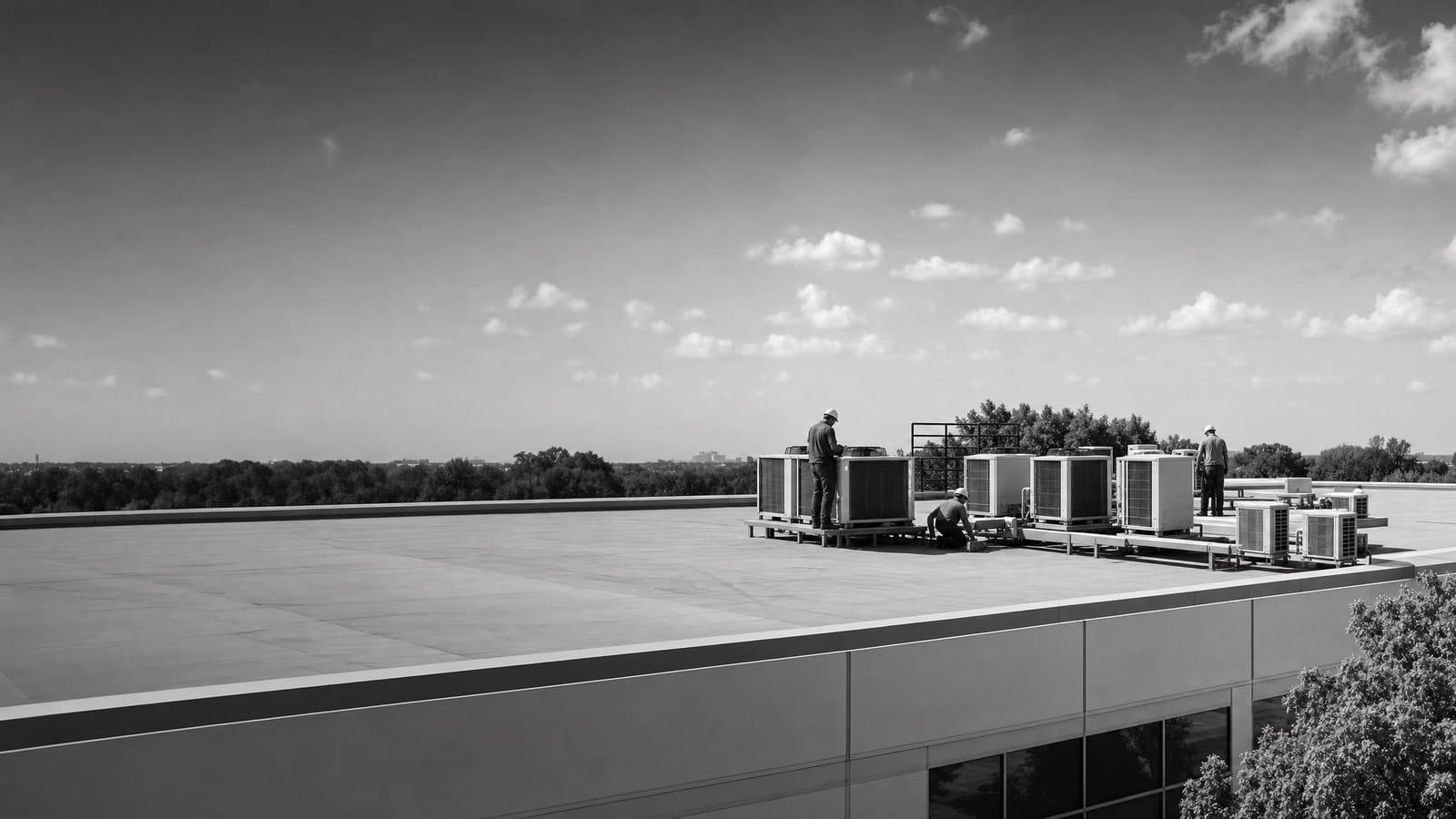
The visible part of a commercial HVAC installation is one morning. A crane sets up, stalls get coned off, the old unit comes off the curb, and the new one lands. Tenants notice the parking cones more than the outage.
Everything that makes that morning boring happens weeks earlier. The curb gets measured and the adapter ordered. The roof structure gets checked against the new unit's weight. Gas and electrical connections get confirmed at the actual equipment, not from a drawing. The permit is issued and the inspection is scheduled. The weather call gets made the day before, because wind stops a lift faster than anything else.
The most common way this goes wrong is waiting for failure. Facility managers routinely delay a replacement until the unit stops holding the space, needs constant service, or dies outright. Replacing on failure removes every choice worth having: you take whatever tonnage is in stock, at whatever price, on whatever day the crane has open. A planned replacement lets you specify the unit you want, compare efficiency tiers honestly, capture whatever incentives are live, and pick a week when the building is quiet.
If a unit is past 15 years and you are pricing a second major repair on it, you are already in the replacement decision. The only question left is whether you make it on your calendar or the equipment's.
COMPLEXITY CHECK
What makes a replacement simple or hard
Before you get a number, it helps to know which project you have. Two buildings with the same tonnage can be a week apart on schedule and far apart on price for reasons that have nothing to do with the equipment.
LOWER COMPLEXITY
Same unit, same curb, open lot
Matching tonnage and fuel, an existing curb that fits, a parking area with clear crane reach, and no change to the electrical service. Permitting is straightforward and the set is usually a one-day event.
HIGHER COMPLEXITY
New tonnage, tight access, fuel change
A larger footprint or weight that triggers structural review, a tight lot or shared drive that limits crane placement, or a gas-to-electric change that pushes the panel. Expect added engineering, longer permitting, and phased work.
SCOPING THE JOB
What a proper site review covers
A real site review is an hour on the roof and twenty minutes in the electrical room. It should produce facts, not impressions.
On the roof: nameplate data on every unit in scope, curb dimensions, the condition of the membrane around each curb, duct connections, and how the existing economizer is set up. In the electrical room: available capacity, breaker sizes, and whether the feeders can carry a larger unit. In the lot: where a crane can actually sit, what it has to reach over, and how many stalls that takes out of service for the day.
The step that gets skipped most often is the load calculation. Twenty years changes a building. Occupancy shifts, plug loads climb, lighting gets replaced with fixtures that throw off a fraction of the old heat, and the envelope may have been improved. Sizing the new unit from the old nameplate carries every one of those changes forward as a mistake. Oversized equipment short-cycles, handles humidity poorly, and wears out early.
Equipment availability belongs in the review too. Lead times vary by manufacturer and by tonnage, and a unit you can get in three weeks may beat a slightly better unit you cannot get until the season is over.
The one question to ask every bidder
Ask whether the tonnage on the proposal came from a current load calculation or from the old nameplate. If nobody measured, nobody knows. That single answer separates a real scope from a price sheet with your address typed at the top.
LOCAL CONTEXT
Permits, climate, and what Tracy changes
California municipalities require a building permit for mechanical work, and a rooftop unit changeout counts. So does the electrical work that comes with it. That matters for scheduling more than for cost: the permit has to be issued before the crane day, and an inspection follows the set. Ask which party pulls it and get the answer in writing. When an owner pulls the permit to save a fee, the owner also owns the correction notice.
Climate points the equipment decision in a specific direction here. Central Valley summers put a long cooling season on every rooftop unit in town, so the efficiency tier compounds over far more run hours than it would in a milder coastal city. Winter heating loads are moderate by comparison, and across the West current heat pump rooftop units can carry most or all of the winter heating demand. That makes an electric or dual-fuel replacement a real option rather than a gamble.
Confirm before the crane is booked
Have the permit number, the inspection window, and the lot closure plan in hand before the crane is scheduled. A lift that shows up ahead of an approved permit turns into an expensive second trip.
OWNERSHIP ANGLE
Two things that change the answer
Who pays and how long you hold the building change the right unit more than any technical detail does. A twelve-year-old owner-occupied warehouse and a leased suite with three years left should not buy the same equipment, even with identical tonnage sitting on the roof.
Fleet position matters too. If you have six rooftop units of similar age, replacing them one failure at a time is the most expensive path available. It produces six mobilizations, six crane days, six permits, and a mixed fleet where no two units share parts or refrigerant. Sequencing them over two or three years on your own schedule fixes all of that and gives you room to negotiate on equipment.
LEASE STRUCTURE
Who actually pays for it
A triple-net lease usually pushes capital replacement to one party and operating cost to the other. That split decides whether the efficiency premium is worth buying, because the party paying for it and the party saving on it may not be the same.
HOLD PERIOD
How long you keep the building
A well-maintained commercial unit runs 15 to 25 years. If you plan to sell inside five, the argument shifts from lifetime energy cost to what a buyer's inspection will flag and what equipment age does to the offer.
THE LONG VIEW
Phasing, procurement, and lifetime cost
Lifetime cost is where these decisions actually get settled. The purchase price is a single number you see once. The energy bill is a number you see every month for two decades. An aging, inefficient rooftop unit burns $900 to $3,700 more per year than it needs to, and top-tier replacements have been shown to cut rooftop energy use by up to half against the old standard. Multiply either figure by the number of units on your roof and by twenty years, and the spread between a cheap bid and a good one usually stops looking like a premium.
That math has held up at scale. More than 200 organizations working through a national rooftop upgrade effort have replaced or retrofitted over 43,000 units, and the group reports roughly $37 million in combined annual energy savings.
On procurement, do three things. Get equipment availability quoted next to price, because the unit you can actually get is the unit you are buying. Ask which incentives apply and who files the paperwork, since utility and federal programs change and an expired one is worth nothing. And if you have several units near end of life, bid them as a program rather than as emergencies. One mobilization covering three units beats three separate crane days on every line of the invoice.
APPLES TO APPLES
Five things a comparable quote shows
Bids only compare if they cover the same scope. If one of these is missing from a proposal, ask for it before you compare prices. A quote that leaves it out is not cheaper, it is just less complete.
01
Tonnage with the basis for it
The selected size, and whether it came from a current load calculation or from the existing nameplate.
02
Efficiency tier and refrigerant
The exact model, its efficiency rating, and which refrigerant it ships with, so service planning across a mixed fleet is not a surprise later.
03
Curb, structural, and roofing work
Adapter or new curb, any framing, and how the roof membrane gets flashed and warranted after the set.
04
Rigging, permits, and inspection
Crane cost, the lot closure plan, who pulls the mechanical and electrical permits, and who meets the inspector.
05
Commissioning and lead time
Startup with verified charge, airflow, and control settings, documented for the warranty, plus the quoted equipment delivery window.
Get a defensible number
Price the equipment and the building together.
Send the address, operating target, and target opening date. Flux will identify what must be verified before the project can be priced.
Get a free estimateQuestions
Straight answers.
When does replacement beat one more repair?
Once a unit is past 15 years and you are pricing a second significant repair, replacement is usually the better buy. Old, inefficient rooftop units waste $900 to $3,700 a year in energy on top of the repair bill, and replacing on failure costs you every choice about tonnage, efficiency, and timing.
Does a commercial HVAC replacement in Tracy need a permit?
Yes. California municipalities require a permit for mechanical work, and a rooftop changeout with its electrical connections qualifies. The permit should be issued before the crane day, with an inspection after the set. Confirm in writing that the installing contractor pulls it and meets the inspector.
Is a heat pump rooftop unit a real option here?
For most of the West, current heat pump rooftop units can carry most or all of the winter heating load, so it is a legitimate choice rather than an experiment. The deciding factors are electrical capacity at the panel and how your electric rate compares to your gas rate. Both get checked during the site review.
What happens to the refrigerant in the old unit?
It has to be recovered before the unit comes off the roof. Federal rules on stationary refrigeration and air-conditioning equipment govern how refrigerant is handled and recycled, and the work is done by certified technicians. It is a small line item, but it should appear on the quote.
Should we replace like-for-like or resize?
Confirm the load either way. If occupancy, equipment, and the envelope are the same as when the old unit went in, like-for-like is often correct and it is the fastest path back to cooling. If any of that changed, sizing from the old nameplate simply carries the original mistake forward.
Sources used for this guide
- [1]betterbuildingssolutioncenter.energy.gov — DOE Advanced Rooftop Unit Replacement Guidance
- [2]betterbuildingssolutioncenter.energy.gov — DOE Commercial Heat Pump Rooftop Unit Replacement Guidance
- [3]betterbuildingssolutioncenter.energy.gov — DOE High-Efficiency Commercial Rooftop Unit Toolkit
- [4]energy.gov — DOE Efficient Commercial Rooftop Air Conditioner Program
- [5]epa.gov — EPA Stationary HVAC Refrigerant Management
- [6]californiacity-ca.gov — HVAC Permits