THE SHORT VERSION
What a commercial HVAC replacement actually includes
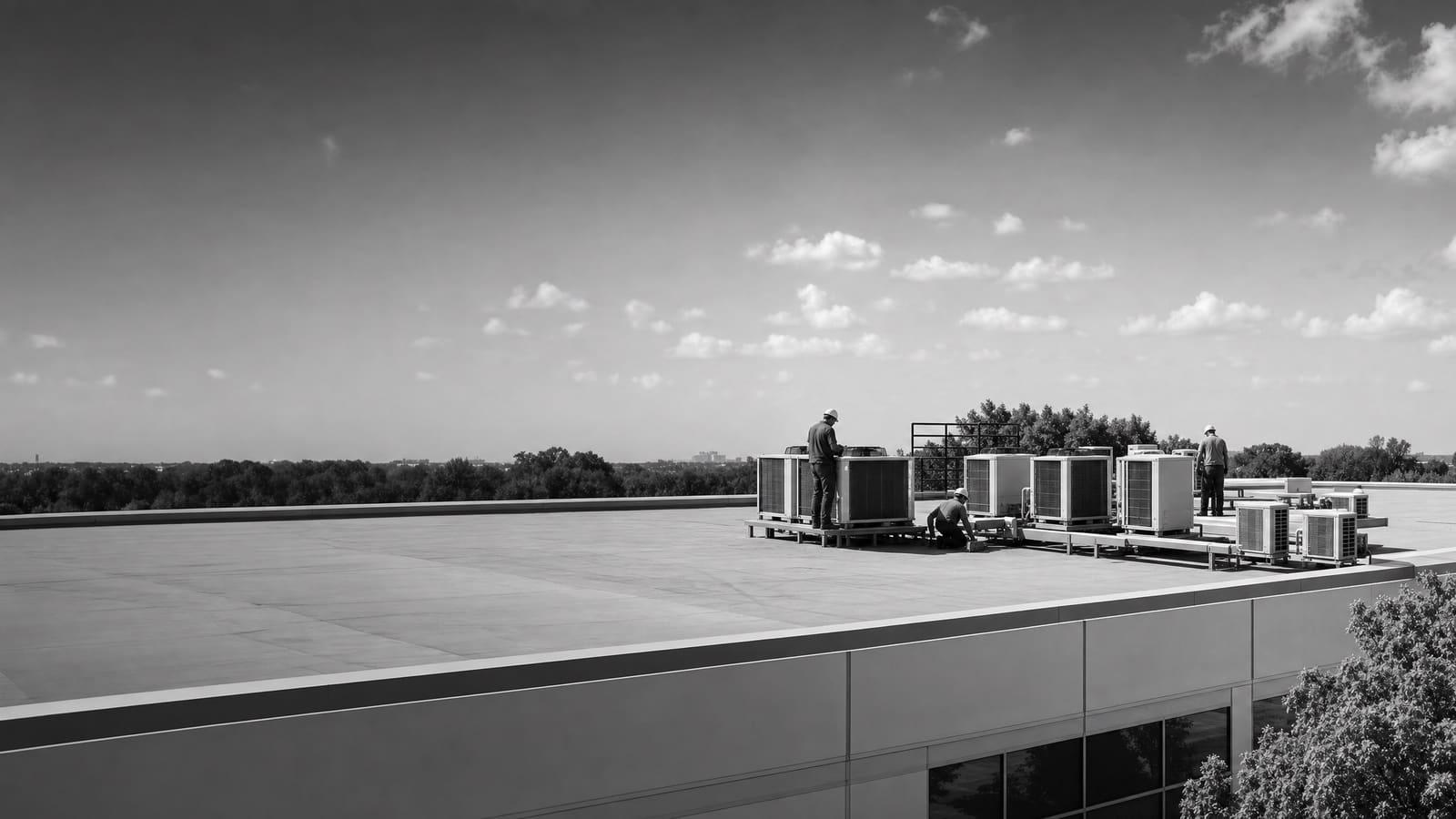
A commercial HVAC replacement covers a confirmed load calculation, equipment selection against real lead times, removal and rigging of the old unit, curb and connection work, and commissioning that proves the system performs to spec. Replacement beats another repair once a unit is old enough that it loses money every month it runs. Department of Energy guidance puts rooftop units past fifteen years in that range, where inefficient units have been measured wasting roughly $900 to $3,700 each per year.
A site review still sets the number. It has to verify tonnage against how the space is used now, the curb and roof structure, crane access, and whether electrical capacity and gas service support the unit you want.
THREE PATHS
Three ways to handle an aging unit
Most buyers are choosing between three postures, not three products. Waiting for failure is the default, and it is the most expensive one, because the unit picks the date. Owners commonly delay a purchase until the old equipment stops holding the space, needs constant service, or quits outright — and by then the only real option is whatever is on a truck this week.
Replacing on plan reverses that. You get to compare efficiency tiers, check whether an electric or dual-fuel option fits the building, and schedule the crane around your operating hours. Proactive replacement with more efficient equipment can beat replacement-on-failure, and can even beat a like-for-like swap at the end of a unit's useful service life. Which posture is right depends on how much runway the unit has left and what a mid-summer outage actually costs you.
WHAT MOVES THE NUMBER
The lines that decide your installed price
Nobody can price a commercial replacement from a tonnage number alone. These are the lines that separate a clean swap from a project, and the ones worth asking about before you compare two bids side by side.
IN PRACTICE
How to compare equipment without guessing
Start with the load, not the nameplate. A unit installed twenty years ago was sized for a building that no longer exists in the same form — different occupancy, different plug loads, different envelope. Confirming the load first tells you whether a like-for-like swap is honest or whether you are about to buy the same comfort complaints again.
Then compare equipment on three axes: efficiency tier, heating source, and availability. High-efficiency rooftop units are no longer exotic. A federal challenge to manufacturers targeted units cutting energy use up to fifty percent below the prevailing standard, and more than twenty models now exceed that specification. So the efficiency conversation is about payback, not about whether the equipment exists.
Heating source is the newer decision. A heat pump rooftop unit is mechanically similar to a standard air-conditioning unit but adds reverse-cycle heating. It comes in three shapes: dual fuel, all-electric, and cold climate. Which one fits depends on your winter heating load, local electricity and gas prices, and whether the building's electrical service has room. Where winters run mild to moderate, a straight heat pump generally covers the season. Where they don't, dual-fuel or cold-climate equipment keeps the building warm without betting on a mild January.
SCOPE CHECK
What makes this simple, and what makes it a project
The gap between a one-morning swap and a multi-week project is usually decided before anyone gets on the roof. These are the conditions that push a job in each direction.
LOWER COMPLEXITY
A clean swap
Same tonnage and heating type, an existing curb still usable, an open lot with straightforward crane reach, electrical and gas service already adequate, and controls that carry over without a redesign.
HIGHER COMPLEXITY
A real project
Changing tonnage or footprint, switching from gas heat to all-electric, tight or shared access that forces night work, an electrical service with no headroom, or building automation that has to be re-integrated.
BEFORE YOU BUY
What a site review has to settle
A quote written from a phone call is a guess with a number attached. The site review exists to remove the variables that turn into change orders later.
Four things get checked on the roof. First, the curb: whether the new unit lands on it, needs an adapter, or needs the roof structure reviewed. Second, the electrical: what the panel has available today, and whether the equipment you are considering fits inside that. Federal guidance on heat pump rooftop units treats electrical capacity as a gating question rather than a footnote, because an all-electric unit can require service work the gas unit never did. Third, the gas line: kept, resized, or capped. Fourth, access: where the crane sets up, what it closes, and for how long.
Two things get checked inside. The load, calculated from how the space is used now. And the controls, because a new unit tied into an existing automation system needs someone to own that integration or it surfaces as a comfort complaint in month two.
Crew familiarity matters too. Newer heat pump equipment is not universally understood, so ask directly what the installers have put in.
Ask for this before you compare bids
A written scope showing tonnage, efficiency tier, heating type, curb treatment, electrical and gas work, rigging plan, permits, and commissioning. Two bids are only comparable when both list the same lines. A bid that is quiet about the curb or the panel is usually quiet because nobody looked.
OWNERSHIP MATH
Two things that outlast the install
The installed price is one number. The building pays two more for as long as it owns the unit: what the equipment costs to run and what it costs to keep running. Both are decided at purchase.
Rooftop units condition close to half of all commercial floor space in the country, which is why utility and federal programs concentrate incentives there. Incentives are worth checking before you sign, because they are usually claimed against equipment specifications that have to be chosen up front rather than discovered afterward. The other long tail is refrigerant. New commercial equipment ships on newer low-GWP refrigerants, and the handling, recovery, and recordkeeping around refrigerant in stationary equipment is federally regulated. On a mixed fleet, that shapes spare-parts strategy and what you want written into a service contract.
OPERATING COST
What it costs to run
Efficiency tier, heating source, and correct sizing set the utility bill for the life of the unit. Old, inefficient rooftop units have been measured wasting roughly $900 to $3,700 each per year.
SERVICE PLANNING
What it costs to keep
A fleet running two refrigerant generations needs a service plan covering both. Certified recovery and refrigerant recordkeeping are legal requirements, so confirm your contractor's handling practices, not just their hourly rate.
PLANNING AHEAD
Phasing a fleet instead of reacting to it
If you own more than one unit, the useful move is to stop treating each replacement as a separate emergency. Walk the roof once and record age, tonnage, heating type, and condition for every unit, then sort them into three buckets: replace this year, watch, and healthy. That list turns an unpredictable capital line into a schedule you can budget against.
Phasing also buys purchasing leverage. Units bought together on a planned schedule tend to get better pricing and better lead times than units bought one at a time under pressure. It also lets you standardize — one manufacturer, one control platform, one set of spare parts — which quietly lowers service cost for years.
The lifetime-cost question is simpler than it looks. Compare the installed price difference between the base unit and the better unit against the annual operating difference, then weigh that against how long you plan to hold the building. A higher tier that pays back in four years is obvious when you are holding for fifteen and a much harder call when a sale is two years out. Ownership horizon belongs in the decision, and it is the one input no contractor can supply for you.
QUOTE CHECKLIST
Five things a comparable quote shows
Bids are only comparable when they list the same scope. If one of these is missing, ask for it in writing before you decide — the gaps are where change orders live.
01
Equipment, spelled out
Manufacturer, model, tonnage, efficiency tier, heating type, and refrigerant — not just "new rooftop unit."
02
Lead time, in writing
Real availability for the unit quoted, and what changes on the schedule if you take the alternate.
03
Curb and structural scope
Adapter or new curb, roof penetrations, patching, and any structural review a size change triggers.
04
Rigging, permits, and inspections
Who owns the crane, the lot closure, the mechanical and electrical permits, and the inspection sign-offs.
05
Commissioning and closeout
Charge, airflow, and control settings verified against spec, documented, and handed over so the warranty stands.
Get a defensible number
Price the equipment and the building together.
Send the address, operating target, and target opening date. Flux will identify what must be verified before the project can be priced.
Get a free estimateQuestions
Straight answers.
When does replacement beat another repair?
When repair spend is recurring and the unit is old enough that it loses money simply by running. Past fifteen years is the usual line. Inefficient rooftop units have been measured wasting roughly $900 to $3,700 each per year, which often exceeds what one more repair saves you.
Should we switch to a heat pump rooftop unit?
It depends on your winter heating load, local electricity and gas prices, and whether the electrical service has headroom. Where winters are mild to moderate, a heat pump generally handles the season on its own. Where they are colder, dual-fuel or cold-climate equipment covers the gap.
How long does the installation actually take?
The crane set is short compared with everything around it. Equipment lead time, permits, and any curb or electrical work drive the calendar, which is why real availability belongs on the quote right next to the price.
Do we have to right-size, or can we match the old unit?
Confirm the load either way. If occupancy, equipment, and operating hours are unchanged, like-for-like is often the correct answer. If they changed, matching the old nameplate carries a sizing mistake forward into the next equipment lifetime.
What happens to the refrigerant in the old unit?
It has to be recovered by certified technicians under federal rules covering stationary refrigeration and air-conditioning equipment, and that work belongs in the written scope. New equipment ships on newer low-GWP refrigerants, which is worth planning for on a mixed fleet.
Sources used for this guide
- [1]betterbuildingssolutioncenter.energy.gov — DOE Advanced Rooftop Unit Replacement Guidance
- [2]betterbuildingssolutioncenter.energy.gov — DOE Commercial Heat Pump Rooftop Unit Replacement Guidance
- [3]betterbuildingssolutioncenter.energy.gov — DOE High-Efficiency Commercial Rooftop Unit Toolkit
- [4]energy.gov — DOE Efficient Commercial Rooftop Air Conditioner Program
- [5]epa.gov — EPA Stationary HVAC Refrigerant Management