THE SHORT VERSION
What a commercial HVAC replacement actually includes
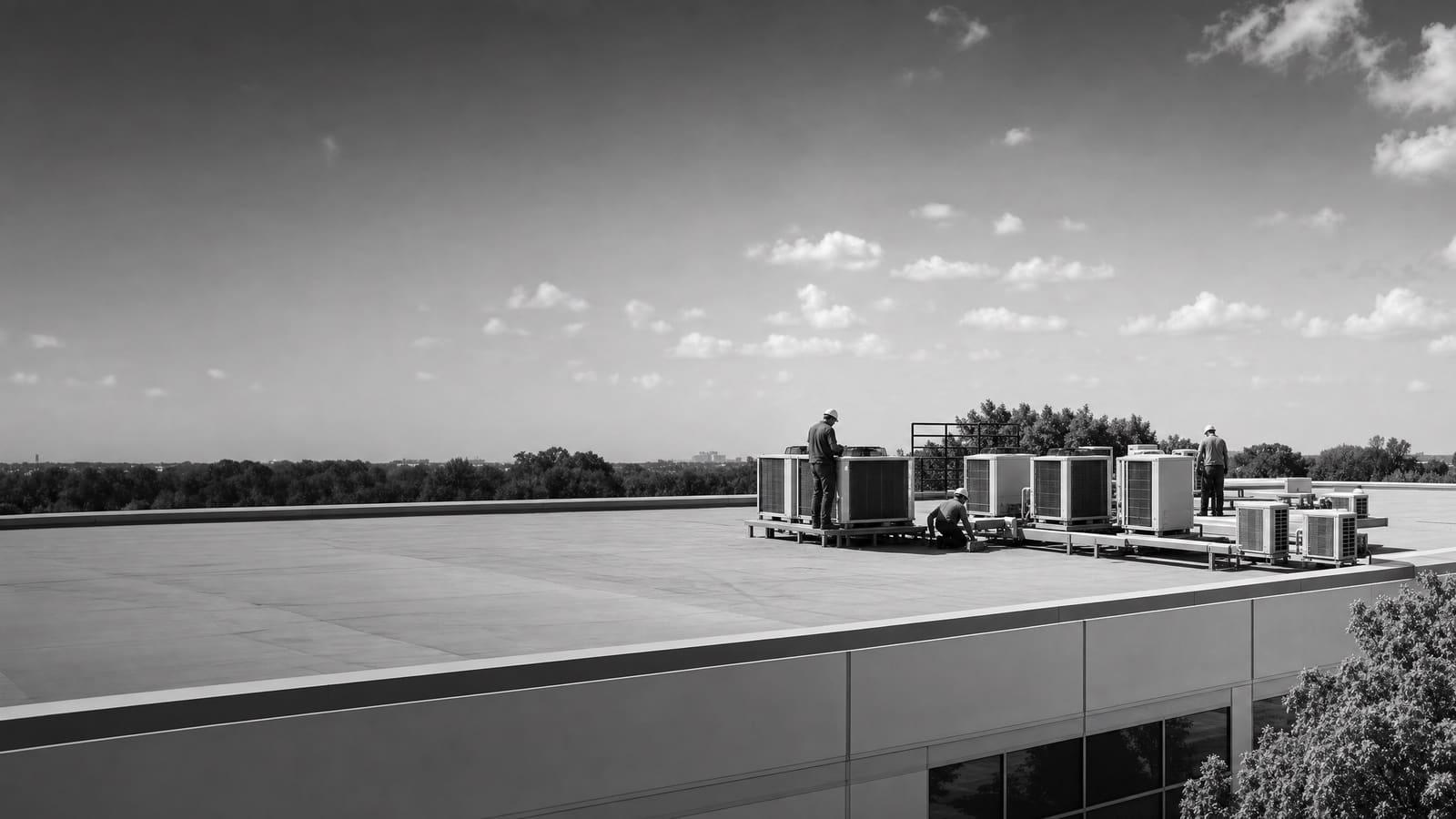
A commercial HVAC replacement is four things: a load check, an equipment decision, a set-and-connect day, and a commissioned startup. Replacement usually beats one more repair once a rooftop unit passes fifteen years, because old, inefficient units waste roughly $900 to $3,700 each per year in energy. A repair buys time. It does not stop that meter.
A site review still has to confirm the tonnage the space needs today, the condition of the curb and roof structure, and whether the electrical service and gas lines support the unit you want.
THREE PATHS
Three ways to handle a failing rooftop unit
Waiting until a unit fails takes the decision out of your hands. Replacement on failure means you accept whatever is available that week, at whatever it costs that week, on whatever curb it happens to fit — and you do it while the space is uncomfortable and someone is calling you about it every hour.
Deciding before that happens is what makes the options below real. You can put back what was there. You can step up to a high-efficiency unit. Or you can move the heating side to a heat pump, which is a bigger conversation about electrical capacity and winter load than it is about the box itself.
There is also a fourth move that is not a replacement at all. A unit with real life left in it can be retrofitted with advanced controls, and that is the right call when the equipment is sound and the problem is how it runs rather than what it is. Worth asking which of the two your unit needs before anyone prices a crane.
WHAT MOVES THE NUMBER
Where the money actually goes
No two roofs price the same, so treat these as the lines that separate a cheap quote from a complete one. Every one of them is real work that someone pays for. The only question is whether it sits inside the number you were given or arrives later as a change order.
IN PRACTICE
Choosing equipment before the unit dies
The cheapest version of this project is the one you plan while the old unit is still running. Waiting for failure collapses your choices down to whatever is on a truck that week, and it usually means paying for a like-for-like swap that carries forward every sizing mistake the original unit had.
Planning early buys three things. Availability, because commercial equipment is ordered rather than stocked and the specialty configurations take longest to arrive. A real load calculation, because two decades change occupancy, plug loads, lighting heat, and how the envelope performs — the number on the old nameplate is a record of an assumption someone made a long time ago. And leverage on efficiency, since the step from a code-minimum unit to a high-performance one is a line item you can weigh directly against what the unit you are removing wastes every year.
That efficiency step is not exotic anymore. Rooftop units condition close to half of all commercial floor space in the country, so manufacturers had every reason to build for it, and more than twenty models now exceed the federal high-performance specification. Organizations working through that program replaced over 43,000 units and cut about $37 million a year from their energy bills. You do not need portfolio scale to run the same arithmetic on one roof.
SCOPE CHECK
Simple swap or engineered project
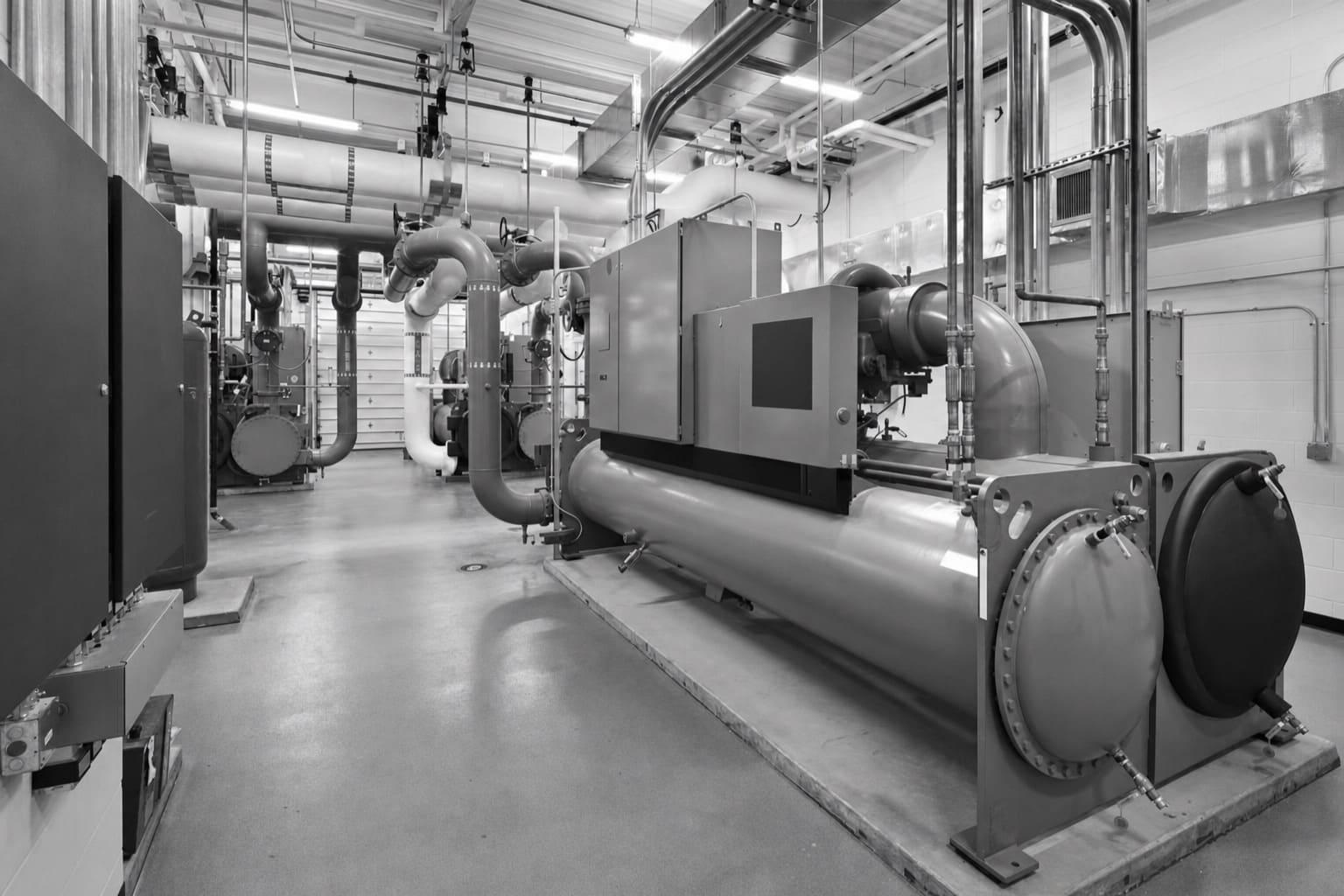
Two replacements with the same tonnage on paper can be very different jobs. What separates them is rarely the equipment. It is what the equipment needs from the building around it — the curb, the structure, the panel, and the hour of the day you can close part of the lot.
LOWER COMPLEXITY
The straight swap
Same capacity, the existing curb fits or takes a standard adapter, gas and electric are already sized, and the roof carries the weight. Crane access from an area you can close for one morning. Permitting stays mechanical and electrical.
HIGHER COMPLEXITY
The engineered replacement
Capacity changes, the footprint grows, or heating moves to electric. Now you are looking at structural review, panel and feeder work, new curbs, duct transitions, and controls integration. Phasing matters, because the building still has to operate through it.
BEFORE THE QUOTE
What a site review has to confirm
A quote written from a nameplate photo is a starting point, not a price. The nameplate tells you what was installed years ago. It does not tell you what the building needs now, and it does not tell you what the roof will allow.
A real site review checks four categories. Physical constraints come first: curb dimensions, roof structure, clearances, and whether a crane can reach the location without closing something your tenants need. Electrical capacity comes second, and it is the item that most often changes the project. If heating moves from gas to electric, the panel, the feeders, and sometimes the service have to carry it, and that work can outweigh the difference in equipment price.
Third is fuel. If a gas line serves the unit and the replacement no longer needs it, someone has to cap and document it. Fourth is availability — of the equipment, and of crews who have installed that equipment type before. Heat pump rooftop units especially reward a crew that has commissioned them, because the heating controls and defrost behavior are where the complaints show up. None of this takes a long engagement. It takes someone on the roof with a tape measure and access to the panel schedule.
The one item worth checking first
Electrical capacity. It decides whether an all-electric or dual-fuel unit is even on the table, and it is the difference that turns a one-morning swap into a multi-trade project. Confirm available service and the panel schedule before you compare equipment.
OWNERSHIP MATH
Two things that outlive the install
The install takes a week of your attention. The decision stays on the roof much longer, since rooftop units routinely run past fifteen years, and past that point they are the ones quietly costing money.
So judge the bid on operating cost, not only installed cost. An old, inefficient unit wastes roughly $900 to $3,700 a year on its own. Set that against the price step to a higher-efficiency unit and the payback question mostly answers itself. Then look at what you are handing to whoever maintains the building, because a new unit changes the service picture the day it lands.
OPERATING COST
Efficiency compounds
High-performance units were specified to cut energy use up to 50% against the older minimum. On equipment that runs every business day, that gap shows up on every bill for the life of the unit.
SERVICE PLANNING
Refrigerant is regulated work
Federal rules govern how refrigerant is handled and recycled in this equipment. Recovery from the unit coming off the roof is not a line anyone can skip, and it belongs to a certified technician named on the quote you sign.
PLANNING AHEAD
Phasing replacements across a building or a portfolio
If you have more than one aging unit, the worst plan is the one the equipment writes for you: replace each one the week it dies, in whatever season it dies, at whatever that week costs. A phased plan is cheaper for reasons that have nothing to do with negotiating. One crane mobilization can set more than one unit. One permit package can cover related work. One engineering review can answer the load question for a whole roof.
Rank the units by age and repair history first. The oldest and least efficient carry the most annual waste, so they go first even when they are not the ones generating complaints. A noisy unit is not necessarily an expensive one.
Then settle the fuel question once, at the building or portfolio level, instead of unit by unit. Whether heat pump rooftop units fit depends on heating load, electrical capacity, energy prices, and whether crews nearby have installed and commissioned them before — and those answers tend to be similar across buildings you own around Thornton.
One last piece of the same plan: a mixed fleet is harder to maintain than a uniform one. Every extra make, control platform, and refrigerant on your roofs adds parts to stock and training to buy. That is an argument for choosing the standard now and phasing toward it.
APPLES TO APPLES
Five things a comparable quote shows
Bids that look far apart are usually just scoped differently, and the gap is almost always one of these five items sitting inside one quote and outside another. Ask every bidder to show all five and the spread gets small enough to decide on.
01
Equipment named, not described
Make, model, tonnage, and efficiency tier, with an availability date. Not a category like high-efficiency rooftop unit.
02
Curb, structure, and roof
Adapter or new curb, any framing, and who patches and flashes the roof when the unit is set.
03
Crane, rigging, and lot plan
Which stalls close and for how long, and whether that cost is in the price or billed after.
04
Electrical, gas, and refrigerant scope
Panel or feeder work, line capping, and certified recovery from the unit being removed.
05
Commissioning and documentation
Charge, airflow, and control settings verified against spec, with the report that keeps the warranty intact.
Get a defensible number
Price the equipment and the building together.
Send the address, operating target, and target opening date. Flux will identify what must be verified before the project can be priced.
Get a free estimateQuestions
Straight answers.
When is replacement better than another repair?
Once a rooftop unit is past fifteen years and repairs keep repeating, replacement usually wins. Old, inefficient units waste roughly $900 to $3,700 a year each, and that cost keeps running no matter how well the last repair went.
Should the new unit match the old one?
Only if the space and how it is used have not changed. Twenty years of occupancy, equipment, and lighting changes move the load, and matching the old nameplate carries any original sizing mistake forward into the next fifteen years.
Is a heat pump rooftop unit the right choice?
It depends on heating load, electrical capacity, energy prices, and crew experience. Heat pump heating efficiency drops as outdoor temperatures fall, so buildings with real winter heating demand usually look at dual-fuel or cold-climate models rather than a standard all-electric unit.
What happens to the refrigerant in the old unit?
Federal rules govern how refrigerant is handled and recycled in this equipment, so recovery is done by a certified technician. That work should appear on the quote rather than as a surprise line at the end of the job.
How much does commercial HVAC installation cost?
The installed price depends on tonnage, efficiency tier, curb and structural work, crane access, and electrical scope, so a credible number follows a look at the roof. What you can compare across bids is how each one handles those lines.
Sources used for this guide
- [1]betterbuildingssolutioncenter.energy.gov — DOE Advanced Rooftop Unit Replacement Guidance
- [2]betterbuildingssolutioncenter.energy.gov — DOE Commercial Heat Pump Rooftop Unit Replacement Guidance
- [3]betterbuildingssolutioncenter.energy.gov — DOE High-Efficiency Commercial Rooftop Unit Toolkit
- [4]energy.gov — DOE Efficient Commercial Rooftop Air Conditioner Program
- [5]epa.gov — EPA Stationary HVAC Refrigerant Management