THE SHORT VERSION
What a commercial HVAC replacement actually covers
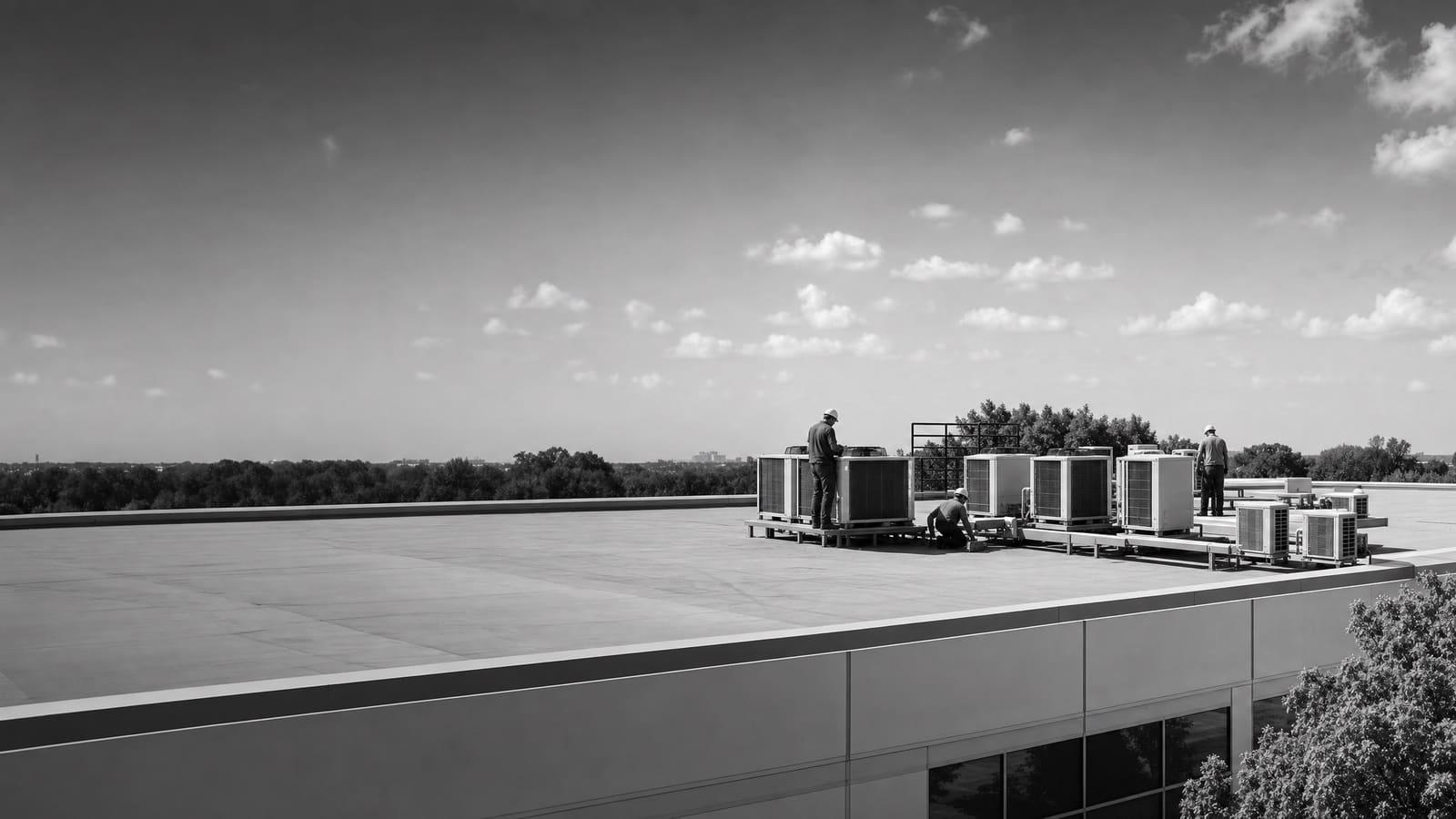
A commercial HVAC replacement covers load verification, equipment selection, curb and roof work, the crane set, the gas, electrical and refrigerant connections, controls integration, and commissioning. Replacement usually beats another repair once a unit passes 15 years and service calls start stacking up. Old, inefficient rooftop units waste $900 to $3,700 each per year, and that operating loss is often larger than the repair invoice you are sitting there debating.
A site review still has to confirm the roof structure at the curb, available electrical capacity, crane access and lot closure, and whether the existing tonnage still matches how the space is used today.
THE THREE POSTURES
How owners actually handle aging equipment
Every commercial building sits in one of three postures, and most owners are in one without having chosen it.
The default is run to failure. It costs nothing today, and it is why so many replacements happen in August with a crane scheduled around a customer parking lot. It also guarantees you buy whatever tonnage is sitting in a regional warehouse rather than what the building actually needs.
The second is planned like-for-like. You pick the month, the curb adapter is measured in advance, and the outage is boring. That is the right call when nothing about the space has changed.
The third is a planned upgrade. You use the replacement as the moment to fix sizing, raise the efficiency tier, or change fuel. It takes the most engineering up front and returns the most over the life of the unit, because what a rooftop unit costs to run dwarfs the gap between two purchase prices.
WHAT MOVES THE NUMBER
The six lines that decide an installed price
Installed price is not one number. It is a handful of lines, and they do not carry the same risk. These are the ones that actually move a rooftop quote, roughly ordered by how much they can surprise you after the site review.
THE REAL DECISION
Like-for-like or re-specify
The first real decision is not which brand. It is whether this is a like-for-like swap or a re-specification.
Like-for-like is fast and cheap to engineer. The curb, the connections, and the permit path are all known quantities. It is the right answer when the space is used the way it was used when the retiring unit went in. It is the wrong answer when occupancy, plug load, or the building envelope has changed, because you buy the old unit's sizing mistake a second time and then live with it for another full equipment life.
Re-specification is where efficiency tier enters. Rooftop units condition nearly half of all commercial floor area in the country, which makes this the most studied replacement decision in your building. High-performance units built to the federal challenge specification were designed to cut rooftop energy use by up to half against the older baseline, and minimum efficiency requirements moved up again with the standard finalized in 2015. If your retiring unit predates that shift, the replacement is very likely a real step down in operating cost before you add a single control.
The honest catch is that tier only pays if the unit is sized and commissioned correctly. An oversized high-efficiency unit short-cycles and will underperform a right-sized standard one. Get the load right first, then buy the tier.
SIDE BY SIDE
Why two same-tonnage jobs price differently
Two replacements with identical tonnage can be a week apart on schedule and far apart on price. What separates them is almost never the equipment.
LOWER COMPLEXITY
Straight swap on a sound curb
Same tonnage, same fuel, a sound curb, an open lot with crane reach, and a controls package the building already speaks. The permit path is routine and the outage is one planned morning.
HIGHER COMPLEXITY
Fuel change or tight access
Going all-electric, growing tonnage, or lifting over an occupied entrance. Now you are checking service capacity, structural loading, gas line disposition, and off-hours crane windows before anyone can quote honestly.
SCOPING
What a real site review has to settle
A quote produced without a roof visit is a guess wearing a decimal point.
The review starts at the nameplate but does not end there. Tonnage on a twenty-year-old label tells you what someone selected back then, under a load calculation that reflected that year's tenant, lighting, equipment, and occupancy. The reviewer's job is to work out what the space asks for now.
From there it gets physical. Is the curb sound, or is there rot under the flashing that only shows itself once the old unit comes off? Does the roof structure carry the new weight if tonnage grows? Where does the crane set up, how far does it reach, and which stalls close for how long? Is there panel capacity and feeder size for an electric option, or does that path start with a service upgrade? Are the gas lines being reused, capped, or abandoned, and by whom?
Controls are the quiet one. If the building runs a building automation system, integration scope belongs in the quote in writing. Finding out at startup that the new unit will not talk to the front end is a schedule problem, not a punch-list item.
Ask for this before you compare prices
Two quotes are only comparable when both contractors have stood on the roof, measured the curb, opened the panel, and walked the crane path. A number produced from a nameplate photo alone is an estimate, not a bid.
OWNERSHIP
Two things that follow the equipment for its whole life
Two obligations arrive with the new unit and stay for its entire service life. Both are far easier to handle at purchase than at the first service call, and both are routinely left out of a quick quote.
REFRIGERANT
What you inherit with the equipment
EPA Section 608 rules govern how refrigerant is handled, recovered, and recycled in stationary cooling and heat pump equipment. That covers the unit coming down and the one going up. Confirm recovery and documentation sit inside the installed price, and plan the service profile for a fleet that will run mixed refrigerants for years.
ELECTRICAL
The constraint that decides fuel
Electrical capacity, physical constraints, and the existing gas lines are the infrastructure checks that decide whether an electric option is even on the table. Answer them before you shortlist equipment, not after a quote lands and the panel turns out to be full.
OVER TIME
Phasing, procurement, and what the unit costs after year one
If you own more than one unit, sequencing matters more than any single purchase.
More than 200 organizations have replaced or retrofitted upward of 43,000 rooftop units through the federal rooftop campaign, and the combined result was about $37 million a year off their energy bills. The useful lesson is not the headline. It is that those owners moved before the units died, which let them standardize equipment, negotiate as a fleet, and book crane days when their buildings were quiet rather than when the weather forced the issue.
For a Temple owner with a handful of units, that looks ordinary: rank the fleet by age and service history, replace the worst one on a planned schedule, and lock the specification so next year's replacement is a phone call instead of a project. Standardizing also shrinks your spare-parts problem and gives your service contractor one system to know well instead of five to guess at.
One caution on incentives. Utility programs and federal credits change year to year, and some close entirely. Confirm what is actually open at the moment you buy, and never build the business case on a rebate you have not been approved for. If the replacement only pays with the incentive attached, it is not a replacement decision yet.
COMPARE LIKE FOR LIKE
Five things a comparable quote should show
If two bids differ by a wide margin, one of these five is usually missing from the cheaper one. Ask for all five in writing before you compare totals.
01
The load basis, not the nameplate
The calculated load for today's use, the assumptions behind it written down, and the selected tonnage shown against that number.
02
Equipment, tier, and availability
Model number, efficiency tier, controls package, and the actual quoted lead time sitting next to the price.
03
Roof and curb scope
Curb adapter, any structural repair, roofing patch and flashing, and who is responsible for each line.
04
Rigging and access plan
Crane size, lot closure hours, the lift window, and what happens if the weather call goes the wrong way.
05
Commissioning and closeout
Startup, charge and airflow verification, controls setup, refrigerant recovery records, permits, inspections, and warranty registration.
Get a defensible number
Price the equipment and the building together.
Send the address, operating target, and target opening date. Flux will identify what must be verified before the project can be priced.
Get a free estimateQuestions
Straight answers.
When does replacement beat one more repair?
Once a unit is past 15 years and repairs are recurring, the math usually flips. Old, inefficient rooftop units waste $900 to $3,700 each per year, which often exceeds the repair invoice you are weighing. Add the risk of failing mid-season, and the planned replacement wins on both cost and control.
Should you replace like-for-like or resize?
Confirm the load either way. If the space is used the way it was when the old unit went in, like-for-like is usually right and cheaper to engineer. If occupancy, plug load, or the envelope changed, resizing fixes comfort complaints the old unit was never able to solve.
Is a heat pump rooftop unit a real option here?
Across most of the South and West, today's heat pump rooftop units are capable of most or all of the winter heating demand. The February 2021 Texas freeze is the reason a backup heat strategy still belongs in the design conversation. The gating question is usually electrical capacity, not climate.
What has to be checked before anyone quotes a price?
Curb condition and roof structure, electrical capacity and gas line disposition, crane reach and lot closure time, controls integration scope, and the calculated load for how the space is used now. A number produced without those is an estimate, not a bid.
What refrigerant rules apply to a replacement?
EPA Section 608 governs the handling, recovery, and recycling of refrigerant in stationary cooling and heat pump equipment. It applies to the unit coming down and the one going up. Confirm that recovery and the associated documentation are inside the installed price.
Sources used for this guide
- [1]betterbuildingssolutioncenter.energy.gov — DOE Advanced Rooftop Unit Replacement Guidance
- [2]betterbuildingssolutioncenter.energy.gov — DOE Commercial Heat Pump Rooftop Unit Replacement Guidance
- [3]betterbuildingssolutioncenter.energy.gov — DOE High-Efficiency Commercial Rooftop Unit Toolkit
- [4]energy.gov — DOE Efficient Commercial Rooftop Air Conditioner Program
- [5]epa.gov — EPA Stationary HVAC Refrigerant Management