THE SHORT VERSION
What a commercial HVAC replacement includes
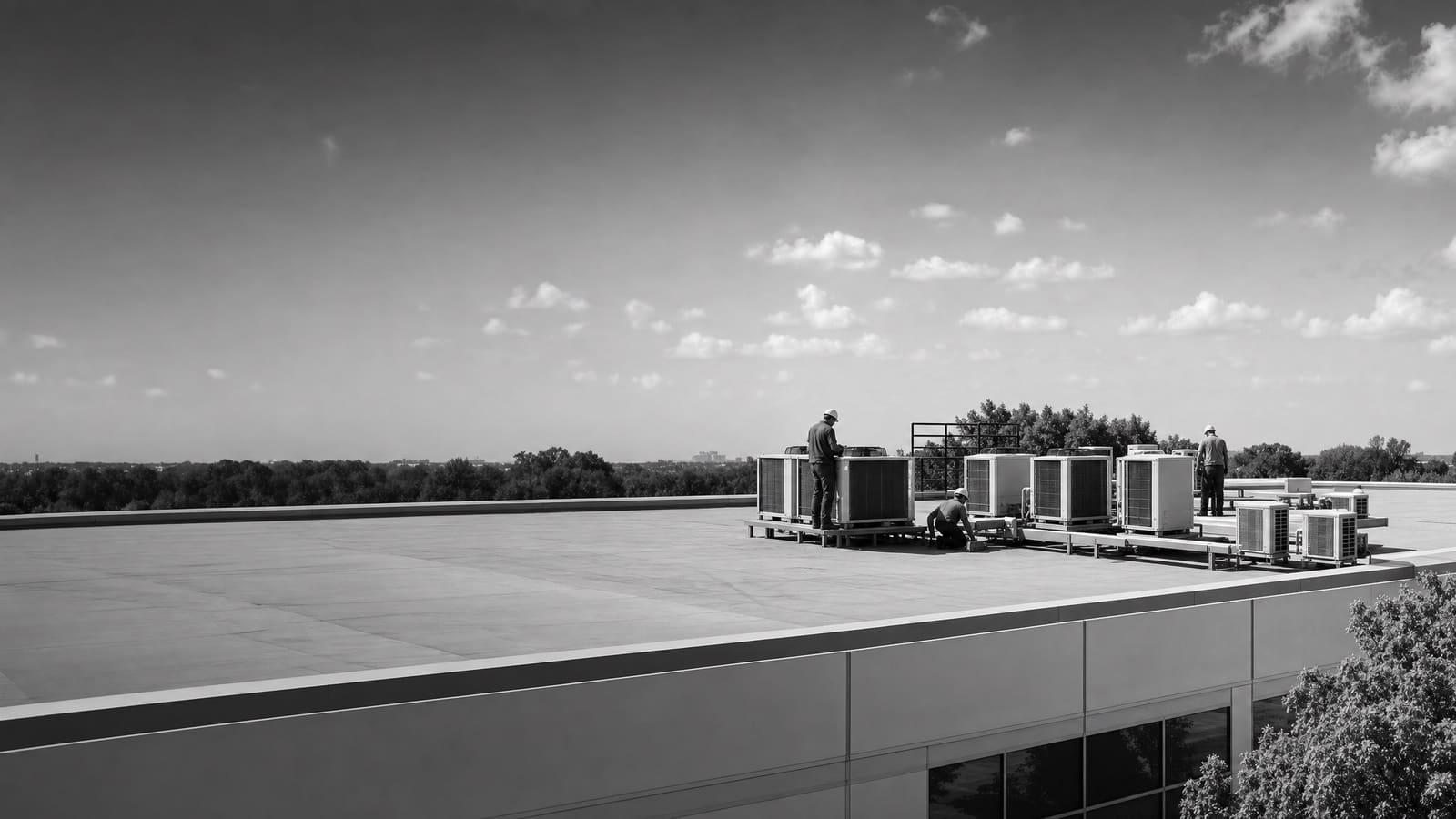
Commercial HVAC replacement means confirming the load, selecting equipment, rigging the old unit off and the new one on, adapting the curb, reconnecting gas and power, integrating controls, and documenting startup. Replacement beats another repair once the unit is past fifteen years, when the same failure returns in season, or when the compressor or heat exchanger goes. An old, inefficient rooftop unit wastes roughly $900 to $3,700 a year on its own.
A site review has to verify tonnage against current occupancy, roof and curb condition, available electrical capacity, gas service, and crane access before any of those numbers mean anything.
THE REAL DECISION
Three ways to heat the building after the swap
Most Syracuse replacements come down to what handles winter. A packaged rooftop unit with gas heat is the known quantity: the gas line is already there, the electrical service already carries the load, and heating capacity does not fade when the temperature drops. Heat pump rooftop units are technically similar to the air-conditioning units they replace and add reverse-cycle heating, but heating efficiency falls as outdoor temperature drops, trending toward electric resistance at the bottom of the range. That makes a straight all-electric swap a harder fit here than it is across the South and West. The two electric paths that survive a real winter are dual-fuel, which runs the heat pump in mild weather and gas below a set point, and cold-climate units built to hold capacity lower. Electrical capacity, physical space on the roof, and existing gas lines usually decide which of the three is even available to you.
WHAT MOVES THE NUMBER
The lines that decide an installed price
These are the items that separate two quotes on the same tonnage. A bid that folds them into one lump sum is not comparable to a bid that breaks them out.
BUYING GUIDANCE
Replace on your schedule, not the equipment's
Most facility managers wait. The unit gets replaced when it stops holding the space, needs constant attention, or fails outright. That is understandable, and it is usually the expensive path. Replacing proactively beats replacement-on-failure and often beats a like-for-like swap at end of service life, because you get to shop equipment, compare efficiency tiers, and pick a week when the building is quiet instead of a July afternoon when it is not.
The second decision is sizing. A twenty-year-old nameplate reflects the building as it was, not as it is. Occupancy changed, plug and lighting loads changed, and the envelope may have been touched. Sizing from current use is what fixes the comfort complaints the old unit never could. Oversizing buys short cycling and humidity problems. Undersizing gives away the point of the project.
Efficiency is where the payback lives. High-performance rooftop units were developed to cut energy use by up to half against the older baseline, and more than twenty models now exceed that specification. Across the organizations that committed to it together, 43,000 upgraded units returned about $37 million a year in combined energy savings. On one roof the math is smaller. It is the same math.
SIDE BY SIDE
What makes one replacement harder than another
Two projects with the same tonnage on the quote can be a week apart on schedule and far apart on price. What separates them is almost never the box itself. It is everything the box has to land on and connect to.
LOWER COMPLEXITY
Straight swap, open roof
Same tonnage, same fuel, existing curb fits or takes a simple adapter. The lot has room for the crane, the panel has capacity, and the unit serves one zone on basic controls. Permits are mechanical and electrical, and the set is a morning.
HIGHER COMPLEXITY
Fuel switch or a tight site
Tonnage or footprint grows, the curb needs structural review, or the fuel changes and the electrical service has to grow with it. Add occupied tenants, limited staging, a night or weekend lift, and controls tied into a building automation system, and the schedule stretches.
SCOPING
What a real site review looks like
A useful site review is short and physical. Someone gets on the roof, photographs the nameplate, measures the curb, checks the deck around it, and looks at how the ductwork drops into the space. Then they look at the electrical room. Then they walk the lot the crane has to work from.
That last one surprises people. Rigging is where a straightforward replacement quietly becomes a difficult one. A unit sitting in the middle of a large roof needs more boom than one near the edge, and more boom means a bigger crane, more staging area, and more closed parking. If the only staging spot is a drive aisle a tenant needs during business hours, the lift moves to a Sunday and the price moves with it.
The review should also settle the questions that decide equipment type: available panel capacity, whether a gas line is present and properly sized, physical room for a larger cabinet, and whether the model you want can actually be delivered on a schedule you can accept. Equipment availability belongs in scoping, not as a surprise after the purchase order.
What the review must produce
Nameplate and curb dimensions, roof deck condition, panel capacity and open breaker space, gas service, duct drop locations, crane position and boom reach, and a lift window that works for tenants. Anything missing here comes back as a change order.
SYRACUSE SPECIFICS
The license that pulls your permit
Syracuse licenses this trade directly. The city's Board of Mechanical Examiners issues mechanical licenses by written examination, and a Class A Master HVAC Mechanical License is what entitles a contractor to engage in the business of installing, altering, maintaining, and repairing heating, ventilating, and air conditioning systems, and to secure the permits for that work.
Refrigeration is licensed separately. A Class M Master Refrigeration license covers refrigeration systems generally, and a Class R limited license covers supermarket, retail food and beverage, and small manufacturing process refrigeration equipment. That distinction matters when a project spans both. A grocery replacing rooftop units and touching rack refrigeration is looking at two license classes, not one. Sort out which license each permit gets pulled under before your schedule depends on the answer.
Confirm the license before the permit
Ask for the Class A Master HVAC license held by the person pulling your mechanical permit, plus a Class M or Class R license if refrigeration work is included. The city licensing department can be reached at (315) 448-8773.
OWNERSHIP
Two things that outlast the install week
Two questions outlive the crane day: what the new unit runs on, and how it fits the rest of the roof. Both are easier to answer while you still have leverage with the vendor. Section 608 of the Clean Air Act governs how refrigerant is handled and recycled in stationary air conditioning and heat pump equipment, so recovery from the old unit is a certified, documented task rather than a line to trim. And most buildings do not own one rooftop unit. They own four or six, bought in different years, aging on different curves. Deciding the replacement order once is cheaper than deciding it four separate times under pressure.
REFRIGERANT
Plan for a mixed fleet
New equipment ships on newer low-GWP refrigerants. Nothing changes on day one, but a roof replaced one unit at a time ends up holding two or three different charges. Write that into the service contract and the spare-parts plan.
PORTFOLIO
Sequence the roof, not the unit
Units past fifteen years are the ones burning money. Rank them by age, repair history, and how much the space they serve matters, then replace in that order during planned windows instead of on failure.
PROCUREMENT
Lead times, phasing, and what it costs to own
Lifetime cost is where the up-front comparison usually flips. An old, inefficient rooftop unit can waste somewhere between $900 and $3,700 a year against a modern one. Multiply that across six units and fifteen years and the efficiency tier stops being a detail, even in a bid room where everyone is looking at the bottom line.
Procurement should be schedule-aware. Equipment availability is a real constraint, and the model that pencils best is worth nothing if it arrives in the wrong season. Ask for two or three equipment options with lead times attached, and treat lead time as part of the price rather than a footnote. If a unit is already down, the honest comparison is between what can be delivered now and what is worth waiting for, with temporary cooling priced into the waiting option.
Phasing matters on multi-unit roofs. Doing all six at once buys one crane mobilization, one permit cycle, one commissioning effort, and usually a better unit price. Doing two a year keeps capital flat and lets the first pair teach you something. Neither is wrong. Choose deliberately, and have the mobilization savings quoted so you can see what the choice actually costs.
BEFORE YOU SIGN
Five things a comparable quote shows
Two bids are only comparable when they show the same things. Ask every bidder for these five in writing, then read the second one against the first line by line instead of by total.
01
The equipment, spelled out
Manufacturer, model, tonnage, heating type, efficiency rating, and the lead time attached to that specific unit.
02
Curb and roof scope
Adapter or new curb, structural review if the footprint grows, and who patches and flashes the roof afterward.
03
Rigging and access plan
Crane size, staging location, lot closure hours, and which day of the week the lift happens.
04
Utility and controls work
Electrical, gas, and refrigerant line changes, plus controls integration and any automation points being added.
05
Permits, startup, and warranty
Who pulls the permit and under which license, commissioning documentation, and the terms that keep the warranty valid.
Get a defensible number
Price the equipment and the building together.
Send the address, operating target, and target opening date. Flux will identify what must be verified before the project can be priced.
Get a free estimateQuestions
Straight answers.
When does replacement beat one more repair?
Three signals usually settle it. The unit is past fifteen years, the same failure keeps returning during the season you need it most, or the failed component is a compressor or heat exchanger. At that point repair money is buying time on equipment that is already wasting hundreds to thousands of dollars a year in energy against a modern unit.
Is a heat pump rooftop unit realistic in a Syracuse winter?
It can be, but not as a plain all-electric swap. Heat pump heating efficiency drops as outdoor temperature falls and trends toward electric resistance at the low end, which is why cold regions lean on dual-fuel units or cold-climate models built to hold capacity. Electrical capacity, roof space, and existing gas service decide which one is actually available to you.
Who pulls the permit for a commercial HVAC replacement here?
A holder of a Class A Master HVAC Mechanical License issued by the Syracuse Board of Mechanical Examiners. That license is what authorizes securing permits for installing, altering, maintaining, and repairing HVAC systems. If your project also touches refrigeration, that work falls under a separate Class M or Class R refrigeration license.
How much does commercial HVAC installation cost?
There is no honest universal number, because the box is only part of it. Tonnage and efficiency tier set the base, then curb and structural work, crane access, electrical or gas changes, refrigerant recovery, and controls integration move it. Ask for a per-unit installed price broken into those lines so you can compare bids instead of totals.
Should you replace like-for-like or resize the unit?
Confirm the load either way. If occupancy, equipment, and the envelope are the same as when the old unit was specified, like-for-like is often correct and simpler to permit. If any of that changed, sizing from current use is what finally fixes the comfort complaints, and it usually trims the utility bill for the life of the unit.
How long is the building without conditioning?
The physical set is typically the short part of the project. The variable that decides your calendar is equipment lead time, which is why availability belongs on the quote next to the price. If the unit is already down, ask what can be delivered now, what is worth waiting for, and what temporary cooling costs during the gap.
Sources used for this guide
- [1]betterbuildingssolutioncenter.energy.gov — DOE Advanced Rooftop Unit Replacement Guidance
- [2]betterbuildingssolutioncenter.energy.gov — DOE Commercial Heat Pump Rooftop Unit Replacement Guidance
- [3]betterbuildingssolutioncenter.energy.gov — DOE High-Efficiency Commercial Rooftop Unit Toolkit
- [4]energy.gov — DOE Efficient Commercial Rooftop Air Conditioner Program
- [5]epa.gov — EPA Stationary HVAC Refrigerant Management
- [6]syr.gov — 2023-mechanical-hvac-license-application-23.pdf