THE SHORT VERSION
What a commercial HVAC replacement actually includes
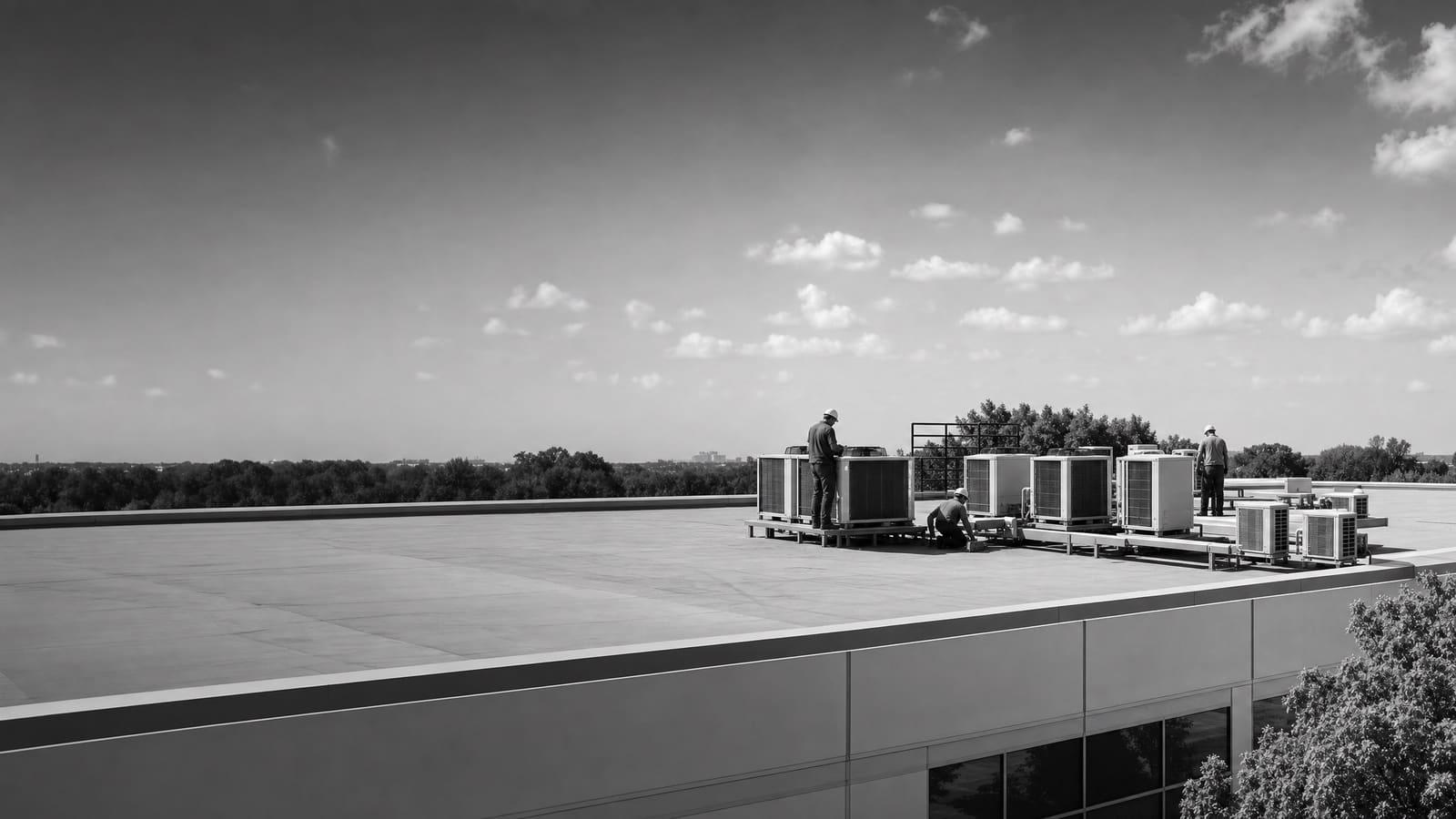
A commercial HVAC replacement covers a confirmed load calculation, equipment selection against real availability, rigging and roof work, electrical and gas connections, controls integration, and commissioning. Replacement beats another repair once a unit is past roughly 15 years and no longer holds the space, because old, inefficient rooftop units are estimated to waste $900 to $3,700 per unit every year. At that point repairs buy time, not performance.
A site review has to verify the actual load, curb and structural condition, available electrical capacity, roof and crane access, and whether the existing refrigerant and gas service carry forward. Those five items set the price.
THREE WAYS TO PLAY IT
Three ways owners handle an aging rooftop unit
Most facility teams delay a new rooftop unit until the current one stops conditioning the space, needs frequent service, or fails outright. That habit is understandable and expensive. Federal guidance is blunt about it: replacing an inefficient, underperforming unit on purpose is often the better business move than either replacement-on-failure or a like-for-like swap at the end of service life.
The choice is really about when you spend and what you get for it. Run-to-failure keeps cash in the building longer but hands you the worst version of every variable — no equipment choice, no schedule control, and a tenant complaint driving the clock. A planned like-for-like keeps engineering simple. A planned upgrade costs more up front and is the only path that changes your operating cost.
Pick the option that matches how long you hold the building, not the one that matches this quarter.
WHAT MOVES THE NUMBER
Where a commercial HVAC quote actually varies
No honest installed price exists before someone looks at the roof. Tonnage sets the floor, and everything below either adds cost or removes it. Ask each bidder to price these lines separately so you can compare quotes that look different on the cover page.
CHOOSING EQUIPMENT
Gas heat, dual fuel, or all-electric
Rooftop units condition close to half of all U.S. commercial floor space, so most replacement decisions come down to the same question: another gas-heat packaged unit, or a heat pump. Heat pump rooftop units are mechanically similar to air-conditioning units and add reverse-cycle heating, which is why they show up as a like-for-like-shaped option rather than a redesign.
Federal guidance sorts the decision by climate first. Heat pump efficiency falls as outdoor temperature drops, so the technology fits mild-to-moderate winter heating best. Across most of the U.S. South and West, current heat pump rooftop units can carry most or all of the winter heating demand. The other filters are cost and utility bill impact, emissions goals, building type, equipment availability, infrastructure, contractor familiarity, and available incentives.
Infrastructure is where the decision usually breaks. Electrical capacity, physical constraints on the roof, and existing gas lines determine whether all-electric is a swap or a project. Dual-fuel equipment exists precisely for buildings that want the efficiency without the service upgrade. Run those checks before anyone quotes, because finding a panel limit after the order is placed is the most expensive way to learn it.
SIDE BY SIDE
Simple swap versus real project
Two replacements with the same tonnage on the cover page can differ by weeks of schedule and a large share of cost. What separates them is almost never the unit itself. It is what the roof, the panel, and the calendar allow.
LOWER COMPLEXITY
Straight replacement conditions
Same tonnage and fuel, existing curb matches, the space is used the way it was when the unit was specified, electrical service is untouched, and the roof has clear crane reach. Permits stay narrow and the outage is short.
HIGHER COMPLEXITY
Conditions that make it a project
Tonnage changes, fuel changes, the curb needs an adapter or framing, all-electric conversion pushes on the panel, occupancy shifted since the last install, or the lot cannot hold a crane during business hours. Each one adds engineering, schedule, and review.
BEFORE YOU BID IT
What the site review has to settle
A quote is only as good as the walk that produced it. The purpose of a site review is to convert assumptions into confirmed facts, and there are a handful worth insisting on before any number is written.
Start with load. Sizing should come from how the space is used today, not from the nameplate on a unit specified fifteen or twenty years ago. Occupancy, plug loads, lighting, and envelope work all move the answer, and carrying an old sizing error forward is the most common way a replacement fails to fix the original complaint.
Then confirm the physical picture. Curb dimensions and condition, roof structure at the opening, available electrical capacity at the panel, gas line status if heat is staying gas, and refrigerant lines if the equipment is split. Add access: where the crane sets up, what it reaches, and how many parking stalls close for how long.
Last, confirm who owns which piece. Rigging, permits, inspections, and startup should be named in the installed price, not discovered afterward.
The question that separates real quotes
Ask every bidder what they measured and what they assumed. A contractor who can name the curb size, the panel capacity, and the crane setup has priced your building. One working from the old nameplate has priced a category.
OWNERSHIP REALITIES
Two things that outlive the install
The install ends in a morning. The consequences of the equipment choice run for the next fifteen to twenty years, and two of them deserve attention before the order is placed rather than after.
The first is refrigerant. EPA regulations under Section 608 of the Clean Air Act govern how refrigerant is handled and recycled in stationary air-conditioning and heat pump equipment, which means recovery at removal is a compliance step, not a courtesy. It also means a mixed fleet — some units on older refrigerant, some on newer — needs a service plan that accounts for both.
The second is who can service what you buy. Contractor availability and familiarity is one of the factors federal guidance flags when evaluating a switch to heat pump rooftop equipment, and it matters most in the fifth year, not the first.
COMPLIANCE
Refrigerant handling and fleet mix
Recovery at removal is regulated work. Ask how the old charge is handled, what refrigerant the new unit ships on, and what that means for parts and service across the rest of your fleet.
SERVICEABILITY
Who maintains it in year five
Efficiency you cannot service is efficiency you will not keep. Before signing, confirm service coverage, parts availability, and whether your existing maintenance contract already covers the equipment type you are buying.
PORTFOLIO AND TIMING
Phasing, procurement, and lifetime cost
If you hold more than one unit on a roof, or more than one building, sequencing beats reacting. The pattern that works is simple: rank units by age and service history, replace the worst on a planned schedule, and let the failures you cannot predict fall into a plan that already exists. That is the difference between one crane mobilization for three units and three mobilizations for one unit each.
Procurement follows the same logic. Equipment availability is a stated factor in whether a heat pump conversion is even practical at a given site, and it belongs on the quote next to the price. A unit you can get in two weeks and a unit you can get in three months are not the same offer, whatever the numbers say.
On lifetime cost, the scale of the opportunity is documented. Through the Advanced RTU Campaign, more than 200 organizations upgraded over 43,000 rooftop units and cut a combined $37 million a year from their energy bills. High-efficiency equipment developed under the related federal challenge targeted energy use up to 50 percent below the prior standard. Those are program-wide figures, not a promise for your roof, but they are why the planned upgrade keeps winning on a fifteen-year view.
QUOTE CHECKLIST
Five things a comparable quote shows
Bids become comparable only when they show the same five things. If one quote is missing a line, the gap is not savings — it is a change order with a later date on it.
01
Equipment, spelled out
Make, model, tonnage, efficiency tier, heating type, and refrigerant, not just "new rooftop unit."
02
Lead time next to price
A committed availability window, so schedule risk is visible before you sign.
03
Roof and curb scope
Curb match or adapter, any structural work, and who is responsible for the opening.
04
Rigging, permits, inspections
Named inside the installed price, with lot closure hours and the weather-delay policy.
05
Commissioning and documentation
Charge, airflow, and control settings verified against spec, documented, and handed over with the warranty.
Get a defensible number
Price the equipment and the building together.
Send the address, operating target, and target opening date. Flux will identify what must be verified before the project can be priced.
Get a free estimateQuestions
Straight answers.
When does replacement beat one more repair?
Once a unit is past roughly fifteen years and no longer holds the space, or needs frequent service, repairs buy time rather than performance. Old, inefficient rooftop units are estimated to waste $900 to $3,700 per unit each year, and that is the number a repair does not touch.
How much does commercial HVAC installation cost in Surprise?
There is no honest universal price. Tonnage and efficiency tier set the baseline, then curb and structural work, electrical capacity, crane access, and controls integration move it. A bidder quoting before walking the roof is pricing a category, not your building.
Should we switch to a heat pump rooftop unit?
Heat pump rooftop units are mechanically similar to air-conditioning units with reverse-cycle heating added. Federal guidance says they suit mild-to-moderate winter heating, and across most of the South and West today's units can carry most or all of the winter heating demand. Electrical capacity and gas line status usually decide it.
Like-for-like or right-sized replacement?
Confirm the load either way. If occupancy, equipment, and envelope are unchanged, like-for-like is often right and keeps permits simple. If how the space is used has changed, right-sizing is the only path that fixes comfort complaints the old unit caused.
What happens to the refrigerant in the old unit?
It is recovered by the contractor. EPA rules under Section 608 of the Clean Air Act govern the handling and recycling of refrigerant in stationary air-conditioning and heat pump equipment, so recovery at removal is required work that belongs in the written scope.
Sources used for this guide
- [1]betterbuildingssolutioncenter.energy.gov — DOE Advanced Rooftop Unit Replacement Guidance
- [2]betterbuildingssolutioncenter.energy.gov — DOE Commercial Heat Pump Rooftop Unit Replacement Guidance
- [3]betterbuildingssolutioncenter.energy.gov — DOE High-Efficiency Commercial Rooftop Unit Toolkit
- [4]energy.gov — DOE Efficient Commercial Rooftop Air Conditioner Program
- [5]epa.gov — EPA Stationary HVAC Refrigerant Management