THE SHORT VERSION
What a commercial HVAC replacement actually includes
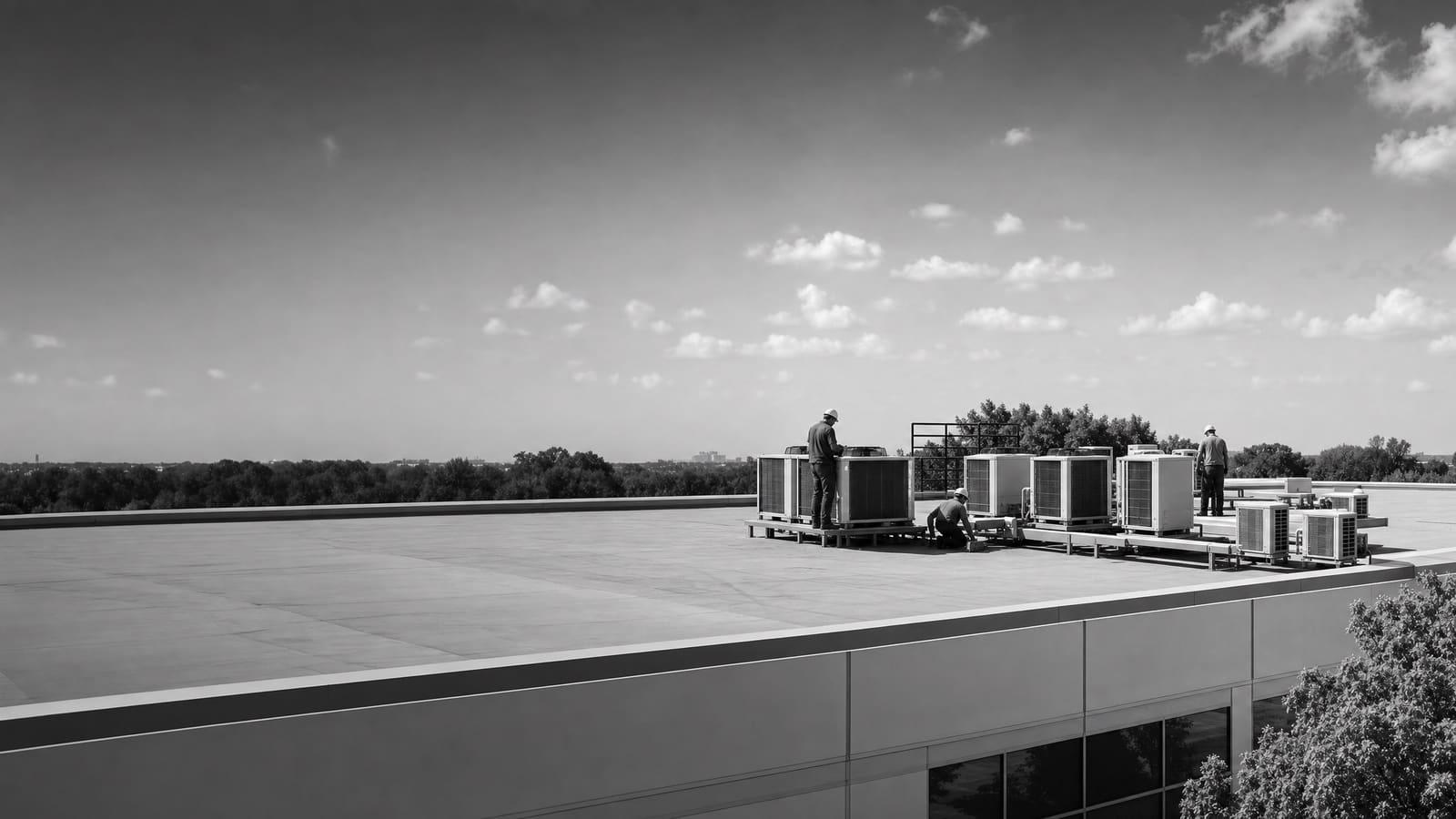
A commercial HVAC replacement covers the load calculation, equipment selection, rigging and set, refrigerant recovery, power and gas connections, curb or duct adaptation, permitting, and commissioning. Replacement beats another repair once a unit passes roughly fifteen years, service calls turn routine, or it can no longer hold the space. Federal guidance is blunt about the math: old, inefficient rooftop units can waste $900 to $3,700 per unit each year, so waiting for failure is rarely the cheaper path.
A site review has to confirm tonnage against current occupancy, the curb and roof structure, available electrical capacity, and crane reach across the lot. Those four answers decide whether your quote is real.
THREE WAYS TO GO
Three replacement paths for a commercial roof
Most buyers are choosing between three paths, and the right one depends on whether the building still uses the space the way it did when the old unit was specified.
Like-for-like is the fastest and cheapest to engineer, but it carries forward every sizing mistake the outgoing unit had. A right-sized replacement adds a load calculation and often changes tonnage, which fixes comfort complaints no repair ever could. A heat pump rooftop unit is the third option, and it is more workable in South Florida than many owners expect: DOE guidance notes heat pump RTUs are technologically similar to air-conditioning RTUs, and that across most of the U.S. South today's units can handle most or all of the winter heating demand.
The deciding factors are practical. Electrical capacity at the panel, physical constraints on the roof, existing gas service, and local contractor familiarity with the equipment all belong in the conversation before anyone quotes a model number.
WHAT MOVES THE NUMBER
Where the money actually goes
No two roofs quote the same, so read a proposal by its variables rather than its bottom line. These are the lines that move most between one Sunrise building and the next.
IN PRACTICE
Buy the equipment, not just the install
The equipment decision gets easier once you separate what you can see from what you cannot. What you can see is the unit on the roof. What you cannot see is the schedule behind it, and in commercial work the schedule is often the real constraint. Equipment availability sits on DOE's own list of factors to weigh before committing to a replacement path, right next to electrical capacity and contractor familiarity with the technology. A unit you can get in three weeks is frequently a better answer than a slightly better unit that lands in ten.
Efficiency tier is the second decision, and it is worth more than it looks. The high-performance rooftop specification DOE developed with manufacturers targeted cutting energy use by up to half compared with the standard equipment of the time, and organizations that upgraded units through the resulting campaign reported large combined annual savings across their portfolios. You will not capture that on every swap, but on a unit that has been running since the early 2000s, the operating difference is the part of the project that keeps paying after the crane leaves.
The third decision is whether to replace proactively or on failure. Waiting costs more than after-hours labor. It removes your ability to compare equipment, negotiate lead times, and schedule the lift for a Sunday morning instead of a Tuesday at noon.
SIMPLE VS COMPLICATED
What makes a job easy and what makes it hard
Two jobs with the same tonnage can price very differently. The gap usually comes from access and from how much has to change behind the unit.
LOWER COMPLEXITY
Straight swap on an open roof
Same tonnage, same curb, adequate power already at the disconnect, and a lot with room for the crane to set up away from tenant doors. The permit package is a standard mechanical alteration and the lift is a morning.
HIGHER COMPLEXITY
Changed load or changed fuel
New tonnage, a different footprint, or a switch from gas heat to all-electric. Now you are checking roof framing, panel capacity, and gas line abandonment, and the drawings take longer than the install. An occupied building adds phasing on top.
BEFORE YOU SIGN
What a real site review has to answer
A quote written from a nameplate photo is a starting number, not a price. It is genuinely useful when a unit is down and you need options today, but before you sign, someone should be on the roof.
The review has to answer a short list. What is the actual load, calculated from how the space is used now rather than how it was designed twenty years ago? Will the new unit sit on the existing curb, or does it need an adapter or structural work? Is there electrical capacity for the equipment being proposed, especially if the replacement adds electric heat? Where does the crane set up, how far does it reach, and how many stalls close for how long?
Refrigerant handling belongs on the list too. EPA rules under Section 608 of the Clean Air Act govern how refrigerant is handled and recovered from stationary air-conditioning equipment, so recovery from the outgoing unit is a compliance step with records behind it, not a line item to shave.
The last question is the one owners forget: who owns the permit, the inspections, and the commissioning? If the proposal does not say, assume it is yours.
Ask for this in writing
Load basis, curb and structural scope, electrical scope, refrigerant recovery, permit and inspection responsibility, crane and lot plan, and commissioning documentation. A contractor who has actually looked at your roof can answer all seven in a paragraph each.
SUNRISE SPECIFICS
What Florida permitting adds to your schedule
The design step catches Florida owners off guard more often than the equipment does. Commercial alteration permit guidance in Florida is clear that mechanical plans are required whenever the scope includes installing or relocating HVAC equipment, that those plans must be signed and sealed by a Florida licensed architect or engineer, and that energy calculations are required when the scope includes heating, ventilation, or air conditioning. Plans also have to show equipment location, and framing plans come into play when roof structure is touched.
That changes how you sequence a Sunrise project. Even on a like-for-like swap, a design professional is in the loop before the application goes in, so sealed drawings and energy calcs should be scoped and priced alongside the equipment. On a job that adds tonnage or moves a unit, the drawing set grows and the review clock starts later than owners expect.
Sequence the drawings first
Engage the sealed mechanical plans and energy calculations as early as the equipment order. Design turnaround and plan review, not crane availability, usually set the date a Sunrise unit can actually be set. Confirm current submittal requirements with the building department for your address.
OWNERSHIP QUESTIONS
Two things to settle before equipment ships
Replacement is a fleet decision as much as a building decision, especially if you hold more than one property. Two questions shape how the next several years feel.
The first is refrigerant strategy. New commercial equipment ships on current-generation refrigerants, which changes nothing on day one but matters later when you are stocking parts and writing service agreements across a mixed roof. The second is whether you standardize. Portfolios that pick a platform and stay with it get faster service and fewer surprises when a unit fails on a Friday. DOE's adoption guidance treats contractor availability and familiarity with the equipment as a real selection factor, not an afterthought. A unit nobody nearby wants to service is a slow repair waiting to happen.
OPERATING COST
The bill after the install
Old, inefficient rooftop units can waste $900 to $3,700 per unit annually against newer equipment. On a roof carrying several aging units, that figure is the whole argument for replacing on your schedule rather than the equipment's.
SERVICE
Who maintains it in year three
Warranty terms depend on documented commissioning and maintenance. Decide before purchase whether the installing contractor holds the service agreement, and require startup records, charge, and airflow readings in writing at handoff.
PLANNING AHEAD
Phasing, procurement, and lifetime cost
If you have more than one aging unit, stop replacing them one emergency at a time. Walk the roof, list every unit with its age and tonnage, and rank them. Anything past fifteen years is a candidate; federal guidance points at that age as the line where units begin wasting real money. Then replace in planned groups sized to your capital cycle, which also gives you something to negotiate with when you go to a supplier.
Procurement follows the same logic. Order against a schedule instead of an outage, and you can compare efficiency tiers, check incentive eligibility through your utility and federal programs before you commit, and pick a lift date that does not interrupt business. Incentives sit on DOE's list of factors worth checking before a replacement decision, and they are genuinely time-sensitive. Verify what is open the week you buy, not what was open last year.
Lifetime cost is where the choice resolves. The purchase price is one number; the operating cost is every year the unit runs. A correctly sized, well-commissioned unit at a higher efficiency tier usually wins that comparison, and the only way to see it is to ask each bidder to show equipment cost, installed cost, and expected operating performance as separate lines.
QUOTE CHECKLIST
Five things a comparable quote shows
When two proposals differ by a lot, it is usually because they are not quoting the same job. These five lines make bids comparable.
01
Equipment, tonnage, and efficiency tier
Model number, rated capacity, and efficiency level — not just "new rooftop unit."
02
Lead time with a date
Quoted availability in writing, so schedule risk sits next to price instead of surfacing after the deposit.
03
Curb, structural, and rigging scope
Adapter or new curb, any framing work, crane size, staging area, and lot closure hours.
04
Permits, sealed drawings, and energy calcs
Who prepares and seals the mechanical plans, who files the application, and who attends inspections.
05
Commissioning and closeout documents
Startup report with charge and airflow readings, controls settings, warranty registration, and O&M manuals.
Get a defensible number
Price the equipment and the building together.
Send the address, operating target, and target opening date. Flux will identify what must be verified before the project can be priced.
Get a free estimateQuestions
Straight answers.
When is replacement better than another repair?
Once a rooftop unit passes roughly fifteen years, repairs turn routine, or it can no longer hold the space, replacement is usually the better spend. Federal guidance notes that old, inefficient units can waste $900 to $3,700 per unit each year on top of what the repairs cost you.
Do I need sealed drawings for a rooftop replacement in Florida?
Florida commercial alteration permit guidance requires mechanical plans signed and sealed by a Florida licensed architect or engineer when the scope includes installing or relocating HVAC equipment, along with energy calculations. Confirm current submittal requirements with your local building department before you build a schedule.
Does a heat pump rooftop unit make sense in South Florida?
Often it does. DOE guidance says heat pump rooftop units are technologically similar to standard air-conditioning rooftop units, and that across most of the U.S. South today's equipment can address most or all of the winter heating demand. Verify panel capacity before pricing one.
What happens to the refrigerant in the old unit?
It has to be recovered properly. EPA rules under Section 608 of the Clean Air Act govern refrigerant handling and recovery for stationary air-conditioning equipment, so recovery from the outgoing unit is a documented compliance step inside the scope, not an optional line.
Should I replace like-for-like or recalculate the load?
Confirm the load either way. If occupancy, equipment, and use have not changed, like-for-like is often the right call. If they have changed, a fresh load calculation fixes comfort problems the old unit was never sized to solve.
Sources used for this guide
- [1]betterbuildingssolutioncenter.energy.gov — DOE Advanced Rooftop Unit Replacement Guidance
- [2]betterbuildingssolutioncenter.energy.gov — DOE Commercial Heat Pump Rooftop Unit Replacement Guidance
- [3]betterbuildingssolutioncenter.energy.gov — DOE High-Efficiency Commercial Rooftop Unit Toolkit
- [4]energy.gov — DOE Efficient Commercial Rooftop Air Conditioner Program
- [5]epa.gov — EPA Stationary HVAC Refrigerant Management
- [6]tampa.gov — Permit Application Guide Commercial Alteration