THE SHORT VERSION
What a commercial HVAC replacement actually includes
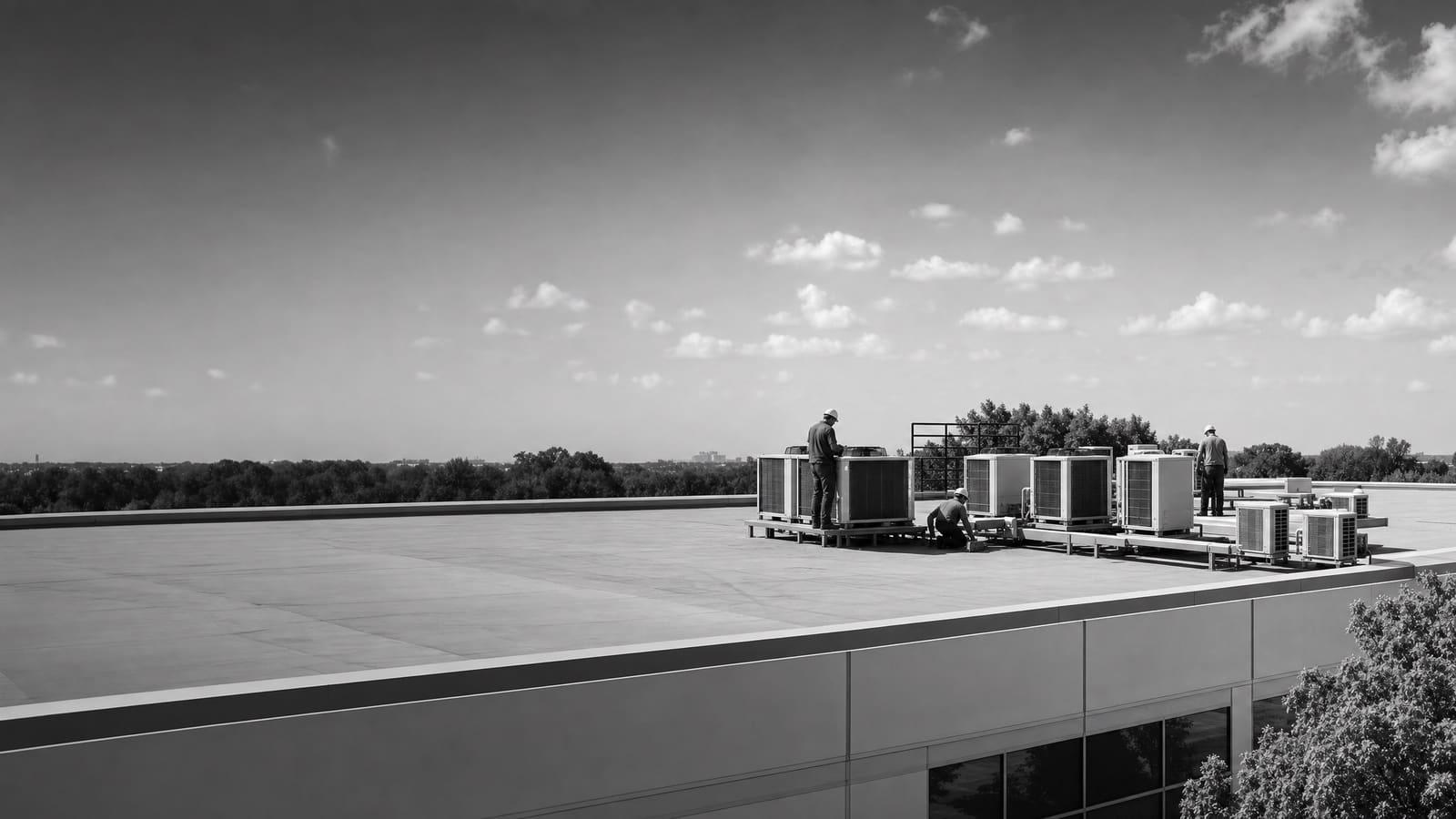
A commercial replacement covers more than the unit. It includes a load check against how the space runs today, equipment selection against real availability, rigging and set, curb or curb-adapter work, gas, electrical and refrigerant connections, controls integration, and commissioning with documented results. Replacement wins over another repair once a unit is past about 15 years, needs repeat service calls, or can no longer hold the space. An aging, inefficient rooftop unit wastes roughly $900 to $3,700 a year in energy alone.
A site review has to verify the load, the roof structure and curb, crane reach and lot access, and the electrical or gas service at the unit before any number is firm.
THREE WAYS TO GO
Three replacement paths, and when each one fits
Most commercial replacements come down to three choices, and the difference shows up in the utility bill for years, not on install day.
The plain swap is the same fuel and the same tonnage on the same curb. It is fast, cheap to engineer, and it carries forward whatever the old unit got wrong.
A high-efficiency unit costs more up front and pays it back in operating cost. Federal efficiency work with manufacturers produced rooftop units built to cut energy use by up to half against the older standard, and more than twenty models now exceed that specification, so the high-efficiency tier is a normal catalog choice rather than a special order.
The third path is a heat pump rooftop unit, which heats by running the refrigeration cycle in reverse. These come as all-electric, dual-fuel, and cold-climate models. Heating efficiency falls as the outdoor temperature drops, so the winter design temperature at your building, the electrical capacity at the roof, and whether a gas line is already there decide whether the conversion makes sense.
WHAT MOVES THE NUMBER
The lines that decide what a replacement costs
No two roofs price the same. These are the lines that separate a routine swap from a project, and they should be visible on the quote instead of buried in a lump sum.
BUYING GUIDANCE
How to buy this without overpaying or undersizing
The most expensive mistake in commercial HVAC is waiting for the unit to die. Replacement on failure takes away every choice worth having. You take whatever tonnage sits in a regional warehouse, you pay for emergency rigging, and the space runs hot or cold until the truck shows up. A planned replacement lets you compare efficiency tiers, book the crane on a slow morning, and hold a date.
The second mistake is sizing from the nameplate. A unit installed twenty years ago was matched to that building's occupancy, lighting, and plug load. All three have changed since. Confirm the load against how the space runs now, then decide whether like-for-like or a different size is right. Right-sizing fixes comfort complaints that no amount of service will fix on the wrong unit.
Third, treat efficiency as an operating decision rather than an upgrade. An old, inefficient rooftop unit can waste $900 to $3,700 a year by itself, and across a roof that compounds. Organizations that upgraded rooftop units through the federal advanced rooftop campaign, more than 43,000 units in all, cut a combined $37 million a year from their energy bills. One purchase order sets your operating cost for years.
SCOPE CHECK
What makes a replacement simple, and what makes it a project
Two jobs with the same tonnage can price very differently. Before you compare bids, work out which side of this line your building sits on, because that is usually what the spread between quotes is measuring.
LOWER COMPLEXITY
Straight swap conditions
Same fuel and similar capacity, an existing curb that takes an adapter, clear crane reach from the lot, and service already sized at the roof. Use has not changed, controls are stand-alone, and the schedule allows a weekday morning outage.
HIGHER COMPLEXITY
Project conditions
A capacity change, new curb or structural framing, tight or shared parking that limits crane setup, an electrical upgrade for an all-electric unit, gas line changes, building automation tie-in, or a space that cannot lose conditioning during business hours.
BEFORE THE QUOTE
What a site review has to confirm
A quote is only as good as the walk that produced it. Whoever prices your job should get on the roof, not read the nameplate over the phone.
Start with the physical constraints. Measure the existing curb and confirm what an adapter can cover. Look at the deck and framing if capacity or footprint is changing. Walk the crane path and check the reach from wherever the truck can actually set up, including anything overhead.
Then check infrastructure. Confirm the electrical capacity available at the roof and whether the existing feeder can carry a larger or all-electric unit. Confirm whether a gas line is present and staying. Identify the refrigerant in the old unit, because recovery is regulated work handled by certified technicians and it belongs in the scope.
Finally, check people and schedule. Ask who performs startup and whether they have installed the exact equipment before, which matters most on heat pump units, where controls and heating stages behave differently from a gas unit. Confirm the outage window your tenants can live with, and get it in writing before the order goes in.
The question that reveals a thin scope
Ask what happens if the curb does not match. A firm answer names who measures it, who supplies the adapter, and whose price covers the difference. A vague answer means that cost is coming back as a change order after the crane leaves.
OWNERSHIP QUESTIONS
Two things to settle before the order goes in
Equipment choice is the loud part of this decision. The quiet parts, who pays for it and who keeps it running, usually decide whether the project still feels like a win in year three.
New equipment does not stay efficient on its own. A high-efficiency unit only delivers its rated savings if the charge, airflow, and control settings verified at startup stay that way, so the maintenance agreement and the commissioning records matter as much as the model number. Ask who holds those records and what the warranty requires you to keep doing.
Then look at how this purchase fits the rest of your obligations: the lease that governs the roof, the capital cycle you budget against, and the other units that are the same age as this one.
SPLIT INCENTIVE
Who owns the rooftop
In a leased building the tenant often pays the utility bill while the landlord owns the unit. Settle who funds the efficiency step and who holds the warranty before you price options, not after.
FLEET TIMING
One unit or the whole roof
Units installed the same year tend to fail in the same window. Pricing two or three replacements together buys scheduling leverage that three separate emergencies never will.
PHASING AND PROCUREMENT
Sequencing replacements over a few budget years
Few buildings replace everything at once, and they should not have to. The useful move is to rank the units rather than argue about the budget in the abstract. Rank by age first, then by service history, then by what each unit serves. A fifteen-year-old unit over a server closet or a dining room carries a different risk than the same unit over a stockroom.
Once you have the ranking, split it across budget years and let the worst unit go first. Replacing proactively is generally a better business decision than replacing on failure, or than defaulting to a like-for-like swap at end of life, because the planned version is the only one where you get to choose the efficiency tier, negotiate the price, and pick the day.
On procurement, ask for the installed price with lead time attached and quoted per unit rather than as one lump sum. Per-unit pricing lets you cut scope by dropping a unit instead of renegotiating the whole job, and it makes next year's budget easier to defend. If an electric option is on the table, ask for it as a priced alternate on the same quote so you are comparing the same scope twice, not two different jobs.
APPLES TO APPLES
Five things a comparable quote shows
Bids that look far apart are usually pricing different scopes. Make every quote show these five, and the spread either disappears or explains itself in a way you can act on.
01
Equipment, tier, and lead time
Model, tonnage, efficiency tier, and a real availability date rather than a placeholder.
02
Curb, structural, and roofing scope
Whether an adapter or a new curb is included, plus who patches and warrants the roof penetration.
03
Rigging and site logistics
Crane size, setup location, how long the lot is closed, and who coordinates with tenants.
04
Utility connections
Electrical, gas, and refrigerant work at the unit, including any feeder or service upgrade the new unit needs.
05
Commissioning and closeout
Startup, charge and airflow verification, controls setup, permit and inspection sign-off, and the documents you keep.
Get a defensible number
Price the equipment and the building together.
Send the address, operating target, and target opening date. Flux will identify what must be verified before the project can be priced.
Get a free estimateQuestions
Straight answers.
When is replacement better than another repair?
When repairs keep repeating, the unit can no longer hold the space, or it is past about fifteen years. Units that old waste a meaningful amount of energy every year, so the repair invoice is only part of what an aging unit actually costs you.
Should we replace like-for-like or resize?
Confirm the load either way. If occupancy, equipment, and the way the space is used have not changed, like-for-like is often right. If they have changed, sizing to today's conditions fixes comfort complaints that service calls never will.
Is a heat pump rooftop unit worth considering?
Often, but it is a site-by-site answer. Heat pump rooftop units come in all-electric, dual-fuel, and cold-climate versions, and their heating efficiency drops as it gets colder outside. Electrical capacity at the roof, existing gas service, energy prices, and available incentives decide it.
What drives the price of a commercial HVAC replacement?
Tonnage and efficiency tier set the base. Curb and structural work, crane access and lot closure time, and any electrical or gas change at the roof move it from there. That is why a firm number follows a roof visit instead of a phone call.
What happens to the refrigerant in the old unit?
It is recovered, not vented. Federal rules govern the handling and recycling of refrigerant in stationary air-conditioning and heat pump equipment, and that work is done by certified technicians. Make sure recovery appears in the written scope rather than being assumed.
How disruptive is the installation?
The visible part is usually short: a coned-off section of the lot and a crane for part of a day. Planning is what keeps it that way, with the curb measured in advance, the rigging plan set, connections confirmed, and a weather call made the day before.
Sources used for this guide
- [1]betterbuildingssolutioncenter.energy.gov — DOE Advanced Rooftop Unit Replacement Guidance
- [2]betterbuildingssolutioncenter.energy.gov — DOE Commercial Heat Pump Rooftop Unit Replacement Guidance
- [3]betterbuildingssolutioncenter.energy.gov — DOE High-Efficiency Commercial Rooftop Unit Toolkit
- [4]energy.gov — DOE Efficient Commercial Rooftop Air Conditioner Program
- [5]epa.gov — EPA Stationary HVAC Refrigerant Management