THE SHORT VERSION
What a commercial HVAC replacement includes
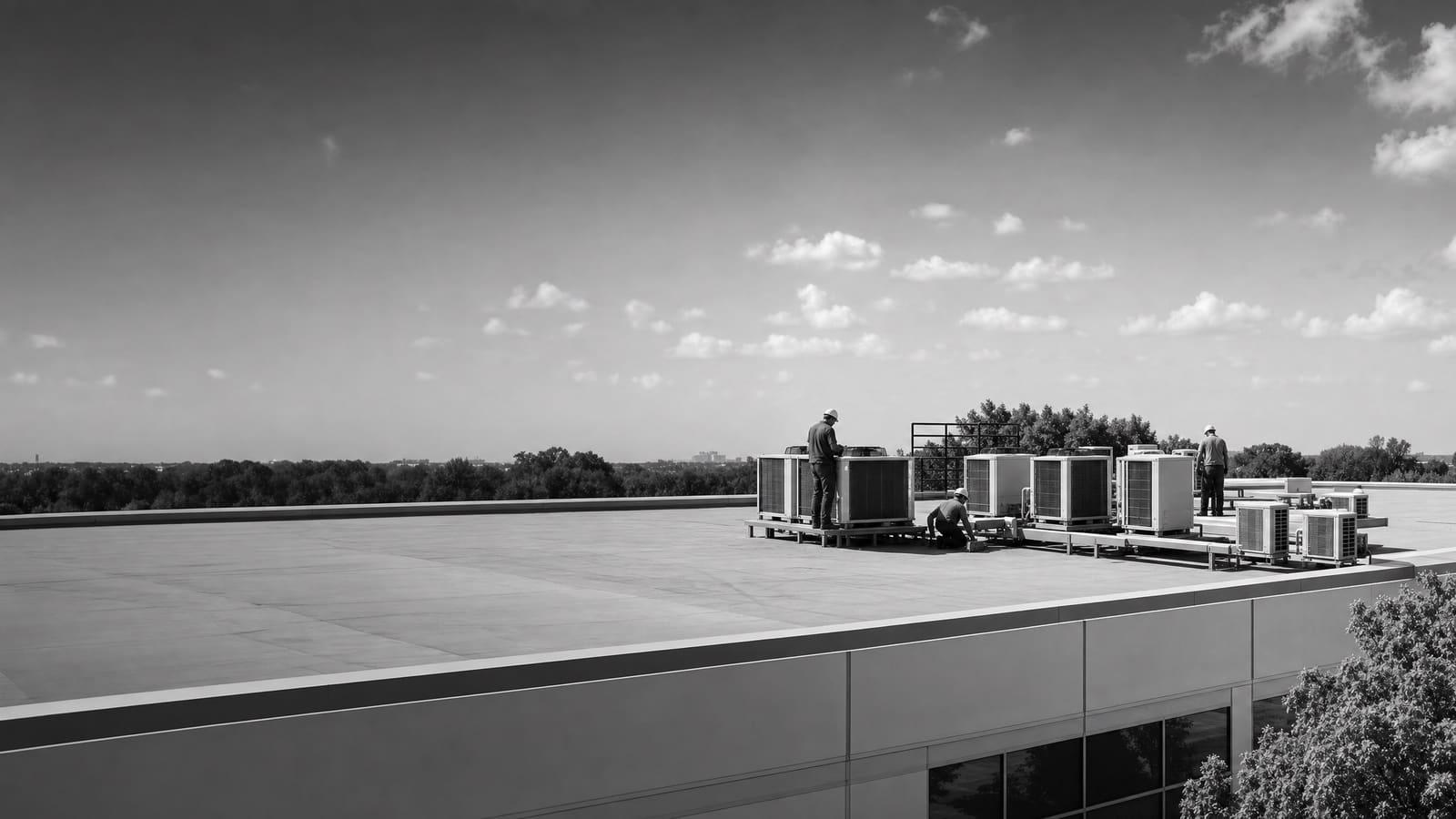
A commercial HVAC replacement covers a load check, equipment selection, rigging and set, the gas, electrical, and duct connections, controls integration, and documented startup. Replacement beats one more repair once a unit is past roughly fifteen years, because equipment that old wastes substantial energy and money compared with current models. Federal estimates put that waste at $900 to $3,700 per unit each year on old, inefficient rooftop equipment.
Age alone does not decide it. A site review has to confirm current load, curb and structural condition, available electrical capacity, and roof access before anyone can price the swap honestly.
THREE PATHS
The replacement choice in front of you
Most replacements come down to three paths, and the right one depends on how the building is used and what the roof can support.
The first is a like-for-like swap: same fuel, same general size, same curb. It is the fastest way back to conditioned space and the cheapest to engineer.
The second is a high-efficiency unit in the same footprint. A federal rooftop unit challenge pushed manufacturers to build packaged equipment that cuts energy use by up to half against the older standard, and more than twenty models now exceed that specification. The extra first cost buys itself back over the life of the unit.
The third is a heat pump rooftop unit, which heats by running the refrigeration cycle in reverse. These come as dual fuel, all-electric, and cold climate versions. Heat pump heating efficiency drops as outdoor temperature falls and trends toward electric resistance, so the real heating load at your site decides whether all-electric works or dual fuel is the safer build.
WHAT MOVES THE NUMBER
The lines that separate two bids
No two roofs price the same, so read a quote as a set of line items rather than as one number. These are the lines that move most between bids written on the same building.
BUYING GUIDANCE
Planned replacement versus replacement on failure
The most expensive way to buy a rooftop unit is to wait until it dies. Federal guidance is blunt about this. Facility managers often delay the purchase until the unit no longer conditions the space, needs constant service, or fails outright, and replacing proactively is usually the smarter business move than replacement on failure, or even than a like-for-like swap at the end of service life.
Under pressure, you take whatever is available, at whatever it costs, on whatever schedule a crane can offer. Planned replacement changes every one of those. You choose the efficiency tier instead of accepting it. You confirm the load against how the space is used today rather than trusting a nameplate written for a different tenant. You book the crane on a slow day. And you have time to find out whether the roof and the electrical service can carry a different fuel or a different footprint before that decision is forced on you.
The practical move is to inventory the units on your roof by age and condition, then flag anything past fifteen years. That is where energy waste on older equipment becomes a real line on the utility bill. Put the flagged units on a replacement calendar instead of a repair reflex.
SCOPE CHECK
Simple job or complicated one
Two projects described the same way on paper can be a week apart in the field. What separates them is what the new unit asks of the building around it.
LOWER COMPLEXITY
Straight swap on a ready roof
Same fuel, similar tonnage, clean crane access from the lot, and a curb the new unit can adapt to. Electrical service already carries the load, controls are straightforward, and set and connect happens in a single visit.
HIGHER COMPLEXITY
Fuel change or capacity change
Going all-electric, adding tonnage, or relocating a unit. Now electrical capacity, physical constraints on the roof, and gas line changes all get verified first. Equipment availability and finding crews experienced with the technology can move the schedule more than the installation itself.
SCOPING IT RIGHT
What a site review has to establish
A quote written from a phone call is a guess with a number attached. Before anyone commits to a price and a date, someone has to be on the roof.
Federal guidance for rooftop replacement lists the checks that matter, and they are the same ones a good contractor walks. The building's climate and heating load. The utility bill impact of whichever fuel you end up with. The building type and how it is actually occupied. Whether the equipment you want is available on a timeline you can live with. And the infrastructure that has to support it, meaning electrical capacity, physical constraints on the roof, and gas lines. Contractor familiarity with the technology belongs on that list too, especially for heat pump equipment. So do incentives, which have to be confirmed as open and current before anyone counts them in a payback.
That visit is also where sizing gets settled. Twenty years changes occupancy, plug loads, lighting heat, and sometimes the envelope itself. The old nameplate records what someone calculated for a building that no longer exists in that form. Carrying it forward is how a comfort complaint survives a brand-new unit.
Ask for the roof visit before the price
A useful scoping visit produces four things: a confirmed tonnage, a curb and structural plan, a written path for electrical and gas, and a rigging approach with the lot closure time named. A bid missing those is not comparable to one that has them.
AFTER THE CRANE LEAVES
Two costs you sign for on day one
The installation is a few weeks of attention. The unit that lands on the curb is a long operating commitment, and two of its costs are locked in the day you sign. The first is what it burns. The second is what it takes to keep running: parts, refrigerant, and technicians who know the platform. Owners who compare bids only on installed price tend to meet both of those later, on worse terms. Neither one shows up on the quote page, so both are worth pricing on purpose. If the building is leased, they also interact with who pays which bill, which is worth settling before the order goes in.
OPERATING COST
What the unit burns
Old rooftop equipment is estimated to waste $900 to $3,700 per unit each year against efficient models. On a roof carrying several tired units, that figure is what justifies moving the replacement calendar forward instead of waiting for a failure.
SERVICE PLANNING
A mixed fleet on one roof
Refrigerant handling is regulated. Federal Section 608 rules cover how refrigerant is handled and recycled in stationary cooling and heat pump equipment. A mixed-age roof means more than one generation of equipment in service, so plan parts and service coverage for both rather than assuming one contract fits.
PHASING AND PROCUREMENT
Replacing several units without stopping the building
Buildings rarely have one tired unit. They have four, and three of them went in the same year. Replacing all of them at once is the cheapest per unit, since you pay for one mobilization, one crane, one permit cycle, and one negotiation. It is also the hardest budget to get approved and the most disruption to absorb in a single season.
The middle path is a phased calendar built on condition rather than on which unit failed last. Rank the roof by age, service history, and the space each unit serves. Replace the worst first, in the shoulder seasons, and hold the specification steady so the second and third units match the first. Matching equipment is worth real money over time: one parts inventory, one control platform, one set of technicians who already know the system.
Procurement follows the same logic. Equipment availability is a genuine planning variable, not a footnote, so lead time belongs on the quote right next to the price. And if incentives are part of your payback, confirm the program is open and funded at the moment you are buying. Programs open, close, and change their terms. A rebate that was current a few years ago is history, not budget.
BEFORE YOU SIGN
Five things a comparable quote shows
Bids that look far apart are often just scoped apart. These five lines make two quotes comparable. If one bid leaves a line out, that scope did not disappear. It moved to a change order.
01
Equipment, tonnage, and efficiency tier
Model number, capacity, heating type, and the efficiency rating. Not simply "new rooftop unit."
02
Lead time and availability
The date the equipment can actually be on site, stated in writing next to the price.
03
Curb, structural, and roofing scope
Adapter or new curb, any framing required, and who patches and flashes the roof after the set.
04
Rigging plan and site impact
Crane size, how much of the lot closes, for how many hours, and the weather contingency.
05
Startup, commissioning, and documentation
Charge, airflow, and control settings verified against spec, recorded, and handed over with warranty registration.
Get a defensible number
Price the equipment and the building together.
Send the address, operating target, and target opening date. Flux will identify what must be verified before the project can be priced.
Get a free estimateQuestions
Straight answers.
When is replacing a rooftop unit better than repairing it again?
Once a unit is past roughly fifteen years, energy waste and service frequency usually pass the point where another repair makes sense. Federal guidance is direct that proactive replacement generally beats replacement on failure. Condition, service history, and current load decide the individual case.
Should we replace like-for-like or resize the unit?
Confirm the load either way. If the space and its use have not changed, like-for-like is often right. If occupancy, equipment, or operating hours have changed, sizing from today's use fixes complaints that a new unit by itself would not.
Is a heat pump rooftop unit a good replacement choice?
It depends on the heating load. Heat pump heating efficiency falls as outdoor temperature drops and trends toward electric resistance heating. Dual fuel and cold climate versions exist for exactly that reason. Electrical capacity at the building has to be checked before either is specified.
Why do two bids on the same unit come back so far apart?
Usually scope, not markup. Tonnage and efficiency tier, curb and structural work, crane access and closure time, electrical capacity, and gas line changes all move the number. Compare the line items before you compare the totals.
What happens to the refrigerant in the old unit?
It has to be recovered under federal rules. Section 608 of the Clean Air Act governs the handling and recycling of refrigerant in stationary refrigeration, air conditioning, and heat pump equipment. Recovery and removal belong as a stated line in the quote.
Sources used for this guide
- [1]betterbuildingssolutioncenter.energy.gov — DOE Advanced Rooftop Unit Replacement Guidance
- [2]betterbuildingssolutioncenter.energy.gov — DOE Commercial Heat Pump Rooftop Unit Replacement Guidance
- [3]betterbuildingssolutioncenter.energy.gov — DOE High-Efficiency Commercial Rooftop Unit Toolkit
- [4]energy.gov — DOE Efficient Commercial Rooftop Air Conditioner Program
- [5]epa.gov — EPA Stationary HVAC Refrigerant Management