THE DIRECT ANSWER
What a commercial HVAC replacement actually covers
A commercial HVAC replacement covers load verification, equipment selection, refrigerant recovery from the old unit, rigging and set, gas and electrical connections, controls, permitting, and commissioning. Replacement beats another repair once a unit is past roughly fifteen years and burning energy — old rooftop units can waste $900 to $3,700 per unit each year — or when the failure sits in the compressor, coil, or cabinet rather than a serviceable part.
A site review has to confirm tonnage against how the space is used now, the roof curb and the structure under it, electrical capacity at the unit, gas line and venting, and crane access before any price is real.
THREE WAYS TO GO
Three replacement paths worth pricing
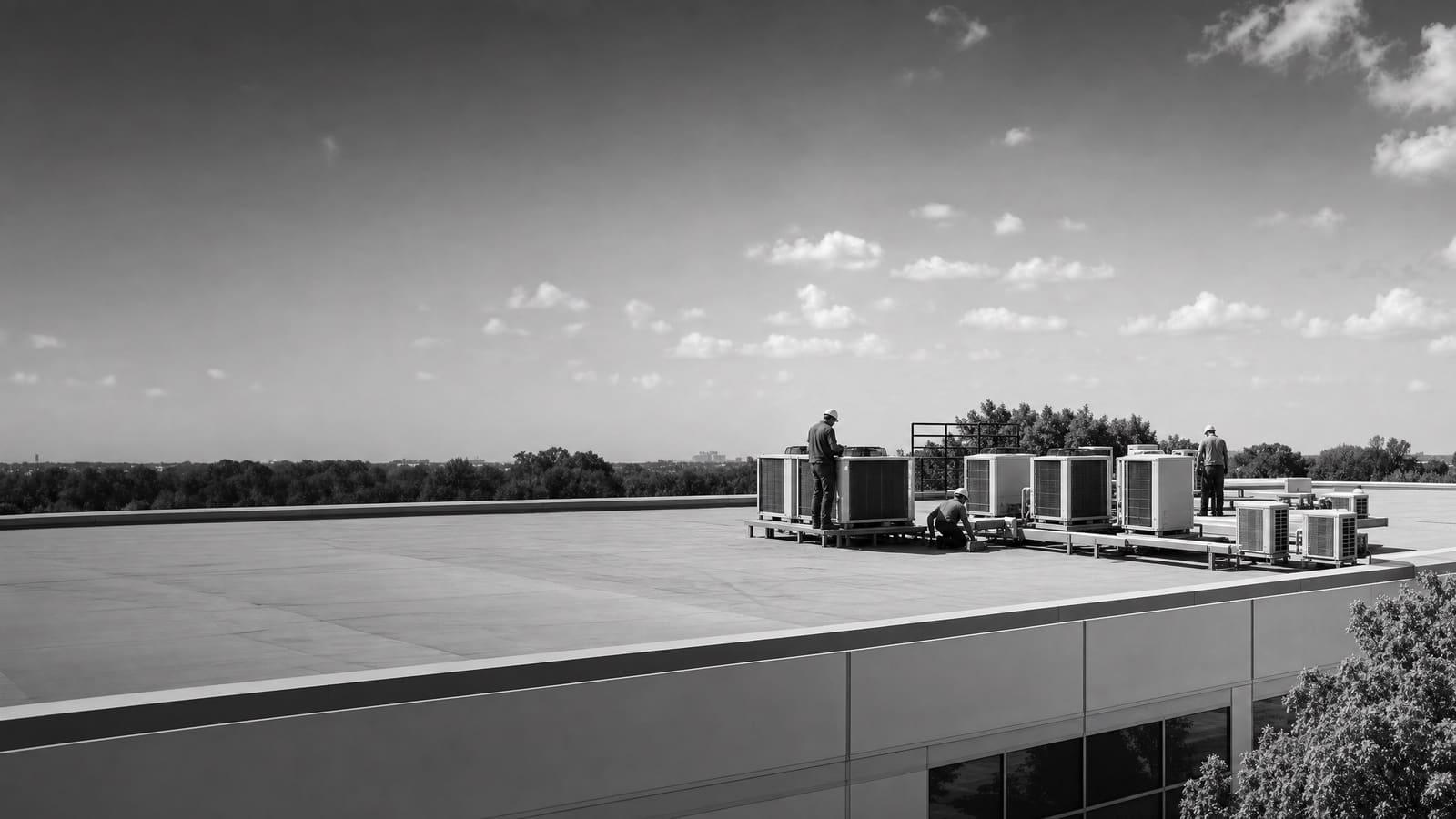
Most commercial roofs carry packaged rooftop units, which is the equipment class this decision usually lands on. Rooftop systems condition close to half of all commercial floor area in the country, so the market is deep and the options are real.
Three paths are worth pricing before you commit. The cheapest quote and the cheapest decade are rarely the same one, and the gap shows up on the utility bill rather than the invoice. DOE's guidance is that a proactive, planned replacement usually beats both replace-on-failure and a like-for-like swap at the end of service life — but only when the load and the heating strategy get checked first. If the unit still has usable life and the real problem is that it runs when nobody is in the building, controls can be the better spend.
WHAT MOVES THE NUMBER
Budget lines that actually move the price
Two roofs with the same tonnage can price very differently. These are the lines that create the spread, and every one of them should be visible on the quote instead of buried in an allowance.
IN PRACTICE
How to buy the replacement, not just the unit
The most common mistake is buying the nameplate. A unit installed fifteen or twenty years ago was sized for a building that no longer exists in practice — different tenants, different hours, different plug loads. Copying the old tonnage forward copies forward whatever was wrong with it. A load check is cheap next to a decade of short cycling, or a unit that never quite keeps up in August.
The second mistake is treating heating as an afterthought. Rooftop heat pumps are close cousins of ordinary air conditioning rooftop units — the same basic machine, run in reverse for heat — but the heating side is where a Connecticut roof differs from a Carolina one. Heat pump efficiency falls as outdoor temperature drops and trends toward parity with electric resistance heat, which is why DOE points colder regions toward dual-fuel or cold-climate units rather than a standard all-electric swap. That is a design decision, and it belongs in scoping before anyone quotes.
The third is buying on the invoice alone. A single old, inefficient rooftop unit can waste $900 to $3,700 a year on its own. Across a roof with four of them, the operating gap between a minimum-efficiency unit and a high-performance one can outrun the price difference well before the next replacement cycle comes due.
COMPLEXITY CHECK
One morning of work, or a multi-trade project
Before you compare quotes, work out which project you actually have. The same tonnage can be a one-morning swap or a job with three trades in it, and the difference is usually visible from the roof and the electrical room rather than from the invoice.
LOWER COMPLEXITY
Same footprint, same fuel
The new unit lands on the existing curb or a simple adapter, the tonnage matches a verified load, gas and electrical service are unchanged, and the lot has clean crane reach. Permitting is straightforward mechanical and electrical work, and the building sees cones for a morning.
HIGHER COMPLEXITY
New fuel, new footprint, tight site
Moving from gas heat to electric heating raises electrical capacity, which DOE flags as a primary infrastructure constraint. Adding tonnage or size can trigger structural review. A tight urban lot with limited crane setup can dictate off-hours work and stretch the schedule more than the equipment does.
SCOPING THE JOB
What a real site review has to settle
A useful site review is not a walk-by. It settles the handful of facts that decide both the equipment and the price, and it does that before anyone types a number.
Start with load. What is the space used for today, how many people are in it, what equipment runs in it, and what hours does it hold? That answer sets tonnage, and tonnage sets almost everything downstream.
Then infrastructure. DOE's heat pump rooftop guidance is blunt about the three things that stop these projects: electrical capacity, physical constraints, and gas lines. Electrical capacity is the one that turns a straightforward replacement into a service upgrade. Physical constraints are the curb, the structure under it, the clearances around the unit, and whether a crane can actually reach the spot. Gas lines matter whether you keep them or abandon them.
Then the old unit. It holds refrigerant, and EPA rules under Section 608 govern how that refrigerant is handled and recovered when equipment is serviced or taken out of service. That work belongs to a certified technician and belongs on the quote.
Finally, availability. Equipment availability is a listed consideration in DOE's own guidance for a reason. A unit you cannot get in season is not really an option, and the review should say which options are genuinely orderable.
The four answers to leave with
Verified tonnage for the space as it is used now, the condition of the curb and the structure under it, available electrical capacity at the unit, and confirmed lead times for every option you are weighing. Without those four, a quote is a guess wearing a number.
IN STAMFORD
Plan for a permit, not around one
Connecticut builds its state building code on the international model codes, and the mechanical code language is direct: a permit is required to install, alter, repair, remove, convert, or replace a mechanical system. The exemptions written into that code are narrow. They cover minor parts that do not change the approval of the equipment, and self-contained refrigeration systems holding roughly ten pounds of refrigerant or less, or driven by motors of about one horsepower or less. A commercial rooftop unit sits well outside those limits.
So the practical answer for a Stamford building is that a replacement is a permitted job, and the contractor should carry the permit and the inspections inside the installed price. Code editions and thresholds do get updated, so confirm current requirements with the Stamford building department before the crane is scheduled — especially if the swap adds tonnage or changes the fuel, since those are the changes that pull in extra review.
Ask for this in writing
The quote should name who pulls the mechanical and electrical permits, who meets the inspector, and whether that cost is included or billed separately. Permit responsibility is the cheapest thing to settle before signing and the most annoying to argue about afterward.
OWNING THE DECISION
Two things that outlive the install
The install ends. The two decisions below stay with the building for the next fifteen or twenty years, and they deserve more attention than the crane day usually gets.
The first is timing. DOE describes the common pattern plainly: owners put off a new rooftop unit until the old one stops holding the space, needs constant service, or fails outright. Replacing on failure is the most expensive version of this project, because it removes your ability to shop equipment, compare efficiency tiers, or schedule around your tenants.
The second is what happens across a roof with several units. Once one is replaced, the fleet is mixed, and mixed fleets need a plan for parts, service coverage, and refrigerant handling. That is not a reason to delay the first replacement. It is a reason to write down the order the rest will follow.
TIMING
Planned beats reactive
A planned replacement lets you price options, order ahead of the season, and set the unit on a Saturday. A failure in August lets you take whatever is available, at whatever it costs that week.
PORTFOLIO
Sequence the rest of the roof
More than 200 organizations have run over 43,000 rooftop units through DOE's upgrade campaign, saving a combined $37 million a year. Those savings come from treating the roof as a program, not as a series of emergencies.
PHASING AND PROCUREMENT
Replacing four units without four emergencies
If you have several aging units, the useful question is not which one to replace but in what order. Rank them by age, service history, and what they serve. A unit past the fifteen-year mark that is already on frequent service calls is a candidate now; a ten-year unit over a storage area can wait. That ranking becomes a two- or three-year plan you can budget against instead of a run of unbudgeted failures.
Procurement follows the same logic. Equipment availability belongs next to price on every quote, because the same unit at the same price is a different decision at two weeks than at ten. Ordering ahead of the cooling season, or committing to a spec early so the unit can be staged, is the easiest way to keep a replacement from becoming an emergency purchase. If your building runs on a fiscal calendar, a plan lets you land the spend in the year you chose rather than the year the compressor chose.
Lifetime cost is where the ranking pays. An old, inefficient rooftop unit can burn $900 to $3,700 a year in avoidable energy, and high-performance units were built against a specification targeting up to half the energy use of the older standard. Multiply that across the units on your roof and the years to the next cycle, and sequencing usually matters more than which of two comparable bids came in lower.
QUOTE CHECKLIST
Five things a comparable quote shows
Two bids are only comparable if they scope the same job. Ask every bidder to show these five, and differences that looked like price often turn out to be scope.
01
Equipment, tonnage, and efficiency tier
Model number, capacity, heating type, and the efficiency level — not just a line that says new rooftop unit.
02
Load basis
Whether the tonnage came from a calculation on today's use, or was carried over from the old unit's nameplate.
03
Curb, structural, and rigging scope
Curb adapter, any structural work, crane size, staging area, and how long the lot is closed.
04
Permits, inspections, and refrigerant recovery
Who pulls the permits, who meets the inspector, and who recovers refrigerant from the old unit under EPA rules.
05
Lead time and commissioning
The real availability date, and what startup verification is documented at handoff: charge, airflow, and control settings.
Get a defensible number
Price the equipment and the building together.
Send the address, operating target, and target opening date. Flux will identify what must be verified before the project can be priced.
Get a free estimateQuestions
Straight answers.
When does replacement beat one more repair?
Once the unit is past roughly fifteen years, on repeat service calls, or failing in the compressor, coil, or cabinet. DOE notes that old rooftop units can waste $900 to $3,700 each per year, which often outruns the repair bill you are trying to avoid.
Does a rooftop replacement in Stamford need a permit?
Plan on it. Connecticut's mechanical code requires a permit to install, replace, or remove a mechanical system, and the exemptions cover only very small self-contained equipment. Confirm current requirements with the Stamford building department and have the contractor carry the permit.
Should the new unit be a heat pump?
It depends on the heating side. Heat pump efficiency drops as outdoor temperature falls, so DOE steers colder regions toward dual-fuel or cold-climate units rather than a standard all-electric swap. Electrical capacity at the unit is the other gate.
What usually causes the surprise cost?
Electrical capacity and the curb. DOE lists electrical capacity, physical constraints, and gas lines as the infrastructure items that decide these projects. A service upgrade or structural work discovered after signing is where budgets break.
Can controls replace a full replacement?
Sometimes. DOE treats retrofitting advanced controls as a legitimate alternative to replacement when the unit still has service life and the financials favor it. It is fair to ask a bidder to price that alongside a new unit.
Sources used for this guide
- [1]betterbuildingssolutioncenter.energy.gov — DOE Advanced Rooftop Unit Replacement Guidance
- [2]betterbuildingssolutioncenter.energy.gov — DOE Commercial Heat Pump Rooftop Unit Replacement Guidance
- [3]betterbuildingssolutioncenter.energy.gov — DOE High-Efficiency Commercial Rooftop Unit Toolkit
- [4]energy.gov — DOE Efficient Commercial Rooftop Air Conditioner Program
- [5]epa.gov — EPA Stationary HVAC Refrigerant Management
- [6]cga.ct.gov — Building Permit Requirements for Devices Installed in a Home