THE DIRECT ANSWER
What a commercial HVAC replacement actually includes
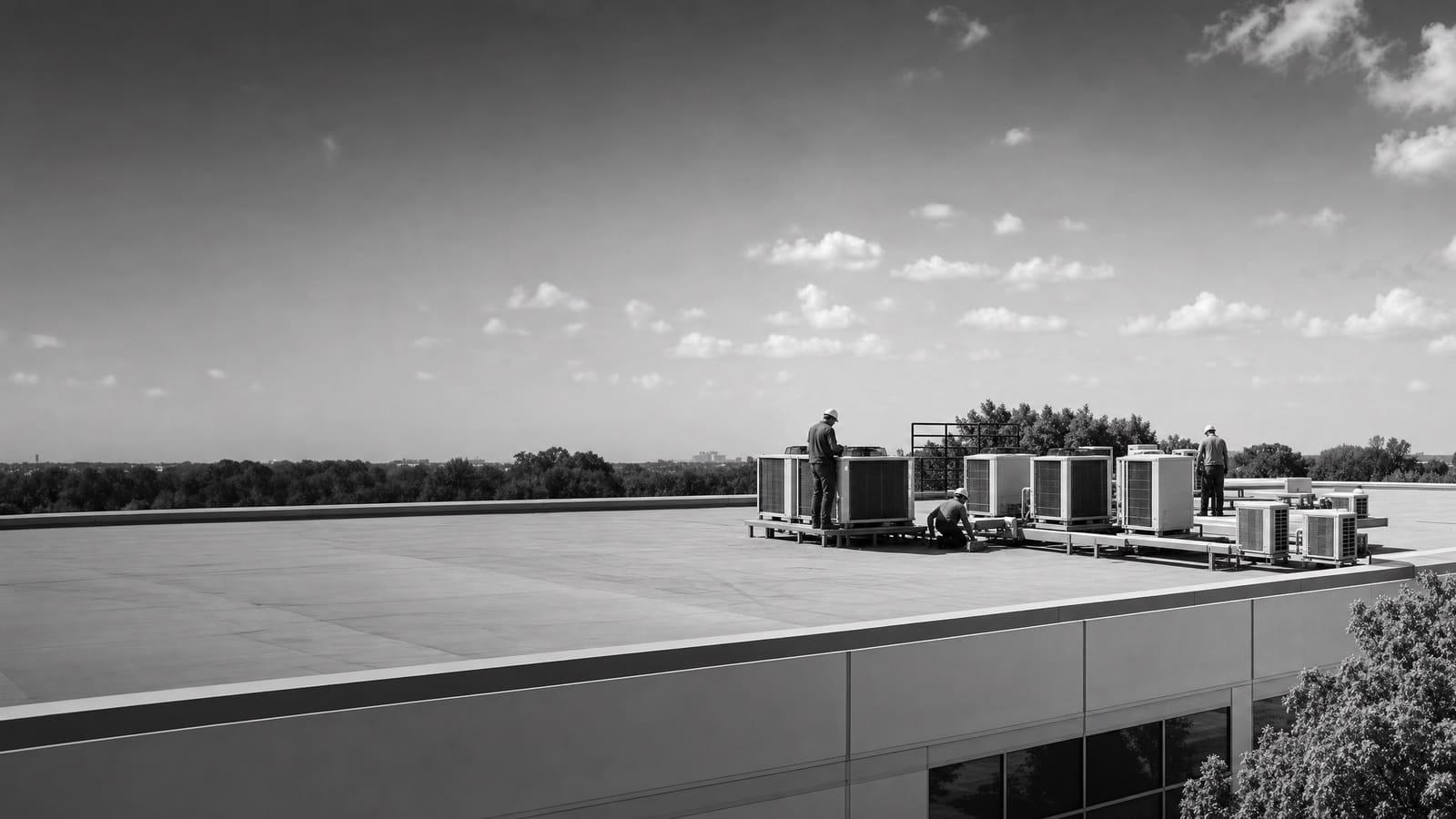
A commercial HVAC replacement covers a fresh load calculation, equipment selection, rigging and set, gas or electrical work, controls integration, and documented commissioning. Replacement beats another repair once a unit is past about 15 years and needing frequent service. DOE puts the yearly waste from an old, inefficient rooftop unit at roughly $900 to $3,700 per unit. Past that point, repair spending buys time on equipment that is already costing you every month it runs.
A site review still has to confirm curb and structural fit, electrical service capacity, gas line size, crane access to the roof, and whether replacement triggers ventilation or economizer work.
THE REAL CHOICE
Three heating strategies to decide between
Most St. Paul replacements come down to how the building will make heat in January. DOE's heat pump guidance is direct about the tradeoff: as outdoor temperature drops, heat pump heating efficiency falls toward parity with electric resistance, so heat pump rooftop units do their best work where winter heating is mild to moderate. That does not rule them out in a cold climate, but it does decide which version fits.
It also means the choice is not only about the box. Electrical capacity, physical constraints on the roof, and existing gas lines all sit in DOE's own consideration list, alongside equipment availability and whether contractors in the area are comfortable with the technology. Pick the operating strategy first, then let it drive the equipment schedule. Deciding in that order keeps you from buying a unit the building cannot feed.
WHAT MOVES THE NUMBER
The lines that decide your installed price
Commercial quotes are priced per unit and per roof, so no single installed figure is worth publishing. These are the items that actually move a bid up or down, and the ones most likely to change after someone walks the site.
IN PRACTICE
Buy the replacement instead of reacting to it
Rooftop units cool close to half of all commercial floor area in the country, which is why replacement guidance keeps circling back to the same habit: owners wait. DOE's framing is blunt about it — facility managers often delay a new unit until the old one no longer conditions the space, needs constant service, or fails outright. Buying under those conditions costs more and narrows the choice to whatever is available that week.
The alternative is to treat replacement as a scheduled purchase. DOE's Advanced RTU Campaign reported more than 200 organizations upgrading over 43,000 rooftop units, with a combined $37 million in annual energy savings. That is the case for planning it rather than reacting to it. The same program made a second point worth keeping: replacement is not the only move. Owners could commit to replacing old units or to retrofitting them with advanced controls, whichever made better financial sense for that building.
So the first question at a St. Paul site is not which brand. It is whether this unit is a controls problem or an equipment problem, and if it is equipment, whether the heating strategy stays the same. Answer those two and comparing quotes gets simple.
SIDE BY SIDE
Simple swap or engineered project
Two replacements at the same tonnage can be very different projects. What separates them is whether the building's inputs change — fuel, footprint, load, or access. That is what decides how much engineering sits in front of the crane day.
LOWER COMPLEXITY
Same footprint, same fuel
The unit lands on the existing curb or a straightforward adapter, the space is used the way it always was, and the heating source does not change. Access is open, the electrical service is untouched, and the work runs on standard mechanical and electrical permits.
HIGHER COMPLEXITY
New fuel path or new load
Moving to electric heating, growing tonnage, or changing the footprint. Now service capacity, roof framing, and gas line decisions come first. DOE also flags contractor familiarity with newer heat pump equipment as its own scheduling risk, not just a preference.
SCOPING
What the site review has to settle before anyone quotes
A quote that arrives without a roof visit is a guess wearing a price tag. The review should produce a short list of facts, and every one of them changes the number.
Start with the existing unit: model, age, tonnage, heating type, and the refrigerant in it. Then the physical fit — curb dimensions, whether an adapter works or the curb gets replaced, and whether the framing carries the new weight. Then access: where the crane sets up, what it has to reach over, and how many stalls come out of service and for how long.
The utilities side is where surprises live. Electrical service capacity and available panel space decide whether an electric heating option is even on the table, and gas line size decides the same for gas heat. DOE lists electrical capacity, physical constraints, and gas lines as core infrastructure considerations for exactly this reason, alongside equipment availability. Last, ask what the replacement triggers. Ventilation and economizer requirements, controls integration, and inspection sequence are all far cheaper to plan than to discover on crane day.
Ask for this before you sign
The scope should name the exact model and heating type, say who pulls the mechanical permit, say who owns the crane and the lot closure, and list the commissioning documents you receive at handoff.
LOCAL CONTEXT
Licensing and permits are handled city by city here
Mechanical contractor licensing in the Twin Cities is issued locally, not once for the whole metro. Minneapolis, for example, licenses mechanical contractors by category — covering HVAC, refrigeration, and gas piping — publishes the list of companies approved to do that work in the city, and maintains its own mechanical and heating permit requirements.
That matters two ways for a St. Paul buyer. If you run one building, confirm your contractor is licensed to pull the mechanical permit in the jurisdiction your address sits in, and that the permit is inside the installed price rather than a change order later. If you run sites on both sides of the river, do not assume one vendor's paperwork travels with them. Ask which city licenses each crew holds before you standardize a rooftop unit across the portfolio, because a gas piping change at one site can follow a different approval path than the identical change a few miles away.
Verify before the crane is booked
Get it in writing: which city issues the mechanical permit for this address, who holds the license there, whether gas piping needs a separate approval, and who schedules the inspections.
OWNERSHIP
Two decisions that outlive the install
Two decisions outlive the installation, and both tend to get made quietly while everyone is focused on price.
The first is when the work happens. A unit replaced on your calendar is a competitive bid; a unit replaced the week it dies is whatever a distributor has on the shelf. The second is what this unit commits the rest of the roof to. Equipment choice sets the refrigerant your service contractor will handle, the controls platform your staff will learn, and the parts your fleet should keep on hand. Neither shows up as a line item, but together they shape the next decade of service calls. Make them on purpose.
TIMING
Planned beats reactive
DOE describes the common pattern plainly: owners wait for inadequate conditioning, frequent repairs, or outright failure. Replacing ahead of that keeps competitive bidding, equipment selection, and shoulder-season scheduling on your side of the table.
FLEET
Refrigerant and parts strategy
A new unit will not always share refrigerant with the ones beside it. EPA Section 608 governs how refrigerant is handled, recovered, and recycled in stationary equipment, so a mixed roof means planning technician certification and spare parts, not just tonnage.
PLANNING AHEAD
Phasing a roof full of aging units
A roof with several aging units rarely gets replaced all at once, and usually should not be. Rank the units by age, service history, and the hours they actually run, then replace the worst first. The per-unit waste figure is a useful sorting tool here: an old, inefficient unit burning $900 to $3,700 a year in avoidable energy gives you a defensible order of operations instead of a gut call.
Phasing also buys procurement leverage. Two or three units replaced on the same crane day share mobilization and lot closure. A multi-year plan lets you standardize on one platform, which shortens future service calls and keeps parts inventory sane. It also gives you time to size the electrical service once, in advance, if the long-term direction for that roof is electric heating.
Compare lifetime cost, not the bid. That means installed price, expected utility spend at the chosen efficiency tier and heating type, the service contract, and the refrigerant the unit ships with. Incentives belong in the math too, but confirm a program is currently open and funded before it goes into the budget. Qualifying equipment lists and offerings change from year to year.
THE QUOTE
Five things a comparable quote has to show
Bids only compare if they describe the same job. Ask every contractor for these five in writing before you weigh price against price, and the differences between proposals stop being guesswork.
01
The exact equipment
Model number, tonnage, efficiency tier, and heating type — named, not described as an equivalent unit.
02
The sizing basis
Whether tonnage came from a current load calculation or was carried over from the old nameplate.
03
Curb, structural, and access scope
Adapter or new curb, any framing work, crane staging, and how long the lot area is closed.
04
Permits and licensed work
Which permits are included, who pulls them, which city issues them, and who schedules inspections.
05
Commissioning and refrigerant handling
Startup readings, controls setup, documented handoff, and certified recovery of the old charge.
Get a defensible number
Price the equipment and the building together.
Send the address, operating target, and target opening date. Flux will identify what must be verified before the project can be priced.
Get a free estimateQuestions
Straight answers.
When does replacement beat one more repair?
Once a unit is past about 15 years and needing frequent service, the repair is buying time on equipment that is already losing money. DOE puts the annual waste from an old, inefficient rooftop unit at roughly $900 to $3,700. Weigh the repair against that number, not against the price of a new unit alone.
Does a heat pump rooftop unit make sense in a St. Paul winter?
It depends on which version. DOE notes that heat pump heating efficiency falls toward electric resistance parity as outdoor temperature drops, so standard heat pump units are best suited to mild-to-moderate winter heating. In a cold climate, the realistic paths are a dual-fuel unit or a cold-climate model, and both depend on confirmed electrical capacity.
Should we replace the unit or add advanced controls?
That is a legitimate fork. DOE's rooftop unit campaign let owners either replace old units or retrofit them with advanced controls, whichever made better financial sense for the building. If the equipment is sound but running badly, controls may be the cheaper fix. If it is old and failing, controls only delay the decision.
Who handles permits and licensing?
The installing contractor should own permits and inspections inside the installed price. Confirm the license applies to the city your building sits in — mechanical contractor licensing in the Twin Cities is issued locally, and Minneapolis, for example, licenses HVAC, refrigeration, and gas piping work under its own program.
What happens to the refrigerant in the old unit?
It has to be recovered by a certified technician. EPA regulations under Section 608 of the Clean Air Act govern how refrigerant is handled and recycled in stationary air-conditioning and heat pump equipment. Recovery and documentation should appear on the quote as scope, not be assumed.
Sources used for this guide
- [1]betterbuildingssolutioncenter.energy.gov — DOE Advanced Rooftop Unit Replacement Guidance
- [2]betterbuildingssolutioncenter.energy.gov — DOE Commercial Heat Pump Rooftop Unit Replacement Guidance
- [3]betterbuildingssolutioncenter.energy.gov — DOE High-Efficiency Commercial Rooftop Unit Toolkit
- [4]energy.gov — DOE Efficient Commercial Rooftop Air Conditioner Program
- [5]epa.gov — EPA Stationary HVAC Refrigerant Management
- [6]minneapolismn.gov — Mechanical and Heating Contractors - City of Minneapolis