THE SHORT ANSWER
What commercial HVAC replacement and installation includes
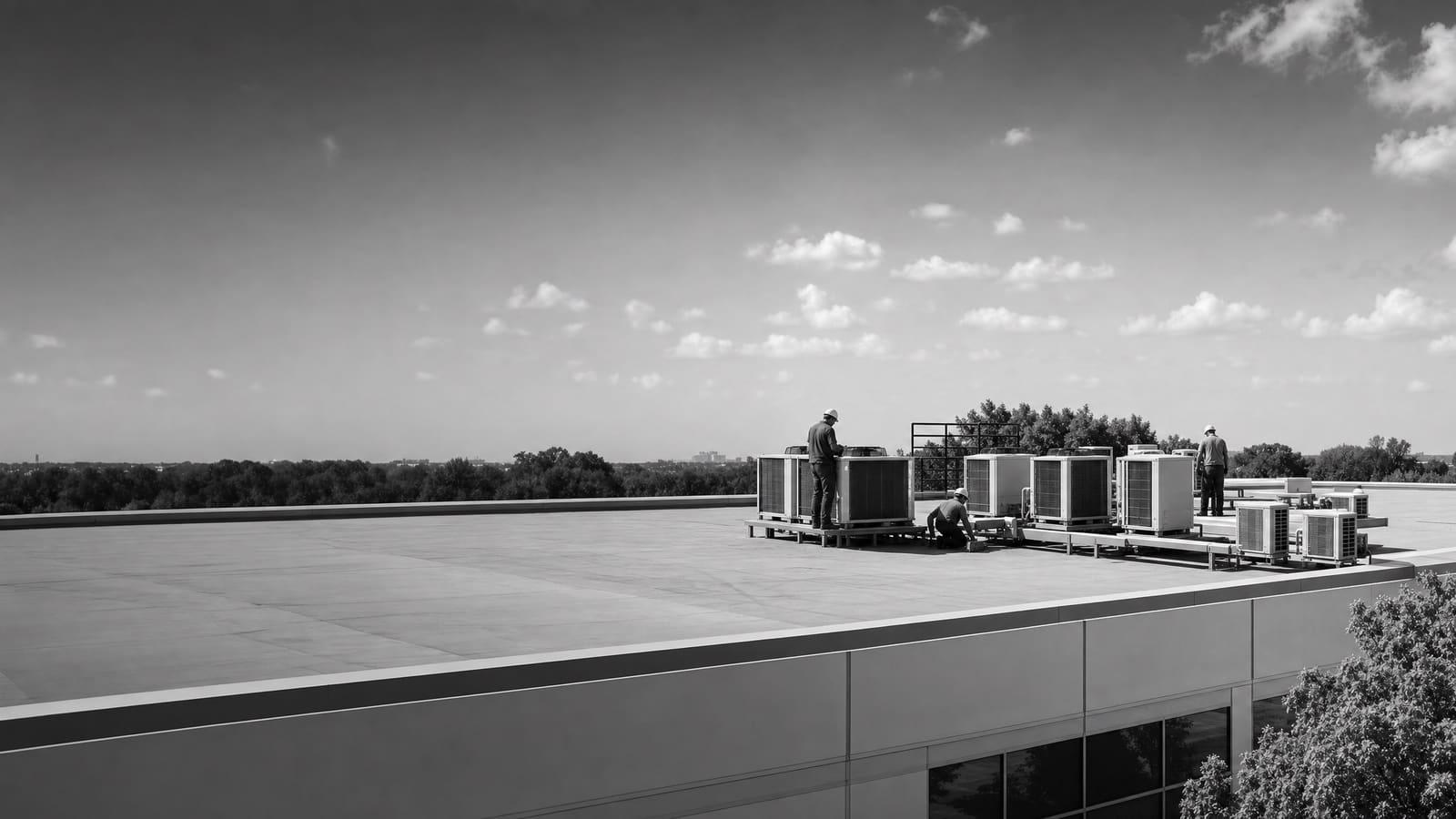
A commercial HVAC replacement covers the load check, equipment selection, certified refrigerant recovery and removal of the old unit, curb and connection work, the crane set, and commissioning. Replacement beats another repair once a unit is past fifteen years, needs frequent service, or can no longer hold the space. Department of Energy figures put the annual energy waste of an old, inefficient rooftop unit at $900 to $3,700 per unit.
A site review still has to confirm the actual load, the roof curb and structure, electrical capacity at the unit, gas line condition, and crane access before any of that means a number for your building.
THREE PATHS
Three ways to handle a unit at end of life
Most buildings default to the first option without ever choosing it. Facility teams hold a rooftop unit until it stops holding the space, needs constant service, or fails outright — and DOE is blunt that proactive replacement usually beats replacement-on-failure, and often beats a like-for-like swap at end of service life.
The middle path is the one people forget. DOE's rooftop campaign let owners either replace old units with high-efficiency equipment or retrofit existing ones with advanced controls, whichever made better financial sense. More than 200 organizations upgraded over 43,000 units that way, cutting a combined $37 million a year in energy spend. Controls only work when the cabinet, coil, and heat exchanger are still sound. Once they are not, it is money spent on a unit that is leaving.
WHAT MOVES THE NUMBER
The lines that actually swing a replacement price
No two rooftop replacements price the same, and the spread is rarely in the equipment itself. Make every bidder break out these lines, because each one is where a low number quietly becomes a change order.
IN PRACTICE
Choose the equipment before you compare the price
The nameplate on the old unit is a record of a decision someone made a long time ago. Occupancy, plug loads, lighting, and the envelope have probably all changed since. Carrying that tonnage forward is the fastest path back to cooling, but it also carries forward whatever was wrong the first time, which is how oversized units end up short-cycling, dehumidifying poorly, and producing comfort complaints nobody can trace.
The second decision is efficiency tier, and it deserves more attention than it usually gets. DOE's rooftop unit challenge set a performance spec aimed at cutting energy use by up to half against the standard of the time, and manufacturers now sell more than twenty models that exceed it. Measured against $900 to $3,700 of annual waste on a tired unit, the gap between a base-tier and a high-tier replacement is often repaid on the operating line rather than the capital line.
The third is availability. Equipment type, efficiency tier, and refrigerant all affect what can actually ship, and a quote that names a price without naming a lead time is half a quote. Ask for both together, and ask what the fallback unit is if the first choice slips.
SCOPE CHECK
What makes a replacement simple, and what makes it complicated
Two replacements at the same tonnage can be two different projects. Work out which one you have before comparing bids, because it explains most of the gap between them.
LOWER COMPLEXITY
Straight swap on an unchanged building
Same use, same occupancy, same load. The new unit lands on the existing curb or a simple adapter, electrical and gas stay where they are, and the crane has real reach from the lot. Permits are usually mechanical and electrical, and the work is planned around one weather window.
HIGHER COMPLEXITY
Anything that changes footprint, fuel, or access
A tonnage change, a larger cabinet, a move to electric or dual-fuel heating, a tight site with nowhere to set a crane, or a tenant who cannot lose conditioning for a shift. Each one adds structural review, electrical work, or phasing, and any of them can outrun the cost of the equipment upgrade itself.
BEFORE YOU BID IT
What a site review has to settle
A useful walk-through is not a look at the unit. It is a look at everything the unit depends on. DOE's own checklist for rooftop decisions covers the same ground: electrical capacity, physical constraints, gas lines, equipment availability, and whether the contractor pool actually knows the technology being proposed.
Electrical capacity is where projects stall. If the replacement adds any electric heating, the question is not whether the new unit fits the curb, it is whether the panel, the feeder, and the service can carry it. That answer takes a meter and a look at the gear, not an assumption.
Physical constraints come next: curb dimensions, roof structure, clearance around the unit, duct connections, and how a crane gets close enough to set it. On a tight lot the rigging plan drives the schedule more than the equipment does.
Then the heating decision. Keeping a gas section, going dual fuel, or going all-electric each imply different piping, venting, and permit work, and that belongs in the scope before the quote rather than during demolition.
Last, removal. Federal refrigerant rules govern how the charge comes out of the old unit and where it goes, so disposal is real scope with real hours behind it.
Ask for the checklist back
A bidder who walked your roof should be able to state your curb size, the panel capacity at the unit, gas line status, where the crane sets up, and the model with its lead time. If any of those come back as an assumption, you are holding an estimate, not a price.
OWNERSHIP MATH
Two things to settle before the purchase order
The equipment decision and the ownership decision are not the same decision. One is about what lands on the roof. The other is about who pays for what happens afterward, and how the building's fuel choice ages.
Rooftop units condition close to half of all commercial floor space in the country, so whatever you decide here is the pattern you are likely to repeat at every other unit you own. Both questions are cheaper to answer now than at the second failure.
LEASE STRUCTURE
Who owns the improvement
In a leased building the unit is usually the landlord's capital and the tenant's utility bill. That split decides who actually cares about efficiency tier, so settle the cost recovery language and the approval path before the equipment is specified, not after it ships.
FUEL PATH
Gas, dual fuel, or all-electric
Heat pump rooftop units are close cousins of standard air-conditioning units, with reverse-cycle heating added. Their heating efficiency falls as outdoor temperatures drop, trending toward electric resistance in deep cold, which is why dual-fuel and cold-climate versions exist for buildings with real winter heating hours.
PLANNING AHEAD
Phase a fleet instead of reacting to it
Most commercial buildings do not have one rooftop unit. They have several, bought at the same time and aging at the same rate. That is a schedule problem wearing a maintenance problem's clothes. When four units pass fifteen years together, the first failure sets the price for the rest, because emergency work does not wait for competitive bids.
The alternative is boring on purpose. Rank the units by age, service history, and what each one costs to run. Replace the worst one or two per capital year, reuse the same specification and the same commissioning documentation every time, and let a single crane mobilization cover more than one unit when the roof allows. That last detail alone often pays for the planning.
Procurement gets easier too. A standing specification means you compare the same scope each year, lead times are known before the season starts, and incentive paperwork follows a template. DOE's guidance treats incentives as a standing part of the rooftop decision, and that paperwork is far easier to handle before a unit fails than during the week it does.
QUOTE CHECKLIST
Five things a comparable quote has to show
Bids only compare when they cover the same scope. Ask every bidder to break out these five items so the difference between two numbers is visible instead of buried.
01
Unit, tonnage, and efficiency tier
Model number, capacity, and the efficiency level quoted, plus the lead time for that exact unit and the fallback if it slips.
02
Curb, structure, and roof work
Adapter or new curb, any structural review, roof patching, and who carries the roofing warranty afterward.
03
Electrical and gas scope
Disconnect, feeder, panel work, gas piping or abandonment, and whether existing capacity was assumed or verified.
04
Crane, rigging, and site plan
Mobilization, lot closure, staging, the weather contingency, and whether after-hours work is included or billed extra.
05
Commissioning and closeout
Startup readings, charge, airflow, controls setup, permits and inspections, and the documentation the warranty depends on.
Get a defensible number
Price the equipment and the building together.
Send the address, operating target, and target opening date. Flux will identify what must be verified before the project can be priced.
Get a free estimateQuestions
Straight answers.
When does replacement beat one more repair?
Once a unit is past fifteen years, needs frequent service, or can no longer hold the space, a repair is buying time on a losing asset. DOE puts the annual energy waste of an old, inefficient rooftop unit at $900 to $3,700, and that number usually settles the argument faster than the repair invoice does.
How much does commercial HVAC installation cost?
There is no honest universal price, because tonnage, curb work, electrical scope, and crane access move the total more than the equipment does. What you can insist on is a quote that breaks those out separately, so you can see which bidder verified a condition and which one assumed it.
Should we replace like-for-like or resize?
Confirm the load either way. If the space is used the way it was when the old unit was selected, like-for-like is often right and is the fastest path back to cooling. If occupancy, hours, or plug loads changed, carrying the old tonnage forward carries the old comfort problems forward with it.
Is a heat pump rooftop unit a real option?
It can be. Heat pump rooftop units are technically similar to standard air-conditioning units with reverse-cycle heating added, and DOE's checklist turns on electrical capacity, gas line status, utility rates, and equipment availability. Because heating efficiency drops as outdoor temperatures fall, dual-fuel and cold-climate versions exist for buildings with real winter heating demand.
Can a controls upgrade replace a new unit?
Sometimes. DOE's rooftop campaign let owners either replace old units or retrofit them with advanced controls, whichever made better financial sense, and more than 43,000 units were upgraded through it. Controls work when the cabinet, coil, and heat exchanger are still sound, and do not when the unit is near the end of its life.
What happens to the refrigerant in the old unit?
It is recovered, not vented. Federal Clean Air Act rules govern how refrigerant is handled and recycled in stationary air-conditioning and heat pump equipment, so removing the old unit is a documented procedure with labor behind it. That is one reason the demolition line on a real quote is never zero.
Sources used for this guide
- [1]betterbuildingssolutioncenter.energy.gov — DOE Advanced Rooftop Unit Replacement Guidance
- [2]betterbuildingssolutioncenter.energy.gov — DOE Commercial Heat Pump Rooftop Unit Replacement Guidance
- [3]betterbuildingssolutioncenter.energy.gov — DOE High-Efficiency Commercial Rooftop Unit Toolkit
- [4]energy.gov — DOE Efficient Commercial Rooftop Air Conditioner Program
- [5]epa.gov — EPA Stationary HVAC Refrigerant Management