THE DIRECT ANSWER
What a commercial HVAC replacement includes
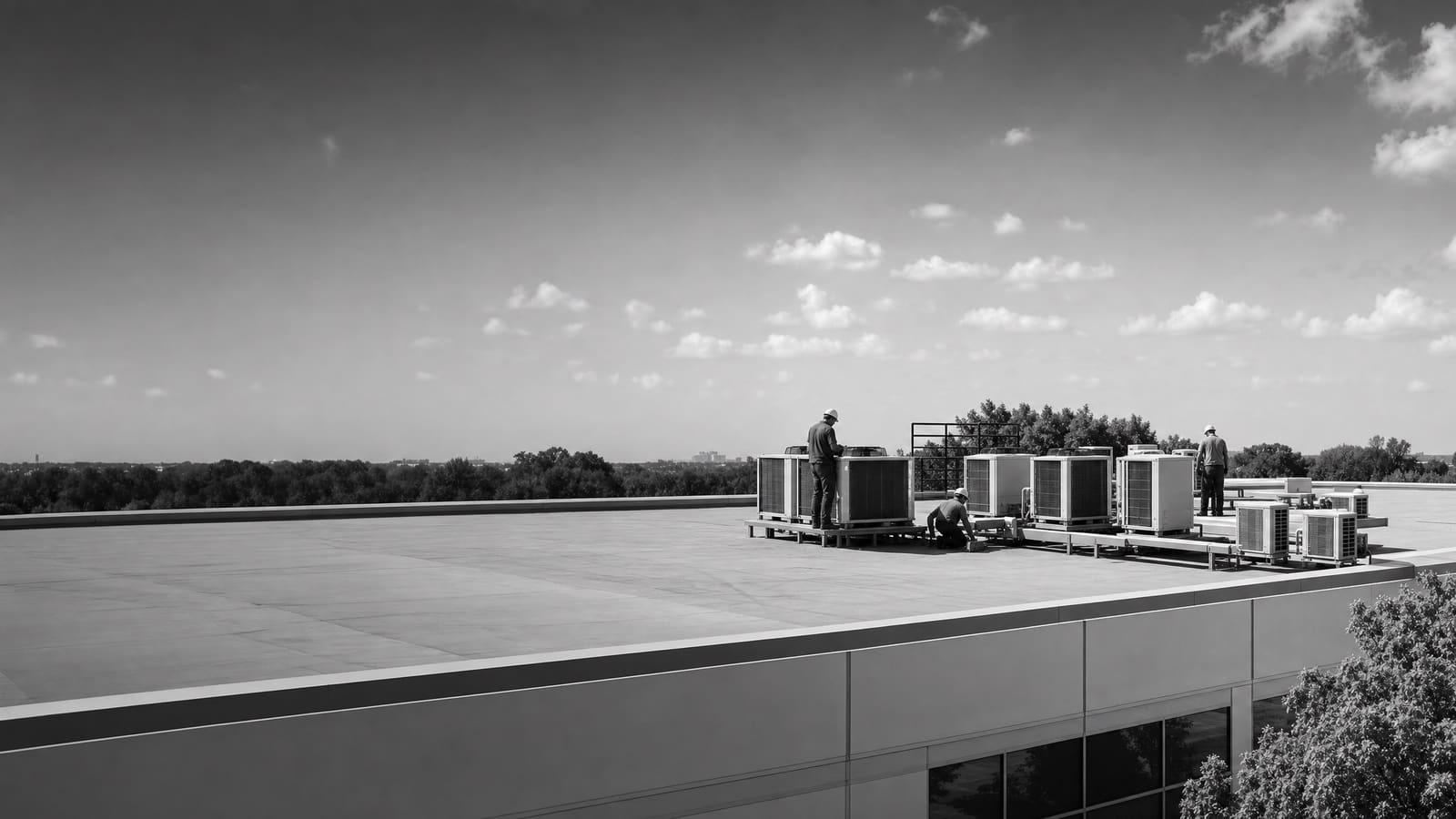
A commercial replacement covers load confirmation, equipment selected against real lead times, rigging and set, gas and electrical connections, controls, permits, and commissioning. It beats another repair once the unit is past about fifteen years and no longer holding the space. Old, inefficient rooftop units waste roughly $900 to $3,700 each per year in energy alone, so a second repair on a tired unit usually buys time rather than capacity.
A site review has to verify the curb and roof framing, available electrical capacity, gas line size, crane reach across the lot, and whether the current load still matches how the space is used.
THREE WAYS TO GO
Three replacement paths, and when each one fits
Rooftop units condition close to half of all U.S. commercial floor space, so most of these projects are rooftop projects. Three paths are usually on the table, and the building decides more than the brochure does. A like-for-like swap is the fastest way back to conditioned space, but it carries forward whatever sizing error the old unit had. A right-sized replacement adds a load calculation and usually a higher efficiency tier, which is where the operating savings live. A heat pump rooftop unit adds reverse-cycle heating and is the most sensitive to the building itself: electrical capacity, roof space, existing gas lines, and how cold the heating design day runs. Heat pump efficiency falls as outdoor temperature drops, and all-electric units lean on electric resistance backup in the coldest hours, which is why dual-fuel units exist. Ask for at least two of the three priced side by side.
WHAT MOVES THE NUMBER
The budget lines that actually swing
An installed price is the unit plus everything the roof and the building make you do to land it. Ask for these as separate lines. A bundled total hides exactly the items most likely to change after the first walk of the roof.
IN PRACTICE
How to buy the equipment, not just the install
The visible part of a replacement is short. A crane arrives, stalls get coned, the old unit comes off the curb, and the new one lands. Everything that makes that morning uneventful was decided weeks earlier.
Start with the load, not the nameplate. A unit installed two decades ago was sized for the occupancy, plug loads, lighting, and envelope of that building at that time. Tenant changes, lighting retrofits, and different operating hours all move the number, and oversized equipment short-cycles, dehumidifies poorly, and wears out early.
Then buy on availability as much as on price. Lead time is the variable that decides whether a building is down for days or for weeks, so the availability date belongs on the quote next to the number. Waiting for failure removes that choice entirely: you take whatever is on the truck, at whatever it costs, during the worst week of the year.
Last, settle the fuel question before you shop rather than after. Whether a heat pump belongs at your site turns on electrical capacity, physical constraints on the roof, existing gas service, contractor familiarity, and the winter heating load. Those answers change which units even belong on the comparison sheet.
SCOPE CHECK
Simple replacement versus real project
Two replacements of identical tonnage can be very different jobs. The gap is almost never the equipment. It is the roof, the power, the access, and whether anything about the building changed since the last install.
LOWER COMPLEXITY
Same size, same curb, same fuel
The new unit matches the existing footprint and connections, the framing already carries the weight, the lot gives the crane clear reach, and the load still matches how the space is used. Permitting is routine and the set happens in a single visit.
HIGHER COMPLEXITY
New footprint, new power, or a fuel change
Tonnage or footprint grows, a curb adapter and framing work appear, the panel needs capacity for electric heating, controls tie into building automation, or the crane cannot reach without closing an access drive. Expect engineering, added review, and phased work.
BEFORE THE QUOTE
What a real site review has to answer
Anyone can price a unit from a nameplate photo. That number is a starting point, not a quote. The site review is what turns it into a price you can hold someone to.
A useful review measures the existing curb and confirms the roof framing carries the new unit's weight. It checks the electrical service: capacity at the panel, feeder size, and breaker, which matters most if an electric heating option is on the table. It confirms gas line size and vent routing when the unit burns fuel. It maps the crane pick, including where the truck sets up, what the reach is, which stalls or drive lanes close, and for how long. It looks at duct and diffuser condition too, because a new unit pushed through undersized duct will not fix the complaints you have today.
It should also record how the space is actually used: occupancy, hours, plug loads, and any area that has never been comfortable. That is the input to the load calculation, and it is the difference between a replacement that fixes something and one that reproduces the old problem in newer sheet metal.
Ask this at the end of the walk
Ask what the review found that could still change the price after you sign, and get the answer in writing. A contractor who can name the three open items — framing, panel capacity, crane access — is scoping the job. One who found nothing has not looked.
SPRINGFIELD SPECIFICS
The permits a Springfield replacement triggers
Springfield requires a mechanical permit for essentially all mechanical work. The written exceptions are narrow: portable heating, ventilating, and cooling equipment; steam, hot, or chilled water piping inside regulated equipment; replacement of a minor part that does not alter the equipment's approval or make it unsafe; and self-contained refrigeration systems holding ten pounds or less of refrigerant or driven by motors of one horsepower or less. A packaged commercial rooftop replacement sits outside all of those, so plan on a mechanical permit for the work itself.
Plan on a second permit as well. The city requires an electrical permit for all electrical work, with exceptions limited to lamp replacement, plugging portable appliances into existing receptacles, and swapping failed overcurrent devices. Reconnecting a new rooftop unit is not on that list. Both are filed through the city's eCity portal.
Two permits, not one
Ask which permits the contractor pulls, who files them on eCity, and whether inspection time sits inside the quoted schedule. A quote that covers the mechanical permit but leaves the electrical connection to you is not an installed price.
OWNING THE DECISION
Two things that outlive the install
The install is a week of your attention. The consequences run for the rest of the equipment's service life. Two of them are worth deciding on purpose instead of by default. The first is the fleet: if you run several units of different ages and refrigerants, each replacement either simplifies your service picture or complicates it. The second is the trigger, meaning whether you replace on a schedule you set or on the day a compressor fails in August. That one choice drives price, lead time, efficiency, and how much of the decision you get to make at all.
REFRIGERANT AND THE FLEET
Mixed fleets get expensive to service
New equipment ships on newer refrigerants, and federal rules govern how refrigerant is handled, recovered, and recycled by certified technicians. A roof carrying three refrigerant types means more training, more stocked parts, and more coordination on every service call. Sequencing replacements narrows that spread.
PLANNED VERSUS FAILURE
Replace-on-failure costs the most
Waiting until a unit dies removes the comparison, the efficiency upgrade, and the schedule. Replacing an inefficient, underperforming unit proactively tends to beat both replacement-on-failure and a like-for-like swap at end of life, because you still get to choose.
PHASING AND LIFETIME COST
Sequencing a roof full of aging units
If you own more than one aging unit, treat them as a queue rather than a series of emergencies. Rank by age, repair history, and how much of the building each one serves. Units past fifteen years with a repair record and a critical zone go first. A younger unit over storage can wait a cycle.
Sequencing also gives you procurement leverage. Two or three units bought and scheduled together usually price better than one bought on a Friday in July, and a single crane mobilization can set more than one unit when the picks are planned together. It also lets you standardize on a platform, which narrows spare parts and shortens every future service call.
Run the arithmetic across the life of the equipment, not the invoice. Compare the installed premium for a higher efficiency tier against the energy an old unit wastes each year, then against how long you expect to hold the building. The spread is real: the top tier of rooftop units was developed to cut energy use by as much as half against the older standard. And for a unit with life left in it, adding advanced controls is a legitimate alternative. Replace or retrofit should come down to which makes better financial sense for that unit, not which is easier to quote.
QUOTE CHECKLIST
Five things a comparable quote shows
Two quotes are only comparable when they list the same things. Ask every bidder to show these five in writing, on the same page as the price.
01
Unit, tonnage, and efficiency tier
Model number, capacity, and efficiency rating, so you are comparing equipment instead of totals.
02
Lead time and an availability date
When the unit ships, not when the crew is free. Availability belongs next to the price.
03
Curb, structural, and rigging scope
Curb adapter, framing work, crane size, staging area, and how long the lot is affected.
04
Permits and inspections included
Which permits get pulled, who files them, and whether inspection time sits inside the quoted schedule.
05
Commissioning and closeout documents
Charge, airflow, and control settings verified against spec, documented, and handed over with warranty registration.
Get a defensible number
Price the equipment and the building together.
Send the address, operating target, and target opening date. Flux will identify what must be verified before the project can be priced.
Get a free estimateQuestions
Straight answers.
When is replacement a better call than another repair?
Once a unit is past about fifteen years, carrying a repair history, and no longer holding the space, repairs stop buying capacity. Old, inefficient rooftop units also waste roughly $900 to $3,700 each per year in energy alone. Replacing proactively usually costs less across the life of the equipment than replacing on the day it fails.
Do I need a permit to replace a rooftop unit in Springfield?
Yes. Springfield requires a mechanical permit for mechanical work, with narrow exceptions for portable equipment, minor parts, and very small self-contained refrigeration systems. A commercial rooftop replacement is not one of those exceptions. Reconnecting the unit also requires a separate electrical permit. Both are filed through the city's eCity portal.
Should I switch a gas rooftop unit to a heat pump?
It depends on the building, not the trend. The decision turns on electrical capacity at the panel, physical space on the roof, existing gas service, contractor familiarity, and winter heating load. Heat pump efficiency drops as outdoor temperature falls, which is why dual-fuel units pair reverse-cycle heating with a fuel-fired section. Price both.
How much does a commercial HVAC replacement cost?
There is no honest universal number, because the unit is often the smaller half of the price. Tonnage and efficiency tier set the base, then curb work, structural review, electrical capacity, crane access, and controls move it. Ask for an itemized scope so you can compare bids line by line instead of total to total.
Will a new unit use a different refrigerant?
New commercial equipment ships on newer refrigerants. It changes nothing about day-one operation, but it does affect service planning. Federal rules require refrigerant to be handled and recovered by certified technicians, so a roof running several refrigerant types means more parts, more training, and more coordination on every call.
Sources used for this guide
- [1]betterbuildingssolutioncenter.energy.gov — DOE Advanced Rooftop Unit Replacement Guidance
- [2]betterbuildingssolutioncenter.energy.gov — DOE Commercial Heat Pump Rooftop Unit Replacement Guidance
- [3]betterbuildingssolutioncenter.energy.gov — DOE High-Efficiency Commercial Rooftop Unit Toolkit
- [4]energy.gov — DOE Efficient Commercial Rooftop Air Conditioner Program
- [5]epa.gov — EPA Stationary HVAC Refrigerant Management
- [6]springfieldmo.gov — FAQs - CivicPlus.CMS.FAQ