THE SHORT VERSION
What a commercial HVAC replacement actually includes
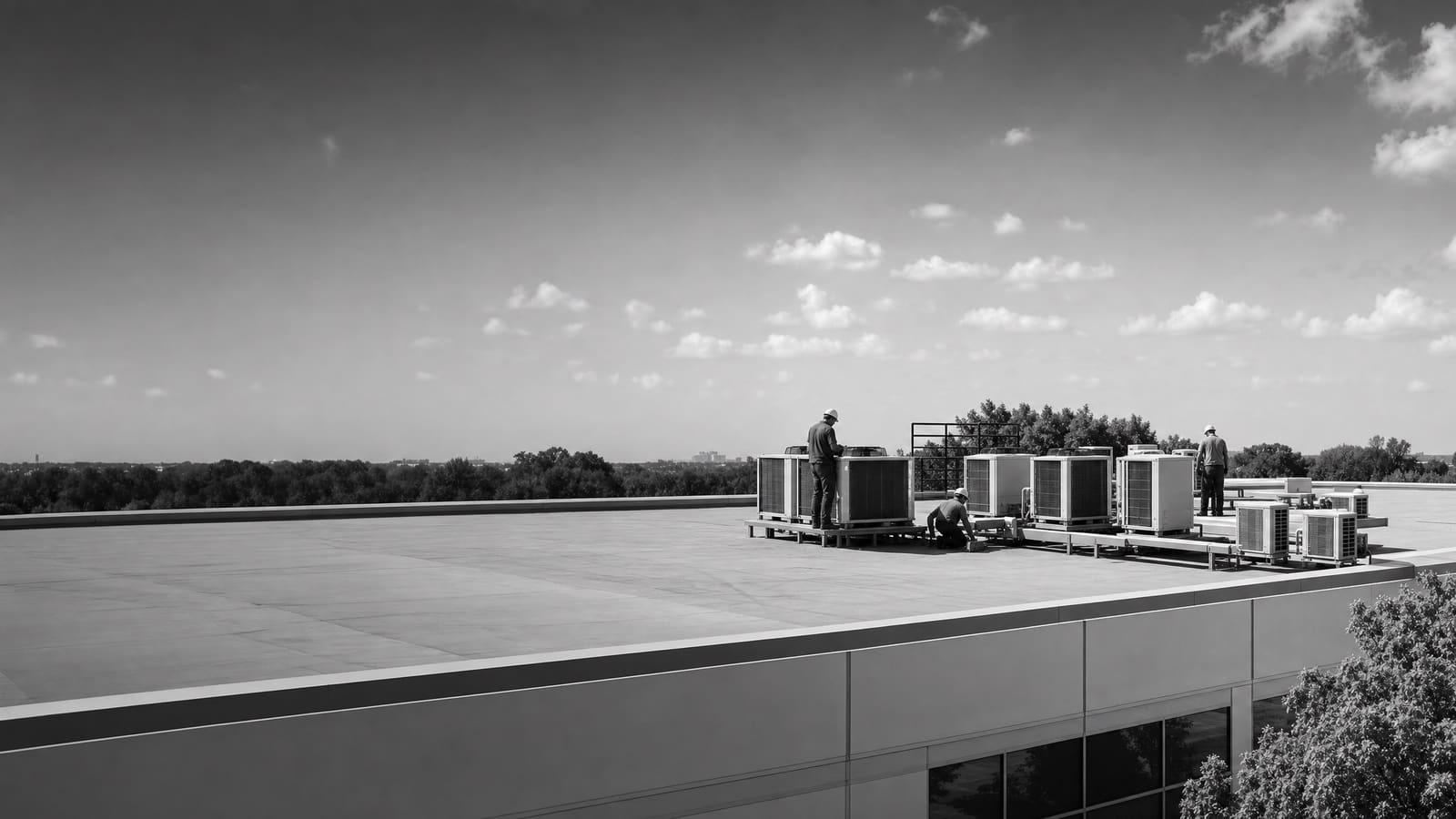
A commercial HVAC replacement covers load confirmation, equipment selection, certified recovery of the old refrigerant charge, rigging and the set, gas and electrical connections, controls, and commissioning. Replacement beats one more repair once a unit is past fifteen years, needs frequent service calls, or no longer holds the space. An old, inefficient rooftop unit can waste $900 to $3,700 a year in energy alone, which is often more than the repair you were about to approve.
A site review still has to verify roof and curb condition, electrical capacity at the panel, what happens to the gas line, and whether the building's real load matches the nameplate you are replacing.
EQUIPMENT PATHS
Three ways to replace a rooftop unit
Rooftop units condition close to half of all commercial floor space in the country, so most replacement decisions come down to which kind of rooftop unit goes back on the curb. A heat pump rooftop unit is mechanically similar to a straight air-conditioning unit. It just adds reverse-cycle heating, which changes the fuel story and the electrical story at the same time.
The right answer depends on your heating load, your electrical headroom, and what your gas and electric rates actually do to the operating bill. Ask for all three paths priced against the same load, with the operating cost modeled on your own utility bills rather than a national average. The cheapest unit to buy is not reliably the cheapest unit to own.
WHAT MOVES THE NUMBER
Where the money actually goes
There is no universal installed price for a commercial unit, and any quote that gives you one before looking at the roof is guessing. These are the lines that separate a routine swap from an expensive one, roughly in order of how often they surprise people.
BUYING GUIDANCE
Plan the replacement before the unit picks the date
The cheapest commercial HVAC installation is the one you plan before the equipment fails. Replace-on-failure hands the decision to whatever happens to be on a truck that week, which usually means a like-for-like swap at whatever efficiency tier is in stock. Deciding a year ahead lets you compare equipment types, pull a real load calculation, and order the unit you actually want.
Efficiency tier is where most owners underthink the purchase. High-efficiency rooftop units developed under the federal rooftop unit challenge were specified to cut energy use by up to half against the older standard, and more than twenty qualifying models now exceed that specification. The premium is paid once. The waste is paid every month for the life of the unit.
That does not mean the biggest number on the data sheet is automatically the better buy for your building. Savings depend on your operating hours, your actual load, and your rates. Ask for the tier comparison run against your own utility bills, and ask what the payback looks like if the building's schedule changes.
SCOPE CHECK
What makes one replacement simple and another complicated
Two buildings on the same street can get very different numbers for the same tonnage. The difference is almost never the unit itself. It is what the unit touches on the way in.
LOWER COMPLEXITY
Straight swap conditions
Same fuel and same tonnage, an existing curb that matches or takes a simple adapter, clear crane reach from the lot, adequate electrical service already in place, and a space whose use has not changed since the last unit went in.
HIGHER COMPLEXITY
Conditions that add scope
Switching to all-electric heating, growing tonnage or footprint, a roof that needs structural review, tight or shared access that limits crane setup, gas service changes, and controls that have to tie into an existing building automation system.
THE SITE REVIEW
What has to be verified before anyone quotes a number
A serious scoping visit is not someone reading your nameplate from the parking lot. It answers a short list of questions that decide both the equipment type and the price.
Start with load. Sizing should come from how the space is used today, not from the tag on a twenty-year-old unit. Occupancy, plug loads, lighting, and envelope work all change what the building actually needs, and carrying forward an old sizing mistake is one of the most expensive habits in commercial HVAC.
Then the infrastructure. Electrical capacity at the panel and the service, the physical constraints on the roof including clearances and structural capacity, and what happens to the gas line if you change fuel. These three items decide whether a heat pump is even a candidate at your building.
Finally, availability. Equipment lead times vary by type and tier, and unusual configurations wait longest. The contractor's familiarity with the specific equipment matters too, because a heat pump rooftop unit commissioned by someone who has never charged one is a comfort complaint waiting to happen.
Get the answers in writing
Ask for the load calculation, the electrical capacity finding, the curb and structural note, the gas line plan, and the quoted lead time as written deliverables. If a contractor will not put those on paper, the number they gave you is an estimate wearing a quote's clothes.
SPRINGFIELD CONTEXT
A heating climate changes the equipment conversation
Springfield sits in a heating climate, and that one fact should shape the equipment decision more than anything else on the roof. Heat pump capacity and efficiency both fall as outdoor temperature drops, and at the bottom of a New England cold snap a standard heat pump trends toward electric resistance performance. That does not rule out electrification here. It means the heating side has to be designed on purpose, using either a cold-climate heat pump rated for low outdoor temperatures or a dual-fuel unit that lets gas take the coldest hours.
It also means the electrical question comes early. All-electric heating pulls far more winter current than a gas-heat unit ever did, so panel capacity and service size get verified before the order goes in, not during the install week.
Ask for heating capacity at design temperature
A heating rating measured at mild conditions tells you nothing about a January morning. Require rated capacity and efficiency at your design outdoor temperature, the backup heat strategy, and what that backup draws when it runs. Then check that number against your panel.
OWNING THE UNIT
Two things that outlive the install
The install is a week. The consequences run for the service life of the equipment, and two of them are worth deciding on before you sign rather than after the first service call.
REFRIGERANT
Service planning for a mixed roof
Federal rules govern how refrigerant is handled, recovered, and serviced in commercial equipment, and new units ship on newer refrigerants. Day-one operation does not change, but a roof with old and new units on different refrigerants needs a service contract and spare-parts plan that accounts for both.
INCENTIVES
Tier and rebate are one decision
Incentive programs generally attach to efficiency tier and equipment type, so the tier question and the rebate question have to be answered together rather than in sequence. Confirm current program requirements before equipment is ordered, since terms and available programs change.
OVER TIME
Phasing, procurement, and what the unit really costs
Owners with more than one rooftop unit should stop treating each replacement as an emergency and start treating the roof as a fleet. Rank units by age, service history, and how much of the building depends on them. The oldest unit over the most critical space goes first, and the rest go on a schedule you control instead of one the equipment picks for you.
Phasing does two useful things for the budget. It spreads capital across fiscal years, and it lets you standardize. When three replacements over four years share a manufacturer and a control platform, the service contract gets simpler, spare parts overlap, and your staff learns one interface instead of three.
Not every aging unit needs to be replaced this year either. Where the cabinet and coils are sound, retrofitting advanced controls can capture real savings for less capital, which is why the federal rooftop campaign treats replacement and controls retrofit as parallel options rather than one answer. Run both numbers. Lifetime cost is equipment plus energy plus service across the whole service life, and the winner on day one is not always the winner in year eight.
QUOTE CHECKLIST
Five things a comparable quote has to show
Bids only compare if they cover the same scope. If two numbers are far apart, one of these five items is usually missing from the cheaper one.
01
Equipment type, tonnage, and efficiency tier
Named model and configuration, not just a tonnage. Heating type and rated heating output stated separately.
02
Curb, structural, and roof work
Adapter or new curb, any structural review, and how the roofing penetration is flashed and warranted.
03
Electrical and gas scope
Panel capacity finding, any service or feeder work, and whether the gas line is kept, extended, or capped.
04
Rigging, permits, and inspections
Crane plan, lot closure window, and which mechanical and electrical permits and inspections the contractor pulls.
05
Commissioning and closeout documents
Verified charge, airflow, and control settings, plus the startup report and warranty registration you receive.
Get a defensible number
Price the equipment and the building together.
Send the address, operating target, and target opening date. Flux will identify what must be verified before the project can be priced.
Get a free estimateQuestions
Straight answers.
When does replacement beat one more repair?
Once a unit is past fifteen years, needs frequent service, or can no longer hold the space, repair is usually buying time at a bad rate. An old, inefficient rooftop unit can waste $900 to $3,700 a year in energy on its own, before you count the repair invoices.
Is a heat pump rooftop unit a good idea in Springfield?
It can be, but the heating side has to be designed for the climate. Heat pump efficiency drops as it gets colder, so a Springfield project generally points toward a cold-climate rated unit or a dual-fuel unit where gas covers the coldest hours.
Should I replace like-for-like or resize?
Confirm the load either way. If the space and its use have not changed, like-for-like is often right and it is the fastest path. If occupancy, equipment, or the envelope changed, resizing fixes comfort problems the old unit could never solve.
What surprises the budget most often?
Electrical capacity. On an all-electric conversion, winter heating current is much higher than a gas-heat unit ever drew, and a panel or service upgrade found during install can outrun the cost of the equipment itself. Verify it before the order.
Will a new unit use a different refrigerant?
New commercial equipment ships on newer refrigerants, and federal rules govern how any refrigerant is handled and recovered. It changes nothing about day-one operation, but a roof running mixed refrigerants needs a service and spare-parts plan that covers both.
Sources used for this guide
- [1]betterbuildingssolutioncenter.energy.gov — DOE Advanced Rooftop Unit Replacement Guidance
- [2]betterbuildingssolutioncenter.energy.gov — DOE Commercial Heat Pump Rooftop Unit Replacement Guidance
- [3]betterbuildingssolutioncenter.energy.gov — DOE High-Efficiency Commercial Rooftop Unit Toolkit
- [4]energy.gov — DOE Efficient Commercial Rooftop Air Conditioner Program
- [5]epa.gov — EPA Stationary HVAC Refrigerant Management
- [6]springfieldmo.gov — FAQs - CivicPlus.CMS.FAQ