THE SHORT VERSION
What a commercial HVAC replacement actually includes
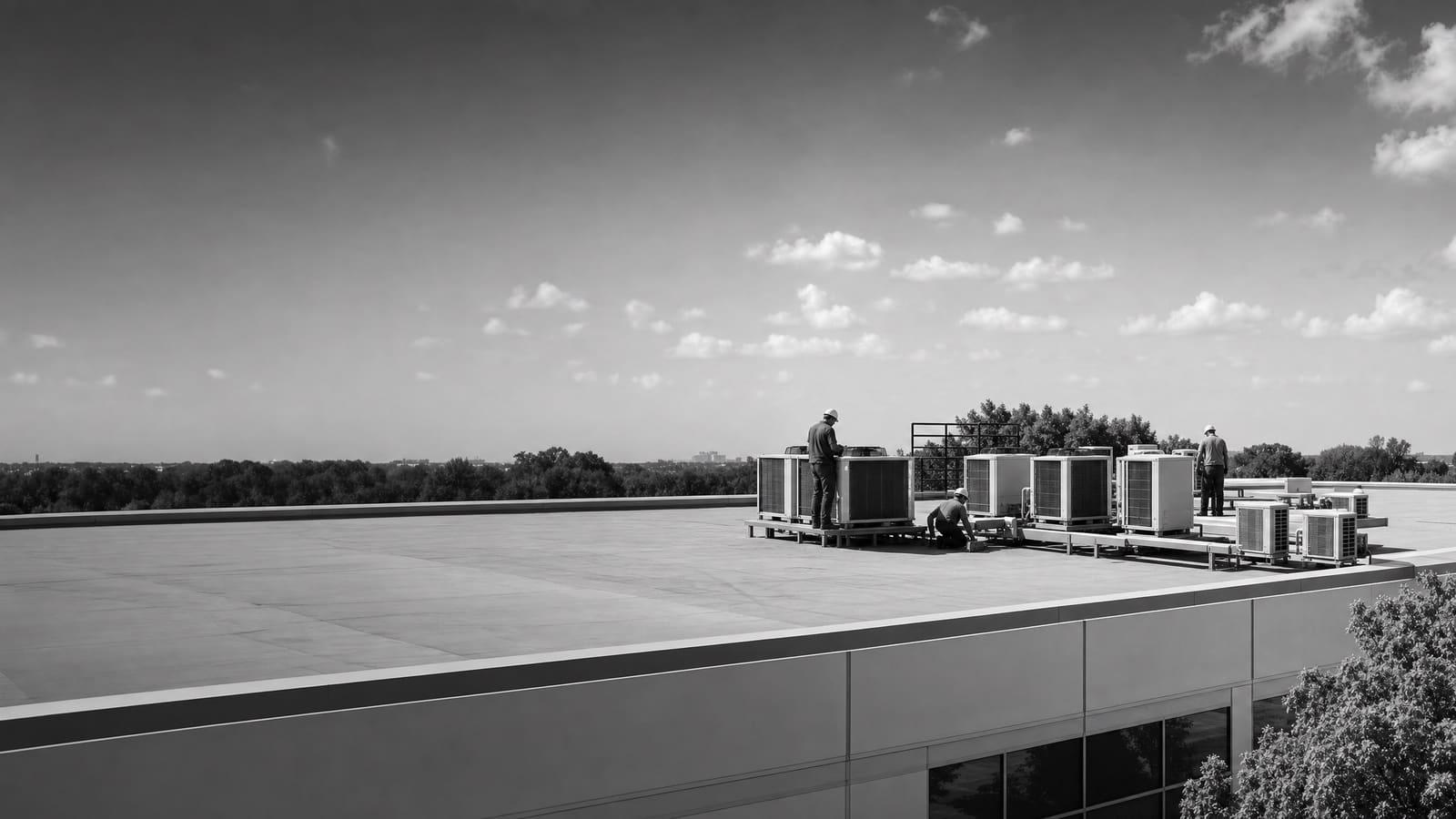
A commercial HVAC replacement covers the load calculation, the equipment selection, the crane set, the curb and connection work, and commissioning before handoff. Replacement beats one more repair when age is the real problem instead of the part that failed. Federal guidance flags rooftop units over fifteen years old as heavy energy wasters, and puts the annual waste of an old, inefficient commercial rooftop unit at roughly $900 to $3,700 per unit.
A site review still has to confirm the real load, the roof and curb condition, and the electrical and gas service on hand before any number on a quote means much.
THE REAL CHOICE
Three ways owners handle an aging unit
Most buildings end up in one of three lanes, and the lane decides how much control you keep over timing and price. Running a unit until it dies is the default, and it is the only option that guarantees you buy in a hurry. Planned replacement lets you set the date, hold the crane slot, and shop the equipment. Federal guidance is direct about this: replacing an old, underperforming unit on purpose is usually the better business move than replacing it on failure, and it can beat a like-for-like swap at the end of service life. The third lane asks a harder question. If the old unit burns gas, is a heat pump unit the better long-term buy for this building? That answer depends on your winter design temperature, your electric and gas rates, your available electrical capacity, and what equipment can actually be sourced.
WHAT MOVES THE NUMBER
The lines that decide your installed price
Nobody can price your roof from a web page. These are the lines that actually move a commercial replacement number, roughly in the order they move it.
IN PRACTICE
Choosing the equipment, not just the size
The efficient option is no longer exotic. A federal challenge to manufacturers set a performance target of cutting rooftop unit energy use by as much as half against the older standard, and more than twenty models now exceed that specification. The follow-on campaign is a useful sanity check on payback: over two hundred public and private organizations upgraded more than 43,000 rooftop units and cut a combined $37 million a year from their energy bills. Those are real buildings, not a manufacturer's brochure.
The heat pump question deserves its own pass. Federal guidance walks owners through a specific checklist: climate and heating load, electric and gas prices, emissions goals, building type, equipment availability, electrical capacity, physical constraints, existing gas lines, contractor familiarity, and incentives. Heat pump heating efficiency falls as outdoor temperature falls, trending toward parity with electric resistance heat at the bottom of the range, so your design heating temperature drives the answer.
That is why the category splits three ways. Dual-fuel units keep gas as backup heat. All-electric units drop the gas line entirely. Cold-climate units are built to hold capacity further down the temperature curve. Picking among them is a building-by-building call, not a portfolio-wide policy.
SCOPE CHECK
What makes one replacement simple and another one long
Two buildings on the same street can produce very different projects. The difference is almost never the unit. It is what the unit touches.
LOWER COMPLEXITY
A clean swap
One packaged unit, similar tonnage, an existing curb that takes an adapter, the same fuel in and the same fuel out, open crane access, and simple standalone controls. Permits stay routine and the visible disruption is a morning of coned-off stalls.
HIGHER COMPLEXITY
A staged project
Occupied tenants, several units phased across seasons, a fuel switch that needs added electrical capacity, structural review because the footprint grew, integration into an existing automation system, or a lot where the crane has one workable position.
BEFORE THE QUOTE
What a real site review has to settle
A serious quote starts on the roof, not in a catalog. The load gets confirmed against how the space is used today, because twenty years changes occupancy, plug loads, and the envelope. The old nameplate records a decision somebody made under different conditions, and carrying it forward carries forward any mistake in it.
Next comes the infrastructure. Federal heat pump guidance calls this out plainly: electrical capacity, physical constraints on the roof and in the shaft, and the status of existing gas lines determine whether a given unit is even installable. This is the step that catches problems late when it gets skipped. Finding out during the crane day that the panel cannot carry the new unit is an expensive way to learn it.
Then availability. The right unit that ships after your season is the wrong unit. Equipment availability and contractor familiarity with the technology are on the federal checklist for a reason, and they belong next to the price on your quote rather than in a footnote.
Ask for the load calculation
Any contractor can copy the old nameplate. Ask to see the load basis, the electrical capacity check, and the lead time in writing. If those three are missing, the price is an estimate wearing a proposal's clothes.
OWNERSHIP
Two things that follow you after the install
The install ends. The obligations do not. Two of them are worth understanding before you sign, because both change how you write service contracts and how you budget the next few years across a mixed fleet of units.
REFRIGERANT
Handling is regulated, not discretionary
EPA rules under Section 608 of the Clean Air Act govern how refrigerant is handled and recycled in stationary cooling and heat pump equipment. That covers recovery from the unit you are removing and service on the one you install. It is a compliance line, so it should appear on the quote.
OPERATING COST
The bill is part of the purchase
Federal guidance treats utility bill impact as a modeling exercise driven by local electricity and gas prices, not a guess. Old inefficient units waste roughly $900 to $3,700 each per year, so the spread between a base unit and a high-efficiency one shows up every month you own it.
OVER TIME
Phasing, procurement, and the number that actually matters
If you own several units, replacing them one panic at a time is the most expensive path available. Emergency buying removes your leverage on price, on equipment choice, and on when the crane shows up. A phased plan does the opposite. You group the oldest and least efficient units, set replacement windows in your shoulder seasons, and buy on a schedule you control.
Phasing also protects the decision quality. Federal guidance is explicit that heat pump suitability varies building by building inside the same portfolio, which means a plan that evaluates each site beats a blanket rule applied to all of them. One building may be a clean all-electric candidate. The one next door may keep gas backup because of its heating load or its panel.
On lifetime cost, weigh three things together rather than separately: the installed price, the modeled utility bill under your actual rates, and any incentives available at the time you buy. Incentive programs change, so confirm what is live before you build a payback around it. The unit with the lower sticker is often not the unit with the lower cost of ownership, and the only way to know is to run both numbers on the same building.
THE CHECKLIST
Five things a comparable quote has to show
Two quotes are only comparable when they scope the same work. Ask every bidder to break out these five, then compare line by line instead of comparing totals.
01
The equipment, spelled out
Manufacturer, model, tonnage, efficiency tier, and heating type. A quote that says only "new rooftop unit" cannot be compared to anything.
02
Load basis and sizing
Whether the tonnage came from a current load calculation or from the old nameplate, and what changed in the space since that unit was installed.
03
Curb, structural, and roof scope
Adapter or new curb, any structural review triggered by size or weight, and who repairs the roof penetration and flashing.
04
Electrical, gas, and controls
Panel capacity verified, gas line changes, and exactly how the unit ties into your existing controls or automation system.
05
Lead time and commissioning
Real equipment availability, the crane and permit responsibility, and documented startup covering charge, airflow, and control settings.
Get a defensible number
Price the equipment and the building together.
Send the address, operating target, and target opening date. Flux will identify what must be verified before the project can be priced.
Get a free estimateQuestions
Straight answers.
When is replacement smarter than one more repair?
When the age of the unit is the problem, not the failed part. Federal guidance identifies rooftop units over fifteen years old as substantial energy wasters, and estimates that an old, inefficient commercial unit wastes roughly $900 to $3,700 a year. If the repair only restores that performance level, you are paying to keep the waste.
Should a gas rooftop unit be replaced with a heat pump?
Sometimes, and the decision is building-specific. Federal guidance weighs climate and heating load, local electricity and gas prices, electrical capacity, physical constraints, existing gas lines, equipment availability, and incentives. Heat pump efficiency drops as outdoor temperature drops, which is why dual-fuel, all-electric, and cold-climate versions exist as separate choices.
What happens to the refrigerant in the old unit?
It has to be recovered under EPA rules issued through Section 608 of the Clean Air Act, which cover handling and recycling of refrigerant in stationary cooling and heat pump equipment. Recovery and disposal should appear as a line on your quote rather than being assumed into the total.
Does the new unit have to match the old tonnage?
No, and matching it blindly can repeat an old mistake. If occupancy, plug loads, or the envelope changed, a current load calculation may point to a different size. If the use of the space genuinely has not changed, a like-for-like swap is often the fastest and most predictable route back to conditioned air.
How much does a commercial HVAC installation cost?
There is no honest universal price, because tonnage, efficiency tier, curb and roof work, crane access, electrical capacity, and controls integration all move it. What can be pinned down early is the operating side: replacing an old, inefficient unit addresses roughly $900 to $3,700 per unit in annual waste, which belongs in the comparison alongside the installed price.
Sources used for this guide
- [1]betterbuildingssolutioncenter.energy.gov — DOE Advanced Rooftop Unit Replacement Guidance
- [2]betterbuildingssolutioncenter.energy.gov — DOE Commercial Heat Pump Rooftop Unit Replacement Guidance
- [3]betterbuildingssolutioncenter.energy.gov — DOE High-Efficiency Commercial Rooftop Unit Toolkit
- [4]energy.gov — DOE Efficient Commercial Rooftop Air Conditioner Program
- [5]epa.gov — EPA Stationary HVAC Refrigerant Management