THE SHORT VERSION
What a commercial HVAC replacement actually includes
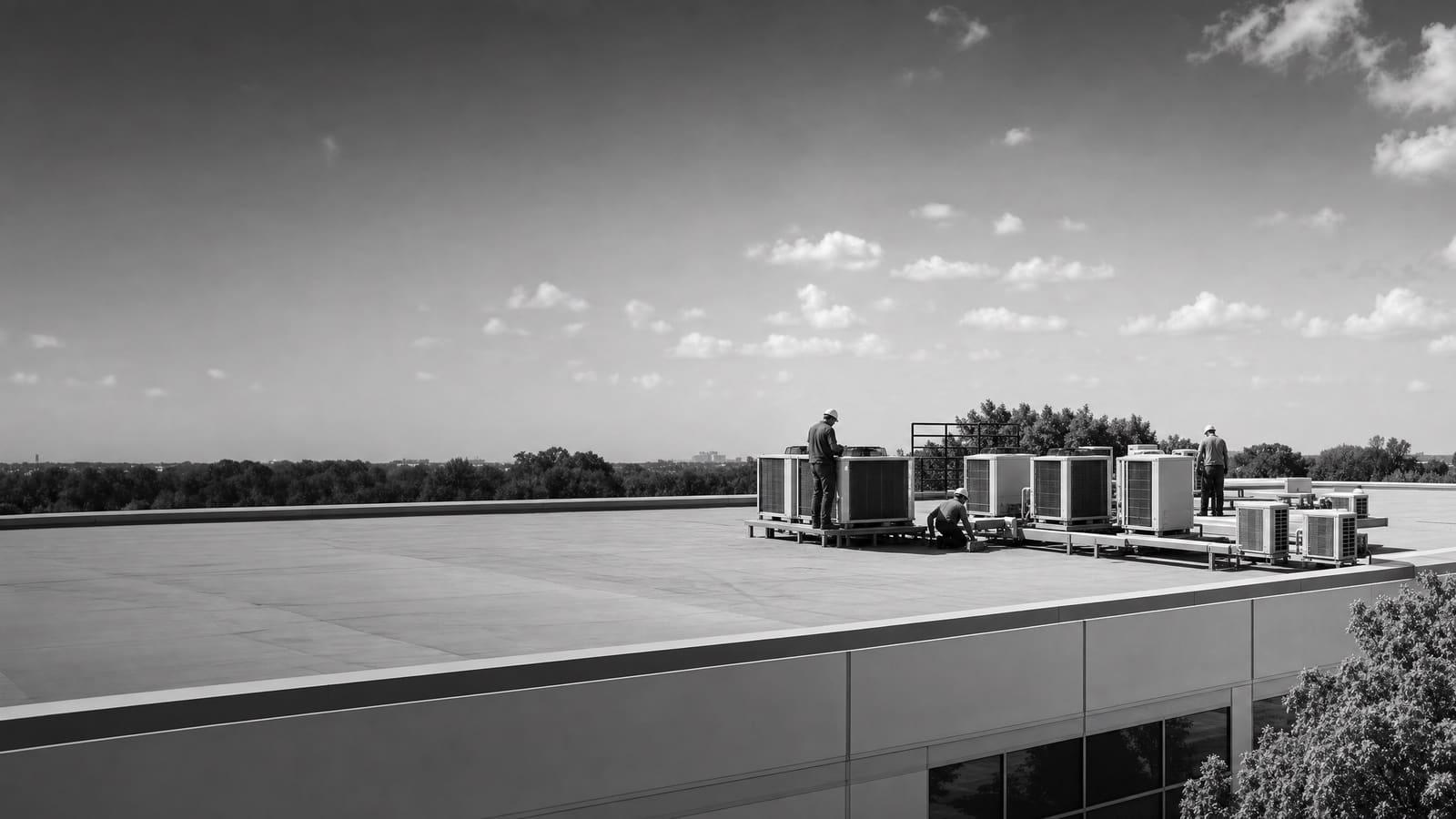
A commercial HVAC replacement covers a load check, the equipment, curb and connection work, the rigging day, permits, and commissioning. Replacement usually beats another repair once a rooftop unit passes fifteen years and starts needing frequent attention. An old, inefficient rooftop unit can waste roughly $900 to $3,700 a year in energy, which is often more than the repair you were about to approve.
A site review has to confirm the real load, curb and roof condition, available electrical capacity, and gas line status before any tonnage or equipment type gets locked in.
THREE WAYS TO GO
Three ways owners handle an aging unit
Most owners face this decision under pressure, which is the worst time to make it. Rooftop units cool close to half of all commercial floor area in the country, and the usual pattern is to wait until a unit no longer holds the space, needs constant attention, or quits entirely. Replacing proactively often costs less over the life of the building than replacement-on-failure, and sometimes less than a like-for-like swap at end of life.
There is also a fourth path worth pricing: retrofitting advanced controls onto a sound existing unit. Owners in the federal rooftop campaign chose between full replacement and a controls retrofit based on which one penciled out for their building, and more than 43,000 units have been upgraded through that program.
WHAT MOVES THE NUMBER
What actually drives the price
Nobody can quote a commercial rooftop replacement from a phone call, because the equipment is only part of the job. These are the lines that move a South Fulton quote the most, ordered roughly by how much they swing from building to building.
IN PRACTICE
Choosing the equipment
The biggest fork in a South Fulton replacement is no longer tonnage. It is whether the new unit heats with gas or with a reverse-cycle heat pump. Heat pump rooftop units are mechanically similar to the air-conditioning units already sitting on most roofs, but they add heating without a burner. Their efficiency falls as outdoor temperature drops, so they work best where winters are mild to moderate. Across most of the South, current heat pump rooftop units can carry most or all of a building's winter heating demand.
That does not make the choice automatic. Even southern climates see sharp cold snaps, and how a building rides one out depends on what backs up the heat pump. A dual-fuel unit keeps a gas burner for the coldest hours. An all-electric unit leans on electric resistance heat instead, which costs more per hour whenever it runs. Cold-climate models push the efficient range lower.
The deciding factors are local and physical: what your electricity and gas actually cost, whether the roof has the electrical capacity for an all-electric unit, whether the gas line stays or gets abandoned, and whether the equipment you want is available on your schedule.
SCOPE CHECK
Simple swap or a bigger project?
Two replacements on roofs that look identical can price very differently. What separates them is usually the work around the unit, not the unit itself. Place your building on one of these lists before you read anyone's number.
LOWER COMPLEXITY
Straight swap conditions
Same tonnage, same fuel, a curb that is still sound, adequate electrical service already at the unit, clear crane access, and space use that has not changed since the original install. Permits are routine and the on-roof work is short.
HIGHER COMPLEXITY
Bigger-project conditions
A fuel switch, a tonnage change, a curb needing an adapter or framing, an electrical service that has to grow, tight or shared parking for the crane, or a tenant that cannot lose conditioning during business hours.
BEFORE YOU BUY
What the site review has to settle
A useful site review is not a walk-around. It is a short list of questions that each have a yes-or-no answer, and every one of them can change the equipment on the quote.
Start with load. Sizing pulled off the old nameplate assumes nothing about the building has changed in fifteen or twenty years, which is rarely true. Occupancy, plug loads, lighting, and envelope work all move that number.
Then infrastructure. Electrical capacity decides whether an all-electric unit is even on the table without a service upgrade. Physical constraints — curb size, roof structure, clearance, and how a crane reaches the spot — decide the rigging plan and the closure time. Gas lines decide whether you are keeping, capping, or extending a fuel source.
Then availability. The unit that models best is worth nothing if it lands in eleven weeks and your tenant needs cooling next month. Equipment availability and installer familiarity with the technology belong in the selection conversation, not after it.
Last, incentives. Utility and federal programs open and close on their own schedule, so confirm what is actually available now instead of assuming last year's program is still funded.
The five answers to get in writing
Calculated load for today's use, confirmed electrical capacity at the roof, curb and structural condition, a quoted lead time for the exact model, and the permit path. A proposal missing any of these is a price, not a plan.
LOCAL CONTEXT
Permits, and why they shape your schedule
Georgia jurisdictions build their permit rules on the state-adopted code, and that language is consistent about one thing: replacing a mechanical system is not an ordinary repair. A contractor who alters, repairs, removes, converts, or replaces a mechanical, electrical, or gas system on a commercial building needs a permit, obtained before work begins. Swapping a minor part that does not change the equipment's approval is treated differently.
Two provisions matter for scheduling. Emergency equipment replacements can proceed, with the permit application submitted the next working business day — that is the path when a unit dies in July. And a permit application is treated as abandoned if work does not commence within six months of filing, which matters if you are pulling permits early for a phased fleet replacement.
Confirm the local path before booking the crane
Permit specifics are set by the jurisdiction issuing them. Have your contractor confirm South Fulton's current commercial mechanical requirements, fees, and inspection sequence with the building official before a crane date is scheduled.
OWNERSHIP
Two things to settle before you sign
A replacement decision outlives the quote. The unit stays on that roof for well over a decade, and two choices made during the quoting week shape most of what follows: how the building gets heated, and who is responsible for the equipment after startup.
The heating choice is the one most owners underestimate. It sets your fuel mix, your winter utility exposure, and whether you keep a gas service at the building at all. The service choice is the one most owners skip entirely. New equipment comes with warranty conditions, refrigerant handling requirements, and controls that only pay off if somebody is actually watching them. Decide both while you still have leverage — before the purchase order, not after the first summer.
FUEL PATH
Dual fuel or all-electric
Dual fuel keeps a gas burner for the coldest hours and keeps the gas service alive. All-electric drops the gas line but leans on resistance heat when the heat pump falls off, and it may need more electrical capacity at the roof.
AFTER STARTUP
Who owns the equipment
Refrigerant work on stationary commercial cooling and heat pump equipment is federally regulated, including recovery and technician certification. Decide before signing whether service, controls monitoring, and refrigerant handling sit with you or your contractor.
PLANNING AHEAD
Phasing a fleet instead of firefighting
If you own more than one unit, the useful planning unit is the roof, not the unit. Age the whole fleet, mark anything past fifteen years, and decide which ones get replaced on your calendar and which ones you are willing to gamble on. A unit replaced in March is a scheduled project with competitive bids. The same unit replaced in July is whatever the supply house has on the shelf.
Lifetime cost is where proactive replacement earns its keep. The gap between an old inefficient rooftop unit and a current one shows up every month on the utility bill, not once at purchase. Units built to the federal high-performance specification were designed to cut rooftop energy use by up to half against the prior standard, and the minimum efficiency floor for new commercial rooftop equipment has since been raised for everyone. A fifteen-year-old unit is not just tired — it is operating below what any new unit is now permitted to do.
Procurement follows from that. Bid equipment and labor clearly enough that you can see both. Ask for the lead time on the exact model, not the product family. And if you are phasing three or four units, ask whether a single mobilization changes the crane and rigging line.
THE QUOTE
Five things a comparable quote shows
Two proposals are only comparable when both spell out the same scope. Before you compare prices, check that each one puts these five items in writing.
01
The selected unit, by model
Exact model, tonnage, efficiency tier, and heating type — not a product category.
02
Curb and structural scope
Adapter curb, framing, and roof work priced as scope rather than buried in an allowance.
03
Rigging and site plan
Crane size, staging area, stalls closed, and how long the lot is affected.
04
Permits, inspections, and code items
Who pulls them, what they cost, and any code item the replacement triggers.
05
Startup and commissioning
Charge, airflow, and controls verified against spec, documented, and handed over.
Get a defensible number
Price the equipment and the building together.
Send the address, operating target, and target opening date. Flux will identify what must be verified before the project can be priced.
Get a free estimateQuestions
Straight answers.
When does replacement beat one more repair?
Once a rooftop unit is past about fifteen years, needs frequent attention, or no longer holds the space, the math usually flips. An old, inefficient unit can waste roughly $900 to $3,700 a year in energy, which often exceeds the repair invoice you were about to approve.
Is a heat pump rooftop unit a good fit here?
Usually yes. Heat pump rooftop units are most efficient where winters are mild to moderate, and across most of the South they can handle most or all of a building's winter heating. The open question is what backs them up during a cold snap: a gas burner in a dual-fuel unit, or electric resistance heat in an all-electric one.
Do I need a permit to replace a rooftop unit?
Yes. Replacing a commercial mechanical system is not treated as an ordinary repair, and the permit must be obtained before work begins. If a unit fails and has to be replaced in an emergency, the application is filed the next working business day. Confirm the current local requirements with the building official.
What happens to the refrigerant in the old unit?
It has to be recovered, not vented. Federal rules govern the handling and recycling of refrigerant in stationary cooling and heat pump equipment, and the work is done by certified technicians. That recovery is required scope and should appear on the quote as a line, not a surprise.
Can I keep the existing unit and upgrade the controls instead?
Sometimes. If the equipment is otherwise sound, retrofitting advanced controls is a real alternative to replacement, and owners in the federal rooftop campaign chose between the two based on which option actually penciled out. It is worth pricing both before committing to a full swap.
Sources used for this guide
- [1]betterbuildingssolutioncenter.energy.gov — DOE Advanced Rooftop Unit Replacement Guidance
- [2]betterbuildingssolutioncenter.energy.gov — DOE Commercial Heat Pump Rooftop Unit Replacement Guidance
- [3]betterbuildingssolutioncenter.energy.gov — DOE High-Efficiency Commercial Rooftop Unit Toolkit
- [4]energy.gov — DOE Efficient Commercial Rooftop Air Conditioner Program
- [5]epa.gov — EPA Stationary HVAC Refrigerant Management
- [6]augustaga.gov — FAQs - CivicPlus.CMS.FAQ