THE SHORT VERSION
What a commercial HVAC replacement actually covers
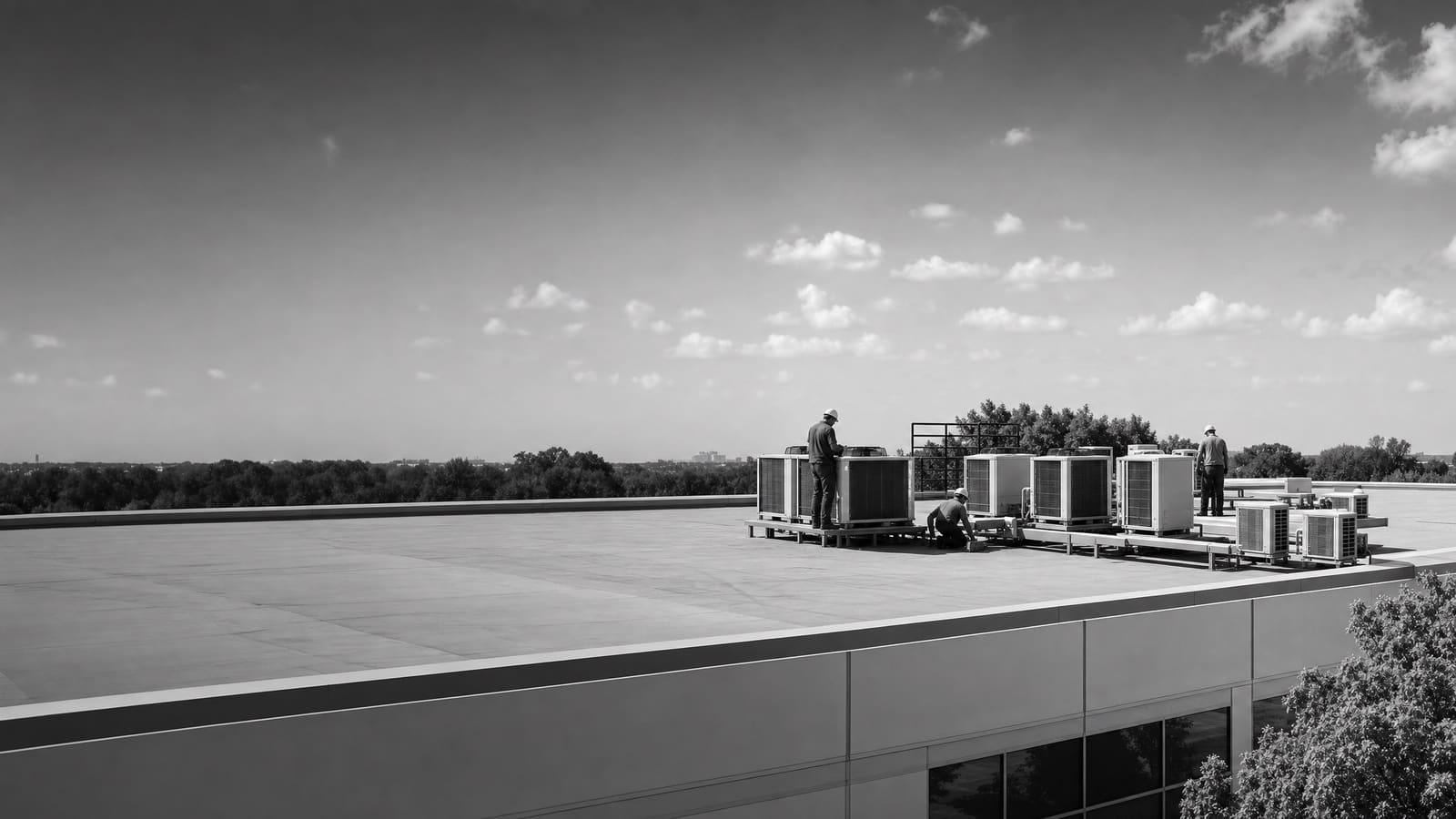
A commercial replacement covers the load calculation, equipment selection, refrigerant recovery, removal of the old unit, curb or adapter work, the crane set, gas and electrical and control connections, then commissioning. Replacement beats another repair once a rooftop unit is past roughly fifteen years and failing in season. Old, inefficient rooftop units can waste $900 to $3,700 per unit each year in energy, which often exceeds the repair sitting on your desk.
A site review still has to verify curb size and roof structure, panel capacity at the unit, gas line sizing, clear crane reach over the lot, and how the controls tie back in.
THREE WAYS THIS GOES
Replace on failure, swap like-for-like, or upgrade on purpose
Most buildings land on one of three approaches, and the difference shows up in cost and downtime more than in the equipment itself. Waiting for failure is the default, and it is the most expensive version of the same project: emergency freight, whatever unit is available, and a hot space while you wait. Replacing like-for-like at end of life is the planned version of that swap, using the existing curb and connections. Replacing proactively with a high-efficiency unit costs more up front and takes more planning, but it is the only path that lowers the operating bill for the next fifteen years. Federal rooftop unit work has pushed more than twenty models past the high-efficiency specification, so the efficient option is a shelf item rather than a special order. The right answer depends on how much of your capital plan you control and how long you intend to hold the building.
WHAT MOVES THE NUMBER
The lines that make two identical-looking jobs price differently
Installed price is not one number. These are the lines that move it, roughly in order of how much they vary between two buildings that look the same from the street.
THE REAL DECISION
Gas unit or heat pump
Rooftop units condition close to half of all U.S. commercial floor space, so most commercial replacements are rooftop replacements. The biggest equipment decision on one is no longer tonnage. It is whether the new unit heats with gas or with a heat pump. Heat pump rooftop units are built much like the air conditioning units they replace, so the swap looks the same on the roof. The difference lives in the heating season and on the utility bill.
Heat pump efficiency falls as outdoor temperature drops, and at the coldest hours it trends toward parity with electric resistance heat. Federal guidance is direct about the consequence: heat pump rooftop units fit best where winter heating is mild to moderate. Buildings in colder places usually look at dual-fuel units that keep a burner for the coldest stretch, or at cold-climate models built for the low end. The heating design temperature at your site is the deciding input, not a general preference for one fuel.
Before committing, model the utility bill both ways against your own electricity and gas rates instead of a national comparison. The same equipment can save money under one rate structure and cost money under another, and that modeling is cheap next to a fifteen-year operating decision.
SIDE BY SIDE
What makes a swap simple or complicated
Two replacements with the same tonnage can be very different projects. The gap is almost always the site, not the equipment.
LOWER COMPLEXITY
Same fuel, same footprint
The new unit lands on the existing curb, uses the same gas and electrical service, and the lot gives the crane open reach. Scope is mostly equipment, rigging, and a single closure window.
HIGHER COMPLEXITY
New fuel or a bigger footprint
Going all-electric, adding tonnage, or changing footprint pulls in panel capacity, curb adapters, structural review, and tight staging. Those items set the schedule, and the crane day waits on them.
SCOPING
What the site review has to settle before anyone prices it
A quote written from a nameplate photo is a guess with a number on it. The site review is what turns it into a price someone can be held to, and it is short work — a couple of hours on the roof and in the electrical room.
Start with physical fit. Measure the existing curb, compare it against the footprint of the units actually available, and decide whether an adapter or new framing carries the load. Look at roof structure if tonnage grows. Then check the infrastructure the unit needs: available capacity at the panel and feeder, gas line size and flue routing if it burns gas, and where condensate and refrigerant lines run.
Access is the third piece and the one most often skipped. The crane needs reach, a staging area, and a plan for the stalls it closes. If the lot is shared or the roof sits back behind the building, that constraint can change the equipment decision, because a unit that cannot be landed is not really an option.
Last, confirm availability against your schedule. The best-fitting unit that arrives in twelve weeks is a different project than the good-enough unit sitting in a regional warehouse.
Ask for this before the price
Curb dimensions and adapter plan, a structural check if tonnage grows, panel and feeder capacity, gas line and flue routing, crane reach and lot staging, and a dated lead time on the specific unit quoted.
AFTER THE CRANE LEAVES
Two decisions that outlive the install
The visible install ends in a day. Two decisions made during it follow the building for the rest of the equipment's life, and both are far easier to handle before the order is placed than after the unit is running. The first is refrigerant. New commercial equipment ships on newer refrigerants, and federal rules govern how the old charge comes off the roof. The second is what one new unit does to the rest of your fleet, because a roof with three units and two refrigerant types needs a service plan that reflects that.
REFRIGERANT
Recovery and mixed fleets
EPA rules under the Clean Air Act govern how refrigerant is handled and recovered when equipment is removed. Put recovery in the written scope, and record which refrigerant the new unit uses.
SERVICE PLANNING
One new unit, one older fleet
A single replacement on a roof of aging units changes your parts strategy. Decide whether the rest follow on a schedule or stay on repair, and price the service contract against that answer.
PLANNING AHEAD
Phasing a roof full of units
If the building carries more than one rooftop unit, the useful question is not which one to replace but in what order and across how many budget years. Ranking by age is the instinct. Ranking by run hours and by the space each unit serves is better, because the unit over the busiest area burns the most energy and generates the most complaints.
Phasing also buys purchasing leverage. Replacing three units across two years on a committed schedule gets better pricing and better lead times than three separate emergencies, and it lets you standardize on one platform so parts, controls, and technician familiarity carry across the whole roof.
On lifetime cost, weigh the operating number as heavily as the install number. The federal rooftop campaign counted more than 43,000 units upgraded across more than 200 organizations, saving a combined $37 million a year. That is the argument for treating the efficiency tier as a financial decision rather than an optional upgrade. Run the same math on your own units: what the current one wastes annually, what the new one is expected to use, and how many years you plan to hold the building.
BEFORE YOU SIGN
Five things a comparable quote shows
A quote you can hold next to another quote shows all five of these. If a line is missing, it is not missing from the job — it is only missing from the price.
01
Unit, tonnage, and efficiency tier
The specific model quoted, the tonnage the load calculation supports, and the efficiency tier — not just a brand name.
02
Curb, adapter, and structural work
Whether the unit lands on the existing curb, what adapter is used, and any framing or roof patching included.
03
Crane, rigging, and lot plan
Who owns the lift, where it stages, how long stalls close, and what happens if weather moves the day.
04
Permits, inspections, and triggered items
Which permits get pulled, who pulls them, and any items the replacement triggers under the governing code edition.
05
Lead time and commissioning
A dated availability for the exact unit, plus startup, charge, airflow, and controls verification documented at handoff.
Get a defensible number
Price the equipment and the building together.
Send the address, operating target, and target opening date. Flux will identify what must be verified before the project can be priced.
Get a free estimateQuestions
Straight answers.
When is replacing a rooftop unit better than repairing it again?
Once a unit is past roughly fifteen years and failing during the season it is needed most, repair stops being the cheap option. Old, inefficient rooftop units can waste $900 to $3,700 per unit each year in energy. Weigh that annual waste plus the repair in front of you against the installed cost of a new unit.
Should the replacement be a heat pump?
It depends on your winter heating design temperature, your electrical capacity, and your own gas and electricity rates. Federal guidance points heat pump rooftop units toward mild-to-moderate winter heating, with dual-fuel and cold-climate models made for colder sites. Model the utility bill both ways before the order, not after.
What actually drives the schedule?
Equipment availability, almost always. The crane set is a single planned window, and the site work around it is knowable. The unknown is when the specific unit ships. That is why a dated lead time for the exact model belongs on the quote next to the price.
Why do two quotes for the same building look so different?
Usually because they scoped different jobs. One may assume the existing curb works while the other includes an adapter and framing. One may include crane time, permits, and commissioning while the other leaves them out. Ask both to show tonnage, efficiency tier, curb work, rigging, and startup as separate lines.
What happens to the refrigerant in the old unit?
EPA regulations under the Clean Air Act govern how refrigerant is handled and recovered when stationary equipment is serviced or removed, so recovery is part of the job and should appear in the written scope. New equipment ships on newer refrigerants, which is worth noting for spare parts and service planning on a mixed roof.
Sources used for this guide
- [1]betterbuildingssolutioncenter.energy.gov — DOE Advanced Rooftop Unit Replacement Guidance
- [2]betterbuildingssolutioncenter.energy.gov — DOE Commercial Heat Pump Rooftop Unit Replacement Guidance
- [3]betterbuildingssolutioncenter.energy.gov — DOE High-Efficiency Commercial Rooftop Unit Toolkit
- [4]energy.gov — DOE Efficient Commercial Rooftop Air Conditioner Program
- [5]epa.gov — EPA Stationary HVAC Refrigerant Management