THE DIRECT ANSWER
Commercial HVAC replacement and installation in Sioux City.
A commercial HVAC replacement should cover load review, equipment selection, removal, rigging, connections, controls, startup, testing, and closeout. Replacement becomes more useful than another repair when an older unit is unreliable, performs poorly, or needs frequent service. DOE guidance notes that rooftop units over 15 years old may waste substantial energy compared with newer models.
A site review must confirm capacity, roof or equipment-room access, curb fit, electrical service, fuel connections, ventilation, controls, and shutdown limits.
FIRST DECISION
Choose the project path before choosing a model
Start with the business problem. A failed unit may call for the fastest sound replacement. A working but unreliable unit gives you time to compare efficiency, heat sources, controls, and electrical needs. A remodel or change in occupancy calls for a fresh load review because the old nameplate only shows what was installed before.
Do not assume the same capacity is still right. Internal equipment, hours, ventilation needs, and space use may have changed. Oversized equipment can also create comfort and control problems. The quote should show why the proposed capacity fits the building today.
Equipment choice should account for more than first cost. Compare expected operation, maintenance access, service support, controls compatibility, and the work required to connect the unit. If electrification is under review, compare all-electric, dual-fuel, and conventional choices against the actual heating load and available infrastructure.
BUDGET CONTROL
What moves the installed price
No supplied research supports a universal installed price for this project. A useful budget separates equipment from the site work and operating constraints that can change the total.
EQUIPMENT CHOICES
Compare systems by how the building must operate
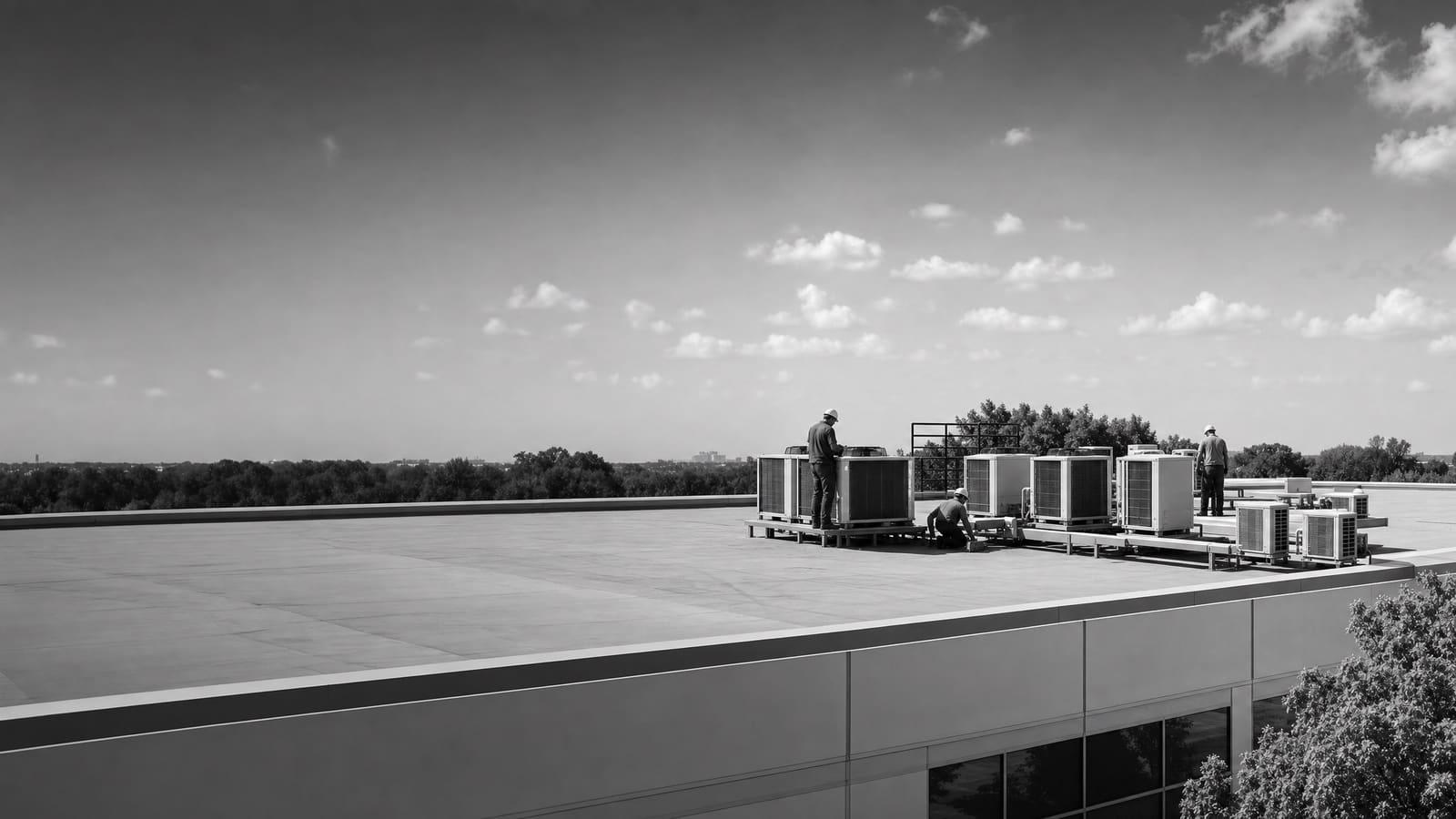
Packaged rooftop units combine major heating, cooling, and air-moving parts in one cabinet. They are common across commercial buildings and condition nearly half of U.S. commercial floor area. They can make replacement simpler when the roof, curb, duct path, and utilities already support the proposed unit. A compatible footprint does not remove the need to verify weight, connections, airflow, and controls.
A conventional air-conditioning rooftop unit may pair cooling with a separate heating source. A heat-pump rooftop unit provides reverse-cycle heating as well as cooling. DOE guidance identifies all-electric, dual-fuel, and cold-climate heat-pump options. The right choice depends on heating demand, utility costs, emissions goals, electrical capacity, physical limits, gas infrastructure, equipment availability, and contractor knowledge.
Split systems and more centralized equipment may suit buildings where rooftop replacement is not practical or where separate zones need different control. Those projects can involve longer piping or duct routes and more coordination inside occupied space. Ask each bidder to state the proposed system type, capacity, heating method, efficiency, ventilation features, controls, refrigerant, warranty, and service access.
SCOPE COMPLEXITY
A direct swap and a system change are different projects
The visible equipment may look similar while the work behind it differs. Compare bids only after each contractor has stated the assumptions, exclusions, connections, and verification work.
LOWER COMPLEXITY
Compatible replacement
The load still fits, the curb and utilities are compatible, access is clear, and existing controls can be reused or replaced without major integration work.
HIGHER COMPLEXITY
Capacity or technology change
A different footprint, weight, fuel, voltage, ventilation plan, control sequence, or heating technology may require added design and infrastructure work.
SITE REVIEW
Turn the walkthrough into a buildable scope
Begin with equipment records, service history, comfort complaints, operating schedules, and any planned changes to the space. Inspect the unit and its serving area. Record model data, capacity, heating source, voltage, controls, filter arrangement, outside-air path, drainage, duct connections, curb dimensions, access, and visible roof conditions.
Next, confirm what must remain open during the work. Identify sensitive rooms, tenant hours, process loads, server or communications spaces, and areas that cannot lose ventilation. A shutdown plan may affect equipment selection, temporary conditioning, work hours, and project phasing.
For a heat-pump option, the review should also examine heating demand, electrical capacity, physical space, gas lines, and expected utility-bill effects. DOE guidance warns that heat-pump efficiency falls as outdoor temperature drops, so equipment and backup heat should be evaluated against the actual application. Current equipment availability and qualified service support also belong in the decision.
Finish with a written scope that identifies who owns design, rigging, roofing, electrical work, fuel work, controls, testing, disposal, and closeout. This makes bids easier to compare and reduces change-order risk.
Bring useful records
Provide nameplate photos, utility history, service reports, control information, floor plans, operating hours, complaint logs, and any known roof or electrical limits.
OWNERSHIP VIEW
Balance urgent reliability with long-term operation
A failed system creates pressure to accept the first available path. A planned replacement creates room to verify loads, compare system types, coordinate shutdowns, and check whether controls or infrastructure should be improved at the same time.
Efficiency matters, but savings should not be assumed from a product label alone. DOE documented that older commercial rooftop units can waste energy and that high-efficiency equipment has produced meaningful savings in real buildings. Your result still depends on the old system, new selection, controls, schedule, climate, utility rates, and commissioning.
RELIABILITY
Plan before failure
Rank aging units by condition, repair frequency, operational importance, and available backup so replacements can be phased deliberately.
LIFETIME VALUE
Model more than purchase price
Compare energy use, maintenance, expected service support, controls, infrastructure changes, warranties, and disruption over the planned ownership period.
PROJECT DELIVERY
Plan procurement, installation, and handoff as one job
Do not order equipment until the selected model and field conditions have been checked together. Confirm capacity, dimensions, weight, curb arrangement, voltage, heating configuration, ventilation features, controls, refrigerant, accessories, and service clearances. Substitution rules should require written review because a model change can affect connections, rigging, electrical work, and performance.
Before installation, settle equipment storage, roof protection, staging, lift access, occupied-area protection, shutdown timing, and weather limits. Define what happens if concealed damage appears after removal. If several units serve the building, phasing can preserve partial conditioning and spread operational risk.
Startup is not the same as commissioning. Startup shows that equipment runs. A complete handoff also verifies airflow, temperature response, drainage, heating and cooling operation, ventilation, sensors, safeties, schedules, alarms, and control sequences as applicable. Refrigerant must be handled under federal requirements by properly qualified personnel. Closeout should include startup records, test results, warranty registration, manuals, control backups, training, filter information, and an updated equipment list. Keep these records with the facility files so future service begins with reliable information.
QUOTE CHECKLIST
Five things every comparable quote should show
Ask bidders to use the same basic scope. A low number is not useful when equipment, controls, rigging, testing, or closeout has been left undefined.
01
Selected equipment
List model, capacity, heating type, efficiency, refrigerant, options, availability, and warranty.
02
Complete installed scope
Define removal, disposal, rigging, curb, roofing, duct, drain, electrical, fuel, and controls work.
03
Operating plan
State shutdowns, phasing, temporary conditioning, work hours, protection, and site-access needs.
04
Testing and commissioning
Name the airflow, functions, safeties, sensors, ventilation, and control sequences that will be verified.
05
Price boundaries
Show allowances, exclusions, alternates, payment terms, change-order rules, schedule, and closeout deliverables.
Get a defensible number
Price the equipment and the building together.
Send the address, operating target, and target opening date. Flux will identify what must be verified before the project can be priced.
Get a free estimateQuestions
Straight answers.
When should a commercial rooftop unit be replaced instead of repaired?
Replacement deserves serious review when an older unit becomes unreliable, needs frequent maintenance, cannot maintain the space, or uses much more energy than newer equipment. DOE guidance specifically flags rooftop units over 15 years old as potential sources of substantial energy and cost waste. Age alone does not decide the project. Condition, repair history, criticality, parts support, comfort, and the remaining building plan should be reviewed together.
Should a replacement use the same capacity as the old unit?
Not automatically. The old nameplate is a useful starting point, but the proposed capacity should reflect present occupancy, schedules, internal equipment, ventilation, envelope conditions, and space use. A like-for-like capacity may be reasonable when those conditions remain similar and performance was sound. A fresh load review is more important when the building changed or the old system never controlled the space well.
Is a commercial heat-pump rooftop unit a good replacement option?
It can be, but it needs a site-specific comparison. Review the heating load, electrical capacity, physical constraints, existing gas service, utility costs, emissions goals, equipment availability, and service support. Options may include all-electric, dual-fuel, or cold-climate heat-pump rooftop units. The design must also address performance and any backup heat needed as outdoor temperature falls.
What should happen after the new HVAC equipment starts?
The contractor should verify more than basic operation. The handoff should address airflow, heating and cooling response, drainage, ventilation, sensors, safeties, schedules, alarms, and control sequences that apply to the project. Ask for startup sheets, test records, manuals, warranty information, control backups, training, filter details, and updated equipment data.
How can owners compare commercial HVAC installation bids?
Give bidders the same performance needs and ask each one to identify equipment, installed work, assumptions, exclusions, alternates, schedule, shutdowns, testing, warranties, and closeout. Separate equipment cost from rigging, curb, roofing, electrical, fuel, duct, drainage, controls, and temporary-operation work. Resolve unclear allowances before signing. The best comparison is based on complete scope and operating outcome, not the total alone.
How should refrigerant be addressed in a replacement quote?
The quote should identify the new equipment refrigerant and explain how refrigerant from removed equipment will be recovered and managed. Federal Section 608 rules govern refrigerant handling and recycling for stationary air-conditioning and heat-pump equipment. The owner should also receive the new model information needed for future service, parts planning, and maintenance records.
Sources used for this guide
- [1]betterbuildingssolutioncenter.energy.gov — DOE Advanced Rooftop Unit Replacement Guidance
- [2]betterbuildingssolutioncenter.energy.gov — DOE Commercial Heat Pump Rooftop Unit Replacement Guidance
- [3]betterbuildingssolutioncenter.energy.gov — DOE High-Efficiency Commercial Rooftop Unit Toolkit
- [4]energy.gov — DOE Efficient Commercial Rooftop Air Conditioner Program
- [5]epa.gov — EPA Stationary HVAC Refrigerant Management