THE SHORT VERSION
What a commercial HVAC replacement includes
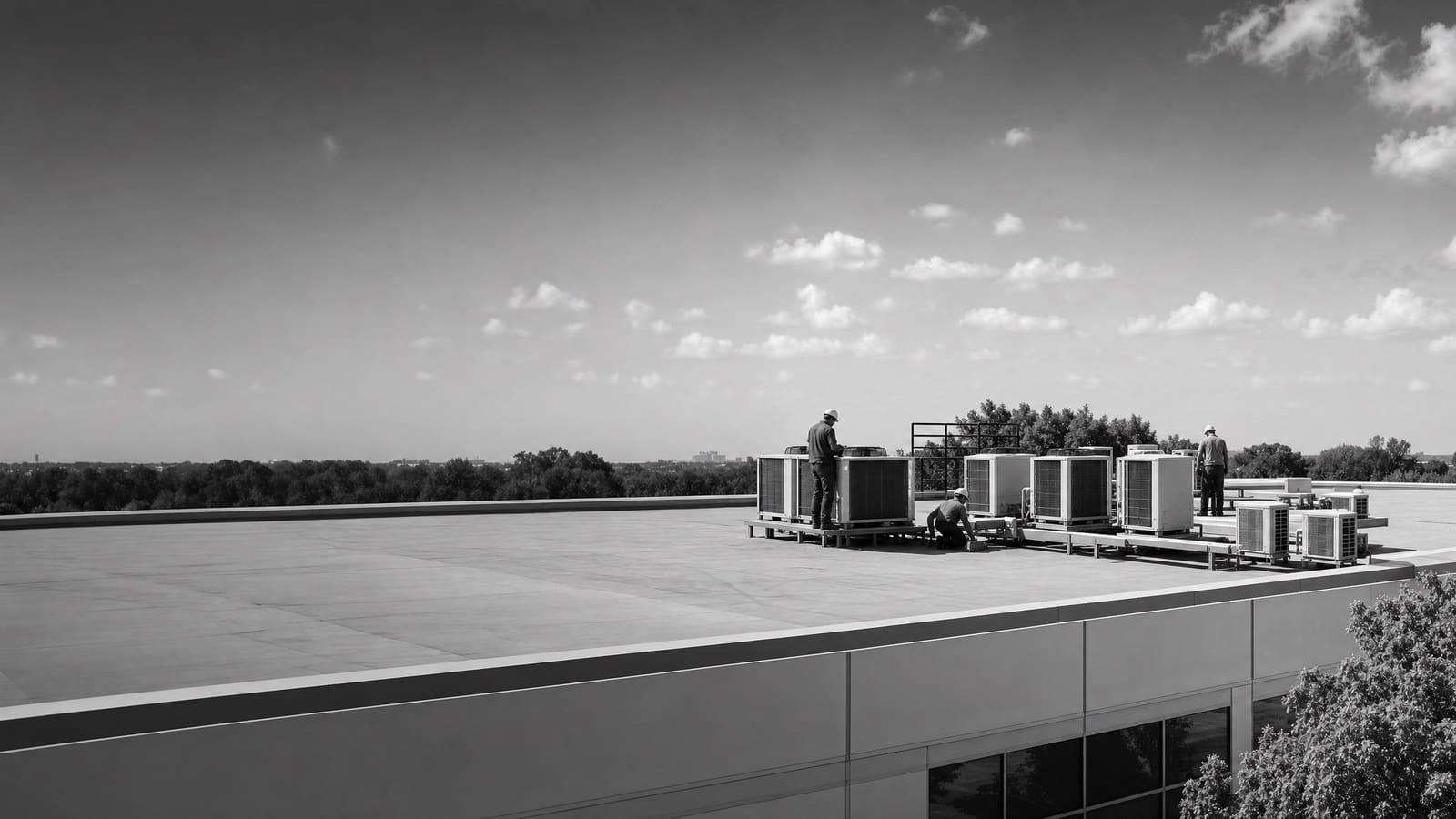
A commercial HVAC replacement covers a fresh load calculation, equipment selection, rigging and set, gas and electrical connections, curb work, controls, permits, and a documented startup. Replacement beats one more repair once a rooftop unit is past roughly fifteen years. Federal analysis puts the annual energy waste of an old, inefficient rooftop unit between $900 and $3,700 per unit. A dated unit that also needs repeat repairs is costing more than the invoice shows.
A site review has to verify roof structure and curb fit, available electrical capacity, gas service, crane access and reach, and any code items the swap triggers before a price means anything.
THREE PATHS
Three ways to replace a rooftop unit
Most commercial replacements land on one of three paths. The right one depends on whether the building still uses the space the way it did when the old unit was specified.
A like-for-like swap keeps the same tonnage, the same fuel, and usually the same curb. It is the fastest path back to conditioned air and the cheapest to engineer, but it carries forward whatever sizing error the old unit had.
A right-sized, high-efficiency replacement starts from today's occupancy, plug load, and envelope. The Department of Energy's high-performance rooftop specification targeted units that cut energy use by up to half against the standard in place at the time, and manufacturers built to it. That is the path when comfort complaints or utility spend have been creeping.
A heat pump rooftop unit replaces the gas heat section with reverse-cycle heating. DOE's guidance is direct about geography: across most of the U.S. South and West, current heat pump rooftop units can handle most or all of the winter heating demand. Simi Valley sits in that mild-winter band, so the electric option deserves a real look rather than a reflex no.
WHAT MOVES THE NUMBER
The lines that decide your installed price
No two roofs price the same, and the equipment is only part of it. These are the lines that move a commercial HVAC installation quote most, in rough order of how often they surprise an owner after the first walk.
IN PRACTICE
How to choose the unit, not just the price
The price is paid once. The energy the unit uses is paid every month it runs. Rooftop equipment conditions close to half of all commercial floor space in the country, which is why the federal effort to improve it has been so sustained.
Start with the load, not the nameplate. A twenty-year-old unit was sized for the tenant, the lighting, and the equipment that existed then. Offices lost heat-producing gear and gained people. Warehouses added packing lines. Sizing from the old plate just reprints an old assumption. If the space is used the same way, that assumption may still hold and a like-for-like swap is honest. If anything changed, ask for the calculation.
Then decide fuel before you decide brand. The heat pump question is a geography question first, and DOE's guidance says that across most of the West, current heat pump rooftop units can carry most or all of the heating demand. What that same guidance stresses is that the answer turns on infrastructure: electrical capacity at the panel, physical space on the roof, and what happens to the existing gas line. Those are site facts, not preferences, and they belong in the walk rather than in an argument after the order. DOE also lists contractor availability and knowledge as a real consideration. Weigh it alongside the price.
SCOPE CHECK
What makes a replacement simple or complicated
Two replacements at the same tonnage can differ by weeks, and by a wide margin in price. The difference is almost never the equipment. It is what the building asks the crew to work around.
LOWER COMPLEXITY
Straight swap on an open roof
Same tonnage and same fuel, an existing curb that matches, adequate electrical service already at the unit, and a lot with room for the crane. Permits are routine, the set happens inside one planned closure, and the controls carry over.
HIGHER COMPLEXITY
Resized, refueled, or hard to reach
A larger footprint needing an adapter and structural review, an electric conversion needing panel work and a capped gas line, tight access that forces a bigger crane or a night lift, or a tenant who cannot lose conditioning during business hours.
BEFORE THE QUOTE
What a real site review has to confirm
A price given from a nameplate photo is a placeholder. It is useful for budgeting and useless for signing. The site review is what converts it into a number that will hold.
On the roof, the crew confirms the existing curb dimensions and whether an adapter is needed, the condition of the membrane around the unit, and whether the structure supports the new weight. They check the disconnect and the wire size feeding the unit, the gas line if one is staying, and the condensate route. DOE's own adoption checklist puts infrastructure in the same tier as equipment choice: electrical capacity, physical constraints, and gas lines decide what is actually installable.
On the ground, they confirm crane reach and setup position, which stalls close and for how long, and whether the lift can happen outside operating hours. In a lot shared with other tenants, that conversation happens before the order, not the week of.
Inside, they confirm how the space is used now, where the thermostat and controls live, and whether the new unit has to talk to an existing building automation system.
Any of these can change the number. All of them are cheaper to find on a Tuesday walk than on crane day.
Ask for the findings in writing
A site review that produces no document is a sales visit. Ask for curb dimensions, electrical findings, the rigging plan, and permit scope on paper. That page is what makes two quotes actually comparable.
SIMI VALLEY SPECIFICS
Permits and the roof you are landing on
California building departments treat a rooftop replacement as permitted work, not maintenance. Mechanical upgrades or repairs require a permit, electrical work is permitted as well, and re-roofing, whether overlay or tear-off, is its own separate permit line. Confirm current requirements with the Simi Valley building division before the schedule is set, so inspection time sits inside the project timeline instead of after it.
The re-roofing detail matters more than it looks. Setting a new unit means opening the roof around the curb, flashing it, and sealing it. If the membrane under that unit is near the end of its life, doing the roof after the set means paying twice for the same square footage and putting a fresh penetration into an old membrane. Ask the roofer for remaining life before you approve a crane date.
Sequence the roof with the unit
If the membrane has only a few years left, coordinate the re-roof and the unit set into one planned closure. One crane mobilization, one set of penetrations, one tenant disruption, and one clean warranty conversation instead of two.
OWNERSHIP
Two things that outlast the install
The install ends. Two obligations do not.
The first is refrigerant. EPA regulations under Section 608 of the Clean Air Act govern how refrigerant is handled, recovered, and recycled in stationary air conditioning and heat pump equipment. That applies to the old unit coming off the roof as much as the new one going on. Recovery is part of the job, and the record is part of the file.
The second is who services the thing. DOE flags contractor availability and knowledge as a genuine consideration when choosing equipment, particularly for newer heat pump rooftop configurations. A unit nobody nearby is trained on is a slow unit to fix in August. Ask who covers warranty labor, how parts are sourced, and whether the crew that sets it is the crew that answers the call.
REFRIGERANT
Section 608 does not end at handoff
The old charge has to be recovered by certified technicians, and the new equipment stays under the same handling rules for its whole life. On a mixed fleet, plan service and spare parts around more than one refrigerant.
SERVICE
Who answers the call in August
Warranty labor, parts availability, and local familiarity with the model matter more than a spec sheet line. Confirm coverage and response terms before the order, while you still have leverage.
PLANNING AHEAD
Replacing on your schedule instead of the equipment's
There are two ways to buy a rooftop unit. One is on the day it dies, in season, with a tenant on the phone. The other is on a plan. DOE's guidance is blunt about the difference: managers often delay until the unit fails or needs constant attention, and replacing proactively with an efficient unit is frequently the better business move than replacement-on-failure, or even than a like-for-like swap at end of life.
Planning also unlocks the parts of a project that emergencies cannot use. Utility and federal incentive programs generally want paperwork before the work, not after. A planned replacement leaves time to check what is currently offered, compare efficiency tiers against the rebate structure, and actually collect. A failure in August leaves time for none of that.
If you own several units, phase them. Rank by age, repair history, and how much of the building each one serves, then replace the worst one or two a year. The DOE-backed campaign built on that approach saw more than two hundred organizations upgrade over forty-three thousand rooftop units and cut a combined thirty-seven million dollars a year in energy spend. That came from a schedule, not from emergencies. Budget the same way: an annual line item, not a surprise.
APPLES TO APPLES
Five things a comparable quote shows
Two quotes for the same roof can differ widely and both still be honest, because they are not scoped the same. These five lines make them comparable. If one quote is missing a line the other has, that is the gap, not the price.
01
Equipment, spelled out
Make, model, tonnage, efficiency tier, and heating type, plus the quoted lead time with a date, so schedule risk is visible before you sign.
02
Curb, roof, and structural scope
Whether an adapter is included, who flashes and seals the penetration, and whether structural work is in the price or excluded.
03
Rigging and access plan
Crane size, staging location, stalls closed, and the hours of the lift. Also who absorbs the cost if weather moves the date.
04
Permits and inspections
Which permits get pulled and by whom, and whether inspection time sits inside the schedule. Exclusions listed, not assumed.
05
Commissioning and documentation
Verified charge, airflow, and control setpoints, delivered as a startup report that supports the warranty.
Get a defensible number
Price the equipment and the building together.
Send the address, operating target, and target opening date. Flux will identify what must be verified before the project can be priced.
Get a free estimateQuestions
Straight answers.
When is replacement better than another repair?
Once a rooftop unit is past roughly fifteen years, it starts wasting real money. Federal analysis puts the annual energy waste of an old, inefficient unit between $900 and $3,700. Add recurring repair spend on top of that and the replacement year is usually the cheaper year, not the expensive one.
Does a heat pump rooftop unit work in Simi Valley?
DOE guidance says that across most of the U.S. South and West, current heat pump rooftop units can handle most or all of the winter heating demand. The open question here is not climate. It is electrical capacity at the panel and physical room on the roof, both of which get checked during the site review.
Do I need a permit to replace a rooftop unit?
Yes. California building departments require permits for mechanical and electrical upgrades, and re-roofing is a separate permit of its own. Confirm current requirements and inspection timing with the Simi Valley building division before locking in a crane date.
What happens to the refrigerant in the old unit?
EPA Section 608 rules under the Clean Air Act govern handling, recovery, and recycling for stationary air conditioning and heat pump equipment. The old charge is recovered by certified technicians as part of the removal, and that record belongs in your project file.
Should I right-size or match the old unit?
Ask for a load calculation either way. If occupancy, lighting, and equipment are unchanged, a like-for-like swap is defensible and fast. If any of that changed, matching the old nameplate just repeats a sizing decision made for a different building.
Sources used for this guide
- [1]betterbuildingssolutioncenter.energy.gov — DOE Advanced Rooftop Unit Replacement Guidance
- [2]betterbuildingssolutioncenter.energy.gov — DOE Commercial Heat Pump Rooftop Unit Replacement Guidance
- [3]betterbuildingssolutioncenter.energy.gov — DOE High-Efficiency Commercial Rooftop Unit Toolkit
- [4]energy.gov — DOE Efficient Commercial Rooftop Air Conditioner Program
- [5]epa.gov — EPA Stationary HVAC Refrigerant Management
- [6]californiacity-ca.gov — HVAC Permits