THE DIRECT ANSWER
What a commercial HVAC replacement includes
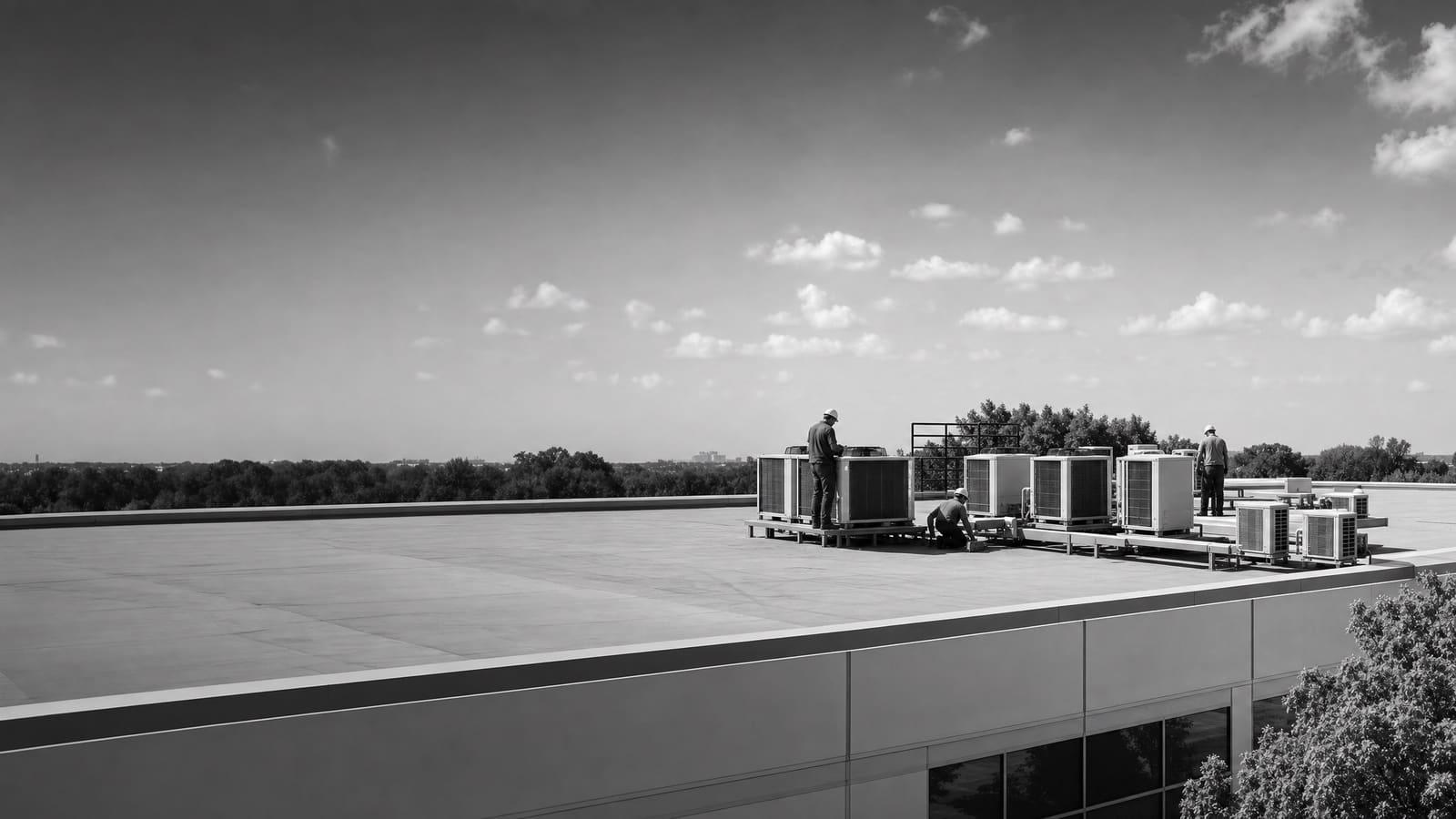
A commercial HVAC replacement covers a load check, equipment selection against lead times, permits, the crane set, refrigerant recovery from the old unit, gas and electrical connections, controls, and commissioning. Replacement usually beats one more repair once a rooftop unit passes 15 years, because old units waste roughly $900 to $3,700 each per year in energy compared with high-efficiency equipment. At that point a repair buys a season, not a decade.
A site review still has to confirm curb size, roof structure, electrical capacity, and crane access before any of that applies to your building.
THE THREE PATHS
Three ways to replace the unit
Most commercial replacements come down to three choices, and the right one depends on how the building runs now, not on what sits on the curb today. A like-for-like swap is the fastest way back to conditioned air and the cheapest to engineer, but it carries forward whatever sizing error the old unit had. A right-sized, high-efficiency replacement takes a load calculation and a little more lead time, and it is the version that lowers the bill for the next fifteen years. A heat pump rooftop unit adds reverse-cycle heating and takes gas out of that part of the building. Shreveport sits in the part of the country where heat pump rooftop units can carry most or all of the winter heating demand, so the real question is whether you go all-electric or choose a dual-fuel unit that keeps a gas backup for hard cold snaps. Electrical capacity, not comfort, is usually what settles that one.
WHAT MOVES THE NUMBER
The lines that decide the price
No two roofs price the same, so ask which of these lines your quote actually carries. The first two move the number most. The rest are the ones that come back as change orders when nobody checked them before the crane was booked.
BUYING GUIDANCE
Choosing the unit you will live with
Rooftop units cool close to half of all commercial floor space in the country, which means the decision in front of you is a common one with well-understood tradeoffs. Start by deciding whether you are buying the same building you had fifteen years ago. If the tenant mix, the occupancy, and the plug load are the same, a like-for-like unit is an honest answer. If any of that moved, the old nameplate is a record of a past building, not a spec for the next one.
The second decision is efficiency tier, and it is easier than it sounds. A unit that runs long hours in a hot climate pays back a higher tier faster than a unit that runs a few months a year. Ask the contractor to price two tiers on the same scope so you are comparing equipment, not proposals.
The third is fuel. Heat pump rooftop units are a fit across most of the South, and they are worth pricing whenever a gas unit is at end of life anyway. The thing that stops the conversation is almost never the weather. It is whether the panel, the feeders, and the service have room for the added electric load.
COMPLEXITY CHECK
Simple swap or engineered project
Before you budget, figure out which project you actually have. The difference between these two columns is usually weeks of schedule and a second set of trades on site.
LOWER COMPLEXITY
Straight replacement
Same tonnage and fuel, existing curb reused or adapted, power and gas already sized, open lot for the crane, and hours available when the building is empty. One mechanical permit, one trade, one morning of visible work.
HIGHER COMPLEXITY
Engineered replacement
Tonnage or footprint changes, roof framing needs review, an all-electric conversion pushes the service, controls tie into a building automation system, or the crane needs a tight setup. Electrical and structural join the job, and the permit path gets longer.
SCOPING THE JOB
What a real site review has to confirm
A price given over the phone from a model number is a guess about equipment and silent about everything that makes the equipment work. The site review is where the guessing stops.
On the roof, the review confirms curb dimensions and condition, the structure under it, clearances around the unit, and whether the existing duct connections line up with the new cabinet. It confirms disconnect location and available electrical capacity, and on any heat pump conversion it confirms that capacity twice, because that is the item that turns a swap into a service upgrade. It confirms the gas line if one stays. It confirms the condensate path, which is a small thing that becomes a roof leak.
On the ground, it confirms crane setup: where the truck sits, what it has to reach over, how many parking spaces close, and how long they close. If your building has tenants or customers, that answer belongs in the proposal, not in a phone call the morning of the lift.
The review should also confirm what the old unit is holding. Refrigerant has to be recovered by a certified technician under federal rules before the unit leaves the roof.
Ask for this in writing
The proposal should name the tonnage, the efficiency tier, the curb solution, the electrical scope, the permit and inspection responsibility, and the lot closure window. If any of those is missing, the number is not comparable to another number.
SHREVEPORT SPECIFICS
Permits and inspections here
In Shreveport, the Division of Permits and Inspections handles construction permitting for the city and for Caddo Parish, and a permit is required for most HVAC work. That includes a rooftop replacement, and typically the electrical work that comes with it.
The part that catches owners is who calls the inspections. Subcontractors doing electrical, plumbing, or HVAC work have to call in their own inspections, and each of those groups has to pass before the related building inspection is called. As the owner or general contractor, you are only scheduling the building inspections. If your mechanical contractor assumes you are handling the calls, the job sits.
When the replacement is part of a larger build-out or a change of use, plan review and the certificate of occupancy sit in the same path, so start those before equipment lands.
Put it in the contract
Name the party responsible for pulling the mechanical and electrical permits and for calling each inspection, and require inspection sign-offs before final payment. That one clause removes the most common cause of a finished unit that cannot be signed off.
AFTER THE LIFT
Two things owners underweight
The install is a week. The consequences run fifteen to twenty years. Two of them are worth deciding now, while you still have leverage with the contractor and the equipment is still on paper.
The first is commissioning. A unit that turns on is not a unit that performs. Charge, airflow, economizer operation, and control settings all have to be verified against the submitted spec and documented, because that documentation is what protects the warranty and what a future technician reads when something drifts.
The second is fleet strategy. If you own four units of different ages, each replacement either moves you toward one platform or adds a fifth thing to stock parts for. Deciding that before the first purchase order costs nothing and saves real money later.
COMMISSIONING
Verified, then documented
Require a startup report with measured airflow, refrigerant charge, and control setpoints. Comfort complaints in month two are usually commissioning items that nobody wrote down in week one.
MIXED FLEETS
Refrigerant and parts planning
New equipment ships on newer low-GWP refrigerants. Day-one operation is unaffected, but service contracts and spare-parts stocking should account for a roof running two generations at once.
TIMING AND MONEY
Replace on a plan, not on a failure
Most facility teams wait until a unit stops holding temperature, needs constant service, or dies outright. That is the most expensive version of this project. Emergency replacement means you take whatever equipment is available rather than the equipment you want, you pay for the schedule, and you carry the outage while it happens.
The alternative is boring and cheaper. Walk the roof once, write down the age and tonnage of every unit, and sort them oldest first. Anything past fifteen years belongs on a replacement schedule, because those units are the ones quietly spending the money that would fund their own replacement. Then place them across budget years so you are replacing one or two a year instead of four in a crisis.
Planning also buys you procurement leverage. Commercial equipment lead times are a real constraint, and a unit ordered on a schedule arrives as the unit you specified. A unit ordered the day one fails arrives as the unit somebody had in a warehouse. Same roof, same crane, very different fifteen years.
COMPARING QUOTES
Five things every quote should show
If two proposals differ by a wide margin, one of them is usually missing a line rather than beating a price. Check these five before you compare totals.
01
Equipment, spelled out
Manufacturer, model, tonnage, efficiency tier, heating type, and the current lead time in weeks.
02
The curb solution
Whether the existing curb is reused, adapted, or replaced, and who covers any structural work the roof needs.
03
Electrical and gas scope
Disconnect, feeder, and panel work included, plus what happens if capacity comes up short.
04
Rigging and access plan
Crane size, setup location, parking spaces closed, and the hours the lift occupies your lot.
05
Permits, inspections, commissioning
Who pulls the permits, who calls each inspection, and what startup documentation you receive at handoff.
Get a defensible number
Price the equipment and the building together.
Send the address, operating target, and target opening date. Flux will identify what must be verified before the project can be priced.
Get a free estimateQuestions
Straight answers.
When does replacement beat another repair?
Once a rooftop unit passes fifteen years, it is usually spending more in wasted energy than the repairs cost. Old, inefficient units commonly waste $900 to $3,700 each per year, so a repair on a unit that age buys a season rather than a solution.
How long does the work actually take?
The visible part of a straight rooftop swap is short. The schedule is set by equipment lead time and permitting, not by the crane. That is why availability belongs on the quote next to the price, and why planned replacements beat emergency ones.
Should we consider a heat pump rooftop unit?
It is worth pricing. Heat pump rooftop units are capable of most or all of the winter heating demand across the South. The deciding factor is usually electrical capacity, and whether you want a dual-fuel unit that keeps gas backup for hard cold snaps.
Do we need a permit to replace a rooftop unit in Shreveport?
A permit is required for most HVAC work in the city and in Caddo Parish. Your mechanical and electrical subcontractors call in their own inspections, and those have to pass before the related building inspection. Assign that responsibility in writing.
What happens to the refrigerant in the old unit?
Federal rules require that refrigerant be recovered by a certified technician before the equipment is removed or disposed of. It should appear as a line in the proposal, along with disposal of the old unit itself.
Sources used for this guide
- [1]betterbuildingssolutioncenter.energy.gov — DOE Advanced Rooftop Unit Replacement Guidance
- [2]betterbuildingssolutioncenter.energy.gov — DOE Commercial Heat Pump Rooftop Unit Replacement Guidance
- [3]betterbuildingssolutioncenter.energy.gov — DOE High-Efficiency Commercial Rooftop Unit Toolkit
- [4]energy.gov — DOE Efficient Commercial Rooftop Air Conditioner Program
- [5]epa.gov — EPA Stationary HVAC Refrigerant Management
- [6]shreveportla.gov — Your Guide to Permits & Inspections MPC