THE SHORT ANSWER
What a commercial HVAC replacement actually includes
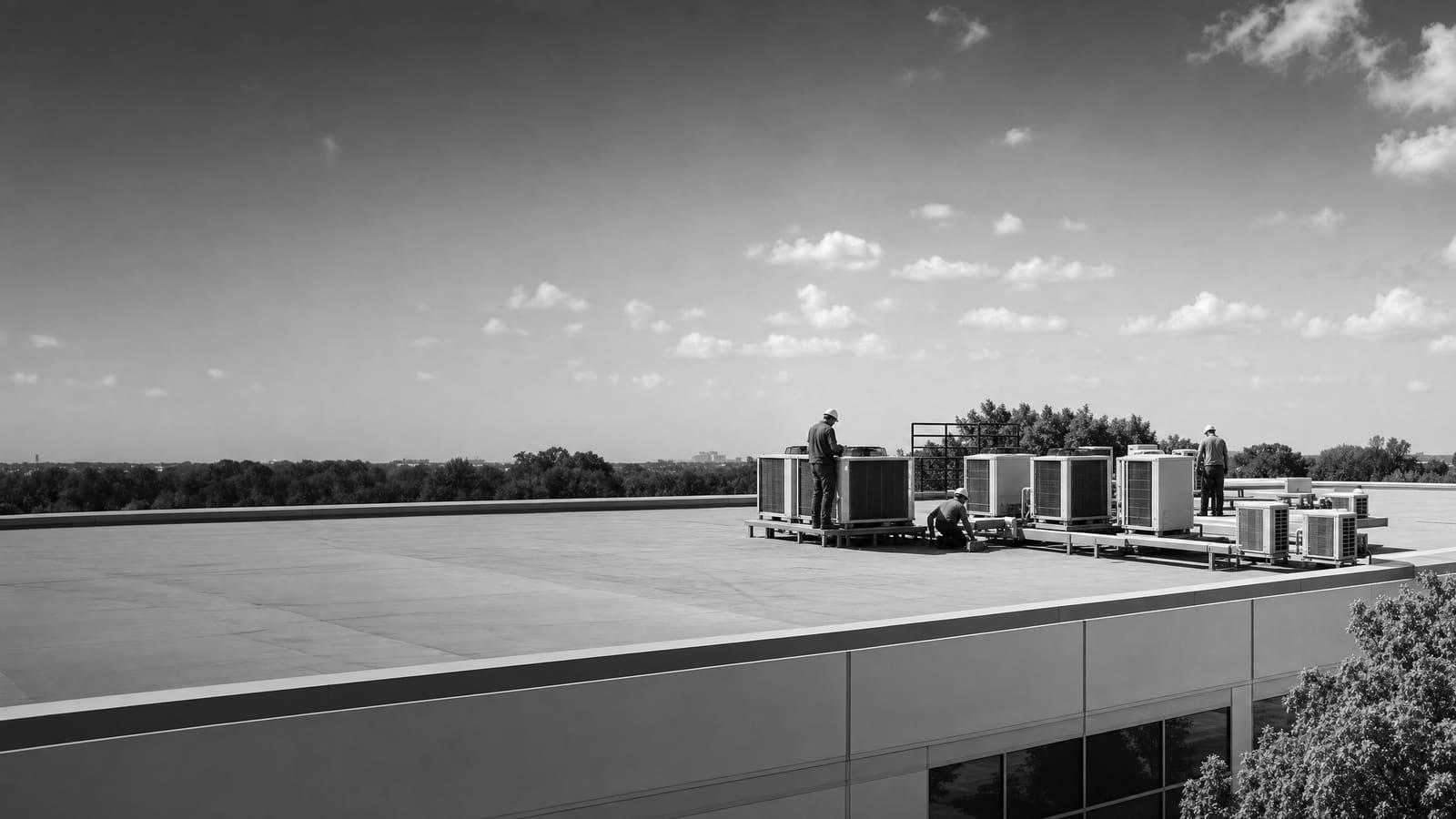
A commercial HVAC replacement covers the load check, equipment selection, permits, removal with certified refrigerant recovery, the crane set, gas, power and control connections, and commissioning. Replacement usually beats another repair once a rooftop unit is past fifteen years, no longer holds the space, or needs service every season. Old, inefficient units waste roughly $900 to $3,700 each per year in energy alone.
A site review still has to verify the roof structure and curb fit, crane reach and lot access, panel capacity, gas line status, and which permits the swap pulls.
THREE WAYS TO GO
Three ways to replace a rooftop unit
Most commercial buildings in Savannah cool through packaged rooftop units. They condition close to half of all commercial floor area in the country, so this decision repeats across the whole portfolio.
Managers often wait until a unit fails, needs constant service, or stops holding the space. That habit costs money: planned replacement with a more efficient unit usually comes out ahead of replacing on failure, and often ahead of a like-for-like swap at end of life. There is also a middle path. If a unit still has life in it, retrofitting advanced controls can capture savings without buying a box.
Savannah's mild winters open the third option below. Heat pump rooftop units run most efficiently in mild-to-moderate heating weather, and across the South they can handle most or all of the winter heating load.
WHAT MOVES THE NUMBER
Where a replacement budget actually goes
No two roofs price the same, so treat these as the lines to interrogate rather than a total. Ask the contractor to show each one separately. Anything bundled into a single number is where the surprises hide.
IN PRACTICE
How to choose the equipment
Start with the load, not the nameplate. A unit installed twenty years ago was sized for a building that no longer exists in the same form: different occupancy, different plug loads, different lighting, sometimes a different envelope. Carrying the old tonnage forward carries the old mistake forward with it.
Then decide how the space gets heated. A gas-heat rooftop unit and an all-electric heat pump unit look similar from the parking lot and behave differently on the balance sheet. The right answer depends on your electricity and gas prices, your winter load, and what the panel can carry. In a mild coastal climate, a heat pump unit can cover most or all of the heating season, which is why the question is worth asking rather than defaulting.
Efficiency tier is the last big lever. The high-efficiency rooftop units built to a federal challenge specification were designed to cut energy use by up to half against the standard in force at the time, and equipment sold today meets a far stronger floor than the one your old unit was built to. That gap is where the payback lives.
COMPLEXITY CHECK
What makes a swap simple or hard
Two projects with the same tonnage can be a week apart on schedule and far apart on price. The difference is almost never the box. It is what the box has to land on, connect to, and get past.
LOWER COMPLEXITY
Same size, same spot
Matching tonnage on the existing curb. Open lot with clear crane reach. Existing power and gas are adequate. Controls are standalone or already compatible. The permit set is mechanical and electrical, and the building stays open through the work.
HIGHER COMPLEXITY
Anything that changes
A new footprint or heavier unit, which brings in structural review. Tight setbacks or a shared lot that limits the crane. A switch to all-electric heat that needs a service upgrade. Integration into a building automation system, phased around occupied hours.
BEFORE YOU BUY
What the site review has to settle
A quote written from a nameplate photo is a starting number. A quote written from a roof visit is a price. The visit exists to answer the questions that change the scope, and there are only a handful that matter.
The first is structure and fit. Does the new unit land on the existing curb, does it need an adapter, and can the roof carry the weight where it sits. The second is infrastructure. Electrical capacity surprises people most, especially on an all-electric conversion, because the panel and the service were sized for the old equipment. Gas line status matters in the other direction: if the new unit is electric, the gas service to it gets properly abandoned, not capped and forgotten.
The third is access. Crane reach, lot layout, closure window, and how much of the parking lot goes out of service for a morning. The fourth is the old unit itself. Its refrigerant has to be recovered by certified technicians under federal rules, and the paperwork is part of the job.
Ask for the findings, not just the number
A serious contractor hands you what the roof visit turned up before the price: curb condition, panel capacity, gas status, crane plan, and the permits the work pulls. If the estimate arrives with none of that behind it, it is a guess wearing a total.
SAVANNAH SPECIFICS
Permits and the timing rules that bite
Georgia building departments treat a commercial equipment swap as permit work, not maintenance. A contractor who replaces or alters a mechanical, electrical, or gas system has to pull a permit before starting, and the mechanical exemptions are narrow: portable heating and cooling appliances, and minor parts that do not change the equipment's approval. A rooftop unit replacement is not on that list.
Two published timing rules shape scheduling. Emergency replacements can proceed, but the permit application has to be filed the next business day. And an application is treated as abandoned if work has not started within six months of filing. That second one matters when equipment lead time is long. Pulling the permit too early can cost you the application.
Confirm who reviews your address
Rules and fee schedules differ by jurisdiction. Before the order goes in, ask your contractor which building department reviews your Savannah address, which trade permits the swap pulls, and who files the emergency paperwork if a unit dies on a Friday night.
OWNERSHIP QUESTIONS
Two things to settle before the order
A rooftop unit is a long-horizon decision usually made in an afternoon, under pressure, with the space already too warm. The two questions below get skipped in that moment, and they are the ones that decide whether the building is better off in year five.
Neither is technical. Both come down to who pays, who benefits, and whether the next unit gets replaced on a plan or in an emergency. Answer them once for the whole roof, and every unit after this one becomes a scheduling question instead of a scramble.
SPLIT INCENTIVE
Who pays, who benefits
In a leased building, the party buying the unit is often not the party paying to run it. With an inefficient unit wasting up to several thousand dollars a year in energy, that split decides whether anyone funds the efficient option. Settle it in the lease conversation, not on the roof.
FLEET PLANNING
Plan it, or replace it on failure
Waiting for failure hands over the schedule, the equipment choice, and the price all at once, and hands all three to whoever answers the phone. Walking the roof once a year and ranking units by age and service history turns next year's failure into next year's budget line.
PROCUREMENT
Lead times, phasing, and the long number
Order around availability, not around the calendar you wish you had. Equipment availability is a real selection criterion, not a footnote, and a unit you can get in three weeks may beat a slightly better unit you cannot get until winter. Ask for the quoted lead time in writing next to the model number, and ask what happens to the price if that date slips.
If several units are aging out together, phase them. Ranking the roof by age, service history, and running cost gives you a replacement order you can spread across budget years. It also lets you standardize, and matching equipment across a roof simplifies parts, service contracts, and training for whoever maintains it.
Then look at the long number. First cost is one line in a decision that runs well over a decade. The unit you buy sets the energy bill for every one of those years, and the gap between an old inefficient unit and a current high-efficiency one runs from hundreds to thousands of dollars a year, per unit. If a rebate program is in play, confirm what it requires before the order goes in. Some will not pay on equipment that has already been bought.
THE QUOTE
Five things a comparable quote shows
Two quotes are only comparable when both show the same five things. If one of them is missing, you are comparing a scope to a hope. Ask for the missing line before you compare totals.
01
Equipment, spelled out
Make, model, tonnage, efficiency tier, heating type, and the quoted lead time in writing.
02
Curb and roof scope
Adapter or new curb, structural check, and any roofing repair around the opening.
03
The crane day
Crane size, rigging plan, lot closure window, and who coordinates tenants.
04
Old-unit removal
Certified refrigerant recovery, disposal, and the documentation that comes with both.
05
Permits and commissioning
Which permits are pulled, who pulls them, and the startup readings recorded at handoff.
Get a defensible number
Price the equipment and the building together.
Send the address, operating target, and target opening date. Flux will identify what must be verified before the project can be priced.
Get a free estimateQuestions
Straight answers.
When is replacement better than another repair?
Once a rooftop unit is past about fifteen years, needs service every season, or no longer holds the space, repair spending stops buying much. Old, inefficient units also waste roughly $900 to $3,700 each per year in energy, which is the cost most repair decisions leave out.
Should a Savannah building consider a heat pump rooftop unit?
It is worth pricing. Heat pump rooftop units are most efficient in mild-to-moderate winter weather, and across the South they can carry most or all of the heating season. The deciding factors are your electricity and gas prices, your winter load, and whether the electrical service can take the added demand.
Does a rooftop unit replacement need a permit?
Yes. Georgia building departments treat replacing or altering mechanical, electrical, and gas systems as permit work, and the exemptions cover portable appliances and minor parts, not a rooftop unit. Emergency replacements can start, but the application still has to be filed the next business day.
What happens to the refrigerant in the old unit?
It has to be recovered by certified technicians. Federal rules under the Clean Air Act govern how refrigerant is handled and recycled when this equipment is serviced or removed, so recovery and its documentation belong on the quote rather than showing up as an extra.
What drives the installed price the most?
Tonnage and efficiency tier first, then whatever the roof requires: a curb adapter or structural work, crane reach and closure time, electrical capacity if the heat goes electric, and controls integration. Ask for those as separate lines so you can see which one is moving the number.
How do you compare two installation quotes fairly?
Line them up on equipment model and lead time, curb and roof scope, crane and lot plan, old-unit removal, and permits plus commissioning. Any quote that folds those into one number is hiding the variability rather than pricing it.
Sources used for this guide
- [1]betterbuildingssolutioncenter.energy.gov — DOE Advanced Rooftop Unit Replacement Guidance
- [2]betterbuildingssolutioncenter.energy.gov — DOE Commercial Heat Pump Rooftop Unit Replacement Guidance
- [3]betterbuildingssolutioncenter.energy.gov — DOE High-Efficiency Commercial Rooftop Unit Toolkit
- [4]energy.gov — DOE Efficient Commercial Rooftop Air Conditioner Program
- [5]epa.gov — EPA Stationary HVAC Refrigerant Management
- [6]augustaga.gov — FAQs - CivicPlus.CMS.FAQ