THE SHORT ANSWER
What a commercial HVAC replacement includes
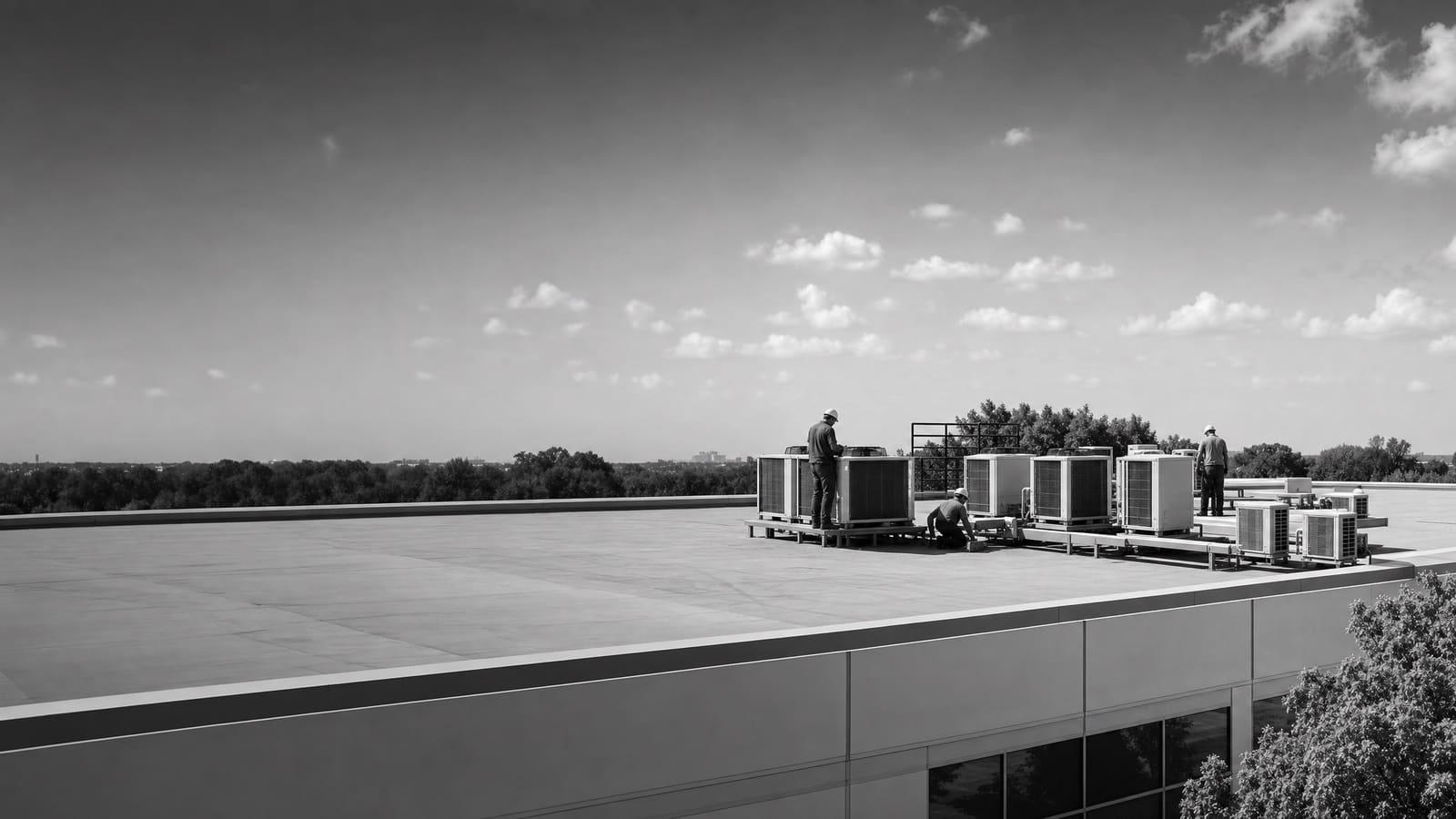
A commercial HVAC replacement covers the load check, the equipment order, the removal and set, the electrical, gas, and duct connections, the permit and inspection, and the startup that proves the system performs. Replacement beats another repair once a unit is past about fifteen years, needs frequent service, or no longer holds the space. Old, inefficient rooftop units can waste $900 to $3,700 each per year in energy alone, whether or not anything is broken.
A site review still has to confirm the curb and the structure under it, crane access and reach, available electrical capacity, the gas line's future, and whether today's use matches the old nameplate.
THREE WAYS TO GO
Three replacement paths worth pricing
Most commercial replacements come down to three paths, and the right one depends on what the building already has and how long you plan to hold it. A like-for-like swap is the quickest way back to conditioned air when the space and its use have not changed. A higher-efficiency unit costs more at the order and pays back through runtime, which matters most in buildings that run long hours. A heat pump rooftop unit does both heating and cooling with one machine, and federal guidance puts most of the West in the range where a heat pump can carry most or all of the winter heating load.
The heat pump question is not only about climate. Bill savings depend on the electricity and gas prices your building actually pays, so that comparison should be modeled with your rates before anything is ordered. Electrical capacity, physical space on the roof, and the status of the existing gas line decide whether the switch is straightforward or a larger project.
WHAT MOVES THE NUMBER
The lines that separate two quotes
Two bids can list the same tonnage and land far apart. These are usually the reasons. Ask for each one as a written scope item rather than an allowance, and ask which ones can still move after the site review.
IN PRACTICE
Buy the project, not the box
The quote you want prices the project. Two bidders can quote the same tonnage and land far apart because one included the curb adapter, the crane, the disconnect, and the startup, and the other left them as allowances. Ask each bidder to write those lines out, even where the number looks small.
Sizing deserves the same attention. A unit installed twenty years ago was sized for the occupancy, lighting, and equipment of that time. Reusing the old nameplate is the fastest way to buy the same complaints again. A short load check against how the space runs today either confirms the size or saves you from an oversized unit that short-cycles and never quite settles the space.
Efficiency is where the operating math lives. Federal work with manufacturers produced rooftop units built to cut energy use by up to half against the older standard, and more than twenty models now exceed that specification. That gap is worth pricing against your real runtime. A unit serving a kitchen or a retail floor earns back a higher tier faster than one serving a lightly used office suite.
COMPLEXITY CHECK
What keeps this simple, and what does not
Not every replacement carries the same risk or the same schedule. Before you commit to a date, work out which side of this line your unit sits on. The answer usually comes from the roof and the electrical, not from the equipment.
LOWER COMPLEXITY
Straight swap on a good roof
Same tonnage on the existing curb, clear crane reach from the lot, adequate electrical already at the unit, and a roof membrane with years left. Permits are routine and the set happens in one morning.
HIGHER COMPLEXITY
New footprint or new service
Larger tonnage, a curb that needs structural review, added panel capacity, a change in fuel, tight or shared access, hours you cannot interrupt, or a roof that should really be replaced first.
SCOPING
What the site review has to settle
The site review turns a price into a commitment. It starts on the roof: curb dimensions and condition, the structure underneath, the membrane's remaining life, and the clear path a crane needs to reach the unit. It moves to the electrical next. What capacity is available at the panel, what the new unit draws, and whether the existing disconnect and conductors carry it. If the unit burns gas today and the replacement will not, the review has to decide what happens to that line.
Then it goes inside. How the space is used now, how many people are in it, what equipment runs, and during which hours. Those answers set the load, and the load sets the tonnage. They also surface the comfort complaints worth fixing during a replacement instead of living with afterward.
Availability belongs in the same conversation. Lead time is a real constraint on commercial equipment, and a schedule built before the order is confirmed is a guess wearing a date.
Get these in writing before you sign
Curb and structure verified, crane path and closure time confirmed, electrical capacity measured at the panel, gas line disposition decided, load basis written down, and the selected unit's availability stated next to the price.
SANTA ROSA
The local steps to plan around
Santa Rosa sits in the West, where federal guidance says today's heat pump rooftop units are capable of carrying most or all of a building's winter heating demand. That makes the electric option worth pricing here rather than waving off. The deciding factors are what your building pays for electricity against gas, and whether the panel has room.
Permitting is the other local step. California building departments treat mechanical upgrades and repairs as permit work, along with the electrical that comes with them, and they list re-roofing as its own separate permit whether it is an overlay or a tear-off. Have your contractor confirm the current requirements with the Santa Rosa building department before the crane date is set.
One decision to make early
If the roof under the unit is near the end of its life, decide before you order whether to re-roof in the same window. Both are permitted work, the crane is already coming, and doing them separately means opening the same area twice.
OWNING IT
Two things that outlive the install
Two parts of a commercial replacement keep mattering long after the crane leaves. The first is refrigerant. New equipment ships on current refrigerants, and federal rules govern how refrigerant is handled, recovered, and serviced in stationary cooling and heat pump equipment. That shapes your service contract and your spare-parts plan once a roof carries more than one generation of equipment. The second is timing. Most owners wait until a unit fails and then buy whatever is available that week. Federal guidance is blunt about it: replacing an inefficient, underperforming unit proactively is often the better business move, compared with replacing on failure or even with a like-for-like swap at the end of service life.
REFRIGERANT
Service planning after the swap
Handling and recovery in stationary equipment is federally regulated work. Confirm recovery from the old unit is in the scope, and plan service for a roof that now runs two refrigerant generations.
TIMING
Proactive beats replace-on-failure
A unit past fifteen years wastes energy every hour it runs and gets expensive to keep alive. Choosing the window yourself protects both the equipment selection and the schedule.
PLANNING AHEAD
Phasing a roof instead of chasing failures
If you own more than one unit, replacement is really a sequencing question. Rank the roof by age, service history, and runtime. Take the worst offender first, then hold a budget line for the next one. Buying on your own calendar keeps you out of the emergency market, where the choice narrows to whatever happens to be in stock.
Not every unit on that list needs a full replacement. Federal guidance treats advanced controls as a legitimate alternative for units with real life left in them, and the right call depends on which option makes better financial sense for that specific unit. A staged plan usually mixes both.
The scale is worth knowing, because this is ordinary work done many times over. Through one federal campaign, more than 200 organizations upgraded over 43,000 rooftop units, and those upgrades together save a combined $37 million a year on energy bills. Your version starts the same way theirs did: know what is on the roof, know what each unit costs to run, and replace in the order that math gives you.
APPLES TO APPLES
Five things a comparable quote shows
Line these up across bidders and the cheapest quote often stops looking cheapest. Anything shown as an allowance is a number that can still move, so ask what would move it.
01
Load basis and selected tonnage
The sizing method used and the tonnage it produced, not the old nameplate copied forward.
02
Model, efficiency tier, and lead time
Exact make and model, its efficiency tier, and the availability date in writing.
03
Roof and rigging scope
Curb adapter, patching, any structural review, and who owns the rigging plan and lot closure.
04
Connections and controls
Electrical, gas, and duct work at the unit, plus integration with existing building controls.
05
Permits, recovery, and startup
Permits and inspections, refrigerant recovery, and documented commissioning against spec.
Get a defensible number
Price the equipment and the building together.
Send the address, operating target, and target opening date. Flux will identify what must be verified before the project can be priced.
Get a free estimateQuestions
Straight answers.
When does replacement beat one more repair?
Once a unit is past about fifteen years, needs frequent service, or no longer holds the space, replacement usually wins. Old, inefficient rooftop units can waste $900 to $3,700 each per year in energy alone, and that cost runs quietly in the background whether or not anything has failed.
How much does a commercial HVAC installation cost?
There is no honest universal number, because tonnage, curb work, electrical capacity, and crane access all swing it. Ask for the price as written scope lines instead: unit, curb and roof work, rigging, connections, permits, recovery, and startup. Then you can compare bids rather than totals.
Is a heat pump rooftop unit a real option in Santa Rosa?
Federal guidance says today's heat pump rooftop units can carry most or all of the winter heating demand across most of the West. The open questions are what your building pays for electricity against gas, and whether the electrical panel has capacity for the change. Both should be settled before the order.
Do I need a permit to replace a rooftop unit?
California building departments list mechanical upgrades and repairs as permit work, along with the electrical that accompanies them, and re-roofing is a separate permit whether it is an overlay or a tear-off. Have your contractor confirm current requirements with the Santa Rosa building department before scheduling.
What does commissioning actually prove?
Startup and commissioning verify that the installed system performs to spec instead of just turning on: airflow, refrigerant charge, and control settings checked and documented. That documentation is also what supports the warranty and prevents month-two comfort complaints.
Sources used for this guide
- [1]betterbuildingssolutioncenter.energy.gov — DOE Advanced Rooftop Unit Replacement Guidance
- [2]betterbuildingssolutioncenter.energy.gov — DOE Commercial Heat Pump Rooftop Unit Replacement Guidance
- [3]betterbuildingssolutioncenter.energy.gov — DOE High-Efficiency Commercial Rooftop Unit Toolkit
- [4]energy.gov — DOE Efficient Commercial Rooftop Air Conditioner Program
- [5]epa.gov — EPA Stationary HVAC Refrigerant Management
- [6]californiacity-ca.gov — HVAC Permits