THE SHORT ANSWER
What a commercial HVAC replacement actually includes
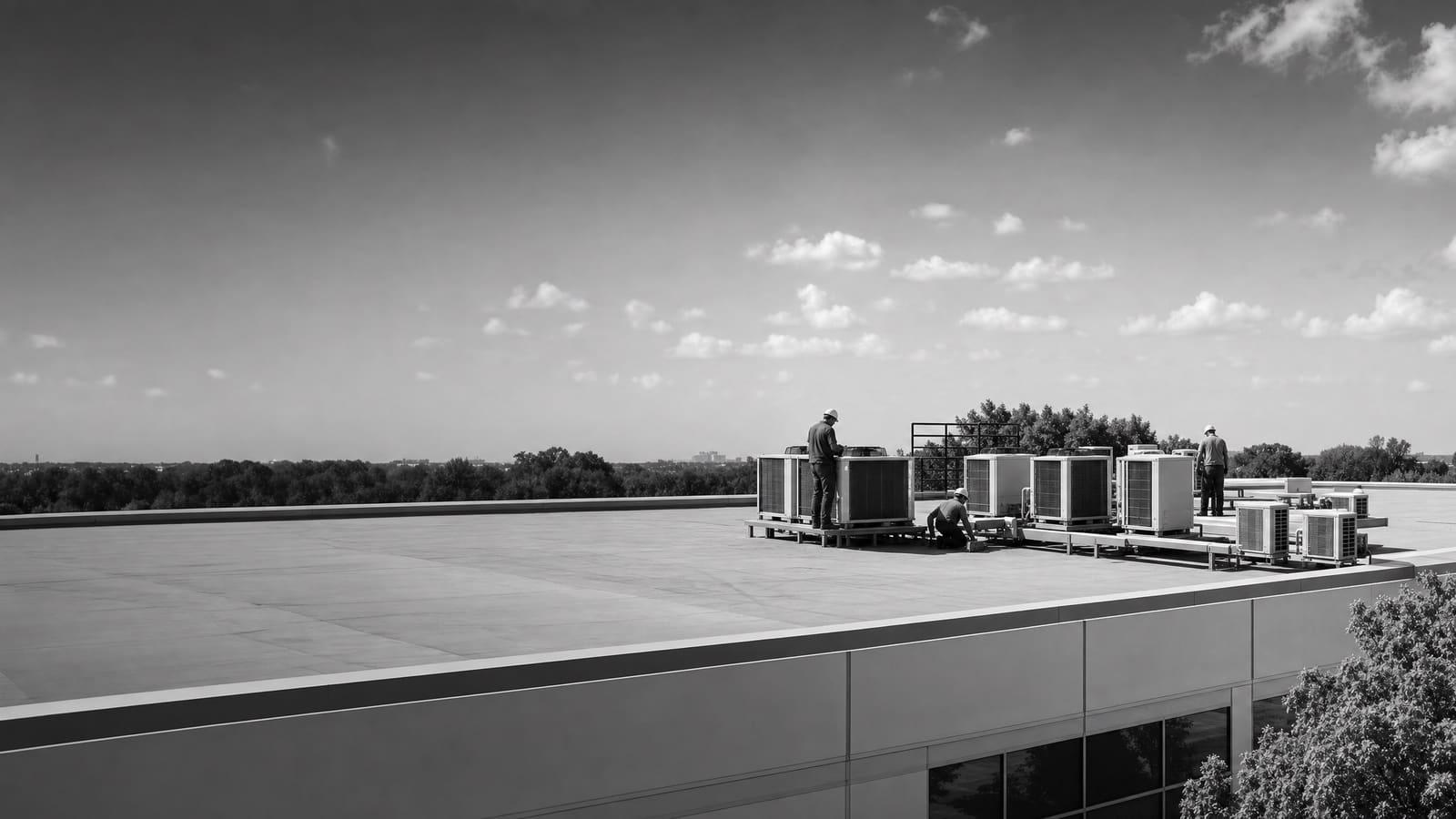
A commercial HVAC replacement covers verifying the real load, selecting equipment against actual lead time, recovering the old refrigerant charge, rigging and setting the new unit, curb and connection work, controls, and commissioning. Replacement beats one more repair once a unit is past roughly 15 years and running poorly. DOE estimates old, inefficient rooftop units waste $900 to $3,700 per unit every year, which often outweighs the repair invoice you are weighing.
A site review still has to verify the real load, roof structure and curb fit, electrical capacity at the panel, gas line status, crane access, and equipment availability before any of it becomes a price.
THE REAL DECISION
Three ways this project can go
The choice is rarely about which brand lands on the roof. It is about when you replace and what you replace with. DOE's guidance is blunt on the point: waiting for a unit to fail and then swapping in whatever is available is usually the most expensive path, because the emergency removes every option that would have saved money. A planned replacement lets you compare efficiency tiers, confirm the load against how the space is used now, and time the crane around your operating schedule. The third question is fuel. Heat pump rooftop units are technologically similar to air-conditioning units but add reverse-cycle heating, and DOE treats them as a workable option across most of the U.S. South and West. Whether one fits your building depends on winter heating load, electricity and gas prices, electrical capacity, and equipment availability.
WHAT MOVES THE NUMBER
The lines that decide the price
Nobody can price a rooftop replacement from a phone call. The lines that move the number, though, are predictable. These are the ones to ask about before you set two quotes side by side.
HOW TO BUY IT
Pick the equipment before you pick the installer
Start with the load, not the nameplate. A unit installed twenty years ago was sized for a building that no longer exists in the same form: different occupancy, different plug loads, different envelope. Carrying the old tonnage forward carries the old sizing mistake forward with it.
Then pick a tier. DOE ran a high-performance rooftop unit challenge that asked manufacturers for units cutting energy use up to 50% below the standard of the time, and more than twenty models now exceed that specification. That spread is wide enough that two bids for the same tonnage can differ by thousands of dollars a year in operating cost while looking identical from the parking lot.
The fuel question comes last and matters most on heating-heavy sites. Heat pump rooftop units heat by running the refrigeration cycle in reverse, and their heating efficiency falls as outdoor temperature drops, trending toward parity with electric resistance. DOE sorts them into all-electric, dual-fuel, and cold-climate versions for that exact reason. If your winter heating load is real, dual-fuel keeps a gas backstop while capturing heat pump efficiency through the shoulder seasons.
SIDE BY SIDE
Simple swap or a real project
Two buildings with the same tonnage on the roof can be very different projects. The difference is almost never the equipment. It is what the building will let you do to install it.
LOWER COMPLEXITY
Straight swap conditions
Same fuel, same tonnage, and an existing curb that fits or takes a standard adapter. The panel has capacity, the roof is structurally sound, and a crane can reach from a lot you can close for a morning.
HIGHER COMPLEXITY
What adds weeks
Tonnage or footprint changes, a fuel switch that needs new electrical capacity, gas lines to cap or reroute, no clear crane path, or a space that cannot lose conditioning during business hours. Each one adds scoping before it adds price.
SCOPING
What a real site review has to answer
DOE's own checklist for rooftop replacement is a good template for what a walkthrough should settle. Heating load first, because that decides whether an all-electric unit can carry the building on its worst days. Utility bill impact next, because local electricity and gas prices decide whether the efficient option actually saves money at your site rather than in a brochure. Then building type and operating hours, because a space that runs continuously gets phased differently than one that closes at six.
After that come the physical constraints, which is where most projects stall. Is there capacity at the panel for a larger or all-electric unit? Do gas lines stay, get capped, or get rerouted? Will the equipment fit the existing opening and curb without structural work? Can a crane physically reach it?
Equipment availability belongs in the same conversation. Lead time is a scoping fact, not a scheduling detail. If the unit you want is months out and the building is limping along on a failed compressor, that changes the recommendation, not just the calendar.
Send this with your request
A photo of the unit nameplate, the tonnage and fuel type, the year it went in, a photo of the electrical panel with its available capacity, and pictures of roof access and the lot. That is enough to come back with real options and real lead times.
OWNERSHIP
Two things that outlive the install
A rooftop replacement is a capital decision that keeps producing operating decisions afterward. Two of them are cheaper to settle before the crane shows up than after: what the new unit does to your service strategy, and who is actually paying for the efficiency tier you picked. Neither one appears as a line on a quote. Both of them change what the right answer was. If the building is leased, or if this unit is one of several on the roof, work them out while you still have leverage in the conversation.
SERVICE
Refrigerant and a mixed fleet
New equipment ships on newer refrigerants while your older units stay on what they have. EPA Section 608 governs how the old charge gets recovered and how each system is serviced. Make sure the service contract names who handles which, and stock parts accordingly.
LEASE
Who pays and who benefits
Rooftop equipment usually sits on the landlord's roof but conditions the tenant's space. The lease decides who funds replacement and who keeps the utility savings. When those are two different parties, the cheapest unit wins by default unless someone settles it during spec.
PHASING
One unit now, or the whole roof on a schedule
If you have one unit, this is a scheduling question. If you have six, it is a program. The common mistake is treating six units as six separate emergencies spread across several years, because every emergency pays the premium that planning would have avoided.
The workable pattern is to inventory what is actually up there first: tonnage, age, fuel, and condition for each unit. Rank by age and run hours, then replace on a schedule you set rather than one the compressors set. Standardizing on one or two models across the fleet pays off in spare parts, technician familiarity, and purchasing leverage. It also lets you order ahead of lead time instead of chasing it.
The scale here is not theoretical. Through DOE's Advanced RTU Campaign, more than 200 organizations upgraded over 43,000 rooftop units and cut a combined $37 million a year from their energy bills. That annual savings figure is the number to weigh against first cost, because it repeats every year the equipment runs. The difference between two bids does not.
THE QUOTE
Five things a comparable quote shows
Two quotes are only comparable when both show the same things. If one is missing an item below, it is not cheaper. It is smaller.
01
Tonnage, efficiency tier, and load basis
Model number, efficiency rating, and what the sizing was based on. If it only matches the old nameplate, ask why.
02
Equipment lead time in writing
A date, not a range with a shrug. Availability is part of the recommendation, not a footnote to it.
03
Curb, structural, and rigging scope
Adapter, any framing, crane size, and how long your lot or aisle stays closed.
04
Electrical, gas, and refrigerant work
Panel work, line changes, and certified recovery of the old charge, priced as scope rather than assumed.
05
Commissioning and documentation
Startup report, charge and airflow verified against spec, controls set, and warranty registered.
Get a defensible number
Price the equipment and the building together.
Send the address, operating target, and target opening date. Flux will identify what must be verified before the project can be priced.
Get a free estimateQuestions
Straight answers.
When is replacement better than one more repair?
Once a unit is past roughly 15 years and no longer holding the space, the energy penalty usually outruns the repair bill. DOE puts the waste from old, inefficient rooftop units at $900 to $3,700 per unit annually. Compare that against the repair quote, not against zero.
How much does a commercial HVAC installation cost?
There is no honest universal price, because tonnage, efficiency tier, curb and structural work, crane access, and electrical scope all move it. The useful move is to get those six lines itemized on every bid so you are comparing the same project twice, not two different projects.
Should the new unit match the old one?
Confirm the load either way. If the occupancy, equipment, and hours have not changed, like-for-like is often correct and it is the fastest path back to conditioning. If any of those did change, matching the old nameplate just reinstalls the old problem.
Is a heat pump rooftop unit worth considering?
It depends on winter heating load, local electricity and gas prices, and whether your panel has capacity. DOE considers heat pump rooftop units appropriate across most of the South and West, with dual-fuel and cold-climate versions available where sustained cold heating demand is a factor.
Does new equipment change how the system gets serviced?
New units ship on newer refrigerants while older units on the same roof stay on what they have. EPA Section 608 covers how refrigerant is handled and recovered on both. Update the service agreement and spare-parts plan so a mixed fleet does not become a sourcing problem later.
Sources used for this guide
- [1]betterbuildingssolutioncenter.energy.gov — DOE Advanced Rooftop Unit Replacement Guidance
- [2]betterbuildingssolutioncenter.energy.gov — DOE Commercial Heat Pump Rooftop Unit Replacement Guidance
- [3]betterbuildingssolutioncenter.energy.gov — DOE High-Efficiency Commercial Rooftop Unit Toolkit
- [4]energy.gov — DOE Efficient Commercial Rooftop Air Conditioner Program
- [5]epa.gov — EPA Stationary HVAC Refrigerant Management