THE SHORT VERSION
What a commercial HVAC replacement actually includes
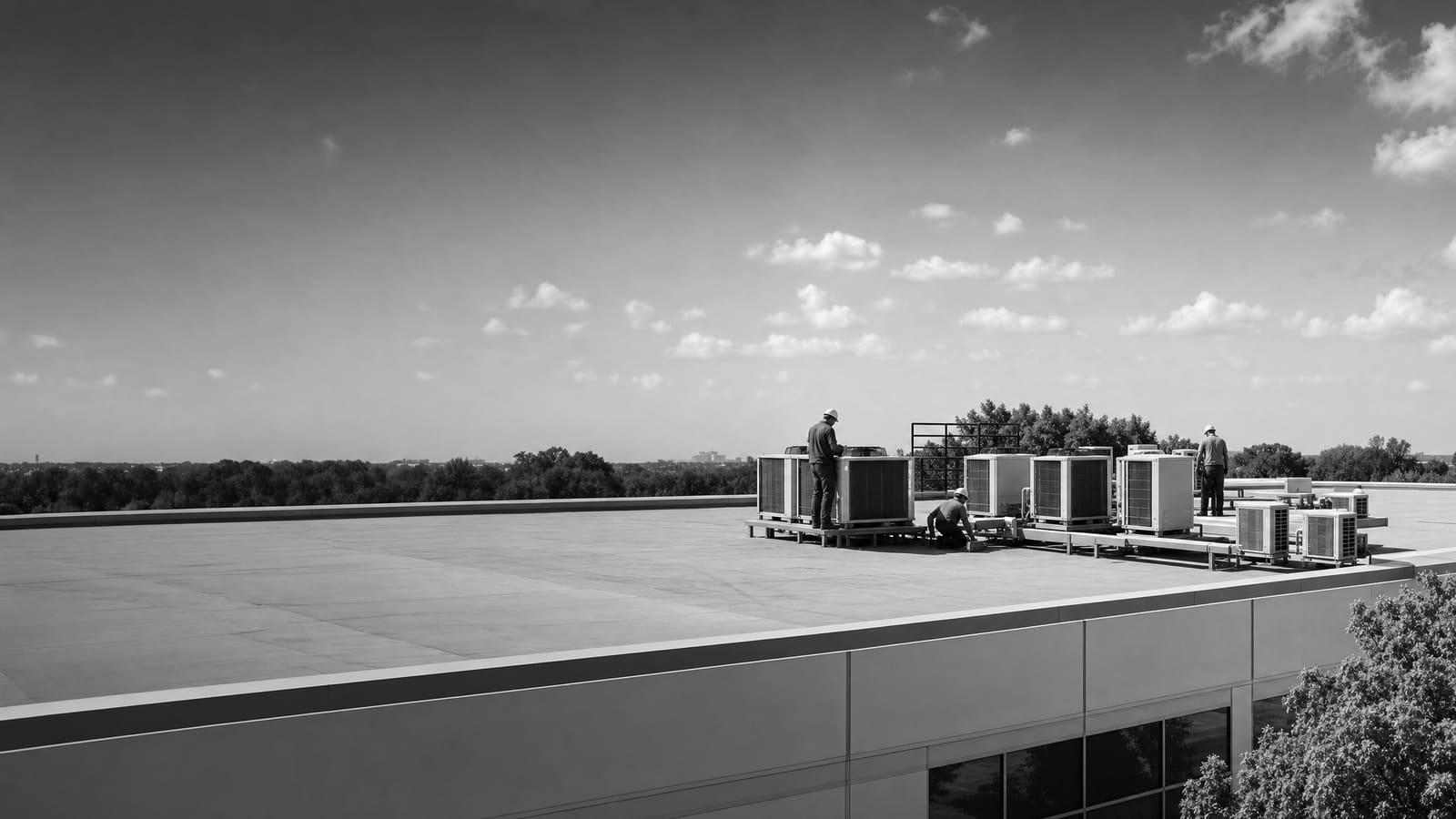
A commercial HVAC replacement covers the load calculation, equipment selection, permits, rigging and set, gas or electrical connections, controls integration, and commissioning. Replacement beats another repair once a unit is past about 15 years, since Department of Energy figures put the annual waste from an old, inefficient rooftop unit between $900 and $3,700. Frequent service calls and a unit that no longer holds the space are the other two signals worth acting on.
A site review still has to confirm curb size and roof structure, available electrical capacity, gas line status, and crane reach. Those four items decide whether the swap is simple or engineered.
THREE WAYS TO GO
Three equipment paths for a rooftop replacement
Most commercial replacements come down to three choices, and the right one depends on how long you plan to hold the building and what the roof can support.
Like-for-like keeps the same fuel and roughly the same capacity. It is the fastest path back to conditioning and the cheapest to engineer, but it carries forward whatever sizing mistake the old unit had.
High-efficiency air conditioning rooftop units cost more up front and pay back through the utility bill. The Department of Energy's high-performance specification targeted units that cut rooftop energy use by up to half against the older standard, and more than 20 models now exceed that spec.
Heat pump rooftop units add reverse-cycle heating on the same footprint. DOE guidance is direct about geography: across most of the U.S. West, today's heat pump rooftop units can carry most or all of the winter heating demand. Santa Clara sits in that mild-winter band, which makes the electric option worth pricing rather than dismissing.
WHAT MOVES THE NUMBER
The line items that decide your installed price
No honest installed price exists before someone looks at the roof. These are the lines that separate a routine swap from a project. Each one should appear on the quote by name rather than hiding inside a lump sum, so a change on one item does not quietly move the total.
IN PRACTICE
Choosing between a fast swap and a better system
The pressure in most replacements comes from timing. A unit fails in season, the building is uncomfortable, and the fastest available box starts to look like the only option. That instinct is understandable and it is usually expensive. Department of Energy guidance on rooftop replacement makes the point plainly: waiting for total failure and then replacing like-for-like is generally worse business than replacing proactively while the old unit still runs.
The practical middle ground is to decide the equipment question before the failure, not during it. Confirm the load against how the space is used today. Twenty years of occupancy changes, added plug loads, and envelope work rarely leave the old nameplate correct. Then price two or three equipment paths and keep them on file with current availability.
When a unit does go down, the decision is already made and the only open question is lead time. Buildings that work this way replace on their own schedule, stay eligible for incentives that require pre-approval, and avoid paying a premium for whatever happens to be sitting in a regional warehouse.
SCOPE CHECK
What makes one replacement simple and another complicated
Two buildings on the same block can quote very differently for the same tonnage. The gap almost always traces to access, infrastructure, and whether the new unit fits the old opening. Work out which side of this line your building falls on before you compare prices.
LOWER COMPLEXITY
Straight swap conditions
Same tonnage and fuel, an existing curb the new unit matches or adapts to cleanly, clear crane reach from the lot, and adequate electrical service already at the roof. These jobs are set and connected quickly, and the permit scope stays mechanical with a small electrical component.
HIGHER COMPLEXITY
Conditions that turn it into a project
Capacity or footprint changes that trigger structural review, a fuel switch that needs new electrical capacity or a gas line capped, tight rigging with no lay-down space, tenants who cannot lose parking, or controls that must integrate with an existing building automation system.
BEFORE YOU BUY
What a real site review has to establish
A quote produced from a nameplate photo alone is an estimate wearing a quote's clothes. The site review is what converts it. Department of Energy heat pump rooftop guidance lists the infrastructure questions that decide feasibility, and they apply to conventional replacements too: electrical capacity, physical constraints like curb dimensions and clearances, and the status of existing gas lines.
Add the items specific to your building. How the space is actually used, since that drives the load calculation. Where the crane can set up and what it can reach. Which stalls close and for how long. Whether the roof structure carries the new weight. What the controls have to talk to.
Contractor familiarity belongs on that list as well. DOE names it as a distinct consideration, because equipment a local crew has not installed or serviced before creates a support gap once the warranty work is done. Ask directly how many of the specific model you are being sold that crew has commissioned.
Ask for these four before you sign
Panel and service capacity, curb dimensions against the proposed unit, crane setup location with the stalls it closes, and gas line disposition. If a quote cannot answer all four, it has not been scoped — it has been guessed.
SANTA CLARA SPECIFICS
Permits and the climate case for pricing electric
California jurisdictions require a permit for mechanical upgrades and repairs, and electrical and plumbing work pulled alongside a rooftop replacement is permitted as well. Build that into the schedule instead of treating it as paperwork at the end. Confirm current submittal requirements and inspection sequencing with the City of Santa Clara building department before the crane is booked, because an inspection that lands after the set day can leave a new unit installed but not signed off.
Climate matters here too. DOE guidance holds that heat pump rooftop units are best suited to mild-to-moderate winter heating, and that across most of the U.S. West they can carry most or all of the winter heating load. Santa Clara's winters sit in that range, so an all-electric or dual-fuel path deserves a real price comparison rather than an assumption that gas heat is the default.
Sequence the permit, not just the crane
Pull the mechanical permit and any electrical scope early, and confirm inspection timing with the city before booking rigging. A crane day is easy to move a week out and expensive to move the day before.
OWNERSHIP QUESTIONS
Two things owners decide too late
Two questions tend to get answered after the equipment is ordered, which is the worst possible time. The first is refrigerant. EPA regulations under Section 608 of the Clean Air Act govern how refrigerant is handled and recycled in stationary refrigeration, air conditioning, and heat pump equipment, so the old unit's charge has to be recovered properly and documented. New equipment also arrives on newer refrigerants, which means a building with a mixed fleet is running two service and parts strategies at once.
The second is incentives. The Department of Energy maintains guidance on financial incentives tied to advanced rooftop unit replacement, and programs of this kind frequently require approval before equipment is purchased or installed. A replacement done in a panic almost never captures them.
REFRIGERANT
Recovery is regulated, not optional
Section 608 rules cover handling and recycling of refrigerant in stationary equipment. The old unit's charge must be recovered by certified technicians and documented. Ask to see that documentation as part of closeout.
INCENTIVES
Approval usually comes first
Incentives for high-efficiency and heat pump rooftop units commonly have to be applied for before equipment is bought. Check program timing early, since a failure replacement rarely leaves room to qualify.
THE LONGER VIEW
Phasing a fleet instead of replacing one unit at a time
If you own several rooftop units, the one that just failed is rarely the only one near the end. Owners who plan replacements as a sequence get better pricing, consistent controls, and one set of spare parts instead of five. The Department of Energy's Advanced RTU Campaign is the large-scale version of this: more than 200 public- and private-sector organizations upgraded over 43,000 rooftop units, and those upgrades saved a combined $37 million a year on energy bills.
The arithmetic on your own roof is simpler than it looks. DOE puts the annual waste from an old, inefficient rooftop unit between $900 and $3,700 against a current model. Multiply that by the number of aging units on the building and by the years before you would otherwise act, and the case for phasing usually makes itself.
Phasing also fixes the thing owners complain about most after a string of one-off replacements: a roof full of units from different eras, on different controls, that nobody can operate as one system.
QUOTE CHECKLIST
Five things a comparable quote has to show
Two quotes are only comparable when they show the same five things. If one is missing an item, it is not cheaper — it is incomplete, and the gap comes back as a change order.
01
Equipment, spelled out
Manufacturer, model, tonnage, efficiency tier, and refrigerant. Not just "new rooftop unit."
02
Real lead time
Current availability for the exact model quoted, and the date the pricing expires.
03
Rigging and access plan
Crane size, setup location, stalls closed, and how long the lot is affected.
04
Permit and inspection scope
Which permits are pulled, by whom, and whether inspection coordination is included in the price.
05
Commissioning and closeout
Startup, charge verification, airflow, controls setup, refrigerant recovery documentation, and warranty registration.
Get a defensible number
Price the equipment and the building together.
Send the address, operating target, and target opening date. Flux will identify what must be verified before the project can be priced.
Get a free estimateQuestions
Straight answers.
When does replacement beat another repair?
Age, repair frequency, and whether the unit still holds the space. The Department of Energy points to rooftop units over 15 years old as the ones wasting real money, and puts the annual waste from an old, inefficient unit at $900 to $3,700. When two of those three signals are true, replacement is usually the cheaper decision.
How much does a commercial HVAC replacement cost in Santa Clara?
There is no honest installed number before someone measures the curb and looks at crane access. What you can pin down early is the equipment tier, the electrical and gas scope, and whether the roof needs structural work. Those three decide most of the spread between quotes.
Is a heat pump rooftop unit realistic here?
It deserves a real quote rather than an assumption. Department of Energy guidance says heat pump rooftop units are best suited to mild-to-moderate winter heating, and that across most of the U.S. West they can handle most or all of the winter load. The gating question is usually electrical capacity, not climate.
Do I need a permit to replace a rooftop unit?
Plan on it. California jurisdictions permit mechanical upgrades and repairs, and electrical work pulled with the replacement is permitted too. Confirm submittal and inspection requirements with the City of Santa Clara before the crane is scheduled, so the sign-off does not trail the install.
What happens to the refrigerant in the old unit?
It has to be recovered, not vented. EPA rules under Section 608 of the Clean Air Act govern the handling and recycling of refrigerant in stationary refrigeration, air conditioning, and heat pump equipment. Ask for the recovery documentation as part of project closeout.
Sources used for this guide
- [1]betterbuildingssolutioncenter.energy.gov — DOE Advanced Rooftop Unit Replacement Guidance
- [2]betterbuildingssolutioncenter.energy.gov — DOE Commercial Heat Pump Rooftop Unit Replacement Guidance
- [3]betterbuildingssolutioncenter.energy.gov — DOE High-Efficiency Commercial Rooftop Unit Toolkit
- [4]energy.gov — DOE Efficient Commercial Rooftop Air Conditioner Program
- [5]epa.gov — EPA Stationary HVAC Refrigerant Management
- [6]californiacity-ca.gov — HVAC Permits