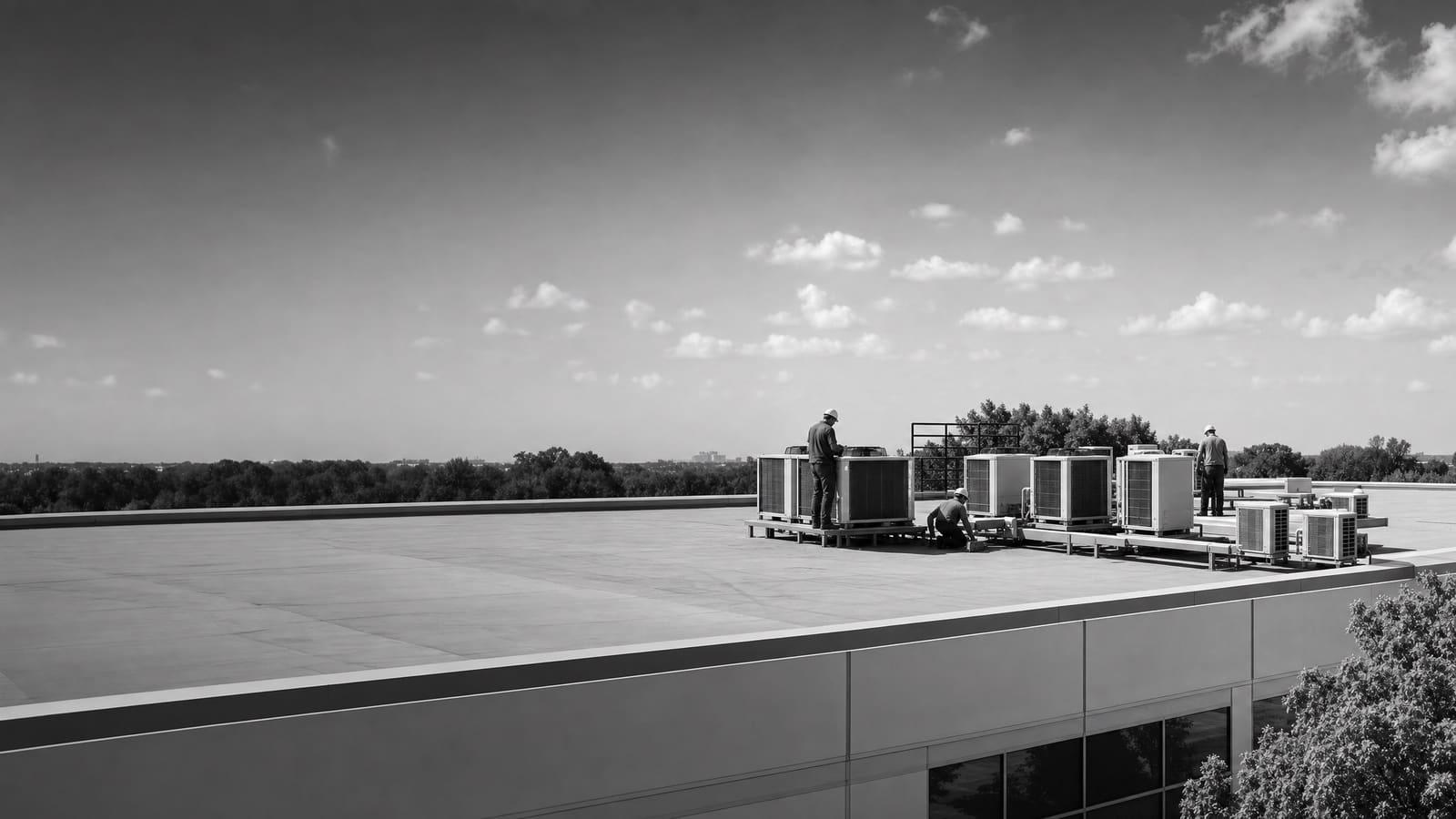
THE DIRECT ANSWER
What commercial HVAC replacement includes
A commercial HVAC replacement should include load review, equipment selection, removal, rigging, curb or connection work, electrical and fuel changes, controls, startup, commissioning, and required closeout records. Replacement becomes more useful than another repair when an older unit needs frequent service, cannot hold comfort, or creates growing operating risk.
A site review must verify the roof, curb, utilities, controls, airflow, service clearances, equipment access, and how long each occupied area can be offline.
THREE OPERATING CHOICES
Decide what the new system must improve
Start with the business problem, not a model number. A failed unit may call for a fast replacement, but speed should not hide a poor fit. An aging unit that still runs gives you time to compare efficiency, heating type, controls, and electrical needs. A building with uneven temperatures may need more than a new rooftop box. Air distribution, zoning, ventilation, schedules, or control settings may be part of the problem.
The old nameplate is useful, but it is not a load calculation. Occupancy, lighting, plug loads, operating hours, partitions, and outdoor-air needs may have changed since the unit was selected. Confirming those conditions helps prevent another oversized or undersized system. It also gives bidders the same basis for their proposals.
BUDGET STRUCTURE
What moves the installed price
The supplied research does not support one universal installed price. A useful budget separates equipment from the work needed to make it fit, operate, and pass through a complete handoff.
EQUIPMENT CHOICES
Compare systems by how the building operates
Packaged rooftop units are common because heating, cooling, ventilation, and controls can sit in one roof-mounted assembly. A high-efficiency rooftop unit can reduce energy use compared with an older, inefficient unit, but the result still depends on sizing, controls, installation, and operating schedules. A premium cabinet placed on the wrong load is not a sound upgrade.
A heat-pump rooftop unit uses reverse-cycle operation for heating as well as cooling. Federal guidance says these systems are especially well suited to mild-to-moderate winter heating. That makes a heat-pump option worth studying, but the choice still requires a site check. Compare electrical capacity, utility impacts, physical space, equipment availability, existing gas service, contractor knowledge, and the organization’s emissions goals. All-electric, dual-fuel, and other heat-pump configurations do not create the same infrastructure needs.
A conventional air-conditioning rooftop unit with separate fuel-based heat may remain practical where electrical work would be extensive or the existing arrangement closely fits the operating plan. For a deeper look at that decision, review commercial heat pump conversion. Ask each bidder to state the heating configuration, efficiency basis, required utility changes, and expected control sequence.
PROJECT COMPLEXITY
A box swap and a system change are different projects
Two units with similar capacity can require very different installation plans. The quote should identify which conditions are confirmed and which remain allowances.
LOWER COMPLEXITY
Compatible replacement
The selected unit fits the existing location, utilities, airflow needs, and controls with limited adaptation. Access is clear, and the occupied area can tolerate a planned outage.
HIGHER COMPLEXITY
Changed system or constrained site
Capacity, weight, footprint, heating source, electrical demand, duct layout, ventilation, controls, or lift access changes. Engineering and coordination should be defined before ordering.
SITE REVIEW
Measure the building before selecting the equipment
Begin with the equipment schedule and nameplate, but keep looking. Record the areas served, occupied hours, temperature complaints, service history, and any tenant or process loads. Review filters, coils, fans, dampers, economizer functions, duct conditions, and control points. Confirm the heating source and available electrical service. On the roof, check the curb, supports, drainage, flashing, clearances, and the route technicians will use for future service.
The review should also map the installation day. Identify crane setup, delivery staging, safe work zones, roof access, and the parts of the property that must remain open. Decide whether work can happen in one outage or needs temporary conditioning and phased shutdowns. If several units serve separate areas, replacement can often be sequenced to keep more of the building usable.
Use this information to create one bid basis. When every bidder prices a different capacity, control package, curb assumption, or outage plan, the totals cannot be compared fairly. A short written scope makes exclusions visible before the purchase order is issued.
Useful information to gather
Collect nameplate photos, service records, floor plans, operating hours, comfort complaints, utility information, controls details, roof-access rules, and known shutdown limits.
SANTA BARBARA PLANNING
Treat local approval as an item to verify
The supplied research does not establish a current Santa Barbara permit rule, code edition, utility incentive, or active local rebate for this project. Do not let a proposal assume those items without confirmation. Before equipment is ordered, the project team should identify the authority with jurisdiction, confirm the required submittals and inspections, and verify any electrical, mechanical, structural, or roof work tied to the selected design.
The same caution applies to incentives. Program rules, eligible equipment, reservation steps, funding, and deadlines can change. An incentive should improve a decision that already works on technical and operating grounds. It should not be treated as secured money until the current program administrator confirms eligibility and timing in writing.
Put verification before procurement
Ask the quote to name who confirms current approvals, prepares documents, schedules inspections, and verifies any incentive before purchase. Keep unverified savings outside the base budget.
OWNERSHIP VIEW
Balance failure risk with lifetime operation
Federal guidance notes that rooftop units more than 15 years old can waste substantial energy compared with newer models. Age alone does not settle the choice, but it should trigger a closer review of repair frequency, comfort performance, refrigerant history, and failure exposure. Planned replacement gives an owner more control over equipment selection and scheduling than replacement after a complete failure.
Operating cost also depends on how the unit runs after installation. Controls, setbacks, ventilation schedules, economizer operation, filters, coils, and maintenance affect performance. Compare the full operating plan, not just the efficiency label. The owner should know what will be measured at startup and what the facility team must maintain.
REPAIR PATH
Keep the present unit
Use repair when the system remains reliable, serves the load, and has a clear service path. Track recurring failures and avoid letting emergency spending become the default plan.
REPLACEMENT PATH
Control the next service cycle
Use planned replacement to compare configurations, reserve shutdowns, coordinate access, and correct known sizing or control problems before failure removes those choices.
PROCUREMENT AND PHASING
Order only after the scope and sequence agree
Ask for a proposed equipment schedule before approving procurement. It should state manufacturer and model, capacity, heating type, efficiency information, electrical characteristics, refrigerant, accessories, controls, dimensions, weight, and availability. Review substitutions against the same criteria. A unit that ships sooner is not equivalent if it changes the curb, electrical load, control sequence, service access, or intended performance.
For multiple units, decide whether to replace everything together or phase the work. One project can reduce repeated planning and mobilization, while phasing can spread capital needs and preserve more conditioned space. Rank units using condition, service history, criticality, and the areas they serve. Keep replacement order separate from convenience alone.
Set hold points before release, delivery, lift, startup, and final payment. Confirm site measurements before ordering. Confirm accessories and adapters before shipment. Inspect delivered equipment before the crane arrives. After installation, require documented startup, airflow and control checks, operator instruction, warranty information, and a complete equipment record. This turns a successful lift into a usable, maintainable system.
QUOTE CHECKLIST
Five things every comparable quote should show
Use one scope for every bidder. The lowest total is meaningful only when equipment, site work, exclusions, commissioning, and handoff are shown on the same basis.
01
Selected equipment
List model, capacity, heating type, efficiency, refrigerant, accessories, controls, availability, and substitution rules.
02
Complete installed scope
Define removal, disposal, rigging, curb, roof, duct, electrical, fuel, drainage, controls, and restoration work.
03
Project sequence
Show delivery, staging, shutdowns, temporary needs, lift plan, occupied-area protection, and expected installation phases.
04
Testing and handoff
Include startup, airflow checks, control verification, training, warranties, manuals, and final equipment records.
05
Assumptions and exclusions
Identify allowances, approval responsibilities, inspection tasks, concealed-condition risks, change-order rates, and payment milestones.
Get a defensible number
Price the equipment and the building together.
Send the address, operating target, and target opening date. Flux will identify what must be verified before the project can be priced.
Get a free estimateQuestions
Straight answers.
When is replacement better than another commercial HVAC repair?
Replacement deserves serious review when an older unit needs frequent repairs, cannot maintain the required conditions, lacks a dependable service path, or creates unacceptable failure risk. Federal guidance notes that rooftop units more than 15 years old can waste substantial energy compared with newer models. Do not use age as the only test. Consider condition, repair history, operating performance, criticality, and whether a planned project can correct sizing or control problems.
Should a Santa Barbara commercial building replace HVAC equipment like for like?
Like-for-like can simplify a project when the present capacity, airflow, utilities, curb, and controls still match the building. It can also repeat an old sizing error. Recheck occupancy, operating hours, ventilation, internal loads, comfort complaints, and space changes before selecting capacity. If the building’s use has changed, base the replacement on today’s load instead of copying the old nameplate.
Is a commercial heat-pump rooftop unit worth considering?
Yes. Federal guidance identifies heat-pump rooftop units as a strong option for mild-to-moderate winter heating, but suitability remains site-specific. Review electrical capacity, utility impacts, physical constraints, existing gas service, equipment availability, control needs, and organizational emissions goals. Compare all-electric, dual-fuel, and conventional configurations on the same installed scope.
How much does commercial HVAC installation cost in Santa Barbara?
The supplied research does not support a universal Santa Barbara installed price or a dependable per-ton figure. The total depends on equipment, capacity, heating type, efficiency, availability, roof and curb work, crane access, electrical or fuel changes, ductwork, controls, commissioning, approvals, and phasing. Ask for those lines separately so a low base equipment price does not hide missing installation work.
How long does a commercial HVAC replacement take?
The research supplied here does not establish a standard local duration. The schedule has at least two parts: procurement and field work. Equipment availability, engineering, approvals, adapters, electrical changes, crane coordination, weather, access, and commissioning can affect the plan. Require the quote to show both the expected equipment availability and the proposed outage sequence.
What should commissioning include after installation?
Commissioning should prove that the installed system does more than turn on. The scope should verify startup settings, airflow, temperature response, ventilation, dampers, heating and cooling stages, schedules, alarms, and integration with building controls. The owner should receive results, warranty information, manuals, equipment data, and clear instructions for operation and maintenance.
What happens to refrigerant in the old equipment?
EPA Section 608 rules address refrigerant handling and recycling for stationary air-conditioning and heat-pump equipment. The quote should assign recovery, handling, and disposal responsibilities to properly qualified parties and document removal of the old unit. Also record the refrigerant used by the new equipment so future technicians and the facility team can plan service correctly.
Who should manage crane access, shutdowns, and inspections?
The proposal should assign each responsibility instead of leaving it implied. One party should coordinate rigging, delivery, staging, safe work zones, roof access, shutdown notices, startup, and closeout. The project team should also confirm the current Santa Barbara approval and inspection path before equipment is released, because the supplied research does not establish those local requirements.
Sources used for this guide
- [1]betterbuildingssolutioncenter.energy.gov — DOE Advanced Rooftop Unit Replacement Guidance
- [2]betterbuildingssolutioncenter.energy.gov — DOE Commercial Heat Pump Rooftop Unit Replacement Guidance
- [3]betterbuildingssolutioncenter.energy.gov — DOE High-Efficiency Commercial Rooftop Unit Toolkit
- [4]energy.gov — DOE Efficient Commercial Rooftop Air Conditioner Program
- [5]epa.gov — EPA Stationary HVAC Refrigerant Management
- [6]californiacity-ca.gov — HVAC Permits