THE DIRECT ANSWER
What commercial HVAC replacement and installation includes
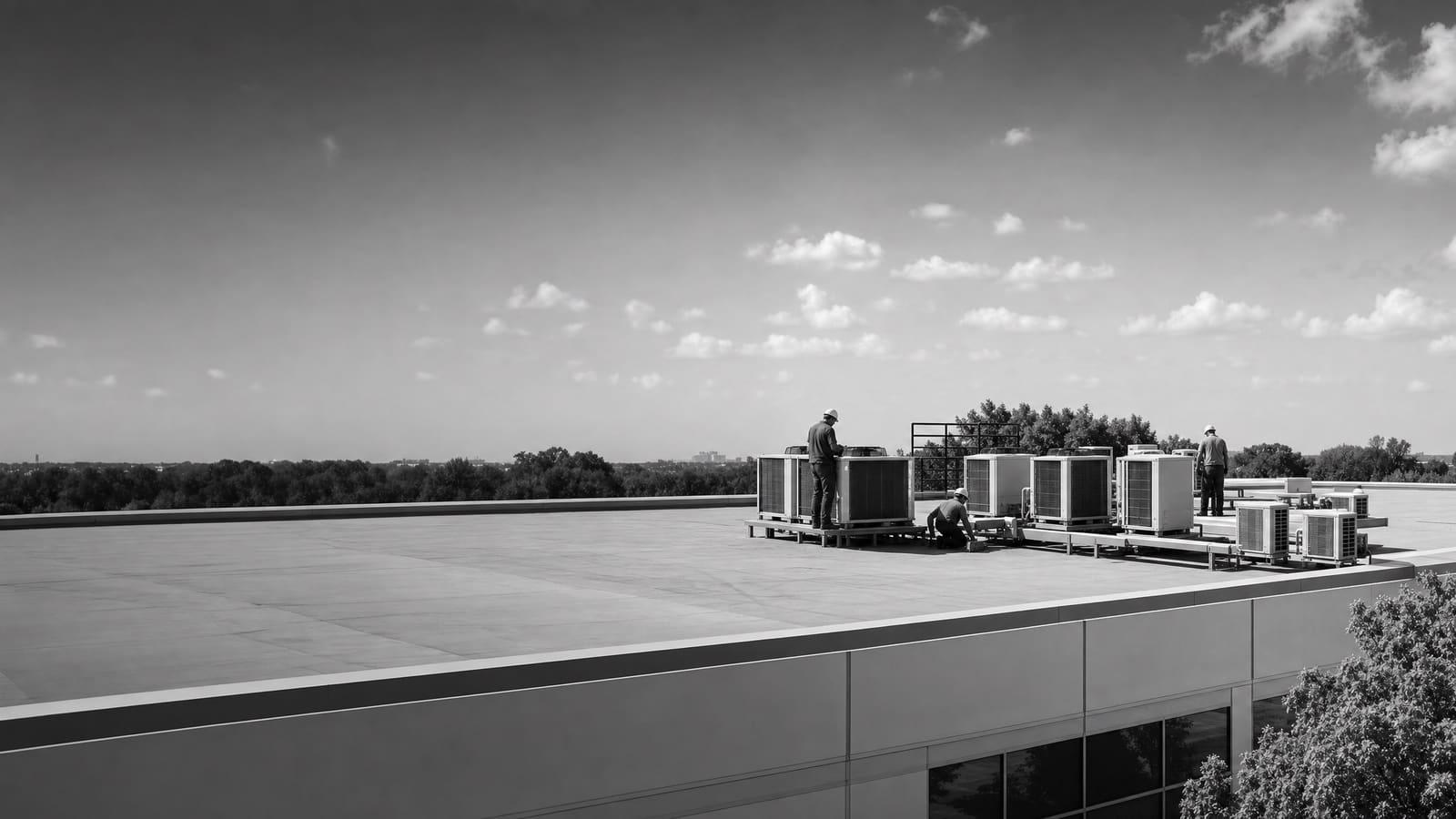
A commercial HVAC installation is a load check, an equipment selection made against real availability, the rigging and connection work, and a documented startup. Replacement beats another repair once a unit is past roughly fifteen years and burning money between service calls. Old, inefficient rooftop units waste $900 to $3,700 each per year. Planned replacement almost always costs less than replacement on failure.
A site review has to confirm the real load, the curb and roof structure, available electrical capacity and gas service, and crane access before any number on a quote means anything.
THREE WAYS TO GO
Your three real options when a unit is failing
There are only three honest answers when a rooftop unit is limping. You can keep it and improve how it runs, you can replace it with the same kind of equipment, or you can replace it with something more efficient than what came off the roof.
DOE frames the first two as a straight financial comparison: replace the old unit with a more efficient one, or retrofit it with advanced controls, depending on which option makes better sense for the building. A controls retrofit is real work, not a patch. It changes how the unit stages, ventilates, and idles.
The third option is where most decisions now get interesting. Units built to the DOE high-performance specification were designed to cut energy use by up to half against the older standard, and more than twenty models exceed that spec today. Whichever way you go, decide before the unit dies. Emergency replacement removes every choice on this list except the one that is in stock.
WHAT MOVES THE NUMBER
The line items that decide your price
No two roofs in Sandy price the same, and the equipment is rarely the part that surprises people. These are the lines that move an installed number the most, ordered roughly by how often they break a budget that was built from equipment cost alone.
IN PRACTICE
Choosing the equipment that goes back on the roof
The old nameplate records a decision someone made twenty years ago about a building that no longer exists in the same form. Occupancy changed. Lighting changed. Plug load changed. Sizing from that nameplate carries the original mistake forward for another two decades, and oversized equipment short cycles, dehumidifies poorly, and wears itself out early.
The bigger fork now is fuel. Heat pump rooftop units are close cousins of standard air conditioning units, with a similar footprint and a similar install, but they also heat by running the cycle backwards. DOE groups them three ways: dual fuel, all-electric, and cold climate. Dual fuel keeps gas heat for the coldest hours and runs the heat pump the rest of the time. All-electric drops the gas line entirely. Cold climate units hold capacity further down the temperature curve.
The honest caveat is physics. As outdoor temperature falls, heat pump heating efficiency falls with it and trends toward parity with electric resistance heat. That is why this stays a building-by-building call. Your heating hours, your electric and gas rates, and your electrical capacity decide it, not the brochure.
SCOPE CHECK
What makes this a simple job or a complicated one
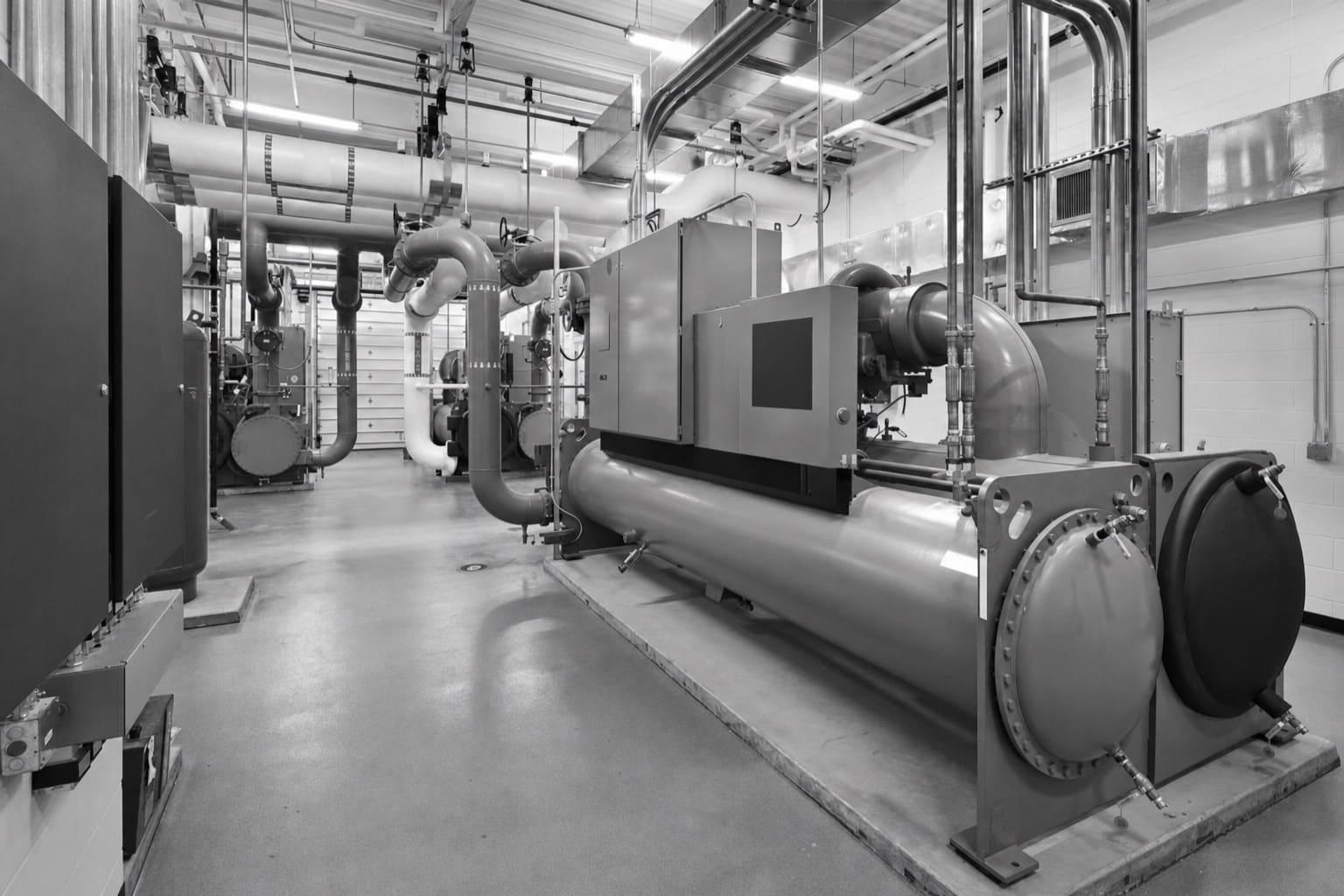
Two buildings can carry the same tonnage on the roof and get quotes that are nowhere near each other. The difference is almost never the equipment itself. It is what has to change around the equipment to make it fit, land, and run.
LOWER COMPLEXITY
Straight swap conditions
The building is used the way it was designed, the new unit lands on an adapted curb, gas and electric are already sized for it, and the crane has open lot to work from. One morning on site and a simple permit path.
HIGHER COMPLEXITY
Where the scope grows
Tonnage or footprint grows, the roof needs structural review, the panel has no room for an all-electric unit, or the only crane position is a street lane. Add engineering time, longer review, and a phased schedule.
BEFORE YOU BUY
What a real site review has to settle
A quote written from a nameplate photo is a starting point, not a price. Before anyone commits to equipment, someone should stand on the roof and work through a specific list. DOE's own adoption checklist for rooftop heat pumps covers most of it: climate and heating load, the utility bill impact at your actual rates, building type and how the space is used, equipment availability, and infrastructure.
Infrastructure is where projects go sideways, and it breaks into three questions. Does the electrical service and panel have room for the unit you want? Do the physical constraints of the roof, meaning curb size, clearances, structure, and access, allow it? And what happens to the gas line, whether you are keeping it, downsizing it, or abandoning it?
Two more belong on the list. Contractor availability and familiarity with the specific equipment matters, because a unit nobody nearby wants to service is a five-year problem instead of a one-day one. And incentives should be checked before the order goes in rather than after. DOE lists them as a core adoption consideration for a reason.
The one question that decides an electric conversion
Electrical capacity. If the panel and service cannot carry an all-electric rooftop unit, the project stops being an HVAC job and becomes an electrical one. Confirm it before you price equipment, not after the order is placed.
OWNING THE DECISION
Two things that outlive the install
The install is one morning. What you signed up for runs for the next fifteen to twenty years, and two decisions carry most of that weight.
The first is timing. Most facility teams wait, delaying the purchase until the unit stops holding the space, needs constant service, or fails outright. DOE is direct that proactively replacing an inefficient unit is often the better business move, compared both to replacement on failure and to a like-for-like swap at the end of service life.
The second is refrigerant. Every removal is regulated work. EPA Section 608 rules govern how refrigerant is handled and recycled when stationary air conditioning and heat pump equipment is serviced or taken out, so recovery belongs on the quote rather than in the fine print.
TIMING
Plan it or inherit it
A replacement chosen in March has options: equipment, efficiency tier, fuel, and a schedule that fits your tenants. The same replacement in July has one option, which is whatever a distributor can put on a truck.
REFRIGERANT
Removal is regulated
Section 608 covers handling and recycling of refrigerant in stationary cooling and heat pump equipment. Recovery, documentation, and certified technicians are not optional extras, and a quote that ignores them is incomplete.
LIFETIME COST
Phasing a fleet instead of buying one unit at a time
If you have six units on a roof and three are past fifteen years, the worst plan is replacing them one at a time as each one dies. You pay emergency pricing, you take whatever is available, and you end up with six units on six different service curves and possibly more than one refrigerant.
A phased plan does better on every count. Group the replacements into one or two mobilizations so the crane comes once. Standardize equipment where you can, so filters, boards, and service knowledge carry across the fleet. Sequence the oldest and least efficient units first, because those are the ones bleeding money. A single old, inefficient rooftop unit can waste $900 to $3,700 a year on energy alone.
The scale of that opportunity is not theoretical. Under DOE's Advanced RTU Campaign, more than 200 organizations upgraded over 43,000 rooftop units, and those upgrades save a combined $37 million a year on energy bills. Those are the numbers a replacement program produces when it is run as a program instead of a run of emergencies.
Rooftop units condition close to half of all commercial floor space in the country. For most buildings, this is the single largest energy decision on the property.
APPLES TO APPLES
Five things every quote should show
Three quotes are only comparable if they scope the same job. Ask each bidder to break out these five lines. The quote missing one of them is usually the cheap number, and the gap tends to show up as a change order in week three.
01
Tonnage, fuel type, and efficiency tier
Model number included, so you can compare what is actually being installed.
02
Equipment lead time, in writing
Availability sits next to price. A number without a date is not a schedule.
03
Curb, structure, and roof work
Adapter, framing, and any patching called out as their own lines.
04
Rigging, lot closure, permits, and inspections
Who owns each one, and how many hours your lot is affected.
05
Startup, commissioning, and refrigerant recovery
Charge, airflow, and controls verified against spec, then documented for the warranty.
Get a defensible number
Price the equipment and the building together.
Send the address, operating target, and target opening date. Flux will identify what must be verified before the project can be priced.
Get a free estimateQuestions
Straight answers.
When is replacement smarter than another repair?
Once a rooftop unit is past about fifteen years, the math usually flips. Old, inefficient units waste $900 to $3,700 each per year on energy, and that runs whether or not you are also paying for service calls. DOE's guidance is that replacing proactively often beats waiting for the unit to fail.
Should you replace like-for-like or resize?
Confirm the load either way. If occupancy, hours, and plug load are close to what they were, like-for-like is often right and it is the fastest path back to cooling. If the use of the space changed, the old nameplate just carries the original sizing mistake forward another twenty years.
Is a heat pump rooftop unit the right call?
It depends on heating hours, rates, and electrical capacity. Heat pump efficiency drops as outdoor temperature drops and trends toward electric resistance heat in real cold. DOE splits the options into dual fuel, all-electric, and cold climate units precisely because one answer does not fit every building.
What does a new unit change about refrigerant?
Handling is the part that affects your quote. EPA Section 608 regulates how refrigerant is recovered and recycled when stationary air conditioning and heat pump equipment is serviced or removed, so recovery is scoped work. On a mixed fleet, plan service contracts and spare parts around more than one refrigerant.
How much does commercial HVAC installation cost?
There is no honest universal number, because tonnage, curb work, electrical capacity, and crane access swing the total more than the equipment does. What you can pin down early is the cost of waiting: an old, inefficient rooftop unit wastes $900 to $3,700 a year on energy by itself.
Sources used for this guide
- [1]betterbuildingssolutioncenter.energy.gov — DOE Advanced Rooftop Unit Replacement Guidance
- [2]betterbuildingssolutioncenter.energy.gov — DOE Commercial Heat Pump Rooftop Unit Replacement Guidance
- [3]betterbuildingssolutioncenter.energy.gov — DOE High-Efficiency Commercial Rooftop Unit Toolkit
- [4]energy.gov — DOE Efficient Commercial Rooftop Air Conditioner Program
- [5]epa.gov — EPA Stationary HVAC Refrigerant Management