THE SHORT ANSWER
What a complete commercial HVAC replacement includes
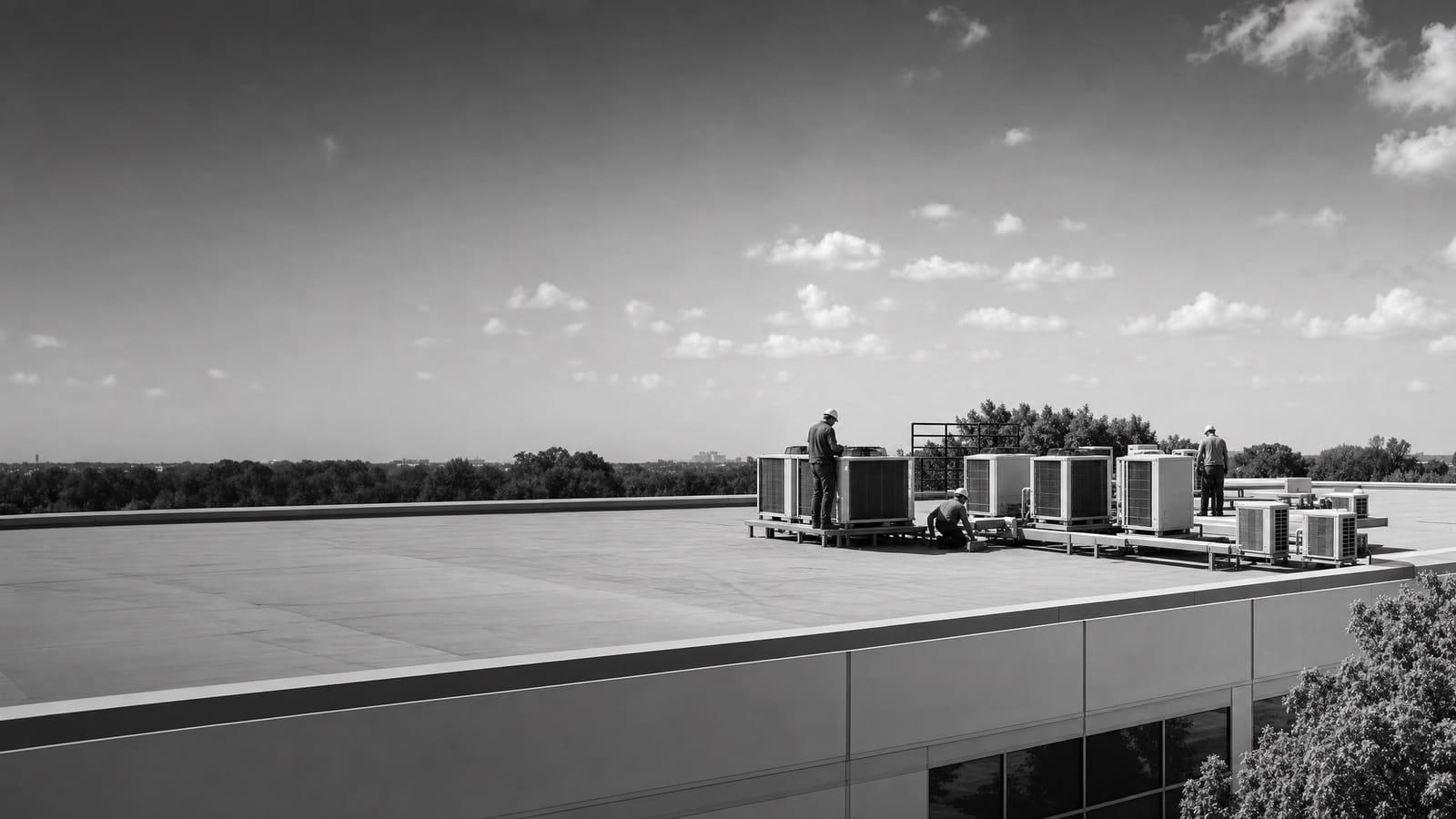
Commercial HVAC replacement includes load review, equipment selection, permits, removal, rigging, utility connections, controls, startup, testing, and owner handoff. Replacement becomes more useful than another repair when an older unit has frequent failures, weak performance, rising maintenance needs, or no clear path to reliable operation.
A site review should verify the roof curb, structural conditions, electrical capacity, gas service, drainage, outside-air needs, controls, access, and occupied work hours.
THREE OPERATING CHOICES
Choose the project path before choosing the equipment
The best replacement path depends on what is wrong and what the building needs next. A direct replacement can reduce design work when the old system served the space well. A right-sized replacement is stronger when occupancy, walls, lighting, computers, kitchen equipment, or operating hours have changed. A heat pump rooftop unit can provide both cooling and reverse-cycle heating, but it needs a review of electrical capacity, utility rates, winter heating demand, physical space, and any existing gas service. DOE guidance also recommends checking equipment availability and contractor experience. Compare these paths using expected comfort, reliability, energy use, project timing, and future service needs. Do not let the old nameplate make the decision by itself. It shows what was installed, not what the building needs today.
BUDGET STRUCTURE
What moves the installed price
The supplied research does not support one universal installed cost. A useful budget separates the equipment from the work needed to place it, connect it, control it, and prove performance.
EQUIPMENT SELECTION
Compare systems by how the building operates
Packaged rooftop units combine major heating, cooling, and air-moving parts in one outdoor cabinet. They are common across commercial buildings and condition nearly half of U.S. commercial floor area. Their familiar layout can make replacement practical, but a similar-looking cabinet is not always a direct match. Dimensions, weight, curb openings, power needs, controls, heating type, airflow, and refrigerant can differ.
A standard air-conditioning rooftop unit may use gas or another separate heat source. A heat pump rooftop unit uses reverse-cycle operation to provide heating as well as cooling. DOE guidance says heat pump rooftop units are well suited to mild-to-moderate winter heating, while the final choice still depends on geography, heating demand, electricity and gas prices, electrical infrastructure, physical constraints, and organizational goals. A dual-fuel design may also be considered where the operating plan supports it.
Higher efficiency can matter over the equipment life, but efficiency should not stand alone. Ask how the unit performs at the building's normal load, how ventilation is controlled, whether the service team can support it, and how quickly parts can be obtained. Owners considering electrification can also review commercial heat pump conversion before committing to a like-for-like heating system.
PROJECT COMPLEXITY
A box swap and a system change are different projects
Two replacements with similar equipment can require very different field work. The quote should identify which conditions have been confirmed and which remain allowances.
LOWER COMPLEXITY
Existing conditions still fit
The load is stable, curb geometry works, utilities have capacity, controls are compatible, access is clear, and the replacement does not require major distribution changes.
HIGHER COMPLEXITY
The building needs a new approach
Capacity changes, electrical conversion, structural work, duct changes, controls integration, difficult rigging, or phased occupied work requires added design and coordination.
SITE REVIEW
Measure the building before ordering the unit
Start with the service record and the reason for replacement. A failed compressor may be the immediate problem, but repeated comfort calls, poor airflow, short cycling, control faults, or refrigerant loss can point to a larger issue. The review should document the old unit's model, capacity, heating type, voltage, weight, curb, duct openings, outside-air setup, controls, and service clearances.
Next, confirm what the equipment serves. Note occupied hours, tenant schedules, heat-producing equipment, ventilation needs, sensitive rooms, and spaces that cannot lose conditioning during the work. If the use has changed, calculate the current load rather than carrying the old capacity forward. Oversizing can cause cycling and control problems. Undersizing can leave the system unable to hold conditions during demanding periods.
The physical route matters too. Inspect roof access, crane reach, staging areas, overhead conflicts, parking impacts, fall hazards, and the path for removed equipment. Check electrical capacity before selecting electric heat or a heat pump. Confirm gas conditions when gas heat remains. This work turns an equipment quote into an installation plan.
Useful information for the first review
Provide nameplate photos, service records, utility information, floor plans if available, operating hours, comfort complaints, roof access details, and any planned changes to the space.
OWNERSHIP VIEW
Balance urgent reliability with long-term operating needs
DOE notes that facility managers often wait until a rooftop unit can no longer condition the space, needs frequent maintenance, or fails. It also says rooftop units more than 15 years old can waste substantial energy compared with newer models. Age alone does not settle the choice, but it changes the value of another major repair. Review repair history, downtime exposure, parts support, refrigerant needs, comfort performance, and the remaining condition of the cabinet, coils, fans, heat section, and controls. For a portfolio, use the same review across all units so the worst risks can be addressed before failure. Planned work also gives the owner more room to compare equipment and coordinate occupied areas.
REPAIR CASE
Keep the unit when the risk is controlled
Repair may fit when the failure is isolated, the unit otherwise performs well, parts are available, and expected reliability supports the operating plan.
REPLACEMENT CASE
Act before another failure
Replacement gains value when failures repeat, downtime is costly, performance is weak, major parts are uncertain, or planned work can avoid an emergency.
PROJECT DELIVERY
Plan the shutdown, lift, startup, and handoff
A good installation plan works backward from the period when the served space can be offline. Confirm equipment availability before promising a shutdown date. Then coordinate permits, submittals, curb details, structural questions, electrical work, controls, rigging, weather, tenant notice, and access. If several units serve the property, phased replacement can preserve partial conditioning and reduce the effect of a single delay.
Before removal, record wiring, controls, duct connections, roof conditions, and equipment data. During installation, protect the roof and occupied areas, seal curb and duct connections, route condensate correctly, and complete utility work to the approved design. Refrigerant must be recovered and managed under applicable federal requirements. EPA rules address refrigerant handling and recycling for stationary air-conditioning and heat pump equipment, so removal and disposal should appear in the contractor's scope.
Closeout should be treated as part of installation, not an optional visit. The team should verify rotation, airflow, temperature response, safeties, heating and cooling operation, outside-air controls, schedules, alarms, and communication with the building automation system. The owner should receive startup records, approved submittals, warranty information, control instructions, and maintenance requirements.
LIFETIME VALUE
Compare the installed result, not just the equipment price
The lowest proposal may exclude work that still has to happen. Compare whether each bidder includes the same equipment configuration, curb solution, rigging, electrical and gas work, controls, permits, refrigerant recovery, startup, testing, training, and closeout. Also compare exclusions, allowances, payment terms, warranty responsibility, and what happens if hidden roof or utility conditions appear.
Operating cost deserves its own review. Ask for the efficiency data used, expected operating pattern, heating source, fan control, and any assumptions about utility prices. Treat savings projections as estimates, not guarantees. A calculation built around the building's schedule and load is more useful than a broad percentage claim. Maintenance access and parts support also affect lifetime cost. A hard-to-service unit can create avoidable labor and downtime even when its rated efficiency is strong.
For multi-unit properties, decide whether to standardize controls, filters, service parts, and training. Standardization can simplify operations, while a mixed fleet may be reasonable when different zones have different needs. Document the reason for each selection so later replacements follow a clear plan.
Check incentives before using them in the budget
No current local incentive was established by the supplied research. Verify active utility, state, and federal requirements directly before treating any credit or rebate as project funding.
QUOTE CHECKLIST
Five items every comparable proposal should show
Ask every bidder to price the same written scope. Clear inclusions, assumptions, and exclusions make proposals easier to compare and reduce change-order risk.
01
Selected equipment
List model, capacity, heating type, efficiency, voltage, airflow options, controls, refrigerant, availability, and approved alternates.
02
Complete field scope
Define removal, recovery, curb and roof work, rigging, ducts, drains, utilities, controls, protection, and disposal.
03
Schedule and phasing
Show procurement assumptions, shutdown needs, occupied-work limits, lift coordination, weather planning, and the expected sequence.
04
Testing and handoff
Include startup, operating tests, control verification, records, training, warranty registration, manuals, and final deficiencies.
05
Commercial terms
State price, allowances, exclusions, permit responsibility, payment terms, warranty labor, change-order rules, and proposal expiration.
Get a defensible number
Price the equipment and the building together.
Send the address, operating target, and target opening date. Flux will identify what must be verified before the project can be priced.
Get a free estimateQuestions
Straight answers.
When should a commercial rooftop unit be replaced instead of repaired?
Consider replacement when failures repeat, maintenance needs are growing, comfort remains poor, major parts are uncertain, or downtime creates serious operating risk. DOE also notes that rooftop units more than 15 years old can waste substantial energy compared with newer models. A condition review should still come before the final decision.
Should a replacement match the old unit's capacity?
Not automatically. Confirm the present building load, occupancy, hours, ventilation, internal equipment, and space layout. A direct match may work when the use has stayed stable. A new load review is more useful when the building or its comfort needs have changed.
Is a heat pump rooftop unit a good commercial replacement?
It can be. Heat pump rooftop units provide cooling and reverse-cycle heating. Review winter heating demand, electrical capacity, utility impact, physical constraints, gas service, equipment availability, emissions goals, and service support. Compare all-electric, dual-fuel, and conventional options against the site's operating needs.
What should happen before the rooftop unit is ordered?
Verify the load, equipment dimensions, weight, curb and duct openings, roof condition, structural questions, voltage, electrical capacity, gas service, drainage, ventilation, controls, service clearances, rigging route, shutdown plan, and equipment availability. Resolve unclear items before approving the order.
What commissioning should be included after installation?
The closeout should verify heating and cooling operation, airflow, temperature response, fan rotation, safeties, outside-air controls, schedules, alarms, and building automation communication. The owner should receive startup records, warranty documents, approved equipment data, control instructions, and maintenance requirements.
Who should handle refrigerant from the removed equipment?
The proposal should assign recovery, handling, and disposal to qualified parties working under applicable federal requirements. EPA rules cover refrigerant handling and recycling for stationary air-conditioning and heat pump equipment. Ask for this work to be included clearly rather than left as an unstated assumption.
How can owners compare commercial HVAC installation quotes?
Give each bidder the same scope and compare equipment, availability, rigging, roof and curb work, utilities, controls, permits, refrigerant recovery, startup, testing, warranty, schedule, allowances, and exclusions. A low price is not comparable if major field work is missing.
Are HVAC incentives available for a San Ramon project in August 2026?
The supplied research does not establish a current San Ramon incentive. Programs, eligibility rules, funding, and deadlines can change. Verify active utility, state, and federal offerings directly before selecting equipment or including an incentive in the approved budget.
Sources used for this guide
- [1]betterbuildingssolutioncenter.energy.gov — DOE Advanced Rooftop Unit Replacement Guidance
- [2]betterbuildingssolutioncenter.energy.gov — DOE Commercial Heat Pump Rooftop Unit Replacement Guidance
- [3]betterbuildingssolutioncenter.energy.gov — DOE High-Efficiency Commercial Rooftop Unit Toolkit
- [4]energy.gov — DOE Efficient Commercial Rooftop Air Conditioner Program
- [5]epa.gov — EPA Stationary HVAC Refrigerant Management
- [6]californiacity-ca.gov — HVAC Permits